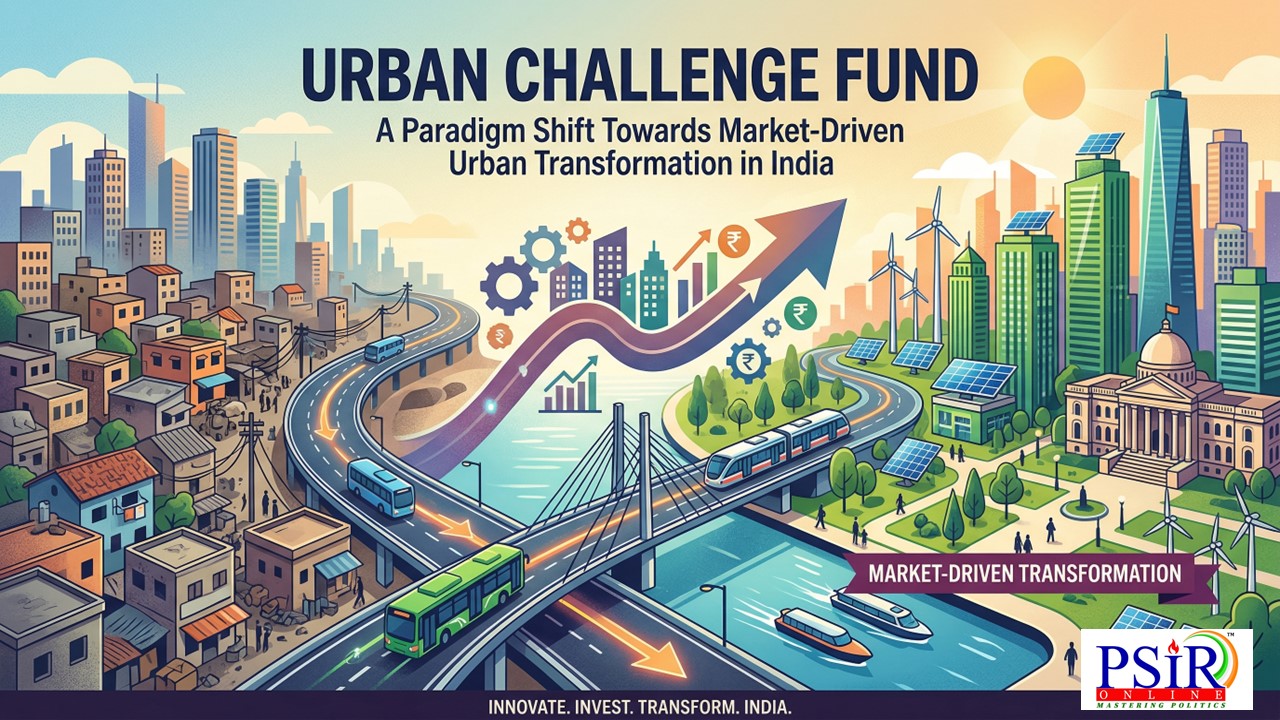
The Urban Challenge Fund (UCF) represents one of the most significant innovations in India's urban governance architecture since the launch of the Smart Cities Mission. Approved by the Union Cabinet on 14 February 2026, this ₹1 lakh crore Centrally Sponsored Scheme (CSS) under the Ministry of Housing and Urban Affairs (MoHUA) marks a decisive move from traditional grant-dependent models to a market-linked, challenge-based, and outcome-oriented approach for urban infrastructure development.
Announced in the Union Budget 2025-26 and made operational from FY 2025-26 to FY 2030-31 (extendable up to FY 2033-34), the UCF provides 25% central assistance for bankable projects, provided cities and Urban Local Bodies (ULBs) raise at least 50% of the project cost from market sources such as municipal bonds, bank loans, and Public-Private Partnerships (PPPs). This leveraging mechanism is expected to unlock a total investment of approximately ₹4 lakh crore in the urban sector over the next five to eight years. An initial allocation of ₹10,000 crore was made for FY 2025-26.
OBJECTIVES AND FUNDING ARCHITECTURE
The primary objectives of the UCF are:
· To transform Tier-2 and Tier-3 cities into engines of sustainable economic growth.
· To promote integrated urban planning, land-use efficiency, and climate-resilient infrastructure.
· To reduce dependence on central grants by enhancing the creditworthiness and reform appetite of ULBs.
· To foster citizen-centric, transparent, and accountable urban governance.
The scheme operates on a challenge mode — projects compete based on their transformative impact, sustainability metrics, innovation, and commitment to accompanying governance reforms. Funding is released in a milestone-linked manner through a dedicated digital portal managed by MoHUA, ensuring accountability and real-time monitoring.
THREE KEY VERTICALS
1. Cities as Growth Hubs: Focus on transit-oriented development, economic corridors, mobility innovation, and positioning cities as regional economic drivers.
2. Creative Redevelopment of Cities: Emphasis on brownfield regeneration, heritage-sensitive redevelopment, public space revitalization, and Transit-Oriented Development (TOD).
3. Water and Sanitation: Modernization of water supply grids, sewerage networks, solid waste management, and circular economy models in urban water and sanitation.

CHALLENGE-BASED REFORMS: THE HEART OF THE SCHEME
What distinguishes UCF from earlier missions like AMRUT or Smart Cities is its explicit linkage of capital funding to governance reforms. Projects are evaluated not just on infrastructure outputs but on the depth of accompanying reforms, including:
· Rationalization and enhancement of property tax and user charges.
· Adoption of open budgets, digital governance, and GIS-based property mapping.
· Promotion of PPPs and creation of an enabling ecosystem for private participation.
· Citizen engagement mechanisms and performance-linked accountability.
This reform-conditionality aligns with long-standing recommendations of the Second Administrative Reforms Commission (2nd ARC) and the Punchhi Commission on Centre-State Relations, which stressed the need for stronger, fiscally empowered urban local bodies.
CITY ECONOMIC REGIONS (CER) MODEL: A NEW SPATIAL APPROACH
Parallel to the UCF, the government has introduced the City Economic Regions (CER) model to move beyond municipal boundaries and plan at a functional economic scale. Seven initial CERs have been identified:
· Bengaluru
· Pune
· Surat
· Varanasi
· Visakhapatnam
· Bhubaneswar-Puri-Cuttack
· Coimbatore-Erode-Tiruppur)
Each CER is envisioned to receive focused support (around ₹5,000 crore over five years in some announcements) for integrated spatial-economic-transit planning. The model aims to decongest metropolitan areas, boost competitiveness of non-metro hubs, and create agglomeration economies through PPPs implemented in challenge mode with reform-linked financing.
This approach reflects a maturing understanding of urbanization as a regional phenomenon rather than isolated city-level interventions.
₹5,000 CRORE CREDIT REPAYMENT GUARANTEE SCHEME: EMPOWERING SMALLER ULBS
A dedicated ₹5,000 crore Credit Repayment Guarantee Scheme forms a crucial pillar for inclusivity. It targets smaller cities, particularly:
· Tier-2 and Tier-3 ULBs
· Cities in North-Eastern and hilly states
· ULBs with population below 1 lakh
Key features:
· First-time loan: Central guarantee up to 70% or ₹7 crore (whichever is lower).
· Subsequent loans: Guarantee up to 50% or ₹7 crore after successful repayment.
· Enables smaller ULBs to undertake projects starting from ₹20 crore (and higher in subsequent phases).
· Covers all 4,223 ULBs with priority for transition areas.
This guarantee mechanism is designed to build the credit history and market confidence of smaller municipalities without converting the support into outright grants, thereby preserving fiscal discipline.
COVERAGE AND EXPECTED IMPACT
The UCF covers:
· Cities with population >10 lakh
· All state/UT capitals
· Major industrial hubs with population >1 lakh
· Special emphasis on Tier-2/3 cities, NE, and hilly regions
Potentially over 4,000 ULBs stand to benefit. The broader goals include:
· Creation of inclusive, climate-responsive, and economically vibrant cities.
· Strengthening municipal bond markets.
· Deepening PPP ecosystems.
· Contribution to Viksit Bharat @2047 through spatially balanced urbanization.
MAJOR MERITS OF URBAN CHALLENGE FUND
· Moves urban funding from grant-dependence to a 25:50:25 model (25% CA, ≥50% market finance, 25% State/ULB), catalysing ~₹4 lakh cr total investment.
· Forces fiscal discipline, better project bankability, and lifecycle costing.
· Funds released only against verified reforms in urban governance, finance, planning, and digital systems; evaluated on KPIs (jobs, revenue, climate resilience).
· Reduces “scheme entitlement” culture; rewards performance.
· Mandates raising ≥50% via municipal bonds, bank loans, PPPs, expanding India’s shallow municipal debt market beyond a few large cities.
· Improves credit ratings and investor confidence through standardized, bankable DPRs.
· ₹5,000 cr Credit Repayment Guarantee Corpus for NE/hilly states and ULBs <1 lakh population; guarantee up to ₹7 cr or 70% of first-time loans.
· Lowers entry barrier for Tier-2/3 cities to access market finance.
· Prioritizes cities-as-growth-hubs, creative redevelopment, and water & sanitation (non-duplicative of AMRUT 2.0/SBM 2.0).
· Explicitly ties funding to climate resilience and economic impact, not just asset creation.
MAJOR DEMERITS / RISKS OF URBAN CHALLENGE FUND
· “Bankability” criterion may skew investment to revenue-rich zones (CBDs, corridors) while neglecting slums, peripheries, and social infrastructure.
· Risk of excluding informal settlements where monetization is hard.
· Many ULBs lack technical, financial, and legal capacity to structure bonds/PPPs, prepare bankable DPRs, and meet reform conditionalities.
· Guarantees cannot substitute for weak accounting, poor land records, and low own-revenue mobilization.
· Pushing indebted or low-revenue ULBs to borrow ≥50% may create debt traps if tariff reforms and O&M revenue streams are weak.
· Without strong user-charge rationalization, debt service could crowd out essential services.
· Early reports note eligibility criteria and application processes still under examination, opening scope for discretionary, politically influenced allocations.
· Cities still burdened with legacy AMRUT/SBM workloads may struggle to pivot to UCF’s complex structuring.
· By design, UCF favors revenue-generating projects; pure public goods (affordable housing, urban greening, last-mile equity upgrades) may get deprioritized unless cross-subsidized.
PRACTISE QUESTIONS FOR GS 2 MAINS
1. “The Urban Challenge Fund marks a shift from grant-based to market-led urban governance in India.” Critically examine this statement.
2. Discuss how the Urban Challenge Fund promotes reforms in Urban Local Bodies (ULBs). What are the key challenges in its implementation?
3. Evaluate the role of Public-Private Partnerships (PPPs) and municipal bonds in strengthening urban governance under the UCF framework.
4. “Urbanisation in India requires a regional, not merely city-centric approach.” Analyse this statement with reference to the City Economic Regions (CER) model.