POLITICAL SCIENCE AND INTERNATIONAL RELATIONS - I - GENERAL STRATEGY
A separate question-and-answer booklet will be provided to the students. Each student must write only in the designated space for each question. Changing the question numbers for adding extra points is not allowed, as this could result in a reduction of marks.
It is generally advised that students attempt three questions from Section A and two from Section B of the question paper. Since Section A covers the theoretical aspects of political science in both Paper 1 and Paper 2, selecting more questions from this section and answering them convincingly can earn an additional 5 to 10 marks. These extra marks can significantly impact final rankings. Therefore, students are encouraged to thoroughly study Section A of both papers and focus on answering more questions from this part to maximize their score.
In PSIR, there are 10-mark, 15-mark, and 20-mark questions. The word limit for 10-mark question is fixed by UPSC, and while you can slightly exceed it, you should avoid writing too much extra. Although no specific word limits are given for other questions, it is still important to follow a structured word count.
| MARKS | WORD LIMIT (UPSC) | WORD LIMIT (Better Results) | PAGES GIVEN |
|---|---|---|---|
| 10 | 150 | 140-175 (MUST NEVER CROSS 200) | 2 |
| 15 | NOT GIVEN | 225-250 | 3 |
| 20 | NOT GIVEN | 275 – 350 | 4 |
Effective answer writing requires efficient time management. With a total of 180 minutes allocated for each paper, you can optimize your time as follows for better results:
| ACTIVITY | TIME LIMIT (For Better Results) |
|---|---|
| INITIAL READING OF QUESTION PAPER | 6 Minutes |
| ANSWERING A 10-MARK QUESTION | 7 Minutes |
| ANSWERING A 15-MARK QUESTION | 10 Minutes |
| ANSWERING A 20-MARK QUESTION | 13 Minutes |
| CONCLUDING REVIEW and PROPER FORMATTING | 5 Minutes |
Do not spend more than 6 minutes on the initial reading of the question paper to decide which questions to attempt. Mark the questions you choose to write and then proceed. If you adhere to the suggested time limits, you will take 70 minutes for answering 10 ten-mark questions, 60 minutes for answering 6 fifteen-mark questions, and 39 minutes for answering 3 twenty-mark questions. This strategy allows for approximately 5 extra minutes for a final review.
Each question should be strategized for 30 to 40 seconds before writing. Students can use the rough page at the end of the question-cum-answer booklet for this purpose.
For example, when addressing the question “Comment on equality of opportunity,” students might outline their answer in their rough work during this time as follows:
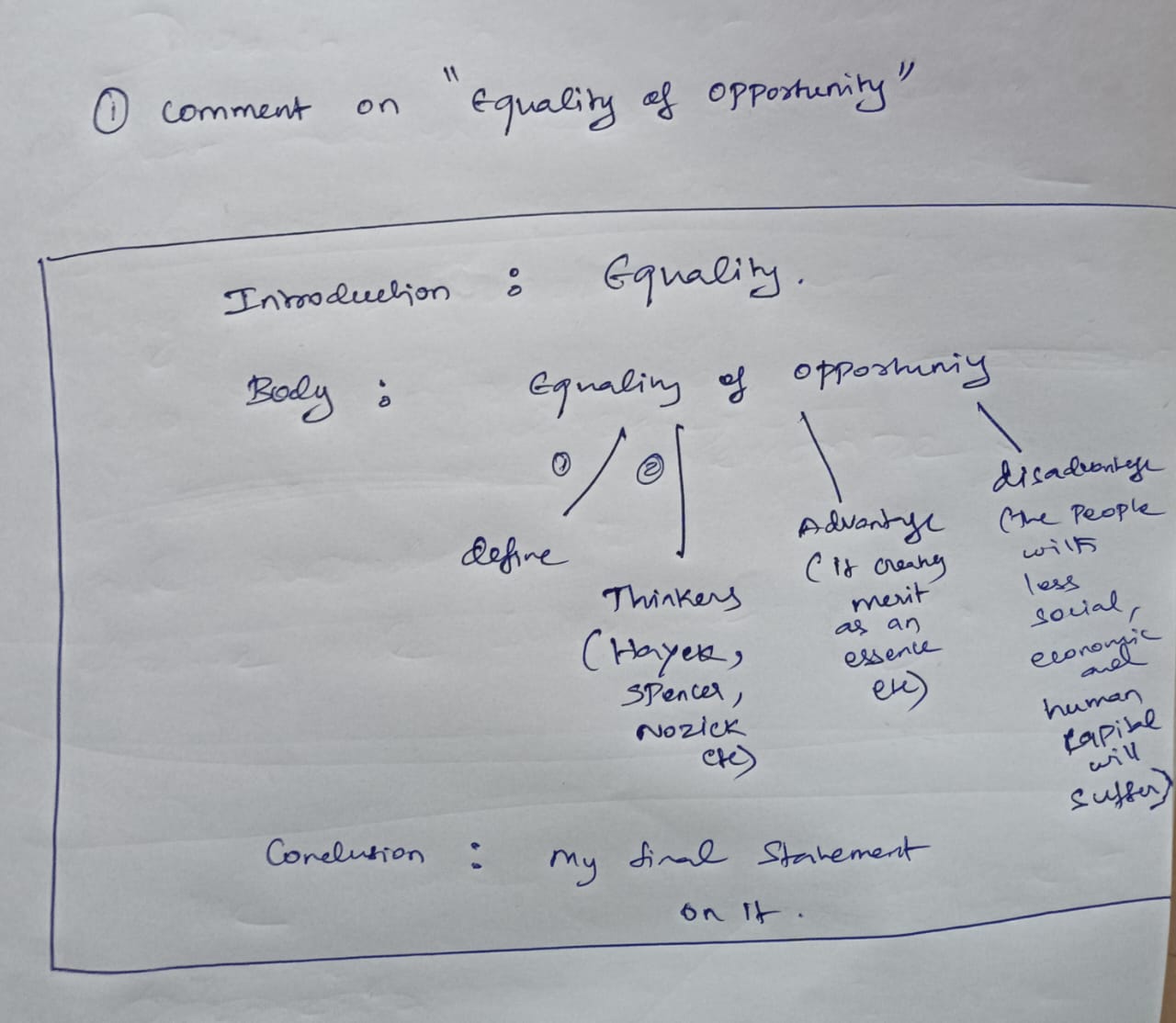
Planning is crucial before you start writing, as it helps eliminate unnecessary content and ensures you cover all relevant points. Do not view this as a waste of time; it is an effective way to approach your answer logically. Therefore, everyone should use the rough page to plan their responses.
Additionally, there is another benefit to this planning: the examiner may review your rough work. This can create a positive impression, potentially earning you extra marks for each question if you are fortunate.
STRUCTURE OF THE ANSWER
The answer must consist of the following structure:
INTRODUCTION BODY CONCLUSION
The introduction is a small paragraph which MUST introduce the ‘central point of investigation’ either through defining the technical term involved in it or through a relevant quote of a famous thinker of that area. Generally, a quote must be followed by few lines (even a definition) for an effective introduction.
The central point of investigation in a question refers to the main issue, concept, or topic that the question is asking you to focus on and explore. To identify it, ask yourself:
Example: in the question "Comment on equality of opportunity," the central point of investigation is "equality of opportunity." The focus must be on furnishing your views on equality of opportunity.
So, in this case, the introduction can be the definition of equality, like “Equality refers to the state of being treated the same, with equal rights, opportunities, and access regardless of race, gender, socioeconomic status, or any other characteristic, ensuring fairness and justice for all.” Since, we are going to write about equality of opportunity in the body, I have introduced the idea equality in introduction and have proceeded further. You can also define equality of opportunity in the definition and proceed with your comments and other relevant points in the body.
You can also use a relevant quote above the equality of opportunity to make the answer very effective…. Like
“My idea of society is that while we are born equal, meaning that we have a right to equal opportunity, all have not the same capacity.” - MAHATMA GANDHI
Remember: Introduction word limit is 30 words (10-mark) and 50 words (15/20-mark).
The body of the answer must consist of the actual answer to the question. It must be based on the question word or command word of the question.
Every question will consist of a question word or a command word or both. A question word (or interrogative) used to ask for specific information. Examples are “what,” “how”, “why”, “when” etc. Command words" or "instructional verbs” provide instructions on how to approach a question. Examples are “comment,” “discuss," "examine," or "analyse" etc.
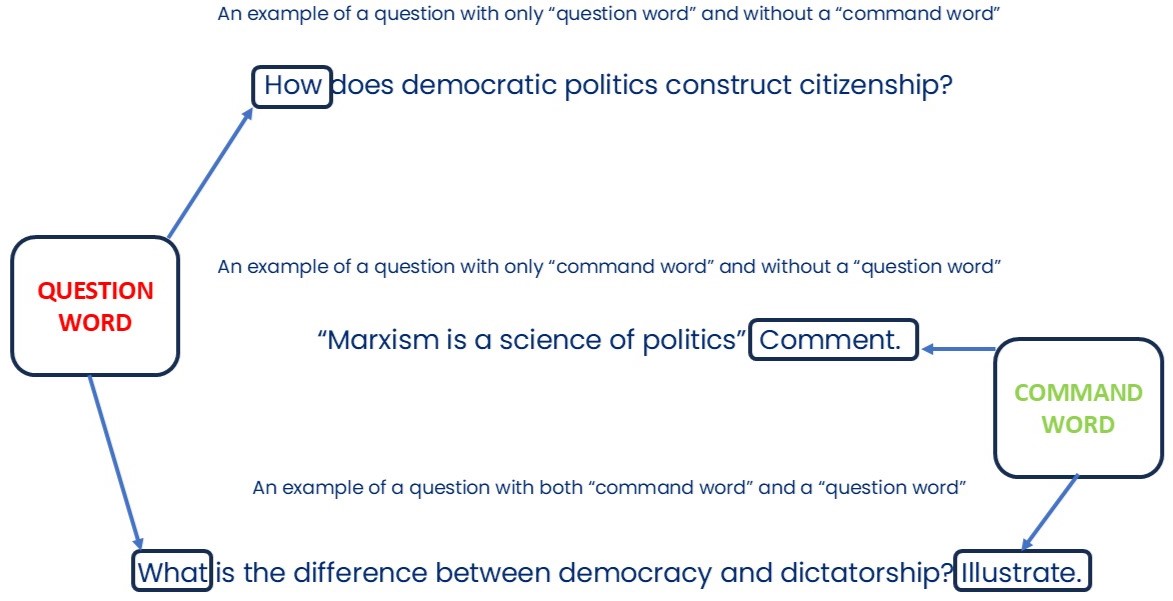
Hence first look for question words available in the question. If that is present without any command word, THEN YOU MUST PLAN YOUR ANSWER accordingly.
But, if the question consists of a command word, then you must approach the question according to the command word.
For example, in the question paper of PSIR optional paper-1, 2023, there were 12 questions which needed your comment, 5 questions which needed explanation etc... see the table below for detailed information.
| COMMAND WORDS | 2023 | 2022 | ||
|---|---|---|---|---|
| Paper 1 | Paper 2 | Paper 1 | Paper 2 | |
| NO COMMAND WORD | 0 | 14 | 0 | 6 |
| COMMENT | 12 | 1 | 7 | 4 |
| EXPLAIN/ ELUCIDATE | 5 | 1 | 4 | 2 |
| ANALYSE | 4 | 0 | 1 | 0 |
| DISCUSS | 2 | 9 | 3 | 13 |
| CRITICALLY EXAMINE | 0 | 1 | 0 | 2 |
| EXAMINE | 0 | 0 | 6 | 0 |
| EVALUATE | 0 | 0 | 0 | 1 |
| JUSTIFY* | 4 | 0 | 0 | 0 |
| ILLUSTRATE | 0 | 1 | 0 | 0 |
| ACCOUNT | 0 | 1 | 0 | 0 |
| SUBSTANTIATE | 0 | 0 | 1 | 0 |
| WRITE | 0 | 0 | 5 | 0 |
| OTHERS** | 1 | 0 | 1 | 0 |
Evaluate" and "Examine" are not the same command word, though they are similar in that both require careful consideration of a subject. However, they have different focuses
Examine: means to inspect or analyse something in detail. When asked to examine, you are expected to look closely at the facts, features, or details of a subject, identifying the key aspects or components.
Evaluate: This goes beyond examination and involves making a judgment. When asked to evaluate, you are required not only to analyse but also to weigh the strengths and weaknesses, advantages and disadvantages, or merits and demerits, and provide an overall assessment.
disadvantages, or merits and demerits, and provide an overall assessment. In short, examine focuses on exploration and analysis, while evaluate involves judgment and assessment after analysis.
"Justify" and "Substantiate" are similar but not exactly the same command word, as they have slightly different focuses:
Justify: This means to provide reasons or arguments in support of a statement or decision. When asked to justify something, you are expected to explain why something is right, appropriate, or valid.
Substantiate: means to provide evidence or proof to support a claim or argument. When asked to substantiate, you need to back up your points with factual evidence or data.
Analyse" and "Examine" are similar, but they are not exactly the same:
In summary:
No, "discuss" and "comment" are not the same, although they both involve expressing thoughts about a topic.
In summary, "discuss" implies a comprehensive analysis, while "comment" is more about personal reflections.
It is beneficial to support each answer with a diagram, flowchart, or similar visual aid. While it may take an extra minute, this approach could earn you an additional one or two marks for each question. Therefore, I recommend including a diagram for every answer. For instance, the following diagram could complement the previous answer effectively.
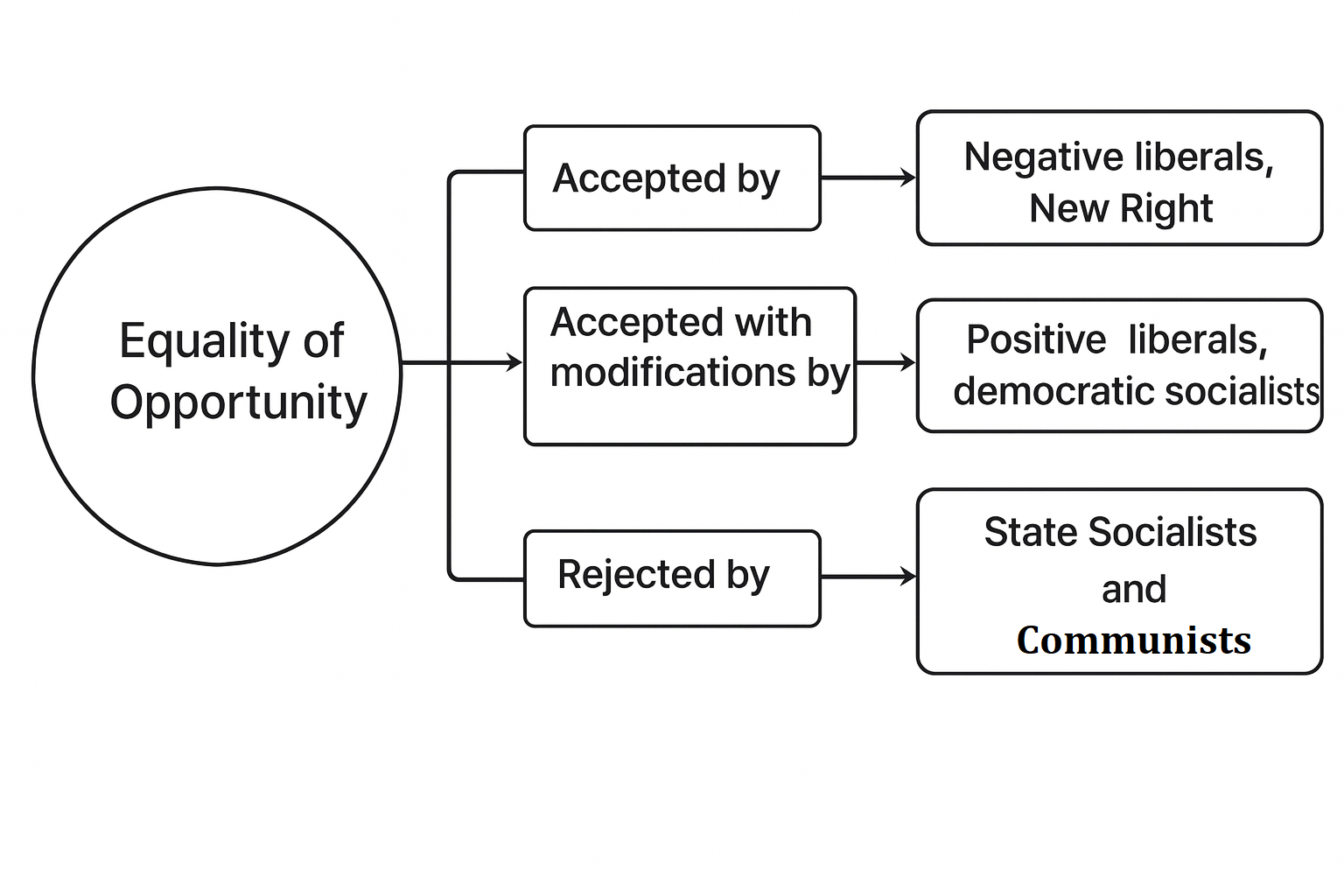
This diagram not only demonstrates your strong understanding of the topic but also provides crucial additional information that will likely be appreciated by the examiner.
Writing a good conclusion for a question involves summarising your key points and reinforcing your main argument or findings. You can use the below suggestions to write an effective conclusion:
For the same question, you can conclude as follows:
“Equality of opportunity even though is a noble idea, it cannot function in its purest form in India where deep-rooted social inequalities persist.”
Common Doubts Regarding PSIR Answer Writing
The presentation of your answer sheet and handwriting plays a crucial role in creating a positive impression on the examiner for the following reasons:
Handwriting should be neat and legible. Poor handwriting can lead to misinterpretation or missed information.
Organizing with headings, subheadings, and bullet points helps the examiner follow your thought process.
Supporting answers with clear diagrams, charts, or flowcharts enhances understanding and earns extra marks.
Neat presentation saves time for the examiner, potentially leading to a more favourable assessment.
Use BLUE pen for writing answers and underlining important points.
Use BLACK pen for drawing figures/diagrams.
Other colour pens are NOT allowed in the exam.
Optional subjects like PSIR are typically best answered in paragraphs. However, in some cases, using bulleted points is necessary to clearly convey specific ideas.
The content of your answer holds greater importance than citing specific names.
Do not overly focus on memorizing thinkers' names. Prioritize well-structured content and effective presentation. If you are familiar with relevant names, include them for additional marks, but avoid forcing or fabricating names to fit your answer.
Please don’t get obsessed with the names of the thinkers.