I.1. SECTION A - POLITICAL THEORY AND INDIAN POLITICS
(Even though original syllabus names this section as ‘Political theory and Indian politics’, syllabus of Indian politics is covered in section B. This section covers only Indian political thought)
The Paper 1, Section A consists of theoretical politics and political thought of famous western thinkers and Indian thinkers. The previous year questions from 2011 have been analysed below. The total syllabus of paper 1, section B is segregated into 32 micro topics and number of questions from each micro-topics from each year is mentioned below. Please observe the table properly to understand the pattern of questions.
| S.No | Topics | 2011 | 2012 | 2013 | 2014 | 2015 | 2016 | 2017 | 2018 | 2019 | 2020 | 2021 | 2022 | 2023 | 2024 |
|---|---|---|---|---|---|---|---|---|---|---|---|---|---|---|---|
| 1 | Political Theory: Meaning and Approaches | 0 | 1 | 0 | 1 | 0 | 1 | 0 | 1 | 1 | 1 | 1 | 0 | 3 | 2 |
| 2 | Theories of State: Liberal, Neo-Liberal, Marxist, Pluralist, Post-colonial and Feminist. | 1 | 1 | 1 | 1 | 0 | 1 | 1 | 1 | 1 | 1 | 1 | 1 | 2 | 1 |
| 3 | Justice: Conception of Justice with special reference to Rawl’s theory of Justice and its communitarian Critiques. | 0 | 0 | 1 | 1 | 1 | 1 | 1 | 2 | 1 | 1 | 1 | 1 | 1 | 0 |
| 4 | Equality: Social, Political, Economic; Relationship between equality and freedom; Affirmative action. | 0 | 2 | 0 | 1 | 0 | 1 | 0 | 1 | 0 | 1 | 2 | 1 | 1 | 1 |
| 5 | Rights: Meaning and theories; different kinds of rights; Concept of human rights. | 0 | 1 | 1 | 0 | 1 | 1 | 1 | 1 | 1 | 1 | 1 | 2 | 1 | 1 |
| 6 | Democracy: Classical & Contemporary theories; different models of democracy – representative, participatory and deliberative. | 1 | 1 | 0 | 2 | 1 | 1 | 1 | 2 | 1 | 1 | 1 | 1 | 0 | 1 |
| 7 | Concept of Power: Hegemony, Ideology and legitimacy *These questions overlap with Gramsci | 1 | 1 | 1* | 1 | 2 | 1* | 0 | 1 | 1* | 1 | 1 | 1 | 1 | 2 |
| 8 | Political ideologies (Introduction) | 1 | 0 | 0 | 0 | 0 | 0 | 1 | 0 | 1 | 0 | 1 | 0 | 0 | 0 |
| 9 | Liberalism | 0 | 0 | 2 | 0 | 0 | 1 | 0 | 1 | 0 | 1 | 0 | 1 | 0 | 1 |
| 10 | Socialism | 0 | 0 | 0 | 1 | 1 | 0 | 1 | 0 | 0 | 0 | 0 | 0 | 0 | 0 |
| 11 | Marxism and Philosophy of Marx | 0 | 0 | 0 | 0 | 1 | 1 | 1 | 0 | 1 | 1 | 1 | 1 | 0 | 1 |
| 12 | Fascism | 0 | 0 | 0 | 0 | 0 | 0 | 0 | 1 | 0 | 0 | 0 | 0 | 1 | 0 |
| 13 | Feminism | 0 | 1 | 1 | 0 | 0 | 0 | 1 | 0 | 1 | 0 | 0 | 0 | 0 | 0 |
| 14 | Political thought (General Introduction- India and western) | 0 | 0 | 0 | 0 | 0 | 0 | 0 | 0 | 0 | 2 | 0 | 0 | 0 | 0 |
| 15 | Dharmashastra | 0 | 0 | 1 | 0 | 0 | 0 | 0 | 0 | 0 | 0 | 0 | 0 | 0 | 1 |
| 16 | Arthashastra * These questions overlap with Machiavelli. | 0 | 1* | 1 | 0 | 1* | 0 | 1 | 0 | 1 | 0 | 0 | 0 | 0 | 0 |
| 17 | Buddhist Tradition | 0 | 1 | 0 | 1 | 0 | 0 | 0 | 0 | 0 | 0 | 0 | 1 | 0 | 1 |
| 18 | Sir Syed Ahmed Khan | 0 | 0 | 1 | 0 | 0 | 0 | 0 | 0 | 0 | 0 | 0 | 1 | 0 | 0 |
| 19 | Sri Aurobindo | 0 | 0 | 1 | 1 | 0 | 1 | 1 | 0 | 0 | 0 | 0 | 1 | 0 | 0 |
| 20 | Gandhi and Gandhism *This question overlap with Ambedkar | 1* | 1 | 0 | 0 | 1 | 1 | 0 | 0 | 1 | 1 | 0 | 1 | 0 | 0 |
| 21 | B.R. Ambedkar *This question overlap with Gandhi | 1* | 0 | 1 | 0 | 0 | 1 | 1 | 1 | 0 | 1 | 0 | 1 | 0 | 0 |
| 22 | M.N. Roy | 0 | 1 | 0 | 0 | 0 | 0 | 0 | 0 | 0 | 0 | 0 | 1 | 0 | 0 |
| 23 | Plato * This question overlaps with Aristotle | 0 | 0 | 0 | 0 | 1 | 0 | 0 | 0 | 1* | 0 | 0 | 0 | 0 | 0 |
| 24 | Aristotle * This question overlaps with Plato | 1 | 0 | 0 | 1 | 1 | 0 | 1 | 0 | 1* | 0 | 1 | 0 | 0 | 0 |
| 25 | Machiavelli *These questions overlap with Arthashastra. | 0 | 1* | 0 | 1 | 1* | 0 | 0 | 1 | 0 | 1 | 0 | 0 | 0 | 0 |
| 26 | Hobbes | 1 | 0 | 1 | 0 | 0 | 1 | 1 | 0 | 0 | 0 | 0 | 1 | 1 | 0 |
| 27 | Locke | 1 | 1 | 1 | 0 | 0 | 0 | 0 | 0 | 0 | 0 | 0 | 1 | 0 | 1 |
| 28 | JS Mill | 1 | 0 | 0 | 1 | 0 | 0 | 0 | 1 | 0 | 0 | 1 | 0 | 0 | 0 |
| 29 | Gramsci * These questions overlap with Power/Hegemony. | 0 | 0 | 1* | 0 | 1 | 1* | 0 | 0 | 1* | 0 | 0 | 0 | 0 | 0 |
| 30 | Hannah Arendt | 0 | 1 | 0 | 1 | 0 | 1 | 0 | 0 | 1 | 0 | 0 | 0 | 0 | 0 |
| 31 | Out of Syllabus/ Liberty | 0 | 0 | 0 | 0 | 0 | 0 | 0 | 0 | 0 | 0 | 0 | 1 | 0 | 0 |
| 32 | Out of Syllabus/ Approaches to Politics | 0 | 0 | 0 | 0 | 1 | 0 | 1 | 0 | 0 | 0 | 0 | 1 | 0 | 0 |
From the table, you can clearly see that not all topics are treated equally by UPSC. Some areas appear year after year, while others are touched once in a blue moon. So here’s how you should interpret and act on the data:
These topics are almost guaranteed to appear. You can’t afford to miss them.
| Topic | Strategy |
|---|---|
| Political Theory: Approaches | Appeared in 11 out of 14 years. Prepare all approaches thoroughly with scholars. |
| Theories of State | Almost every year. Cover each variant: liberal, neo-liberal, Marxist, pluralist, feminist, post-colonial. |
| Equality, Rights, Democracy | Core themes. Their combined presence is strong. Link theory with constitutional and global practices. |
| Concept of Power (Gramsci etc.) | High recurrence. Prepare power, hegemony, legitimacy, and interlink with thinkers like Gramsci. |
| Western Political Thought (Aristotle, Hobbes, Locke, Mill) | Frequently appear in rotation. Prepare each thinker’s contribution + comparison. |
These are asked with some gaps. Don’t ignore them, but revise strategically.
| Topic | Strategy |
|---|---|
| Justice (Rawls & critics) | High in some years, absent in others. Prepare key principles and counter-arguments. |
| Feminism & Political Ideologies | Marginal but relevant. Keep short, crisp points ready. |
| Indian Thinkers: Gandhi, Ambedkar, Aurobindo | Gandhi & Ambedkar appear often, but not always together. Compare their thoughts. |
| Buddhist Tradition, Dharmashastra, Arthashastra | Cultural angle often linked to political thought. Prepare basic contributions & philosophical standpoints. |
These topics appear sporadically. Revise them in the final phase or if time permits.
| Topic | Strategy |
|---|---|
| Fascism, Socialism, M.N. Roy, Hannah Arendt, Sir Syed Ahmed Khan | Appeared only once or twice. Just understand the core ideas. |
| Out of syllabus entries (Liberty, Approaches to Politics) | Optional — prepare if you’re aiming for 300+ and have time. |
Paper 1, section B has three major areas. They are Indian Nationalism, Indian Polity and Indian Politics. The total syllabus of Paper 1, section B can be segregated into these areas as follows.
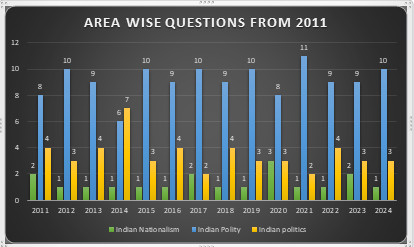
This overview helps you plan better — for example, if Indian Polity dominates a few consecutive years, you will know where to invest more time. And if Indian Politics gets more questions in recent years, you know the exam is leaning towards current socio-political realities.
This table shows you exactly how many questions have been asked from each topic in PSIR Paper 1 (Indian Government & Politics) from 2011 to 2024.
| S.No | Topics | 2011 | 2012 | 2013 | 2014 | 2015 | 2016 | 2017 | 2018 | 2019 | 2020 | 2021 | 2022 | 2023 | 2024 |
|---|---|---|---|---|---|---|---|---|---|---|---|---|---|---|---|
| 1 | Political Strategies of Freedom Struggle | 1 | 1 | 0 | 1 | 1 | 0 | 2 | 1 | 1 | 2 | 0 | 1 | 1 | 0 |
| 2 | Perspectives of Indian National Movement | 1 | 0 | 1 | 0 | 0 | 1 | 0 | 0 | 0 | 1 | 1 | 0 | 1 | 1 |
| 3 | Making of Constitution: Legacies & Perspectives | 0 | 1 | 0 | 0 | 0 | 0 | 0 | 0 | 1 | 1 | 1 | 1 | 1 | 1 |
| 4 | Salient Features, Preamble, FR & Duties | 0 | 0 | 2 | 0 | 1 | 1 | 1 | 1 | 0 | 1 | 2 | 1 | 2 | 2 |
| 5 | Directive Principles of State Policy | 1 | 1 | 0 | 1 | 0 | 0 | 0 | 0 | 1 | 0 | 1 | 0 | 0 | 1 |
| 6 | Amendment Procedures & Important Amendments | 0 | 0 | 0 | 0 | 1 | 1 | 0 | 0 | 0 | 0 | 1 | 0 | 0 | 0 |
| 7 | Judicial Review, Activism & Basic Structure | 0 | 2 | 1 | 0 | 1 | 1 | 1 | 1 | 1 | 1 | 0 | 1 | 1 | 0 |
| 8 | Principal Organs: Union Government | 0 | 0 | 3 | 1 | 0 | 0 | 3 | 0 | 1 | 1 | 2 | 1 | 0 | 0 |
| 9 | Principal Organs: State Government | 1 | 0 | 0 | 0 | 1 | 1 | 0 | 0 | 0 | 1 | 0 | 1 | 0 | 1 |
| 10 | Grassroots Democracy: PRIs & Urban Bodies | 0 | 0 | 1 | 1 | 1 | 1 | 1 | 2 | 1 | 1 | 1 | 1 | 2 | 2 |
| 11 | Statutory Institutions & Commissions | 2 | 1 | 0 | 3 | 0 | 1 | 1 | 1 | 2 | 1 | 1 | 2 | 1 | 1 |
| 12 | Federalism: Provisions & Disputes | 1 | 1 | 1 | 0 | 1 | 2 | 1 | 2 | 1 | 2 | 1 | 1 | 1 | 0 |
| 13 | Planning and Economic Development | 0 | 1 | 1 | 0 | 3 | 2 | 2 | 1 | 1 | 1 | 1 | 0 | 1 | 2 |
| 14 | Caste, Religion, Ethnicity & Secularism | 2 | 0 | 1 | 2 | 2 | 1 | 1 | 1 | 1 | 1 | 1 | 1 | 1 | 1 |
| 15 | Party System & Coalition Politics | 2 | 2 | 1 | 3 | 1 | 2 | 1 | 2 | 1 | 1 | 1 | 2 | 1 | 1 |
| 16 | Social Movements: HR, Women, Environment | 0 | 1 | 2 | 2 | 0 | 1 | 0 | 1 | 1 | 1 | 0 | 1 | 1 | 1 |
Asked almost every year. Master these thoroughly.
Party System, Caste & Secularism, Grassroots Democracy.
Irregular but repeated patterns. Revise strategically.
Federalism, Judiciary, Planning & Economic Development.
Rarely touched but don't skip completely.
Amendment Procedures, State Government Organs.
By looking at the spread across years, you’ll also notice how some topics rise during key national developments — for example, questions on Judicial Activism become more frequent when constitutional debates are in the news.
II.1. SECTION A - COMPARATIVE POLITICS AND INTERNATIONAL RELATIONS
Paper 2, section A has two major areas: Comparative Politics and International Relations. The total syllabus for this section is segregated as follows.
The chart and table below give you a clear picture of how questions in PSIR Paper 2, SECTION A have been distributed across Comparative Politics and International Relations over the last 14 years.
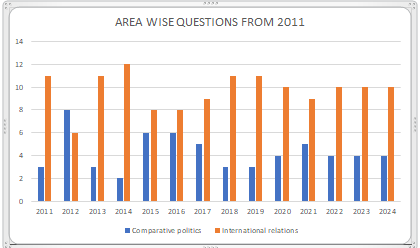
This table shows exactly how many questions have been asked from each topic in PSIR Paper 2, section A (comparative politics and international relations).
| S.No | Topics | 2011 | 2012 | 2013 | 2014 | 2015 | 2016 | 2017 | 2018 | 2019 | 2020 | 2021 | 2022 | 2023 | 2024 |
|---|---|---|---|---|---|---|---|---|---|---|---|---|---|---|---|
| 1 | Comparative politics: nature, approaches & limitations | 1 | 2+1* | 0 | 0 | 2 | 1+1* | 1 | 1 | 1 | 1 | 1 | 1 | 2 | 1 |
| 2 | State in comparative perspective | 0 | 0 | 1 | 0 | 0 | 1 | 2 | 1 | 0 | 1 | 1 | 0 | 1 | 1 |
| 3 | Politics of representation and Participation | 0 | 4 | 0 | 1 | 2 | 1 | 0 | 1 | 1 | 1 | 2 | 1 | 0 | 1 |
| 4 | Social Movements in industrial & developing societies | 1 | 1 | 2 | 1 | 0 | 1 | 1 | 0 | 1 | 0 | 0 | 1 | 0 | 0 |
| 5 | Globalisation: Responses from societies | 1 | 0 | 0 | 0 | 2 | 1 | 1 | 0 | 0 | 1 | 1 | 1 | 1 | 1 |
| 6 | Approaches to IR: Idealist, Realist, Marxist, etc. | 1 | 2+2* | 3 | 3 | 1 | 1 | 2 | 2 | 1 | 1 | 2 | 2 | 2 | 2 |
| 7 | Key concepts of IR: Interest, Security, Power, BoP | 2 | 4 | 3 | 1 | 1 | 2 | 0 | 1 | 1 | 1 | 0 | 3 | 0 | 1 |
| 8 | Transnational actors & Globalisation | 0 | 0 | 2 | 2 | 0 | 1 | 0 | 0 | 0 | 0 | 1 | 0 | 0 | 0 |
| 9 | Changing Order: Super powers, Cold War, Nuclear threat | 0 | 0 | 0 | 1 | 0 | 1 | 0 | 0 | 0 | 0 | 0 | 0 | 0 | 3 |
| 10 | NAM: Aims, Objectives & Relevance | 0 | 1 | 1 | 0 | 0 | 0 | 1 | 1 | 1 | 1 | 0 | 0 | 2 | 0 |
| 11 | Collapse of USSR, Unipolarity & Hegemony | 0 | 0 | 1* | 0 | 1 | 2 | 1* | 1* | 1 | 1* | 1 | 1 | 1 | 0 |
| 12 | Evolution of IR Economic System: WTO, NIEO | 0 | 0 | 3 | 0 | 1 | 1 | 0 | 1 | 1 | 2 | 0 | 1 | 0 | 1 |
| 13 | United Nations: Role, Agencies & Reforms | 2 | 1 | 0 | 1 | 1 | 1 | 1 | 1 | 1 | 2 | 1 | 0 | 2 | 0 |
| 14 | Regionalisation: EU, ASEAN, SAARC, etc. | 0 | 1 | 2 | 1 | 1 | 1 | 2 | 0 | 0 | 1 | 2 | 1 | 1 | 2 |
| 15 | Global Concerns: HR, Democracy, SDGs | 0 | 1 | 0 | 0 | 1* | 0 | 0 | 1 | 1*+2 | 0 | 1 | 1 | 1 | 0 |
| 16 | Environment | 0 | 1 | 1 | 1 | 0 | 1 | 1 | 1 | 0 | 1 | 1 | 0 | 1 | 0 |
| 17 | Gender Justice | 0 | 0 | 1 | 0 | 1 | 0 | 1 | 1 | 0 | 0 | 0 | 0 | 0 | 1 |
| 18 | Nuclear Proliferation & Terrorism | 1 | 1 | 2 | 1 | 0 | 0 | 0 | 1 | 0 | 0 | 0 | 1 | 0 | 0 |
As far as the Paper 2 is concerned, Section A and Section B are not strictly maintained by UPSC. For example, in 2013, there were only 6 to 7 questions on ‘India and World’ and that too appeared in Section A! All other questions were from Comparative Politics and IR. Even in other years, questions from ‘Comparative Politics and IR’ appeared in Section B. UPSC gives significantly more weight to Section A topics. In our analysis, we have grouped these questions logically by topic for your convenience, regardless of which section they originally appeared in.
Use this data to fine-tune your preparation. Spend more time on high-yield topics and revise moderate zones strategically.
Detailed sub-topic analysis of questions asked in the last 8 years.
| TOPIC | SUB-TOPIC (YEAR) |
|---|---|
| 1. Comparative politics: nature and approaches. Political economy and political sociology perspectives. Limitations of comparative method. North-south concept |
|
| 2. State in comparative perspective: Characteristics and changing nature of the state in capitalist and socialist economies, advanced industrial & developing societies |
|
| 3. Politics of representation and Participation: Political parties, Pressure groups in advanced industrial and developing societies |
|
| 4. Social Movements in advanced industrial and developing societies |
|
| 5. Globalisation: Responses from developed and developing societies |
|
| 6. Approaches to the study of international relations. Idealist, Realist, Marxist, Functionalist and Systems theory |
|
| 7. Key concepts of IR: National interest, security and power; Balance of Power and deterrence |
|
| 8. Transnational actors and collective security; World capitalist economy and globalisation |
|
| 9. Changing International Political Order: Super powers, Bipolarity, Cold War, Nuclear threat |
|
| 10. NAM: Aims, Objectives & Relevance |
|
| 11. Collapse of Soviet Union, Unipolarity and American hegemony |
|
| 12. Evolution of International Economic System: Brettonwoods to WTO, NIEO |
|
| 13. United Nations: Role, Specialized Agencies, UN Reforms |
|
| 14. Regionalisation of World Politics: EU, ASEAN, APEC, SAARC, NAFTA |
|
| 15. Contemporary Global Concerns: HR, Democracy, SDGs |
|
| 16. Environment |
|
| 17. Gender Justice |
|
| 18. Nuclear Proliferation, Terrorism |
|
II.2. SECTION B - INDIA AND THE WORLD
Alright students, before you jump into the table below, let’s understand what it’s telling us — because this is not just a set of numbers. It’s a map of UPSC’s priorities in international affairs — and if you learn to read it right, it can sharpen your preparation in no time. This table tracks how many questions have been asked each year from the 13 key topics in Section B — all of which are part of your India’s foreign policy syllabus.
| S.No | Topics | 2011 | 2012 | 2013 | 2014 | 2015 | 2016 | 2017 | 2018 | 2019 | 2020 | 2021 | 2022 | 2023 | 2024 |
|---|---|---|---|---|---|---|---|---|---|---|---|---|---|---|---|
| 1 | India’s Foreign policy: Determinants, Institutions, Recent developments | 2 | 2 | 2 | 2 | 2 | 1 | 1 | 4 | 3 | 1 | 2 | 3 | 2 | 1 |
| 2 | India’s contribution to NAM: Phases & Current role | 1 | 0 | 0 | 1 | 1 | 1 | 0 | 0 | 1 | 0 | 1 | 0 | 0 | 1 |
| 3 | India and its neighbours (Part of India & South Asia) | 0 | 1 | 0 | 1 | 1 | 1 | 2 | 0 | 0 | 2 | 1 | 2 | 0 | 3 |
| 4 | India and South Asia: Regional Co-operation, SAARC, Look East | 1 | 1 | 0 | 1 | 0 | 1 | 1 | 2 | 1 | 1 | 1 | 1 | 1 | 1 |
| 5 | Impediments to South Asian regional cooperation: Border, Water, Migration | 1 | 1 | 0 | 0 | 2 | 1 | 0 | 1 | 0 | 1 | 1 | 1 | 1 | 0 |
| 6 | India and Global south: Africa, Latin America, NIEO, WTO | 0 | 0 | 1 | 0 | 1 | 0 | 2 | 3 | 1 | 1 | 2 | 1 | 3 | 2 |
| 7 | India and Global Centers of Power: USA and Russia | 1 | 0 | 0 | 2 | 1 | 1 | 2 | 1 | 1 | 1 | 2 | 1 | 1 | 2 |
| 8 | India and European Union | 0 | 0 | 0 | 1 | 0 | 1 | 0 | 0 | 0 | 0 | 0 | 0 | 0 | 0 |
| 9 | India – Japan – China | 1 | 1 | 1 | 1 | 1 | 1 | 2 | 2 | 3 | 2 | 1 | 1 | 1 | 1 |
| 10 | India and the UN system: Peace keeping, Security council seat | 0 | 0 | 1 | 2 | 1 | 1 | 2 | 1 | 1 | 1 | 1 | 1 | 1 | 1 |
| 11 | India & the Nuclear Question: Perceptions & policy | 1 | 0 | 1 | 1 | 1 | 1 | 1 | 0 | 1 | 1 | 0 | 1 | 1 | 1 |
| 12 | India’s position in recent crisis: West Asia, Israel, Afghanistan | 1 | 0 | 0 | 2 | 3 | 0 | 1 | 1 | 2 | 2 | 1 | 1 | 3 | 1 |
| 13 | India and New World Order | 0 | 0 | 0 | 0 | 1 | 0 | 0 | 0 | 1 | 1 | 1 | 1 | 0 | 0 |
✅ India’s General Foreign Policy (Topic 1) is the king of Section B. It appears every single year — contribution 2 to 4 questions. This is your non-negotiable area.
📈 Emerging Zones: Topics like "India and Global South", "India–Japan–China", and "India’s Role in Global Crises" are steadily gaining ground in the last 6–7 years.
🔁 Cyclical Trends: SAARC and Neighbours disappear for a year or two and then come back stronger. You cannot ignore them given the changing geopolitics.
⚠️ Rare Topics: India and EU or New World Order appear rarely, but stay on the radar as UPSC loves to throw curveballs from these areas.
💥 Staple Concepts: NAM, UN, and Nuclear Policy are never truly out of the game. They provide the framework for other answers. Prepare them concise and current.
To gain sharper insights into the current trend, the last eight years' question papers have been analysed separately below.
| TOPIC | SUB-TOPIC (YEAR) |
|---|---|
| 1. India’s Foreign policy: Determinants, Institutions, Recent developments | Nehruvianism to Neoliberalism (2024, 2018); Determinants (2023, 2017); Institutions (2020); Strategic culture (2018); Public diplomacy (2022); Energy security: Indo-US BECA (2022); Look East to Act East (2021, 2018); Indo-Pacific & Look West (2023, 2024); Asia-Pacific vs Indo-Pacific (2024) |
| 2. India’s contribution to NAM. Different phases. Current role | NAM relevance and limitations (2017, 2018, 2019, 2020, 2023); Soft power through NAM (2023); Multi-alignment replacing NAM (2024); Non-alignment 1.0 vs 2.0 (2019) |
| 3. India and its neighbours | Bhutan-China tensions (2024); India-Sri Lanka-China triangle (2024); India-Myanmar Free Movement (2024); India-Bangladesh hydro cooperation (2022, 2020); Rohingya issue (2017, 2018, 2021, 2024); Border disputes (2023, 2021, 2024) |
| 4. India and South Asia Regional Cooperation | SAARC prospects (2018, 2020, 2024); Lack of ‘regionness’ (2023); BIMSTEC, ASEAN engagement (2021); Regional cooperation impediments (2023, 2017) |
| 5. Impediments to South Asian regional cooperation | Water disputes & migration (2017, 2020, 2022, 2024); Ethnic conflicts in NE (2024, 2021); Regional peace impediments (2023) |
| 6. India and Global south | India-Africa relations (2017, 2020, 2023); South-South Cooperation: RIS, ITEC (2018); WTO diplomacy & NIEO leadership (2022, 2023, 2024) |
| 7. India and Global Centers of Power | India-USA strategic alignment (2019, 2020, 2023, 2024); Indo-US: close partners not formal allies (2024); Russia-India changing context (2023, 2017, 2020) |
| 8. India and European Union | EU relations post-Brexit (2018, 2021) |
| 9. India – Japan – China | India-China standoff & recalibration (2020, 2021); India-Japan strategic relations (2018, 2019); India-China trade & environment convergence (2018) |
| 10. India and the UN system | UN peacekeeping contributions (2017, 2018, 2020, 2023); Permanent seat demand (2018, 2020, 2022); UNSC veto & semi-permanent idea (2024) |
| 11. India & the Nuclear Question | No First Use & NPT refusal (2019, 2020, 2021, 2022, 2023, 2024); India's autonomous nuclear strategy (2018) |
| 12. India’s position in the recent crisis | Afghanistan Taliban impact (2021, 2020, 2024); India-Israel convergence & Palestine (2017, 2018, 2019, 2024); West Asia Quad & Look West (2023); India-Iran ties (2023) |
| 13. India and New World Order | India's evolving role (2017, 2018, 2019, 2022, 2024); Strategic autonomy (2019, 2023); India's balancing act: QUAD, Indo-Pacific, Africa (2021–2024) |
This table isn’t just to memorise numbers — it’s to help you predict patterns, prioritise topics, and prepare smart.