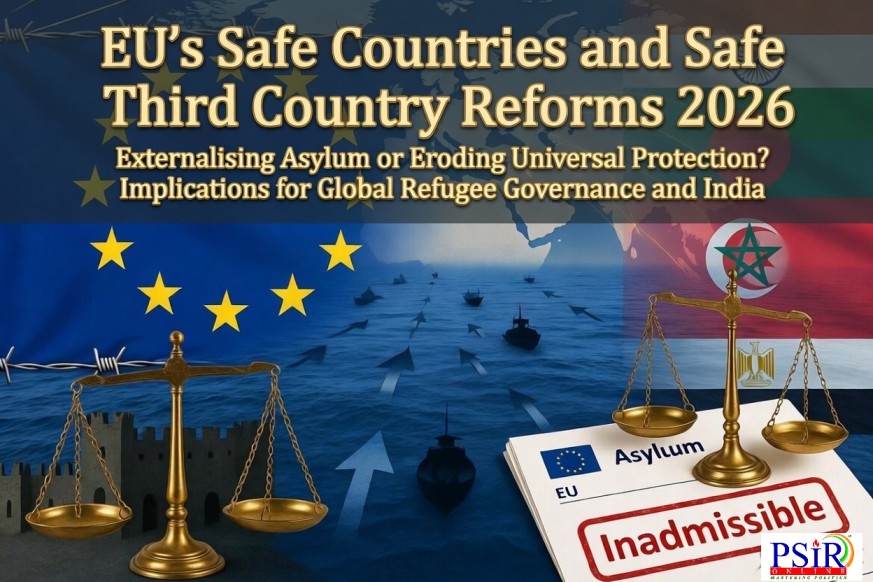
On 10 February 2026, the European Parliament approved deep reforms to the EU’s asylum system that expand the “safe third country” concept and introduce a common EU‑wide list of “safe countries of origin” (SCOs), including Bangladesh, Tunisia, Morocco, Kosovo, Colombia, Egypt, and India. These changes are designed to speed up asylum decisions and increase returns, but they have also triggered strong criticism from human‑rights groups over risks to protection standards.
What the “safe countries of origin (SCO)” list means
Under the new rules, nationals of the listed countries are presumed not to need international protection, so their asylum claims are to be processed under accelerated procedures, typically within a few months. Claimants retain the right to argue that their individual case is exceptional (for example, due to persecution or serious harm), but the burden of proof now lies much more firmly on them.
The list is not closed; EU member states can still add further “safe” countries at national level, but they cannot treat countries on the EU‑wide SCO list as unsafe and must apply the fast‑track procedure to asylum‑seekers from them. The Commission is also expected to monitor conditions in each listed state and adjust the list if the situation deteriorates.
What is the concept of ‘safe-third country’?
The “safe third country” concept is a legal and administrative idea used in international asylum and migration policy to justify returning an asylum‑seeker to a country that is neither their home country nor the country where they first applied for protection, but which is considered “safe” for them.
Core idea
· A safe third country is a state where an asylum‑seeker has previously stayed or passed through and where they can, in principle, access international protection (refugee status or equivalent safeguards) without facing persecution, torture, or serious harm.
· Instead of processing the person’s claim in the current country, authorities may declare the application “inadmissible” and return or transfer the individual to that third country, provided it meets certain legal conditions.
|
SIMPLE EXPLANATION
Imagine: · A man is born and lives in Sri Lanka (his “country of origin”). · He fears persecution in Sri Lanka and wants to apply for asylum in the UK. · To reach the UK, he travels via Nepal (he transits or stays there for some time) and then flies or otherwise enters the UK.
Now imagine the UK government has classified Nepal as a “safe third country” for him, meaning: · the UK believes Nepal does not expose him to persecution or torture, and · Nepal allows him to apply for asylum or at least stay safely and not be sent back to Sri lanka.
If the UK also finds that he had a real “connection” to Nepal—such as: · a visa or residence there, or · fingerprints recorded when he entered or left Nepal, or · documentary evidence that he stayed there for weeks or months—
In that scenario, the UK could argue: · he had a reasonable chance to apply for asylum in Nepal before coming to the UK, and · since Nepal is “safe,” his claim in the UK is inadmissible on “safe third country” grounds.
So instead of processing his asylum claim in the UK, the Home Office might: · declare the claim inadmissible, and · seek to return or transfer him to Nepal, where he would then have to apply for protection there.
|
How the “safe third country” concept is widened in New European Union reforms?
The reforms also relax the conditions under which a member state can treat a non‑EU country as a “safe third country” outside the person’s own country of origin. This means that:
· Asylum‑seekers can be pushed back or transferred to a third country even if they have no prior legal or social ties there, provided that the EU considers that country to respect core asylum standards and that a bilateral agreement is in place.
· Applications may be declared inadmissible in the EU altogether, without a full merits‑based asylum examination, if the person is sent to a third country deemed “safe.”
In practice, this could allow member states to conclude deals with countries such as those on the SCO list (or other partners) to examine asylum claims on their soil instead of inside the EU, reinforcing the EU’s broader strategy of “externalising” border control and returns.
IMPACT ON GLOBAL IMMIGRATION, AND RIGHTS OF REFUGEES/ASYLUM‑SEEKERS
The EU’s expanded “safe countries and safe third country” reforms are likely to reshape global immigration patterns and significantly narrow the rights of refugees and asylum‑seekers seeking protection in Europe.
Impact on global immigration
· Externalisation of borders and “off‑shoring” of asylum
EU states can now more easily treat certain countries (including Bangladesh, Egypt, Morocco, Tunisia, India, etc.) as “safe” and push asylum‑processing or returns to those states, even if people have no prior ties there. This encourages bilateral “migration‑and‑returns” deals with third countries, effectively shifting the burden of hosting and screening refugees away from the EU toward states that often already host large displaced populations.
· Discouragement of regular routes and increased irregular migration
By making it harder to access asylum in the EU and normalising faster rejections and returns, the rules may push people toward riskier, irregular routes through conflict‑affected or unstable regions, increasing death, smuggling, and human‑trafficking risks on the way. Human‑rights bodies warn this will not reduce migration but only make it more dangerous and less predictable for sending and transit countries alike.
· Re‑shaping of migration corridors
The EU is likely to see more emphasis on “containment” arrangements in North Africa (Morocco, Tunisia, Egypt) and the Middle East, similar to past deals with Turkey and Libya, which may alter regional migration corridors and increase pressure on local systems in those countries.
Impact on the rights of refugees and asylum‑seekers
· Weaker individual assessment and presumption of safety
The EU‑wide list of “safe countries of origin” creates a presumption that nationals of listed countries do not need protection, forcing them to prove exceptional risk in short‑time, accelerated procedures. Evidence shows that even in “low‑recognition” countries, several percent of applicants are still recognised as refugees, meaning the blanket SAFETY label can miss real protection needs.
· Reduced access to asylum and increased risk of refoulement
Under the broader “safe third country” concept, EU member states can declare an asylum‑seeker’s application inadmissible and send them back to or through a third country deemed “safe,” even if they have no connection there. Critics argue this contravenes the core principle of non‑refoulement (no return to persecution or serious harm) and may expose people to detention, exploitation, or violence in countries where human‑rights conditions are fragile.
· Unfair burden‑sharing and erosion of global solidarity
The EU’s strategy of shifting asylum‑processing and returns to poorer third countries has been described as “outsourcing” protection, undermining the principle that major economies must share responsibility for global refugee protection. This risks deepening global inequality in how burdens are shared and may weaken multilateral cooperation on refugee protection over time.
Policy and conceptual implications
· Tension between migration control and human‑rights obligations
The reforms are openly framed as a way to reduce irregular arrivals and speed up returns, but scholars and UN‑level bodies warn they create an “uneasy compromise” between border control and rights‑based asylum systems. By streamlining procedures and expanding “safe country” tools, the EU tilts the balance toward exclusion first, protection second.
· Setting a precedent for other regions
If major powers like the EU increasingly rely on “safe country” lists and safe‑third‑country returns, other countries or blocs may adopt similar models, which could globalise fast‑track rejections and reduced asylum access under the guise of “efficiency.”
IMPACT ON INDIA
The EU’s designation of India as a “safe country of origin” (SCO) and the broader “safe third country” rules will primarily affect Indian nationals who seek asylum in Europe, while also shaping India’s migration diplomacy, return cooperation, and reputation in global protection debates.
Impact on Indian asylum‑seekers
· Accelerated and harder‑to‑win asylum procedures
Indian nationals applying for asylum in the EU will generally face fast‑track procedures (often within 3 months) and a legal presumption that their claims are unlikely to succeed, because India is treated as “safe” for its own nationals. This makes it far more difficult for people fleeing specific threats (such as political persecution, caste‑based violence, or religious/minority‑based harm) to obtain refugee status, even though some genuine protection needs may still exist.
· Higher risk of quick rejections and forced returns
Because the designation assumes India is “safe,” EU states will be encouraged to reject applications more frequently and expedite returns, including of people who entered irregularly. Human‑rights groups warn this can lead to refoulement‑like situations if individual risks are not adequately assessed, undermining the principle of non‑refoulement.
Diplomatic and policy implications for India
· Diplomatic framing: “safe” vs responsibility for its nationals
Listing India as “safe” is meant to signal that the EU regards India as a stable democracy with functioning institutions, but it also implicitly shifts part of the burden back to India for managing irregular migration and ensuring protection at home. This creates a diplomatic tension: India may welcome the “safe” label for its image, but it must also address concerns about minority rights, caste‑based violence, and civic‑space restrictions that drive some Indians to seek asylum abroad.
· Pressure to cooperate on readmissions and returns
The EU will likely negotiate readmission and return agreements with India, under which New Delhi must accept deported nationals more readily. This could strain domestic capacity and raise human‑rights questions if returnees are sent to unsafe or discriminatory environments, especially for vulnerable groups such as religious minorities, LGBTQ+ persons, or political activists.
Socio‑legal and human‑rights concerns
· Under‑recognition of genuine protection needs
While most Indian asylum‑seekers may not qualify for refugee status, critics stress that even in “low‑recognition” countries there are legitimate cases of persecution that risk being missed under a blanket “safe” label. This threatens due process and may push genuinely vulnerable Indians to use riskier routes to avoid detection or return.
· Influence on other countries’ treatment of Indians
The EU’s SCO designation may encourage other countries (including the UK, which has also treated India as “safe”) to adopt similar fast‑track rejection and return practices for Indian nationals. This could make it harder for Indians in need of international protection to find safe havens, while reinforcing India’s role as a “source country” rather than a protection‑provider.
Strategic takeaways for India
· The reforms push India to strengthen domestic protection mechanisms (for minorities, dissenters, and vulnerable groups) so that people have fewer incentives to flee abroad.
· At the same time, India must negotiate clear safeguards in any EU return‑cooperation framework, ensuring that deported individuals are not exposed to persecution or abuse and that their rights are monitored
PRACTISE QUESTIONS FOR GS 2 MAINS
1. “The expansion of the ‘safe country’ and ‘safe third country’ concepts reflects a shift from protection to deterrence in global asylum governance.” Critically examine.
2. Discuss how the European Union’s new asylum reforms may affect the principle of non-refoulement and international refugee protection norms.
3. Evaluate the implications of the EU’s “safe countries of origin” list for global migration patterns and burden-sharing among states.
4. How does the inclusion of India in the EU’s “safe country of origin” list impact India’s domestic governance and international migration diplomacy?
PRACTISE QUESTIONS FOR PSIR OPTIONAL
1. “The externalisation of asylum policies by developed regions represents a crisis of global justice.” Analyse in the context of recent EU reforms.
2. Examine the EU’s asylum reforms through the lens of liberal institutionalism vs realist state interests in international relations.
3. Critically assess how the “safe third country” doctrine reshapes the concept of sovereignty and responsibility in global refugee governance.
4. Discuss whether the EU’s migration policy reflects a weakening of cosmopolitan norms in favour of securitisation of borders.