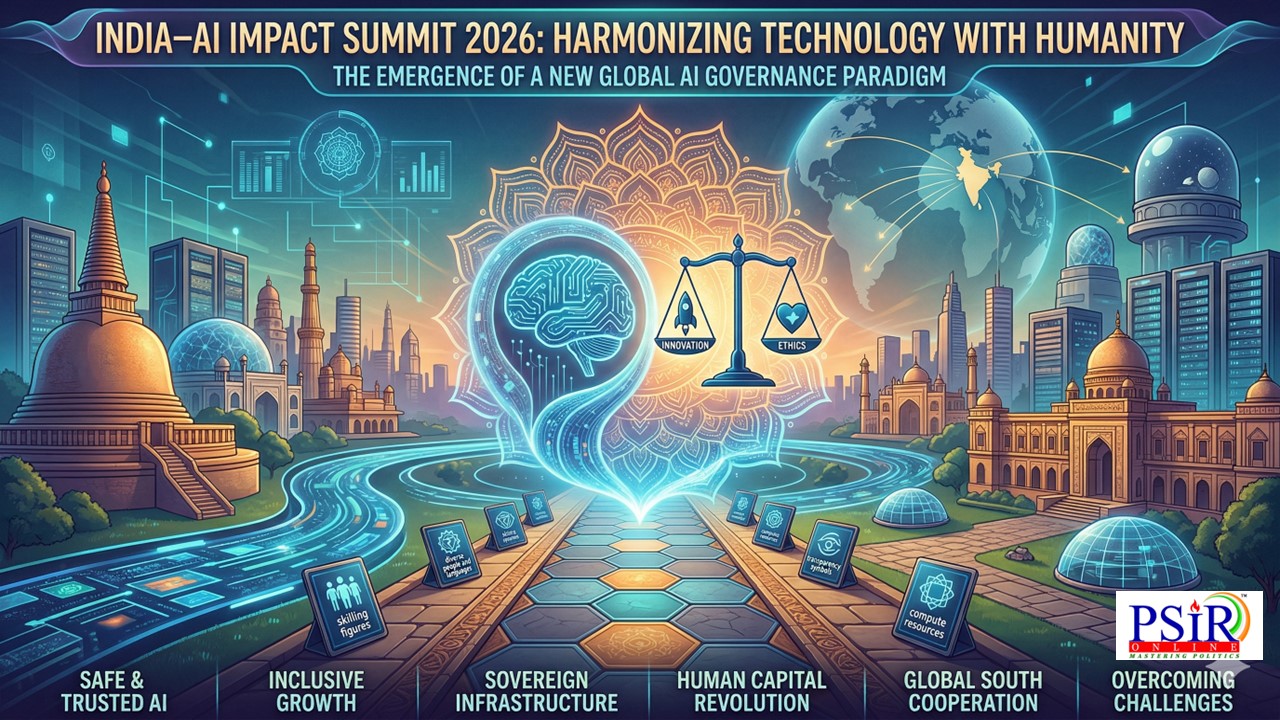
The India–AI Impact Summit 2026, held from February 16–20 in New Delhi, marked a historic milestone — the first global AI summit hosted in the Global South. Under India’s leadership, over 100 countries convened to chart a collective roadmap for responsible, inclusive AI governance. The summit’s core outcome was the articulation of the “Seven Chakras of AI Governance”, a framework symbolizing equilibrium between innovation, ethics, inclusion, and sustainability. Inspired by India’s philosophical ethos of balance and holistic development, this model reflects a uniquely “Indo-centric humanism” in technology governance.
THE SEVEN CHAKRAS FRAMEWORK
The Seven Chakras correspond to key dimensions shaping AI’s societal transformation:
1. Human Capital – Advocates equitable skilling and reskilling pathways for India’s workforce to thrive amid AI-driven transitions. It focuses on upskilling educators, technologists, and public servants to ensure broad-based readiness for an AI-enabled economy.
2. Inclusion for Social Empowerment – Encourages AI design and deployment that are inclusive by intent, serving marginalized groups and diverse languages, communities, and regions. It promotes AI for Bharat — localized technologies that amplify social empowerment.
3. Safe and Trusted AI – Upholds principles of transparency, accountability, and risk management. This Chakra seeks to cultivate public trust while safeguarding innovation through strong ethical oversight.
4. Science – Explores AI as a multiplier for research collaboration, scientific breakthroughs, and knowledge acceleration across disciplines — from healthcare to space exploration.
5. Resilience, Innovation, and Efficiency – Emphasizes building sustainable, efficient AI systems resilient against cyber risks, data vulnerabilities, and ecological impacts.
6. Democratizing AI Resources – Focuses on equitable access to critical AI infrastructure — particularly compute power and datasets — to prevent monopolization and ensure participation from all regions of the Global South.
7. AI for Economic Growth and Social Good – Channels AI for productivity gains and human welfare, shaping policies that intertwine economic progress with societal well-being.

SAFE AND TRUSTED AI: A KEYSTONE FOR ETHICAL GOVERNANCE
The Safe and Trusted AI Chakra stands as the linchpin of the entire framework. It recognizes that AI’s promise must rest on a foundation of reliability, human oversight, and regulatory prudence. At the summit, India showcased major institutional and technical advances in this domain:
· IndiaAI Safety Institute: Established to develop methodologies for AI risk assessment, compliance auditing, and red-teaming protocols, ensuring trustworthy deployment across sectors.
· Responsible AI Projects: Thirteen flagship initiatives underway in collaboration with academia and industry address algorithmic bias, explainability, and transparent model reporting.
· AI Governance Guidelines: Proposed formation of an AI Governance Group (AIGG) and a Technology and Policy Expert Committee (TPEC) — bodies envisioned to coordinate risk frameworks, ethical evaluations, and multi-stakeholder deliberations.
Together, these initiatives form India’s three-tier structure for AI governance, integrating technical safeguards, participatory policymaking, and regulatory agility. The enhanced support for the Safety Institute reflects India’s commitment to trust-led innovation — ensuring that progress never comes at the cost of public confidence.
INDIA’S STRATEGIC ALIGNMENT AND GLOBAL LEADERSHIP
The Seven Chakras framework aligns seamlessly with India’s national priorities of Digital India, inclusive development, and digital sovereignty. It positions India not just as a consumer but as a norm-shaper in global AI governance. By advocating multicultural, human-centric, and sustainability-driven principles, India offers a model distinct from technocratic or market-dominated paradigms.
This vision also strengthens South–South cooperation, enabling countries across Africa, Latin America, and Southeast Asia to participate equitably in the AI revolution. Using technology-enabled oversight and interoperable governance architectures, India champions shared global standards anchored in openness and ethics.
The “Seven Chakras” framework represents more than a policy vision — it’s a philosophical call to harmonize technology with humanity. As AI becomes a defining force of our century, India’s approach underscores that global progress must be inclusive, trusted, and sustainable. By infusing governance with ethical depth and social purpose, India’s leadership at the India–AI Impact Summit 2026 marks the emergence of a new paradigm — where innovation attains balance through responsibility, and advancement finds its soul in trust.
CHRONOLOGY OF GLOBAL AI SUMMITS (2023–2025)
Here are the countries that hosted major global AI summits before India’s 2026 summit, forming the evolving Global AI Summit Series:

Key Distinctions
· UK (2023): Pioneered the safety-first approach, centering on existential and frontier AI risks. It was the first-ever global AI summit.
· South Korea (2024): Bridged safety with practical governance, introducing corporate accountability frameworks and Asian technological perspectives.
· France (2025): Shifted toward action and investment, blending regulation with innovation financing and positioning Europe as an AI hub.
· India (2026): First summit in the Global South, introducing the “Seven Chakras” framework—integrating ethics, inclusion, skilling, and democratized access to AI resources.
Upcoming Hosts
The summit series will continue with:
· 2027: 🇨🇭 Switzerland (Geneva) – Expected focus on multilateral AI governance and UN alignment.
· 2028: 🇦🇪 UAE – Anticipated emphasis on AI infrastructure, energy-efficient computing, and Middle East–Global South partnerships.
BENEFITS OF INDIA AI-SUMMIT FOR INDIA’S GROWTH
The India–AI Impact Summit 2026 is far more than a diplomatic event—it is a strategic economic catalyst designed to accelerate India’s transition from an IT services hub to a global AI powerhouse. Its utility for India’s growth unfolds across five transformative dimensions:
1. Massive GDP Boost and Productivity Gains
AI is projected to add USD 500–600 billion (₹40–48 lakh crore) to India’s GDP by 2030 through productivity enhancements alone. The summit catalyzed this by:
· Sectoral Transformation: AI integration in manufacturing, logistics, finance, and agriculture is expected to raise output efficiency by 25–40%.
· Startup Explosion: With 1.8 lakh startups (89% AI-enabled in 2024), the summit’s “Compute-as-a-Service” model (GPUs at <₹100/hour) lowers entry barriers, fostering innovation-led job creation.
· Revenue Surge: India’s AI-powered tech sector is on track to generate USD 280 billion in revenue by 2025, accelerating post-summit investor confidence.
2. Sovereign AI Infrastructure and Digital Independence
The summit operationalized the IndiaAI Mission’s ₹10,372 crore outlay, ensuring India builds domestic AI capacity rather than relying on foreign platforms:
· 38,000 GPUs Onboarded: Creates shared national compute infrastructure, enabling Indian researchers and startups to train large foundation models locally.
· 12 Indigenous Foundation Models: Supports development of Indian language AI (Bhashini), healthcare diagnostics, and agricultural advisory tools.
· Tax Holiday till 2047: Foreign cloud providers using Indian data centres receive tax exemptions, positioning India as a global AI data hub.
3. Human Capital and Employability Revolution
Through the Human Capital Chakra, the summit addressed the critical challenge of workforce transitions:
· IndiaAI FutureSkills: Trains 6 million AI professionals, with special focus on Tier-2/3 cities and PhD scholars to prevent a digital divide.
· Curriculum Reform: Aligns engineering and management education with industry AI needs, ensuring employability matches technological disruption.
· Global Talent Magnet: Positions India as both a consumer and creator of AI, attracting R&D centres from Amazon, Microsoft, and Google (who pledged over $50 billion in investments).
4. Inclusive Growth and Social Empowerment
The summit’s Inclusion Chakra ensures AI benefits reach Bharat, not just India’s urban elite:
· Agricultural Gains: AI advisory tools have already increased crop yields by 30–50% in Andhra Pradesh and Karnataka.
· Healthcare Access: AI diagnostics expand specialist-level care to rural primary health centres, reducing urban-rural disparity.
· Financial Inclusion: AI-based fraud detection (e.g., MuleHunter.AI) and credit scoring strengthen UPI and banking security for 500+ million digital users.
· Justice & Governance: AI-assisted translation of court judgments and government documents improves access for non-English speakers.
5. Global Leadership and Norm-Setting Power
By hosting the first AI summit in the Global South, India achieved strategic diplomatic gains:
· Voice for Developing Nations: The “Seven Chakras” framework positions India as the advocate for equitable AI governance, countering Western-centric models.
· South–South Cooperation: Strengthens AI partnerships with Africa, Latin America, and ASEAN, creating export markets for Indian AI solutions.
· Standards Influence: India’s AI Governance Guidelines (AIGG, TPEC, Safety Institute) are being adopted as reference models for emerging economies.
CHALLENGES FOR INDIA’S RISE IN AI-TECHNOLOGY
1. Critical Infrastructure Deficits: Power, Water, and Compute
The most immediate constraint is physical, not digital. AI data centres are exponentially more resource-intensive than traditional cloud infrastructure.
· Power Grid Instability: A single large-scale AI data centre consumes as much electricity as a small city. AI workloads require 3–5x more power than traditional cloud computing, and India’s grid is already stressed in key tech hubs like Maharashtra, Karnataka, and Telangana.
o Risk: Frequent outages or voltage fluctuations can corrupt AI training runs lasting weeks, costing millions in lost compute time.
o Cooling Overhead: India’s tropical climate adds 30–40% extra energy costs for cooling servers, reducing competitiveness against cooler regions.
· Water Scarcity: Data centres require massive water volumes for cooling. The Economic Survey 2026 explicitly flagged water stress as a critical limiter for expanding AI infrastructure in drought-prone states.
· GPU Dependency: Despite onboarding 38,000 GPUs via IndiaAI, India remains 100% import-dependent for advanced semiconductors (NVIDIA, AMD). Geopolitical supply shocks or export bans could stall domestic model training.
2. Severe Talent Shortage: Quantity ≠ Quality
India produces the world’s largest pool of AI learners (1.3 million), but suffers a catastrophic quality mismatch.
· The 82% Shortage: 82% of Indian employers report inability to fill AI roles in 2026—significantly higher than the global average of 72%.
· 1:10 Ratio: For every 10 open Generative AI positions, only 1 qualified engineer is available.
· Global Ranking Paradox: Despite high enrollment, India ranks 89th out of 109 nations in measured AI proficiency, indicating curricula are outdated and industry-aligned skills are missing.
· Consequence: Startups and GCCs are forced to import expensive foreign talent or poach domestically, inflating salaries by 40–60% and burning cash reserves.
3. Regulatory Uncertainty and Legal Gaps
India’s regulatory framework is fragmented and reactive, creating compliance risks for investors.
· No Dedicated AI Law: Unlike the EU’s AI Act, India lacks a comprehensive AI statute. Regulation relies on the IT Act, 2000 (obsolete for AI) and the DPDP Act, 2023, which has critical loopholes.
o DPDP Loophole: The Act does not apply to publicly available data, allowing unchecked scraping of personal data for model training without consent.
o No Algorithmic Accountability: There is no legal mandate for transparency or auditability of AI decisions, leaving citizens vulnerable to biased lending, hiring, or policing algorithms.
· Policy Churn: Frequent, unpredictable advisories (e.g., sudden content takedown orders) create an environment of regulatory uncertainty, deterring long-term R&D investments.
4. Innovation Gap: Risk of Becoming a “Test Market”
India risks becoming a consumer and testing ground for foreign AI rather than an innovator.
· No Foundational Breakthroughs: Indian startups largely build application-layer wrappers over US/Chinese foundation models (LLMs). India has yet to produce a globally competitive foundational model comparable to GPT, Claude, or Gemini.
· Network Effect Trap: Global LLMs (Meta, Google) benefit from massive data networks, making them superior even for Indian languages. Indian startups struggle to compete, risking market colonization by foreign tech giants.
· Outcome: India could end up as a data colony—providing raw data and users, while value capture (profits, IP) flows abroad.
5. Data Quality and Bias Issues
AI is only as good as its training data. India’s data ecosystem suffers from fragmentation and bias.
· Low-Quality Datasets: Much of India’s digital data is unstructured, noisy, or non-digitized, leading to poor model performance in critical sectors like healthcare and agriculture.
· Algorithmic Bias: Models trained on skewed data perpetuate caste, gender, and religious biases, risking discriminatory outcomes in welfare distribution, policing, and credit scoring.
· Language Gap: While Bhashini is promising, high-quality datasets for low-resource Indian languages (e.g., Santhali, Kashmiri) remain scarce, limiting inclusive AI deployment.
6. Capital and Risk Aversion
Despite summit fanfare, patient capital for deep-tech AI is scarce.
· VC Caution: Indian VCs prefer low-risk SaaS and fintech over capital-intensive, long-gestation AI infrastructure or foundational research.
· High Cost of Capital: Interest rates and risk premiums make it expensive for startups to finance GPU clusters or multi-year R&D projects compared to US/Chinese peers.
The “Middle-Income AI Trap”
India faces the risk of a “Middle-Income AI Trap”: possessing the ambition and market size of a superpower, but lacking the infrastructure depth, talent quality, and regulatory clarity to match. Without urgent reforms in power grid modernization, curriculum overhaul, AI-specific legislation, and patient capital mobilization, India’s AI rise could stall at being a low-value assembly hub rather than a high-value innovation leader.
PRACTISE QUESTIONS FOR GS- PAPER 2
1. “AI governance today is as much a question of ethics as it is of regulation.”
Discuss in the context of the “Seven Chakras of AI Governance” framework.
2. Examine the role of India in shaping global AI governance. How does the India–AI Impact Summit 2026 reflect this emerging leadership?
3. Discuss the challenges posed by the absence of a comprehensive AI regulatory framework in India. Suggest measures to ensure accountable and inclusive AI governance.
4. “Technological advancement without inclusivity can deepen social inequalities.”
Analyse this statement with reference to AI-driven development in India.