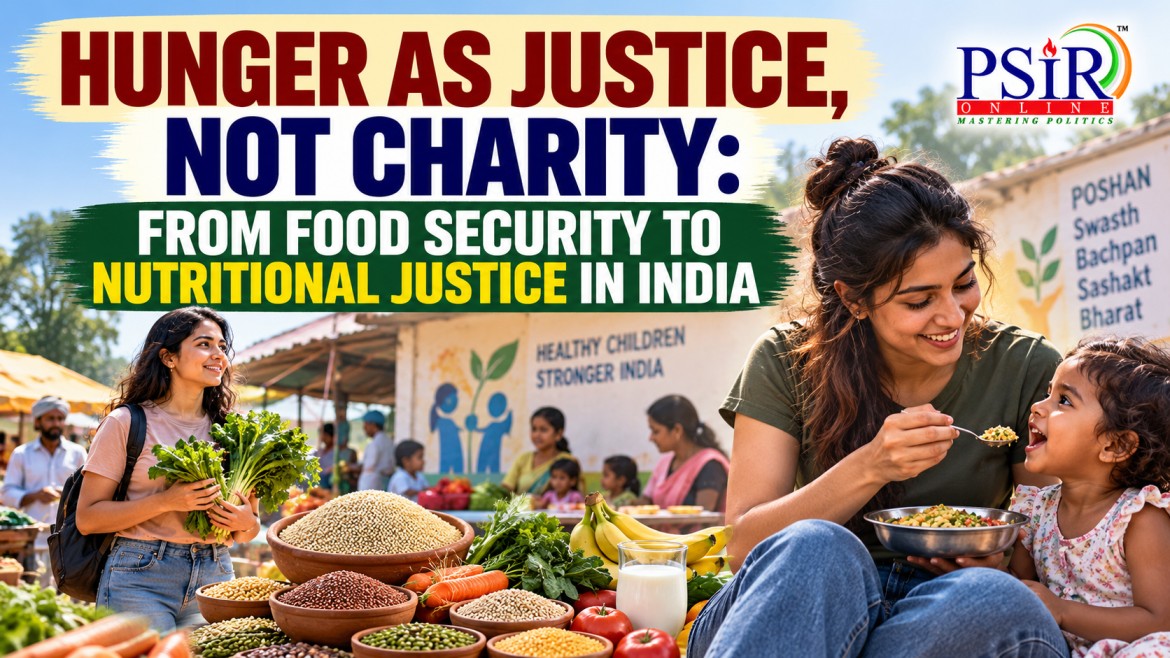
INTRODUCTION: THE NORMATIVE SHIFT IN INDIA'S FOOD POLICY
At a Nutrition and Healthy Lifestyle workshop organised by the Central Bureau of Communication in Bhubaneswar, former Odisha State Food Commission Chairman Pramod Kumar Merkap highlighted an urgent conceptual shift: hunger must be recognized as a non-negotiable claim of justice, not a benevolent act of state charity. He drew particular attention to the persistent scourge of micronutrient deficiencies among pregnant and lactating women and underscored the first 1,000 days of life as an irreplaceable window for human capability formation.
This intervention reflects a critical evolution in India’s social-policy landscape. The defining governance challenge is no longer merely logistical—preventing starvation through the bulk distribution of raw grain. Instead, it has transformed into a substantive human-development question: Does every citizen possess equitable access to the adequate, micronutrient-rich, and culturally resonant diet required to live a dignified, healthy life?
FROM CALORIE SUFFICIENCY TO NUTRITIONAL JUSTICE: THE CONCEPTUAL SPECTRUM
The national discourse on welfare has outgrown the traditional paradigm of food security. To build a robust social architecture, policy must navigate a three-tier hierarchy:

A household may be strictly "food secure" in terms of daily caloric intake while remaining severely malnourished. Reliance on cheap, carbohydrate-heavy staples leaves vast segments of the population trapped in "hidden hunger"—a chronic deficiency of essential vitamins and minerals that manifests as stunting, wasting, maternal anemia, and impaired immunity.
· Food Security measures input: Is there grain on the plate?
· Nutrition Security measures biological adequacy: Does that plate deliver dietary diversity, bioavailability, and micronutrients?
· Food Justice interrogates structural inequality: Are systemic poverty, geography, or intra-household gender biases dictating who eats well and who merely survives?
THE FIRST 1,000 DAYS: HUMAN CAPITAL FORMATION OVER CONSUMPTION SUPPORT
The biological window spanning conception to a child’s second birthday—the first 1,000 days—is foundational for neurodevelopment, immunological priming, and physical growth. Investing in this sensitive developmental phase transcends traditional welfare provisioning. It functions as an intersectional policy lever:
Maternal-Infant Nutrition = Health Policy + Social Justice + Human Capital Formation + Intergenerational Mobility
When maternal undernutrition and early childhood micronutrient deficits occur during this period, the damage to neural pathways and physical stature is largely irreversible. Undernourished infants grow into adults with diminished cognitive capacity, lower educational attainment, and compromised economic productivity. Consequently, targeted nutritional expenditure under initiatives like the National Nutrition Mission (POSHAN 2.0) must be operationalized as an essential capital investment in national capabilities rather than consumable revenue expenditure.
INTRA-HOUSEHOLD ASYMMETRY: DECONSTRUCTING THE GENDER DYNAMIC
Nutritional vulnerability is fundamentally asymmetrical, shaped by entrenched social norms and biological lifecycles:
· Biological Vulnerability: Pregnant and lactating mothers require elevated caloric, iron, folate, and protein thresholds to sustain fetal growth and lactation without depleting their own physiological reserves.
· Sociological Vulnerability: Within patriarchal household economies, food allocation is frequently hierarchical. Women and adolescent girls routinely eat last and least, absorbing dietary deficits during lean seasons.
True nutritional justice requires focused systemic interventions: structured maternal wage compensation (such as Pradhan Mantri Matru Vandana Yojana), decentralized Anganwadi Supplementary Nutrition Programs (SNP), localized tracking of Severe Acute Malnutrition (SAM), and institutional support for exclusive breastfeeding and timely complementary feeding.
DECENTRALIZED NUTRITION: AGRARIAN DIVERSITY AND THE MILLETS IMPERATIVE
Merkap’s emphasis on coarse grains highlights the crucial convergence between agriculture and public health. Moving away from water-intensive monocultures (paddy and wheat) toward nutri-cereals (millets such as ragi, jowar, and bajra) accomplishes multiple structural goals:
· Nutritional Density: Millets offer superior calcium, iron, dietary fiber, and glycemic control compared to polished white rice.
· Ecological Resilience: Coarse grains are climate-resilient, requiring minimal irrigation and thriving in rainfed, fragile drylands.
· Agrarian Livelihoods: Procuring locally grown nutri-cereals through decentralized Minimum Support Price (MSP) channels directly boosts the incomes of marginal and dryland farmers.
Integrating millets into the Public Distribution System (PDS), PM POSHAN (Mid-Day Meal Scheme), and Integrated Child Development Services (ICDS) aligns public health mandates directly with sustainable agro-ecology and regional food sovereignty.
UPSC DIMENSION
|
UPSC Dimension |
How the Issue Connects with It |
|
Constitutional Justice & Fundamental Rights (GS-II) |
Connects the eradication of hidden hunger with the Right to Life with Dignity under Article 21. Enforces Directive Principles of State Policy, notably Article 47 (duty of the State to raise the level of nutrition and the standard of living) and Articles 39(e) & (f) (protecting the health of workers and children against exploitation). |
|
Substantive Equality vs. Welfare Paternalism (GS-II) |
Marks a conceptual transition from "state benevolence/charity" to a rights-based framework of legal entitlements under the National Food Security Act (NFSA), 2013, treating nutritional well-being as a non-negotiable claim of citizenship. |
|
Vulnerable Sections: Women & Child Development (GS-II) |
Demonstrates the critical importance of lifecycle-based social protection. Focuses on the first 1,000 days to dismantle the intergenerational transmission of poverty, stunting, and maternal mortality. |
|
Human Capital & Economic Productivity (GS-III) |
Analyzes malnutrition as a structural barrier to demographic dividends. Cognitive and physical deficits caused by early undernutrition undermine labor productivity, depress wages, and impose significant public healthcare burdens. |
|
Gender Justice & Intra-Household Allocation (GS-I & GS-II) |
Interrogates patriarchal food dynamics where women face caloric and micronutrient penalties. Connects food policies directly with female agency, maternal education, and direct financial transfers. |
|
Sustainable Agriculture & Resilient Food Systems (GS-III) |
Connects public health outcomes with sustainable agrarian patterns by mainstreaming climate-resilient nutri-cereals (millets), promoting crop diversification away from water-intensive staples, and supporting dryland farmer livelihoods. |
|
Public Health Infrastructure & Convergence Governance (GS-II) |
Highlights the governance requirement for multi-sectoral institutional convergence—integrating ICDS (WCD), Jal Jeevan Mission (Drinking Water), Swachh Bharat (Sanitation), and primary healthcare (Health Ministry) to maximize nutrient absorption. |
|
Ethics in Public Administration (GS-IV) |
Addresses the moral imperative of distributive justice: evaluating whether a state's economic progress can be deemed ethical if its marginalized strata are kept alive on bare calories while being denied the substantive capabilities to flourish. |
WAY FORWARD
· Legislative and PDS Diversification: Amend the procurement and distribution architecture of the National Food Security Act (NFSA) to systematically incorporate millets, pulses, and fortified oils alongside traditional wheat and rice rations.
· Institutionalize First 1,000 Days Interventions: Universalize targeted conditional cash transfers for maternity benefits, ensuring wage-loss compensation covers informal and agricultural laborers without administrative friction or procedural exclusions.
· WASH and Nutrition Convergence: Intensify convergence between nutrition programs and WASH initiatives (Water, Sanitation, and Hygiene) to curb enteric infections and environmental enteropathy, ensuring ingested micronutrients are biologically absorbed.
· Address Intra-Household Gender Disparities: Expand community-level behavioral change communication through Self-Help Groups (SHGs) and front-line workers (ASHA, Anganwadi Workers) to tackle gendered dining practices and prioritize adolescent and maternal diets.
· Decentralized Nutri-Hubs & Kitchen Gardens: Scale the establishment of community-led Poshan Vatikas (nutrition gardens) at every Anganwadi center and government school to supply fresh, unadulterated green vegetables and seasonal fruits to daily diets.
· Accountability via Real-Time Audits: Strengthen social audits of the ICDS and PM POSHAN ecosystems through village health, sanitation, and nutrition committees (VHSNC), leveraging real-time data from the POSHAN Tracker to prevent leakage and supply bottlenecks.
CONCLUSION
The assertion that "hunger is a matter of justice, not charity" captures a vital re-imagining of India’s social contract. A nation cannot claim genuine democratic or economic advancement if millions of its citizens are shielded from acute starvation yet systemically denied the dietary diversity necessary to realize their basic biological and intellectual potential. Calorie security ensures physical survival; substantive nutritional justice establishes the fundamental capabilities for citizens to learn, work, and live with dignity.
RELATED READING
· National Food Security Act (NFSA), 2013: Statutory Shift from Welfare Relief to Legal Food Entitlements.
· NITI Aayog: Strategy for New India @ 75 (Chapter on Nutrition and Poshan Abhiyaan Convergence).
· Amartya Sen & Jean Drèze: Hunger and Public Action: Capability Deprivation and Social Entitlements.
· Xaxa Committee Report (2014): Nutritional Vulnerabilities and Public Health Delivery in Forest-Dwelling Communities.
· Lancet Series on Maternal and Child Undernutrition: Evidence-Based Interventions for the Critical First 1,000 Days.
GS-II MAINS PRACTICE QUESTIONS
1. “Hunger should be viewed as a matter of justice rather than charity.” Explain the significance of this approach to India's food and nutrition policy. 10 Marks
2. Why must India move from food security to nutrition security? Discuss with particular reference to women and children. 10 Marks
3. The first 1,000 days of life represent a critical window for breaking the intergenerational cycle of malnutrition. Examine. 15 Marks
4. “Nutritional justice requires more than ensuring food availability.” Discuss the social, gender and human-development dimensions of nutrition security in India. 15 Marks
