For decades following India’s independence, the political economy of the forest was defined by an acute paradox: while indigenous and tribal communities served as the de facto custodians of the country’s richest bio-resources, they occupied its most impoverished economic margins. Statutory milestones like the Panchayats (Extension to Scheduled Areas) Act (PESA) of 1996 and the landmark Forest Rights Act (FRA) of 2006 formally recognized tribal ownership over Minor Forest Produce (MFP). Yet, substantive justice remained elusive.
Legal ownership on paper could not shield primary gatherers from asymmetric market relations, predatory moneylending, manipulated weighing scales, and distress sales to non-tribal intermediaries. In the absence of localized aggregation, storage, and processing infrastructure, tribal collectors were structurally condemned to export raw value out of the forest, capturing less than a fifth of the terminal consumer price.
A decisive institutional shift occurred on April 14, 2018, when the Government of India launched the Pradhan Mantri Van Dhan Vikas Yojana (PMVDY) under the aegis of the Ministry of Tribal Affairs, with the Tribal Co-operative Marketing Development Federation of India (TRIFED) designated as the apex national implementing agency. While PMVDY articulated the overarching policy roadmap and TRIFED engineered the supply-chain and marketing corridors, the true cutting edge of this reform was neither in ministry corridors nor in urban retail outlets. It was anchored on the village ground in the form of the Van Dhan Vikas Kendra (VDVK).
VAN DHAN VIKAS KENDRA (VDVK).
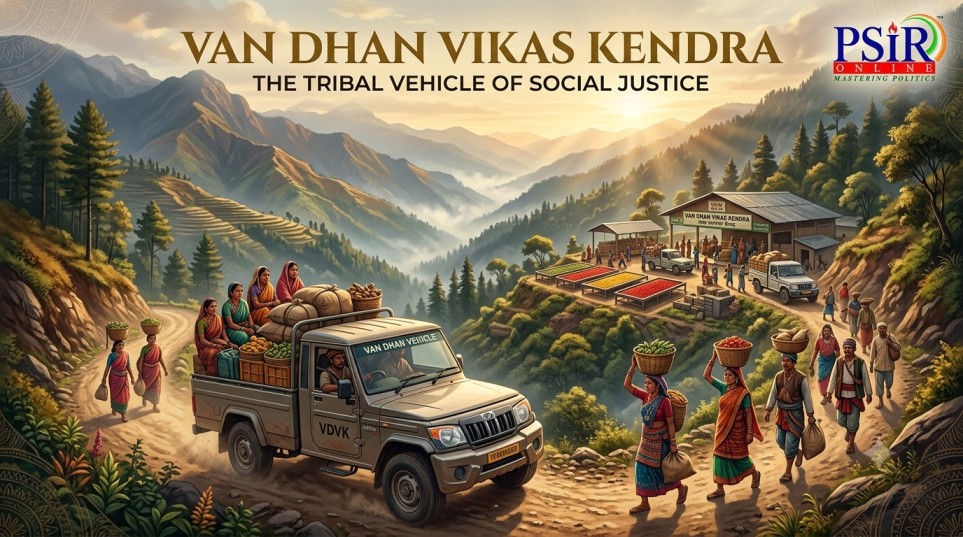
Under the Pradhan Mantri Van Dhan Yojana (PMVDY)—implemented by TRIFED (Ministry of Tribal Affairs)—the Van Dhan Vikas Kendra (VDVK) model solves the primary hurdle tribal gatherers face in high-altitude terrain: transporting raw, bulky Minor Forest Produce (MFP) across mountain trails where transport costs typically wipe out profits.
Core Structure of a VDVK Cluster
· Composition: 15 tribal Self-Help Groups (SHGs), each consisting of roughly 20 tribal gatherers/artisans, forming a single operational cluster of ~300 tribal members.
· Funding Grant: TRIFED provides a 100% centrally funded grant of ₹15 Lakhs per 300-member cluster.
· Focus Items in Mountain Regions: Large cardamom, wild honey, sea buckthorn, bay leaf (tezpatta), wild turmeric, ginger, bamboo shoots, and medicinal alpine herbs.
HOW THE VDVK MECHANISM SOLVES MOUNTAIN COMMUTATION & LOGISTICS
1. "Aggregation at the Ridge" (First-Mile Relief)
· The Problem: In rugged mountain pockets (such as Dzongu in Sikkim, Pangi in Himachal, or remote ridges in Arunachal), individual tribal gatherers historically had to trek on foot with 20–40 kg headloads to distant plains mandis.
· The VDVK Fix: The cluster establishes an aggregation depot in the tribal hamlet or Gram Panchayat building. Tribal collectors walk only short distances to drop produce at an assured local collection point operating under Minimum Support Price (MSP) benchmarks.
2. Earmarked Transport & Logistics Budget
· Out of the ₹15 Lakh cluster corpus, a specific allocation is set aside for procurement of tools, primary processing units, and transport logistics.
· Rather than each family hiring individual, expensive private mountain taxis, the cluster pools its operational capital to hire collective utility pickup vehicles (such as Mahindra Bolero Campers / 4x4 pickup trucks) on fixed schedules to move pooled harvests down to central nodal markets.
3. In-Situ Value Addition (Weight Reduction for Hill Transit)
· Transporting raw forest produce down mountains is economically inefficient due to high moisture content and bulk.
· VDVKs provide mechanical dryers, grading sieves, pulverizers, and vacuum sealers at the mountain base.
· Drying and primary processing reduces raw bulk by up to 60–70%, drastically cutting down headload transit fatigue and vehicle freight expenditures before downhill transport.
4. Forward Institutional Linkages (TRIFED & Tribes India)
· Once aggregated and packaged at the Kendra, TRIFED steps in through its regional logistics network.
· TRIFED links the VDVK directly to Tribes India retail outlets, e-commerce platforms, and central procurement depots, removing middleman transport contractors who exploit isolated tribal communities.
PRADHAN MANTRI VAN DHAN YOJANA (PMVD) VS TRIFED VS VAN DHAN VIKAS KENDRA (VDVK)
The distinction lies in their structural hierarchy: PMVDY is the government policy/scheme, TRIFED is the national implementing agency, and VDVK is the grassroots operational unit.


GEOGRAPHICAL COVERAGE OF VDVKS
Van Dhan Vikas Kendras (VDVKs) operate across 27 States and 1 Union Territory covering all major tribal and forested districts of India:
· Northeastern & Mountain States: Sikkim, Arunachal Pradesh, Assam, Meghalaya, Manipur, Mizoram, Nagaland, Tripura, Himachal Pradesh, and Uttarakhand.
· Central & Eastern Tribal Belt (Highest Concentration): Chhattisgarh, Madhya Pradesh, Jharkhand, Odisha, Maharashtra, and Andhra Pradesh.
· Western & Southern States: Rajasthan, Gujarat, Karnataka, Kerala, Tamil Nadu, and Telangana.
· Union Territory: Andaman & Nicobar Islands.
(Manipur, Nagaland, Chhattisgarh, and Maharashtra are consistently among the most active states in cluster sanctions and operationalization).
FUNDING PATTERN & STATE FINANCIAL CONTRIBUTION
1. 100% Centrally Funded Capital Grant
· Zero Mandated State Budget Share: Unlike typical Centrally Sponsored Schemes (CSS) that require a 60:40 or 90:10 Centre–State split, the core establishment grant of PMVDY is 100% funded by the Central Government through TRIFED (Ministry of Tribal Affairs).
· TRIFED transfers a direct grant of ₹15 Lakh per VDVK cluster (covering ~300 tribal members).
2. Community Equity (Beneficiary Contribution)
· There is a nominal contribution of ₹1,000 per tribal member (yielding ₹3 Lakh for the 300-member cluster).
· This is held directly by the cluster's managing committee as revolving working capital to build financial discipline and community ownership.
WHAT STATES ARE REQUIRED TO PROVIDE (NON-FINANCIAL & IN-KIND SUPPORT)
While states do not match the ₹15 Lakh capital grant, they bear the administrative and operational responsibilities:
· State Nodal Department (SND) & Implementing Agency (SIA): States designate a department (e.g., Tribal Development, Forest Department, or State Rural Livelihood Mission) and assign State Implementing Agencies (like TRICOR in Andhra Pradesh, TRIFED-state federations, or Forest Development Corporations) to oversee implementation.
· Physical Premises: Gram Panchayats and District Administrations must provide existing government premises, panchayat halls, or primary processing sheds rent-free for operating the VDVK.
· District Implementation Unit (DIU): District Collectors/Magistrates head the DIU to approve Annual MFP Gathering Plans, verify SHG lists, and monitor equipment procurement through the GeM portal.
· Scheme Convergence: States are expected to channel working capital and infrastructure top-ups by converging PMVDY with the National Rural Livelihood Mission (NRLM), District Mineral Foundation (DMF) funds, and Tribal Sub-Plan allocations.
GROUND-LEVEL SUCCESS OF VDVK
When evaluating the actual ground-level success of VDVKs as functional processing units, here is the zonal breakdown of how these ~300-member Kendra centers are genuinely performing versus sitting idle on paper:
1. North-East Zone: ~70–75% Functional & Revenue-Generating
· Operational Reality: This is the only zone where the physical VDVK unit functions as a self-sustaining micro-enterprise.
· Ground Performance:
o Manipur: Clusters like Senapati, Churachandpur, and Ukhrul set up functioning processing halls with operating machinery (mechanical dehydrators, pulp extractors, vacuum sealers). They moved beyond local sales, bottling wild amla juice, packaging king chilli powder, and creating shelf-stable brands that reached state capitals.
o Nagaland: VDVKs regularly process, grade, and package wild honey and dried wild ginger, holding periodic cluster accounts and sharing profits among SHG members.
· Why the Kendra units work here: Pre-existing village council structures took collective ownership of the physical premises, preventing machinery from gathering dust.
2. Central Zone: ~50–60% Operational (Tied to State Procurement)
· Operational Reality: Kendras function primarily during peak harvesting seasons as collection and basic de-seeding/grading hubs, but struggle to operate as year-round processing enterprises.
· Ground Performance:
o Chhattisgarh (Bastar, Dantewada): Physical Kendras operate successfully for high-volume, labor-intensive tasks—compacting tamarind cakes, decorticating chironji, and drying mahua flowers on elevated polythene beds.
o The Limitation: Most Kendras shut down once the government MSP procurement window closes. They function more like state buying depots than independent commercial factories.
o Madhya Pradesh: High rate of physical shed establishment, but advanced equipment (like oil expellers or honey filters) often remains underutilized due to irregular power supply and lack of machine maintenance technicians.
3. East Zone: ~35–45% Operational
· Operational Reality: Heavy drop-off between sanctioned Kendras and active processing machinery.
· Ground Performance:
o Odisha (Mayurbhanj, Rayagada): Functional success in hill-broom tying and packaging units, as well as tamarind processing. PVTG-operated Kendras show active community participation.
o Jharkhand: Severe ground lag. While funds were sanctioned, many Kendras face delays in procurement through the GeM portal. In numerous locations, members still sort raw lac and sal seeds manually on the ground rather than utilizing mechanical grading tables.
4. South Zone: ~30–40% Operational (Fragmented)
· Operational Reality: A few superstar Kendras run by established federations, while the rest remain dormant.
· Ground Performance:
o Andhra Pradesh (ITDA Paderu / Araku): High success where Kendras are integrated with the Girijan Cooperative Corporation (GCC). Coffee pulping, grading, and wild honey filtration units run with strict quality control.
o Tamil Nadu & Kerala (Jawadhu Hills, Wayanad): Kendras that were handed over to existing, well-trained women's federation buildings (like Kudumbashree or TNSRLM) successfully package honey and minor millets. However, independent stand-alone VDVK sheds without prior NGO/mission backing struggle with working capital and packaging inventory.
5. West Zone: ~25–35% Operational
· Operational Reality: The Kendras face stiff competition from private local traders and established agricultural APMCs.
· Ground Performance:
o Maharashtra (Gadchiroli, Melghat): Bamboo-craft Kendras and custard apple pulp-freezing centers have shown good seasonal margins where PESA Gram Sabhas take charge.
o Rajasthan & Gujarat: Many Kendra buildings struggle to source enough volume because private village traders offer cash-in-hand advances to gatherers at the forest edge, bypassing the Kendra's delayed bank-transfer process.
6. North Zone: Under 20% Operational
· Operational Reality: Severely stalled by terrain and extreme winters.
· Ground Performance:
o In Himachal Pradesh, J&K, and Uttarakhand, the physical Kendras have largely failed to scale. High-value produce like Gucchi (morel mushroom) or walnut is still sold directly to private contractors for quick cash. The infrastructure provided under the ₹15 Lakh grant (basic sheds, plastic crates, basic solar dryers) is inadequate to handle the sub-zero drying and storage needs of high-altitude belts.
CORE STRUCTURAL BOTTLENECKS AT THE KENDRA LEVEL
1. Working Capital Exhaustion: The Kendra's ₹15 Lakh grant covers machines, sheds, and training, leaving very little liquid cash to immediately pay gatherers for raw produce upon delivery. Gatherers return to local middlemen who pay hard cash immediately.
2. Electricity & Connectivity Deficits: Many rural Kendra sheds sit in deep forest fringes without three-phase power lines needed to run commercial grinders, pulpers, and sealers.
3. Packaging & Shelf-Life Barriers: Raw produce gets aggregated, but without proper moisture-barrier packaging, high humidity during monsoon causes spoilage inside the village storehouses before TRIFED picks it up.
HOW IT DELIVERS SOCIAL JUSTICE
The Van Dhan Vikas Kendra (VDVK) delivers social justice by changing who owns the tools, who controls the price, and who keeps the profit in the forest economy.
Historically, forest-dwelling Adivasis were legally recognized as owners of Minor Forest Produce (MFP) under the Forest Rights Act (FRA 2006) and PESA 1996, but remained economically exploited because they lacked physical aggregation points and processing technology. The VDVK serves as the physical institutional instrument that turns those legal rights into substantive economic and social power.
1. Structural Economic Justice: Dismantling Monopsony & Debt-Traps
· Breaking the "Sahukar-Moneylender" Chokehold: In the traditional system, non-tribal private traders and moneylenders (mahajans) held a local buying monopoly. They exploited gatherers via:
o Manipulated, faulty weighing scales.
o Unequal barter (trading cheap table salt or tobacco for high-value wild honey and medicinal roots).
o Tied-credit traps, where loans given during lean seasons forced gatherers to pledge their harvest at below-market rates.
· Aggregated Bargaining Power: A single tribal gatherer with a 15 kg basket has zero bargaining power. When 300 gatherers pool their harvest inside the Kendra depot, they control 5 to 10 metric tons of sorted, graded produce. They shift from price-takers to price-negotiators, setting terms anchored by the statutory floor of the Minimum Support Price (MSP) for MFP.
2. Redistributive Justice: Retaining the Value-Addition Margin
· Capturing the Supply-Chain Spread: In the unorganized trade, gatherers capture only 15–20% of the terminal retail price of raw produce. The rest is pocketed by urban processors and logistics middlemen.
· Village-Level Retention: Inside the VDVK processing shed, primary value addition happens locally:
o De-seeding and bricking wild tamarind.
o Cleaning, drying, and grading hill brooms.
o Dehydrating wild amla, ginger, and turmeric.
o Filtering and hygienic bottling of wild honey.
o Mechanical decortication of chironji and deshelling of nuts. By converting raw forest extract into a semi-finished or packaged consumer good inside the village, up to 60–70% of the terminal value stays within the tribal community.
3. Gender Justice: Direct Economic Agency for Tribal Women
· Formalizing Invisible Forest Labor: The gathering, drying, and carrying of headloads is overwhelmingly performed by tribal women. Traditionally, their labor was treated as uncompensated household work, while male heads of households or middlemen controlled the cash sales at weekly haats.
· SHG-Centric Leadership and Financial Inclusion: Every VDVK is built out of 15 federated women-dominated Self-Help Groups (SHGs).
o Women operate the machinery, run the weighing scales, and maintain the ledger.
o Payments for produce and processing wages are credited directly to individual women’s bank accounts via Direct Benefit Transfer (DBT).
o This shifts intra-household financial power, directly increasing household expenditure on children's nutrition, healthcare, and schooling.
4. Human Dignity & Overcoming Paternalism
· From "Relief Beneficiary" to "Enterprise Shareholder": Conventional tribal development policy historically treated Adivasi communities as passive targets for welfare rations. The VDVK model treats them as equity-holding micro-entrepreneurs:
o Each member contributes an equity stake (₹1,000) to build a collective revolving corpus.
o Members elect their own Kendra Management Committee to decide work shifts, procurement rates, and marketing avenues.
· Technological Democratization ("Tech for Tribals"): Tribal workers receive structured, institutional training in food hygiene, FSSAI quality parameters, digital weight-scale calibration, inventory management, and digital banking. It closes the historic knowledge gap that kept forest-dwellers alienated from mainstream commercial markets.
5. Ecological & Cultural Justice: Preserving Autonomy
· Validating Indigenous Knowledge Systems: Tribal gatherers possess empirical, intergenerational knowledge regarding non-destructive harvesting—such as cutting only ripe wild grass, leaving bee colonies intact during honey harvesting, and tapping gums without killing the tree. The VDVK structure incorporates and rewards this traditional ecological knowledge instead of discarding it for destructive industrial exploitation.
· Halting Coerced Distress Migration: The lack of income during non-harvest months routinely forces Adivasi families into seasonal distress migration to urban brick kilns, sugarcane fields, and hazardous informal construction sites, where they face acute social exclusion, bonded labor, and cultural alienation. Year-round value-addition and staggered inventory sales inside the Kendra keep families rooted in their ancestral lands with economic security.
Summary of the Structural Shift
|
Dimension |
Before the VDVK (Traditional Forest Economy) |
After the VDVK (Decentralized Community Hub) |
|
Market Status |
Individual gatherer selling raw produce in distress |
Co-owner of an aggregated 300-member rural micro-enterprise |
|
Price Determination |
Fixed arbitrarily by the private village middleman |
Anchored by MSP and collective auction power |
|
Processing Margins |
Exported entirely to urban wholesale traders |
Retained in the village through primary value-addition |
|
Labor of Women |
Invisible, uncounted, non-monetized headload labor |
Paid processing wages and direct digital profits to women’s accounts |
|
Social Relations |
Asymmetrical, dependent on seasonal moneylender credit |
Autonomous community asset ownership under Gram Sabha frameworks |
UPSC DIMENSION
|
UPSC Dimension |
How the Issue Connects With It |
|
Constitutional Justice & Directive Principles (Part IV) |
Operationalizes Article 46 (promotion of educational and economic interests of Scheduled Tribes and protecting them from social injustice and all forms of exploitation) and Article 39(b) & (c) by preventing wealth concentration among non-tribal intermediaries and ensuring fair distribution of material forest resources. |
|
Operationalizing Statutory Tribal Rights (FRA & PESA) |
Transforms paper rights under the Forest Rights Act (FRA), 2006 [Section 3(1)(c) right of ownership over Minor Forest Produce] and PESA Act, 1996 into substantive economic reality by giving Gram Sabhas and local clusters the physical capital and processing facilities to exercise control over bio-resources. |
|
Substantive Equality & Economic Justice (GS-II & GS-III) |
Moves beyond formal equality to substantive equality by eliminating asymmetric market exchange, monopsonistic exploitation by private moneylenders (mahajans), and distress selling through institutional price support (MSP for MFP) and localized value retention. |
|
Gender Empowerment & Intra-Household Equity (GS-I & GS-II) |
Formalizes and monetizes the unpaid, invisible forest labor of tribal women who constitute over 70% of gatherers. Direct Benefit Transfer (DBT) of sales and processing wages into women-led SHG bank accounts directly enhances intra-household decision-making and human development outcomes. |
|
Inclusive Growth & Micro-Enterprises (GS-III) |
Drives bottom-up industrialization by transitioning vulnerable primary gatherers from wage-laborers into equity-holding shareholders and micro-entrepreneurs under the TRIFED "Tech for Tribals" framework, fostering localized capital formation. |
|
Good Governance & Convergence Architecture (GS-II) |
Serves as a benchmark for multi-tier institutional federalism and scheme convergence, linking central bodies (TRIFED, Ministry of Tribal Affairs) with District Implementation Units (DIUs), Gram Panchayats, NRLM SHG federations, and PM-JANMAN interventions. |
|
Human Dignity & Prevention of Distress Migration (GS-I & GS-II) |
Protects the fundamental right to life with dignity (Article 21) by creating sustained, multi-seasonal non-farm forest livelihoods within native habitats, arresting seasonal distress migration to urban informal sectors, and preserving indigenous cultural autonomy. |
|
Ethics in Governance: Overcoming Paternalism (GS-IV) |
Exemplifies the ethical transition in administrative philosophy from welfare paternalism (treating tribal citizens as passive beneficiaries of state charity) to rights-based participatory agency (empowering them as autonomous economic managers of their common pool resources). |
WAY FORWARD
· Infusion of Revolving Working Capital: The central grant of ₹15 Lakh primarily covers infrastructure, equipment, and capacity building, leaving minimal liquid cash for seasonal procurement. State governments must establish dedicated revolving credit windows through District Mineral Foundation (DMF) funds and State Cooperative Banks so Kendras can pay gatherers upfront cash at harvest time.
· Overcoming Rural Utility & Cold-Chain Bottlenecks: To eliminate spoilage of perishable produce (e.g., wild amla, custard apple, bamboo shoots), state agencies must prioritize rural electrification (three-phase lines for commercial pulverizers/dryers) and deploy decentralized, solar-powered cold rooms at the cluster level.
· Institutional Off-Take & Market Convergence: Beyond sporadic exhibitions (Aadi Mahotsav) and TRIFED’s Tribes India stores, state procurement must mandate the off-take of VDVK products (such as millets, honey, and pulses) for Mid-Day Meal schemes, Anganwadi rations under POSHAN 2.0, and tribal residential schools (EMRS).
· Strengthening Gram Sabha Oversight: Align Kendra management firmly with the legal architecture of PESA (1996) and FRA (2006) to ensure that the Kendra remains an accountable community asset owned by the Gram Sabha rather than an outpost captured by local contractors.
CONCLUSION
The Van Dhan Vikas Kendra (VDVK) represents an ideological transition in India's developmental state—from welfare paternalism to rights-anchored economic agency. By translating nominal statutory ownership under FRA and PESA into tangible processing power, price discovery, and localized capital formation, the VDVK fundamentally alters the political economy of the forest. When supported with uninterrupted working capital, reliable infrastructure, and institutional market linkages, the Kendra stands as India’s most potent grassroots vehicle to deliver substantive social justice and dignified self-reliance (Atmanirbharta) to its forest-dwelling Adivasis.
RELATED READING
· Ministry of Tribal Affairs & TRIFED: Pradhan Mantri Janjati Vikas Mission (PMJVM) Operational Guidelines.
· Forest Rights Act (FRA), 2006: Section 3(1)(c) and the Institutional Realization of Minor Forest Produce (MFP) Rights.
· Xaxa Committee Report (2014): High-Level Committee on Socio-Economic, Health, and Educational Status of Tribal Communities of India.
· PESA Act, 1996: Empowerment of the Gram Sabha in Resource Ownership and Minor Forest Produce Trade.
· PM-JANMAN Framework: Special Interventions for Van Dhan Vikas Kendras in Particularly Vulnerable Tribal Group (PVTG) Habitations.
GS II MAINS PRACTICE QUESTIONS
1. "Van Dhan Vikas Kendras (VDVKs) bridge the gap between statutory rights and economic empowerment for tribal communities." Discuss. (10 Marks, 150 Words)
2. Examine the role of VDVKs in advancing gender justice and institutional agency among tribal women. (10 Marks, 150 Words)
3. "Transitioning from welfare paternalism to market-led entrepreneurship is vital for tribal development." In this context, evaluate the performance of VDVKs. (15 Marks, 250 Words)
4. Identify the key structural and logistical bottlenecks hindering the operational success of VDVKs. Suggest measures to strengthen them. (10 Marks, 150 Words)
