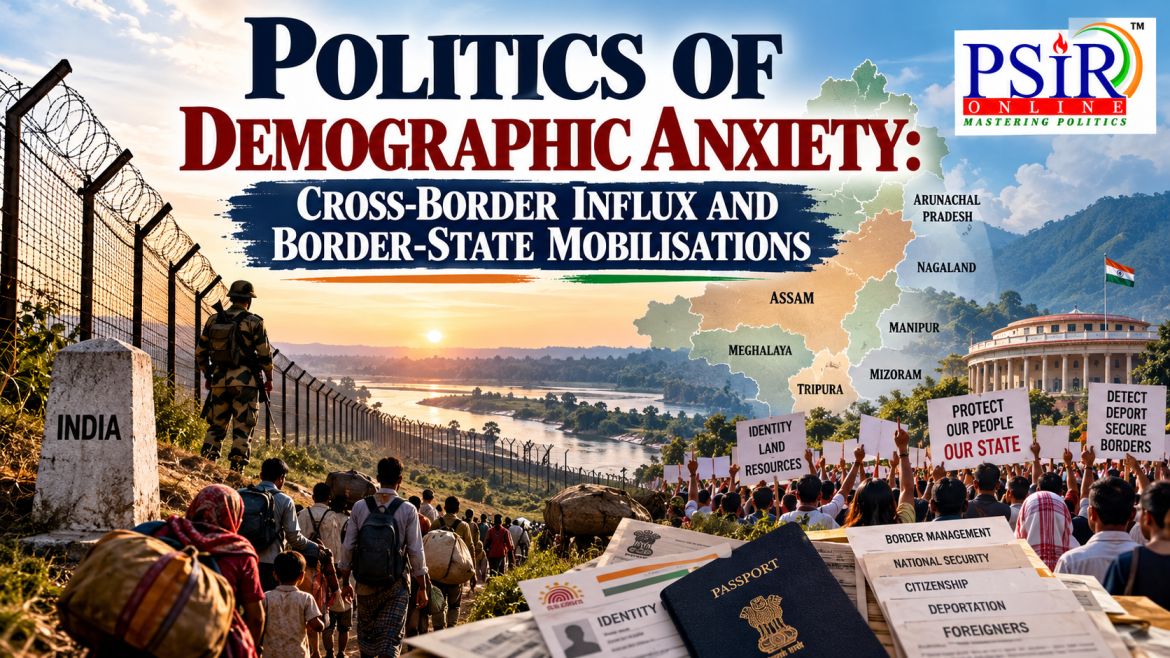
Cross-border migration into India has once again become one of the most volatile drivers of street-level politics, civil disobedience, and inter-party friction. Triggered by the continuous civil war in Myanmar and the seismic political transitions in Bangladesh, India’s borderlands—spanning the North East down through the Bengal delta—are experiencing heightened demographic anxieties.
Unlike conventional political agitations confined to institutional bargaining or labor disputes, contemporary border-state mobilisations operate as an existential contest over land, indigenous survival, electoral franchise, and constitutional categorization. The landscape is divided along two distinct operational axes: direct anti-migrant mobilisations spearheaded by regional student unions and indigenous civil fronts demanding physical exclusion, and defensive counter-mobilisations resisting administrative profiling and blanket deportations.
MANIPUR: CROSS-BORDER INFILTRATION AND THE BATTLE FOR THE 1951 NRC
In Manipur, the influx of Chin refugees fleeing Myanmar’s military junta since 2021 has directly intersected with the state's ongoing, deadly ethnic divide between valley-dwelling Meiteis and hill-dwelling Kuki-Zo populations. The issue of cross-border movement has become the central ideological narrative in the conflict.
· The Coordinating Committee on Manipur Integrity (COCOMI): Valley-based civil society bodies, led by COCOMI, have organized sustained street rallies, sit-ins, and ultimatums addressed to the Union Ministry of Home Affairs. COCOMI contends that undocumented cross-border migration from Myanmar has facilitated the mushrooming of unrecognized hill settlements, fueled cross-border poppy cultivation, and destabilized the demographic balance of the state. Their primary operational demand is an immediate statewide National Register of Citizens (NRC) verification with 1951 as the base year, paired with total physical border fencing and an end to all refugee accommodation.
· The Hill Counter-Stance and Census Boycott: In the surrounding hills, Naga platforms—including the All Naga Students’ Association, Manipur (ANSAM) and the United Naga Council (UNC)—alongside Kuki-Zo groups have articulated their own positions on demographic enumeration. Naga bodies have repeatedly warned against conducting any national census in Manipur until an empirical, audited identification of undocumented foreign entrants is carried out, arguing that an unverified headcount would legitimize recent demographic distortions.
· Policy Outcome: Mass civic mobilisations from valley organisations were instrumental in prompting the Union Government to scrap the Free Movement Regime (FMR)—which previously permitted border residents to move 16 km across either side without visas—and accelerate physical border fencing along the mountainous frontier.
MEGHALAYA: DIRECT CHECKPOINTS AND THE INNER LINE PERMIT AGITATION
In Meghalaya, mobilisation against external migrants has taken a direct, extra-parliamentary turn, focusing on preventing demographic spillover from Bangladesh and neighboring Assam.
· Khasi Students’ Union (KSU) Independent Checkpoints: Frustrated by protracted central delays in granting presidential assent for the Inner Line Permit (ILP) under the Bengal Eastern Frontier Regulation of 1873, the KSU established autonomous, vigilante-style inspection checkpoints along major transit highways, including National Highway 6 in the Ri-Bhoi district and transit corridors in East Jaintia Hills.
· Physical Interceptions and Street Action: Student volunteers physically halted commercial transport vehicles and long-distance buses, inspecting identification papers and turning back hundreds of inter-state and suspected cross-border workers lacking local administrative clearances. Subsequent police pushbacks and the filing of FIRs against student leaders sparked sit-ins outside the Meghalaya Secretariat in Shillong, where student platforms demanded the rigorous implementation of the Meghalaya Residents Safety and Security Act (MRSSA).
· Combined Pressure Fronts: Formations like the Federation of Khasi, Jaintia and Garo People (FKJGP) and the Hynniewtrep Youth Council (HYC) extended these verification drives into industrial estates and construction sites in Byrnihat and Umiam, issuing expulsion warnings to employers hiring unregistered non-local laborers.
ASSAM: THE CUT-OFF CONFLICT AND RIVERINE BORDER SURVEILLANCE
Assam’s anti-migrant politics remains rooted in the historical legacy of the six-year Assam Movement and the 1985 Assam Accord. However, recent mobilisations have focused on preventing the dilution of the historical citizenship cut-off date and securing vulnerable riverine entry points.
· All Assam Students’ Union (AASU) and the Assam Accord: AASU and allied regional platforms have organized statewide protests, sit-ins, and effigy-burning demonstrations across districts such as Nalbari, Sivasagar, Jorhat, and Kamrup. AASU’s primary grievance is directed at administrative notifications and the operationalization of the Citizenship (Amendment) Act (CAA) rules. The union argues that providing naturalisation pathways to post-1971 entrants nullifies the hard-won March 24, 1971 cut-off enshrined in Section 6A of the Citizenship Act, 1955, thereby threatening indigenous Assamese linguistic and cultural hegemony.
· Border Vigilance and Tribunal Expeditions: Concurrently, bodies such as the Asom Jatiya Parishad (AJP) and the Krishak Mukti Sangram Samiti (KMSS) have targeted human-trafficking transit networks through Guwahati. They continue to pressure the state government to accelerate proceedings across Foreigners Tribunals and step up pushbacks along the porous Brahmaputra and Barak riverine border corridors in Dhubri and Karimganj.
WEST BENGAL: PARTISAN CLEAVAGES AND LINGUISTIC COUNTER-MOBILISATION
Unlike the North Eastern states, where the movement against migration is led largely by non-partisan indigenous student bodies, the border dispute in West Bengal is split along sharp electoral and ethno-linguistic lines.
· Opposition Border Mobilisations: The state unit of the Bharatiya Janata Party (BJP), alongside affiliated border-area platforms, regularly stages demonstrations and rallies across key border districts like North 24 Parganas, Malda, Murshidabad, and Nadia. These protests—frequently organized near major land customs stations and border posts such as Petrapole and Hakimpur—allege continuous cross-border infiltration from Bangladesh, illegal ration-card racketeering, and local administrative complicity in altering the demographic composition of border constituencies.
· Bangla Pokkho and Linguistic Counter-Mobilisation: On the opposite end of the spectrum, ethno-linguistic rights organizations like Bangla Pokkho, backed broadly by the state's ruling apparatus, conduct sustained counter-mobilisations. Crucially, these groups do not mobilize to champion undocumented infiltration; rather, they resist what they define as aggressive, arbitrary profiling of genuine Bengali-speaking Indian citizens under the guise of anti-infiltrator drives. Bangla Pokkho stages demonstrations outside central agencies and railway hubs, contending that migrant Bengali manual laborers across the country and genuine border residents face systemic intimidation, wrongful detention, and disenfranchisement threats whenever NRC or Special Intensive Revision procedures are invoked.
PSIR THEORETICAL DIMENSION & EXAMINATION LINKAGES
|
PSIR Theoretical Dimension & Concepts |
How It Connects to Examination Answers |
|
Ethnic Security Dilemma & Defensive Mobilisation (Barry Posen; Donald Horowitz) |
Cross-Border Influx as an Existential Threat: Explains how statelessness, political breakdown, and armed turmoil across international frontiers (Myanmar, Bangladesh) trigger preemptive, defensive mobilisations by borderland communities. Groups perceive incoming demographic shifts as irreversible threats to indigenous land, linguistic preservation, and political hegemony. |
|
"Sons of the Soil" & Nativist Contestation (Myron Weiner; Paul R. Brass) |
Material and Spatial Exclusion: Weiner’s classic thesis accounts for direct street actions, road blockades, and highway checkpoints established by indigenous student unions (such as KSU in Meghalaya and AASU in Assam). Shows how rapid demographic movement transforms cultural identity into protectionist demands over local employment, administrative access, and spatial control. |
|
State Legibility, Borders & High Modernism (James C. Scott – Seeing Like a State) |
The Dilemma of the Bureaucratic Sieve: Analyzes state attempts to render fluid, historically porous frontier populations administratively legible through tools like the National Register of Citizens (NRC), biometrics, and border fencing. Demonstrates how bureaucratic standardisation clashes with organic trans-border kin networks and fluid regional geographies. |
|
National Sovereignty vs. Cosmopolitan Hospitality (Hannah Arendt; Seyla Benhabib – The Rights of Others) |
The "Right to Have Rights" in Peripheral Enclaves: Highlights the theoretical friction between Westphalian state sovereignty (the sovereign prerogative to control borders and enforce pushbacks) and cosmopolitan ethical duties owed to displaced persons and cross-border refugees escaping persecution. |
|
Majoritarian Hegemony vs. Vernacular Counter-Mobilisation (Antonio Gramsci; Partha Chatterjee – Politics of the Governed) |
Defensive Regional Sub-Nationalism: Explains why border-state mobilisations are not monolithic. In West Bengal, vernacular platforms (such as Bangla Pokkho) mount counter-mobilisations against central deportation rhetoric and intensive roll scrutinies, reframing pan-national security sweeps as administrative profiling of genuine linguistic citizens. |
|
Consociationalism & The Breakdown of Compromise (Arend Lijphart; Alfred Stepan) |
The Fragility of Asymmetric Accords: Evaluates the destabilisation of historic compromises (such as the 1985 Assam Accord and its March 24, 1971 cut-off date). Demonstrates how altering statutory naturalisation timelines without regional consensus fractures the delicate "holding together" federal compact in ethnically fragmented border polities. |
|
Internal Frontier Governance & "Durable Disorder" (Sanjib Baruah) |
The Borderland as an Exceptional Space: Applies Baruah’s concept of institutionalised friction to the North East. Illustrates how the co-existence of special regimes (Inner Line Permit, Sixth Schedule, revoked Free Movement Regime) produces a chronic condition of contested citizenship and endemic civil mobilisation. |
|
Substantive Democracy vs. Demographic Majoritarianism (Hannah Pitkin – Concept of Representation; Will Kymlicka) |
Demographic redistricting and Representation: Links indigenous demands for the 1951 NRC baseline and census boycotts in Manipur to anxieties over electoral dilution. Shows how unfettered cross-border settlement is viewed as distorting democratic representation and turning native populations into political minorities within their own homelands. |
CONCLUSION
The resurgence of cross-border mobilisations along India’s frontiers reveals an enduring constitutional and governance challenge: reconciling national sovereignty and border enforcement with local sub-national anxieties and civil rights.
In the North East, indigenous groups view demographic change as an existential threat to land, political representation, and ethnic survival, prompting direct street actions such as autonomous highway checkpoints and demands for an updated NRC. In West Bengal, the debate has transformed into a polarized electoral battleground, where demands for national security and border sealing clash directly with vernacular assertions against administrative profiling.
As geopolitical volatility along the Myanmar and Bangladesh borders persists, managing these porous frontiers will require more than paramilitary force; it requires transparent, institutional mechanisms that defend the territorial integrity of the republic without compromising the constitutional protections of legitimate borderland communities.
RELATED READING & ANALYTICAL ANGLES
Constitutional Provisions & Statutory Enactments
· Articles 5 to 11 (Part II - Citizenship): The constitutional baseline governing citizenship at the commencement of the republic, and the plenary power of Parliament under Article 11 to regulate naturalisation, rights, and termination.
· Section 6A of the Citizenship Act, 1955: The statutory codification of the historic Assam Accord establishing the March 24, 1971 cut-off date, and its constitutional affirmation by the Supreme Court.
· The Foreigners Act, 1946 & Foreigners (Tribunals) Order, 1964: The legal architecture empowering executive pushbacks, burden of proof standards (Section 9), and quasi-judicial determination of undocumented status.
· The Bengal Eastern Frontier Regulation, 1873 (BEFR): The statutory instrument governing the Inner Line Permit (ILP) system designed to protect indigenous tribal peripheries from demographic swamping.
· Seventh Schedule (Union List, Entries 17, 18 & 19): Exclusive parliamentary jurisdiction over citizenship, naturalisation, aliens, admission into, and emigration/expulsion from India.
Key Conceptual & Analytical Angles for Examination Prep
· From Humanitarian Affinity to Ethnic Panic: Trace how trans-border ethnic kinship (e.g., Kuki-Zo-Chin affinities across the Indo-Myanmar border) initially enabled refugee accommodation, but eventually triggered valley-hill polarization, calls for NRC, and the revocation of the Free Movement Regime (FMR).
· The Two Faces of Frontier Mobilisation: Contrast the indigenous exclusionary mobilisations in the North East (demanding the physical sealing of borders, ILP, and accelerated pushbacks) with linguistic defense counter-mobilisations in West Bengal (resisting voter profiling and administrative harassment of Bengali-speaking citizens).
· State Legibility vs. Informal Reality: Examine how high-modernist surveillance measures—border fencing, biometrics capture, and intensive roll revisions—encounter physical terrain hurdles (riverine boundaries in Dhubri/Nadia) and political friction over documentation poverty.
PRACTICE QUESTIONS FOR PSIR
