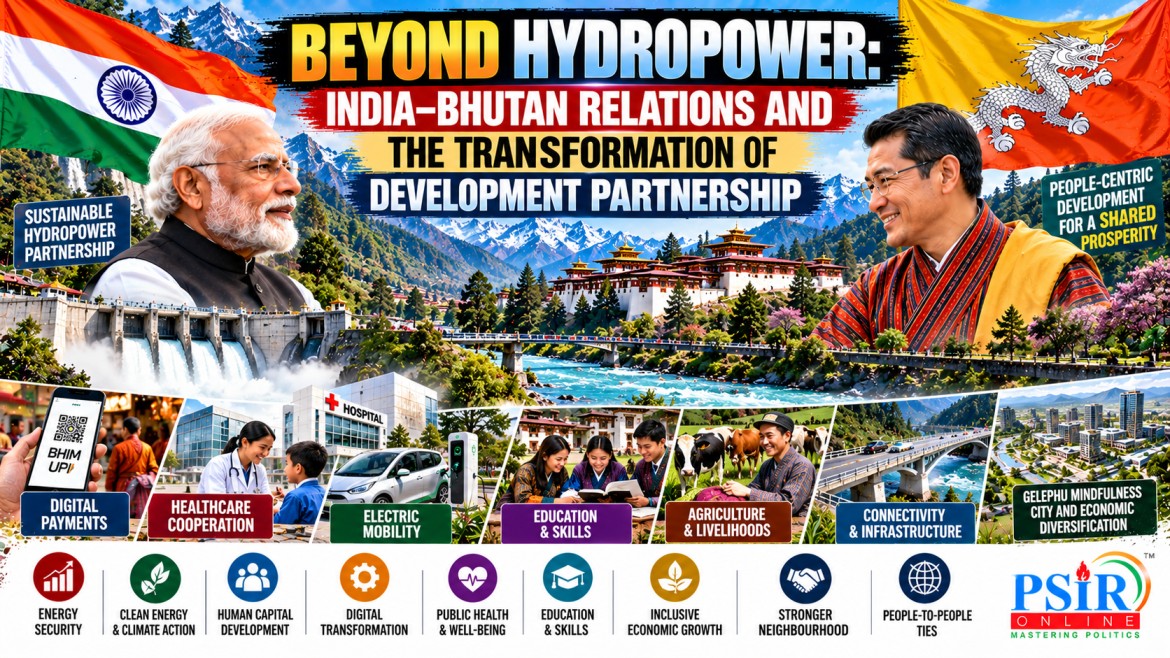
India–Bhutan relations represent one of South Asia’s most distinctive bilateral partnerships, built on geographical proximity, historical ties, mutual trust, economic interdependence and sustained development cooperation. For decades, hydropower has been the most visible expression of this relationship. Joint electricity projects have generated export earnings for Bhutan, supported India’s energy requirements and created a durable framework for economic cooperation.
However, the relationship is increasingly extending beyond dams, electricity generation and infrastructure finance. Cooperation in healthcare, electric mobility, education, digital connectivity, agriculture, skills and regional connectivity reflects a wider understanding of development partnership. The objective is not to replace hydropower, but to connect it with the broader transformation of Bhutan’s economy and society.
The September 2026 visit of External Affairs Minister S. Jaishankar to Bhutan illustrated this evolution. Initiatives included the inauguration of a mother-and-child hospital, the handover of electric vehicles, a highway bridge, agricultural cooperation and progress on renewable energy. These developments placed public services and community-level outcomes alongside established energy cooperation.
The broader significance lies in the changing character of India’s neighbourhood diplomacy. Development partnership is increasingly measured not only by the infrastructure constructed or the financial assistance provided, but also by its contribution to human capabilities, institutional capacity and everyday public services. The India–Bhutan relationship offers an important case study of how a longstanding strategic partnership can evolve while preserving mutual trust and respect for the priorities of the smaller partner.
THE SEPTEMBER 2026 VISIT: DEVELOPMENT PARTNERSHIP IN PRACTICE
Jaishankar visited Bhutan from 16 to 18 September 2026 at the invitation of Bhutan’s Foreign Minister and External Trade Minister. He met the King of Bhutan, Jigme Khesar Namgyel Wangchuck, and Prime Minister Tshering Tobgay, while holding discussions with Foreign Minister D. N. Dhungyel in Bumthang.
The visit reviewed bilateral cooperation and reaffirmed India’s support for Bhutan’s development priorities under its Thirteenth Five-Year Plan for 2024–29. Several initiatives demonstrated the breadth of the partnership.
The inauguration of the 65-bedded Gyaltsuen Jetsun Pema Mother and Child Hospital in Mongar highlighted cooperation in healthcare infrastructure. The transfer of 54 electric vehicles to the Royal Government of Bhutan connected bilateral engagement with sustainable mobility. The inauguration of the Jaganathan Bridge on the Samdrup Jongkhar–Trashigang Highway supported physical connectivity in eastern Bhutan.
Agricultural cooperation was reflected in the transfer of 43 Jersey cows to Bhutan’s National Cattle Breeding Centre in Bumthang. The visit also included the foundation-stone laying for the 500 kW Lunana hydropower project. These initiatives ranged from specialised public services and rural livelihoods to transport infrastructure and renewable energy.
|
Initiative |
Development significance |
|
65-bedded mother-and-child hospital in Mongar |
Strengthens healthcare infrastructure and maternal and child health services |
|
Handover of 54 electric vehicles |
Supports cleaner mobility and public-sector transport modernisation |
|
Jaganathan Bridge |
Improves transport connectivity along an important eastern Bhutan highway |
|
Transfer of 43 Jersey cows |
Supports livestock development and agricultural productivity |
|
Lunana 500 kW hydropower project |
Extends energy cooperation to a smaller-scale renewable energy initiative |
|
Cooperation on Gelephu Mindfulness City |
Connects bilateral engagement with Bhutan’s long-term economic transformation |
These measures are significant because they illustrate different dimensions of development. A hospital addresses public-service capacity; a bridge supports mobility and access; agricultural cooperation can strengthen livelihoods; and electric vehicles connect infrastructure policy with environmental objectives.
The visit therefore demonstrated a multi-sectoral development partnership rather than a departure from the established relationship. Hydropower remains central, but it increasingly operates alongside initiatives directed towards people, communities and economic diversification.
HYDROPOWER: THE ENDURING FOUNDATION OF BILATERAL INTERDEPENDENCE
Hydropower remains the economic backbone of India–Bhutan cooperation. Bhutan’s mountainous terrain and river systems provide substantial hydroelectric potential, while India offers a large electricity market, financing, technical capabilities and access to transmission infrastructure.
The two countries have jointly developed major hydropower projects, including Chukha, Kurichhu, Tala, Mangdechhu and Punatsangchhu-II. The 1,020 MW Punatsangchhu-II project was inaugurated in November 2025 and began exporting surplus electricity to India in September 2025. Work on the 1,200 MW Punatsangchhu-I project has also progressed, with dam construction resuming in 2026.
For Bhutan, electricity exports generate revenue, support public investment and provide opportunities to develop technical expertise. For India, cross-border electricity trade contributes to energy security and regional power integration. The partnership also illustrates how shared infrastructure can create continuing economic incentives for cooperation.
Yet hydropower creates challenges alongside benefits. Large projects require substantial upfront investment, long construction periods and careful environmental and geological assessment. Delays can increase costs and postpone expected revenue. Electricity generation may fluctuate seasonally, while Bhutan’s domestic demand and winter energy requirements complicate the balance between exports and imports.
The two countries have consequently sought to broaden energy cooperation. Their 2024 Joint Vision on Energy Partnership envisaged collaboration in hydropower, solar energy, green hydrogen, energy efficiency and cross-border electricity trade. In April 2026, they also advanced institutional arrangements concerning hydropower tariffs and the accounting of reactive energy in electricity exchanges.
The strategic objective should be to strengthen the entire energy ecosystem rather than rely exclusively on large hydroelectric projects. Solar energy, grid modernisation, energy storage, transmission infrastructure and technical training can complement hydropower and help Bhutan manage changing energy requirements.
Hydropower should remain a foundation of the partnership, but not its sole economic foundation. A broader energy relationship can strengthen resilience, create new technical capabilities and support Bhutan’s efforts to diversify its economy.
FROM INFRASTRUCTURE TO HUMAN DEVELOPMENT
The September visit highlighted a wider conception of development cooperation in which infrastructure is connected to public welfare and human capabilities.
Healthcare is a particularly important area. The mother-and-child hospital in Mongar illustrates how bilateral cooperation can strengthen access to specialised services beyond major urban centres. Its long-term contribution will depend on staffing, medical equipment, referral networks, medicine supply and sustainable operating arrangements. Infrastructure is necessary, but service quality ultimately depends on the health system surrounding the facility.
Education and skills development are equally important. Bhutan’s economic diversification requires professionals and technicians capable of working in information technology, tourism, clean energy, healthcare, advanced agriculture and emerging industries. Cooperation in higher education, vocational training, research and digital skills can support this transition.
Digital public infrastructure offers another avenue for partnership. Digital payments, interoperable systems, secure identity-related services and online public administration can reduce transaction costs and improve access to services. However, such cooperation must be adapted to Bhutan’s institutional and social context, with attention to cybersecurity, data protection, digital inclusion and local capacity.
Agricultural cooperation also connects development diplomacy with rural livelihoods. The transfer of Jersey cattle can contribute to livestock improvement, but productivity gains depend on veterinary services, feed availability, breeding support, market access and farmer training. The broader lesson is that the transfer of equipment, animals or technology must be accompanied by the institutional capacity needed to use them effectively.
Electric mobility illustrates how development priorities can intersect with environmental sustainability. The handover of 54 electric vehicles can support public-sector transport modernisation, but long-term benefits will depend on charging infrastructure, maintenance, electricity availability and lifecycle costs.
Together, these initiatives show how India’s engagement can contribute to human-capital formation, service delivery and productive capacity, rather than being defined only by the construction of major physical assets.
ECONOMIC DIVERSIFICATION AND THE GELEPHU MINDFULNESS CITY VISION
Bhutan is pursuing a development trajectory that seeks to expand economic opportunities while retaining its distinctive approach to environmental protection and well-being. Its emphasis on Gross National Happiness, ecological sustainability and social welfare creates a particular framework for economic modernisation.
The proposed Gelephu Mindfulness City is an important element of this vision. Located in southern Bhutan near the Indian border, it is intended to become a new centre for investment, employment and economic activity. Its development could create opportunities in services, logistics, technology, education, healthcare and sustainable business, although the scale and timing of these outcomes will depend on implementation.
India’s role is significant because connectivity with neighbouring Indian states can affect the city’s commercial viability. Roads, transport links, border facilities, reliable energy and streamlined movement of people and goods could support access to larger markets. During the September visit, both sides reaffirmed cooperation related to Gelephu, including India’s commitment to establish an immigration check post at Hatisar in Assam.
This cooperation demonstrates the connection between domestic development planning and international partnership. Gelephu’s success will depend not only on capital investment, but also on regulatory arrangements, environmental safeguards, skilled labour, access to markets and the ability to attract sustainable economic activity.
India can contribute through infrastructure, technical cooperation, investment and connectivity while allowing Bhutan to determine the city’s priorities and institutional arrangements. Such an approach would support Bhutan’s economic ambitions without reducing the initiative to an external strategic project.
Diversification is important for Bhutan because an economy heavily dependent on hydropower and a limited number of sectors can be vulnerable to project delays, fluctuating demand and changing market conditions. Expanding tourism, technology, agriculture, education and services can create employment and broaden the domestic economic base.
The broader objective is to connect cross-border connectivity with Bhutan’s own development strategy. India’s contribution will be most sustainable when it strengthens Bhutan’s capacity to generate employment, develop institutions and participate more effectively in regional economic networks.
ASYMMETRIC INTERDEPENDENCE, SOVEREIGNTY AND MUTUAL TRUST
India is substantially larger than Bhutan in population, economic scale, industrial capacity and international influence. This asymmetry shapes their relationship, but it does not automatically determine its political character. The durability of India–Bhutan cooperation rests on the management of differences through consultation, trust and respect for Bhutan’s development priorities.
Asymmetric interdependence can generate both benefits and vulnerabilities. Bhutan benefits from access to the Indian market, development assistance, energy cooperation, connectivity and technical expertise. India gains from a stable neighbourhood, cross-border economic integration, energy cooperation and a relationship grounded in longstanding political trust.
However, the smaller partner may face vulnerabilities arising from concentration in particular markets, sectors or infrastructure relationships. Hydropower dependence, for example, makes project financing, electricity pricing, transmission arrangements and access to markets especially important. A sustainable partnership must therefore consider the distribution of benefits, risks and decision-making capacity.
Development cooperation is most effective when it is aligned with Bhutan’s own priorities. This principle is reflected in India’s support for Bhutan’s Five-Year Plans and its mix of major infrastructure projects and smaller community development initiatives. Such an approach can help ensure that cooperation responds to national and local requirements rather than relying exclusively on externally defined priorities.
Mutual trust also requires predictable implementation. Delays in infrastructure projects, administrative barriers and insufficient consultation can weaken the practical value of commitments. Regular dialogue, transparent financing arrangements and joint monitoring can help address these issues.
India must also recognise that Bhutan’s foreign policy and economic strategy reflect its own national interests. Supporting Bhutan’s economic diversification and institutional capacity is not inconsistent with India’s strategic interests; it can strengthen the resilience of the relationship.
The essential principle is that asymmetry need not produce domination when interdependence is managed through consultation, reciprocity and respect for sovereignty. Development partnership becomes more durable when it expands the smaller partner’s capabilities and choices.
THE WAY FORWARD: BUILDING A BROADER DEVELOPMENT PARTNERSHIP
The next phase of India–Bhutan relations should preserve the strengths of hydropower cooperation while expanding the range of sectors that contribute to economic and social development.
First, energy cooperation should become more diversified. Hydropower can be complemented by solar energy, grid modernisation, storage, energy efficiency and green hydrogen research where economically viable. Better planning for seasonal electricity demand and export arrangements can strengthen the resilience of both energy systems.
Second, human-development initiatives should focus on long-term outcomes. Healthcare projects require trained staff, maintenance and reliable supplies; education cooperation should connect training with employment and research; and agricultural initiatives should incorporate extension services, veterinary support and access to markets.
Third, digital cooperation should be based on interoperability, security and local capacity. Digital payments and public-service platforms can simplify transactions, but their success depends on reliable connectivity, user trust, accessible design and safeguards against cyber risks.
Fourth, connectivity should be planned as a system. Roads, bridges, border facilities, customs procedures and logistics networks should complement one another. This is especially relevant to Gelephu and other cross-border economic initiatives, where the movement of goods, people and investment is central to viability.
Fifth, Bhutan’s private sector and local communities should participate meaningfully in development projects. Local employment, skills transfer, domestic supplier development and opportunities for Bhutanese enterprises can help ensure that large projects generate benefits beyond construction and electricity revenue.
Finally, development cooperation should be evaluated through measurable outcomes. The assessment of projects should include service accessibility, employment, local value addition, environmental effects, financial sustainability and the distribution of benefits. This would shift attention from the number of projects announced towards the quality of development they deliver.
|
Priority |
Practical direction |
Expected contribution |
|
Energy diversification |
Combine hydropower with suitable solar, grid and efficiency initiatives |
Greater energy resilience and technical capacity |
|
Healthcare |
Strengthen staffing, maintenance, referral systems and medical supply chains |
More reliable public-health outcomes |
|
Education and skills |
Expand technical training, research and employment-linked cooperation |
Stronger human capital and economic diversification |
|
Digital connectivity |
Support secure and interoperable public-service and payment systems |
Improved access and lower transaction costs |
|
Cross-border infrastructure |
Coordinate roads, bridges, border facilities and trade procedures |
Better connectivity and regional economic integration |
|
Local economic participation |
Develop domestic suppliers, entrepreneurship and skills transfer |
More inclusive and sustainable development |
|
Project accountability |
Monitor costs, delivery, environmental impacts and social outcomes |
Greater transparency and long-term effectiveness |
The purpose is not to abandon the established model, but to broaden it. A partnership built on energy, connectivity, human development and institutional cooperation can respond more effectively to Bhutan’s changing economic priorities.
THEORETICAL ANGLES
|
Theory or concept |
Application to India–Bhutan relations |
|
Neighbourhood First |
India’s engagement with Bhutan reflects the importance of stable neighbouring relationships, connectivity and development cooperation in regional policy. |
|
Asymmetric Interdependence |
Differences in economic scale create both mutual benefits and vulnerabilities, making consultation, predictability and respect for sovereignty essential. |
|
Soft Power |
Healthcare, education, skills, cultural ties and public-service cooperation can strengthen goodwill and the attractiveness of the bilateral partnership. |
|
Development Diplomacy |
Infrastructure finance, technical assistance and human-development projects connect foreign policy with socioeconomic transformation. |
|
Complex Interdependence |
Energy, trade, mobility, technology and people-to-people relations create multiple channels of cooperation beyond traditional security engagement. |
|
Human Security |
Healthcare, livelihoods, education, mobility and reliable public services broaden the meaning of security beyond territorial defence. |
|
Sustainable Development |
Renewable energy, electric mobility, environmental protection and economic diversification link bilateral cooperation with long-term ecological and social objectives. |
CONCLUSION
India–Bhutan relations are evolving from a partnership widely identified with hydropower and infrastructure towards a broader framework encompassing healthcare, education, digital connectivity, electric mobility, agriculture and economic diversification. The September 2026 visit demonstrated this transition through concrete initiatives that linked bilateral cooperation with public services and community-level development.
Hydropower will continue to play a central role because it generates economic benefits for both countries and supports regional energy cooperation. However, a more diversified partnership can strengthen Bhutan’s human capital, reduce concentration in a limited number of economic sectors and expand opportunities for employment and innovation.
For India, the relationship illustrates how neighbourhood diplomacy can create lasting influence through reliable delivery, consultation and respect for the priorities of partner countries. For Bhutan, cooperation can support its ambition to broaden its economic base while maintaining its distinctive development philosophy.
The long-term success of the partnership will depend on implementation, institutional capacity and the distribution of benefits. The future of India–Bhutan relations lies not in moving beyond hydropower itself, but in ensuring that hydropower becomes one pillar of a wider partnership centred on people, capabilities and sustainable development.
RELATED READING
PRACTISE QUESTIONS FOR GS2 MAINS
PRACTISE QUESTIONS FOR PSIR
