INTRODUCTION: CAN A DIGITAL WELFARE STATE LISTEN TO THE VILLAGE?
Haryana has built a highly digitised welfare-delivery architecture around the Parivar Pehchan Patra (PPP). The Family ID functions as a common database through which government schemes and services can identify households and determine eligibility. Haryana's own systems describe PPP as a verified family database, while several welfare programmes are directly linked to it.
But a central database has an inherent limitation: a household can change faster than a database can detect it. Income may fall. A family may split. An elderly dependent may be added. A house may deteriorate. Employment may disappear. A family classified as eligible may actually be relatively well-off, while a genuinely vulnerable household may remain incorrectly classified.
This is where Haryana's Gram Sabha-Based Verification Module becomes significant. It represents an important shift: From government knowing the household through data to government verifying the household through the community.
PPP: THE DIGITAL BACKBONE OF HARYANA’S WELFARE STATE
The Parivar Pehchan Patra (PPP) provides Haryana with a unified family-level identity and database. The objective is to maintain reliable information on families and use that information for more efficient delivery of government services and benefits.
This architecture enables Haryana to move towards:
· automatic identification of eligible beneficiaries;
· proactive delivery of services;
· reduction of repeated documentation;
· integration of family-level information;
· quicker updating of birth, death and marriage-related records; and
· more targeted welfare delivery.
The state's pro-active service model already demonstrates this approach: eligible senior citizens can be identified from government data and their information pushed to the Social Justice Department, reducing the need for them to repeatedly visit government offices. Thus, PPP is not merely an identity document. It is increasingly becoming the data infrastructure through which Haryana delivers social protection.
KEY PARAMETERS VERIFIED
The module focuses on structural socio-economic indicators that determine scheme eligibility:
· Household Composition & Demographics: Verifying genuine family splitting or merging. Families often split PPP cards artificially to show lower per-capita income to qualify for BPL (Below Poverty Line) thresholds, or conversely, real dependents (orphans, elderly, widows) are left off records.
· Actual Income Status: Re-verifying self-declared income brackets against visible local living conditions, correcting arbitrary bureaucratic entries that previously pushed deserving rural families over the ₹1.80 lakh/year BPL cutoff.
· Antyodaya Anna Yojana (AAY) Targeting: Pinpointing the "poorest of the poor" (families earning under ₹1 lakh annually, terminally ill heads of households, or single-earner elderly) to prioritize subsidized food grains under the National Food Security Act (NFSA).
· Kutcha-House Status: Physical ground validation of dwelling conditions (mud walls, thatch/tin roofs, or houselessness) to prepare authentic beneficiary priority lists for rural housing schemes like Pradhan Mantri Awas Yojana - Gramin (PMAY-G).
· Occupation & Employment Reality: Distinguishing between agricultural laborers, gig/daily-wage workers, and salaried or small-business owners.
HOW THE GROUND VERIFICATION MECHANISM WORKS

1. Generation of Pre-Populated Lists: The state IT department pushes draft beneficiary lists down to the village level through the digital portal.
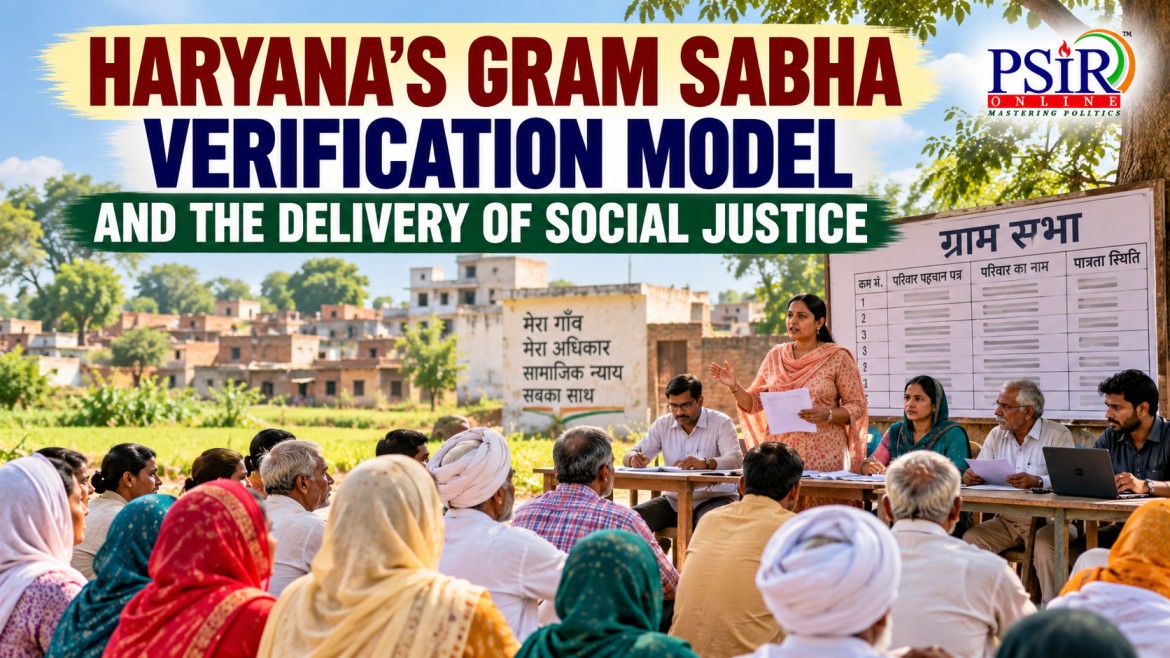
2. Open Social Audit: The lists are read out during an open Gram Sabha meeting attended by village residents, ward panches, the Sarpanch, and the Gram Sachiv (Panchayat Secretary).
3. Public Scrutiny (Peer Verification): In a village setting, community members readily know whose house is actually kutcha, who owns four-wheelers, or whose family members have secured formal government/private jobs.
4. Correction and Resolution: Objections, exclusions, and fraudulent inclusions are recorded in the Gram Sabha register, ratified through a formal Panchayat resolution, and fed back into the module to update the family repository.
WHY IT MATTERS: POLICY & PRACTICAL IMPLICATIONS
· Eliminating Digital Exclusion: Algorithms often flag rural families as ineligible based on minor anomalies—such as a single high electricity bill in a summer month or shared ancestral farmland. Gram Sabha verification allows genuine families to clear their names without running around government offices.
· Weeding Out Ghost & Ineligible Beneficiaries: Better-off households frequently conceal informal business income or omit urban assets to retain ration cards, free health cover (Chirayu/Ayushman Bharat), and housing grants. Peer scrutiny serves as an effective deterrent against misrepresentation.
· Constitutional Decentralization: It operationalizes the core intent of the 73rd Constitutional Amendment Act, empowering Panchayati Raj Institutions (PRIs) with functional authority over social sector expenditures rather than reducing them to rubber stamps.
· Targeted Budgetary Efficiency: By ensuring that limited fiscal resources (subsidies, direct benefit transfers, free food rations) reach actual bottom-of-the-pyramid households, the state prevents welfare leakage and fiscal waste.
SOCIAL JUSTICE DELIVERY: INCLUSION AND EXCLUSION
The ultimate test of a welfare system is not how sophisticated its database is. It is: Who gets included, who gets excluded, and why? The Gram Sabha mechanism can potentially address both sides.
Preventing wrongful exclusion: A genuinely vulnerable household incorrectly classified as ineligible can have its circumstances publicly examined and corrected.
Preventing wrongful inclusion: A relatively better-off household incorrectly receiving benefits can also be identified through community scrutiny.
Thus, the objective is not simply to increase the number of beneficiaries. It is to improve the accuracy of social justice delivery.
THE HARYANA MODEL AND THE 73RD CONSTITUTIONAL AMENDMENT
The model also has a constitutional dimension. The 73rd Constitutional Amendment envisaged the Gram Sabha as an institution of grassroots democratic participation. Haryana's verification mechanism gives this institution a practical role in welfare governance. The Gram Sabha is therefore not merely discussing village development works; it can become part of the process through which the State establishes who is socially and economically vulnerable. This raises a larger question of decentralisation:
Can welfare identification itself be decentralised?
Haryana's experiment provides an important policy answer: digital centralisation of information can coexist with democratic decentralisation of verification.
LIMITATIONS AND CHALLENGES OF THIS APPROACH
While Gram Sabha-based verification integrates grassroots democracy with digital databases, relying on open village assemblies to verify income, assets, and welfare eligibility faces several structural, social, and administrative constraints.
1. Village Power Dynamics and Elite Capture
· Caste and Class Hierarchies: Rural societies remain stratified. Lower-income, marginalized communities (especially Scheduled Castes and landless laborers) often lack the voice or social capital to challenge wrongful inclusions claimed by dominant land-owning castes or local elites.
· Patronage and Vote-Bank Politics: Sarpanches and Ward Panches are elected representatives who face political disincentives to cut ineligible voters from welfare rolls. Approving affluent local supporters or turning a blind eye to inflated claims frequently supersedes objective verification.
2. Social Friction and the "Whistleblower Dilemma"
· Community Cohesion vs. Public Scrutiny: Publicly objecting to a neighbor's BPL or AAY status causes immediate interpersonal and clan conflict. Few villagers are willing to invite long-term social hostility, retaliation, or boycott simply to protect the state exchequer.
· Omertà on Underreported Income: Because multiple households may hold unrecorded assets or informal income, there is often a tacit, mutual agreement among residents not to challenge one another during public readings.
3. Chronic Quorum Deficits and Low Participation
· Low Attendance: Genuine Gram Sabha quorums are notoriously difficult to achieve. Most working-age adults, daily-wage laborers, and migrant workers cannot afford to forfeit a day's wage to attend an assembly.
· Underrepresentation of Vulnerable Groups: Women, elderly single women, and persons with disabilities (Divyangjan)—who are the primary intended beneficiaries of social security nets—are routinely underrepresented in Gram Sabha discussions.
· Proxy Representation: Male relatives frequently attend meetings on behalf of elected female representatives (Sarpanch Pati culture), sidelining genuine gender-specific scrutiny of household needs.
4. Digital–Physical Friction (The Last-Mile Interface)
· Administrative Bottlenecks: The module depends heavily on the Gram Sachiv (Panchayat Secretary) or local village-level operators (VLEs) to upload verified records. A single Gram Sachiv often handles multiple Gram Panchayats, causing data entry backlogs.
· Data Overwrite Conflicts: When Gram Sabha resolutions contradict the state’s automated digital registries (e.g., electricity utility data, vehicle registration databases, or bank PAN linkages in the PPP), bureaucratic protocols frequently default to algorithmic flags over manual Gram Sabha resolutions, rendering local decisions toothless.
· Connectivity and Portal Glitches: Rural internet instability and portal freezes during synchronized state-wide Gram Sabha sessions slow real-time objection recording.
5. Subjectivity in Economic Assessment
· Informal and Volatile Incomes: Unlike salaried employees, rural incomes fluctuate sharply due to crop failures, erratic monsoons, or seasonal labor. Gram Sabhas lack standard accounting tools to calculate annual earnings accurately, leading to subjective guesswork.
· Kutcha vs. Pucca Ambiguity: Defining what constitutes an inadequate dwelling creates local disputes. A family with an inherited, dilapidated brick structure may be classified as "pucca" despite facing acute deprivation, while families with modern amenities inside an older mud-roof shell may claim "kutcha" status.
6. Weak Grievance Redressal and Post-Assembly Tampering
· Resolution Alteration: Resolutions passed during open meetings can be modified before final digital submission if local functionaries collude with influential families.
· Opaque Appellate Tracks: When an excluded family wants to appeal a Gram Sabha consensus, the bureaucratic recourse (running between the Block Development and Panchayat Officer [BDPO] and Additional Deputy Commissioner [ADC] offices) remains cumbersome, defeating the objective of decentralized justice.
UPSC DIMENSION
|
Dimension |
How to use it in a UPSC answer |
|
Constitutional – Social Justice |
The Gram Sabha-based verification mechanism can be viewed through the constitutional commitment to social, economic and political justice in the Preamble. Articles 14 and 21 reinforce the need for fair, non-arbitrary and dignity-oriented access to welfare. If digital records incorrectly exclude a genuinely vulnerable family, procedural accuracy becomes a question of substantive equality. |
|
Constitutional – Decentralisation |
The 73rd Constitutional Amendment gave constitutional recognition to Panchayati Raj and the Gram Sabha. Haryana's use of the Gram Sabha in welfare verification demonstrates how decentralisation can move beyond local development works towards participatory identification and verification of welfare needs. Use this dimension when the question concerns grassroots democracy, PRIs or democratic decentralisation. |
|
Digital Governance |
PPP and the State's digital databases demonstrate how technology can create a single-window architecture for welfare delivery. However, the Haryana model shows that digital governance should not become algorithmic governance without human oversight. Use the case to argue for technology combined with institutional and community verification. |
|
Inclusion vs Exclusion Errors |
Welfare databases face two opposite risks: wrongful inclusion of ineligible beneficiaries and wrongful exclusion of deserving households. Gram Sabha verification introduces a local feedback mechanism that can identify discrepancies between administrative data and lived realities. This dimension is particularly useful in questions on targeting, DBT, welfare efficiency or social protection. |
|
Participatory Governance & Social Audit |
Public scrutiny of beneficiary information brings citizens into the welfare-delivery process. The Gram Sabha becomes an accountability institution rather than merely an administrative forum. Use this dimension when discussing transparency, social audits, citizen participation and bottom-up governance. |
|
Data Governance & Human Verification |
Digital welfare systems are only as reliable as the data on which they operate. Household composition, income, occupation and living conditions can change faster than official databases. Haryana's approach illustrates the principle that data-driven governance requires continuous verification, correction and citizen feedback. |
|
Cooperative Federalism & Multi-level Governance |
Although the case is Haryana-specific, its governance structure demonstrates interaction between the State government, district administration, Panchayats and Gram Sabhas. Welfare delivery therefore becomes a multi-level governance process in which centralised information is reconciled with decentralised knowledge. Use this for questions on administrative decentralisation and last-mile delivery. |
|
Targeted Welfare & Fiscal Efficiency |
Accurate beneficiary identification helps direct limited public resources towards households that actually require assistance. Thus, better verification can simultaneously promote social justice and fiscal efficiency by reducing leakage and erroneous inclusion. |
|
Administrative Accountability |
The model creates a feedback loop: database → community verification → objections → correction → updated database. This strengthens responsiveness because administrative records are not treated as permanently correct. Use it to illustrate accountability, responsiveness and corrective administration. |
|
Ethics in Governance |
Welfare administration involves a moral responsibility to ensure that vulnerable citizens are neither denied legitimate benefits nor displaced by fraudulent claims. The case can therefore be used under integrity, fairness, empathy, transparency and citizen-centric administration in Ethics answers. |
|
Social Justice – From Welfare to Empowerment |
Social justice is not achieved merely by announcing schemes; it depends on whether benefits actually reach intended households. Haryana's experience demonstrates that accurate identification is itself an important component of social justice delivery. |
WAY FORWARD
1. Institutionalise periodic verification – Make Gram Sabha verification a regular exercise so welfare databases reflect changing household realities.
2. Strengthen community participation – Give Gram Sabhas adequate information, time and procedural safeguards to scrutinise beneficiary lists meaningfully.
3. Create an appeal mechanism – Citizens wrongly excluded should have a simple, time-bound process to challenge and correct their PPP information.
4. Improve data quality – Integrate regular updating of family composition, income, occupation and asset information while minimising documentation burdens.
5. Protect privacy and prevent misuse – Greater community verification must be accompanied by safeguards against unnecessary disclosure of sensitive household information.
6. Combine algorithms with human judgement – Automated eligibility identification should assist, not replace, field verification and administrative discretion.
7. Build Panchayat capacity – Gram Sachivs, Panchayat representatives and field officials need training in verification, data handling and grievance redressal.
8. Measure outcomes, not merely databases – Haryana should evaluate whether improved verification actually reduces wrongful exclusion, leakage and delays in welfare delivery.
CONCLUSION
Haryana's Gram Sabha-based verification model demonstrates that a digital welfare state cannot be built on databases alone. Technology can identify households at scale, but communities provide the contextual knowledge required to test whether those classifications reflect lived reality.
The real objective is therefore not simply “digitising welfare delivery,” but “democratising the accuracy of welfare delivery.” “The last mile of digital governance must ultimately meet the lived reality of the citizen.”
FURTHER READING
· Parivar Pehchan Patra (PPP) and Haryana's family database architecture
· Gram Sabha and Panchayati Raj institutions in Haryana
· Haryana's proactive welfare-service delivery model
· Mukhya Mantri Antyodaya Parivar Utthan Yojana
· Digital governance and beneficiary identification
· Social audits and participatory governance
· Inclusion and exclusion errors in welfare delivery
· 73rd Constitutional Amendment and grassroots democracy
GS2 MAINS PRACTICE QUESTIONS
10 Marks | 150 words
1. “Digitalisation can improve welfare delivery, but cannot by itself guarantee social justice.” Discuss with reference to Haryana's Gram Sabha-based verification mechanism.
2. Examine the role of Gram Sabhas in improving transparency and accountability in welfare beneficiary identification.
15 Marks | 250 words
1. Haryana's Gram Sabha-based verification model represents an attempt to combine digital governance with participatory democracy. Critically examine its potential to reduce inclusion and exclusion errors in welfare delivery.
2. “Effective social justice requires not merely identifying beneficiaries through technology, but continuously validating their lived socio-economic realities.” Discuss with reference to Haryana's PPP and Gram Sabha-based verification system.
