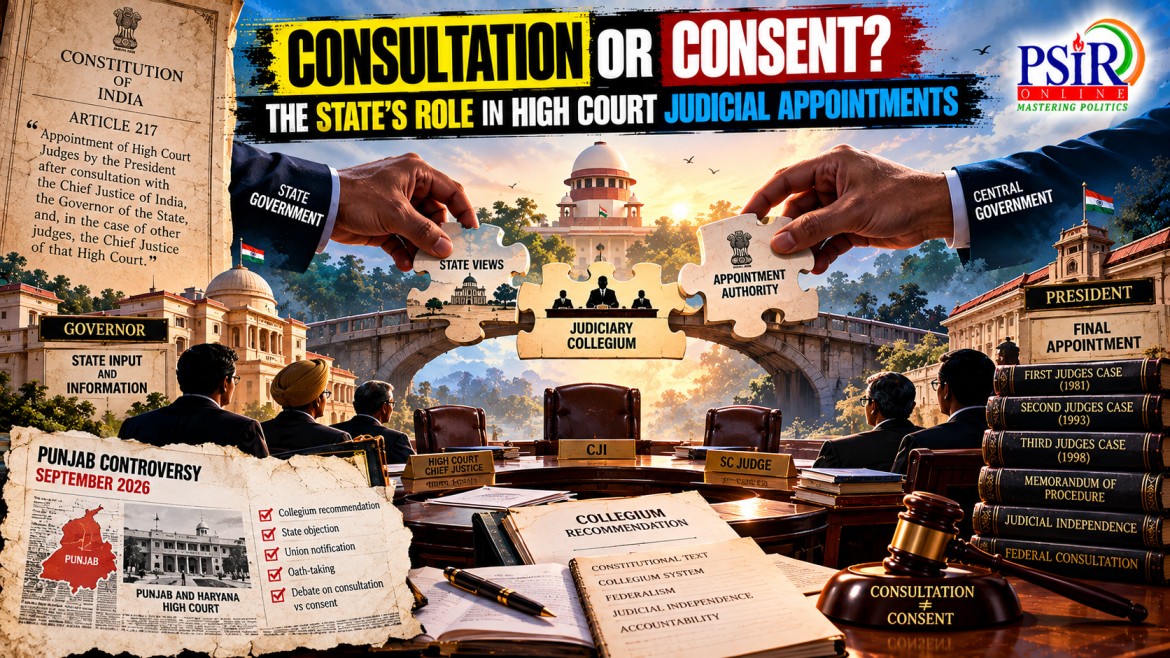
The appointment of High Court judges sits at the intersection of judicial independence, executive participation and India's federal structure. The Constitution assigns formal appointment authority to the President, requires consultation with specified constitutional functionaries and, through Supreme Court judgments, has developed the Collegium system that gives the judiciary primacy in recommending candidates. Within this framework, State Governments have a role, but the nature and limits of that role remain important constitutional questions.
The controversy surrounding the appointment of Justice Ashwani Kumar Mishra as Chief Justice of the Punjab and Haryana High Court in September 2026 brought this issue into focus. The Union Government notified the appointment on 5 September. The Punjab Cabinet objected the following day, arguing that the State's views had not been obtained and considered in accordance with the Memorandum of Procedure. Justice Mishra took oath on 7 September despite the objection. The dispute raised a central question: does the constitutional requirement of consultation give a State Government the power to withhold consent to a High Court Chief Justice's appointment?
The constitutional framework distinguishes consultation from consent. A State's views are relevant to the appointment process, and procedural requirements should be followed. But the State Government does not possess an independent constitutional veto over a recommendation made through the established Collegium system.
THE PUNJAB CONTROVERSY: WHAT HAPPENED?
Justice Ashwani Kumar Mishra had been serving as Acting Chief Justice of the Punjab and Haryana High Court from 2 June 2026. Following a recommendation by the Supreme Court Collegium, the Union Government notified his appointment as the full-time Chief Justice on 5 September 2026.
On 6 September, the Punjab Cabinet passed a resolution objecting to the appointment. It argued that the Union had acted without waiting for the State Government's response and requested that the appointment and oath-taking be put on hold until the State's views were obtained and considered. The objection was framed as a procedural and constitutional concern relating to the Memorandum of Procedure governing judicial appointments.
The Union Government's position, as reported at the time, was that the State had been informed of the proposal and asked to provide its views in August. It maintained that the appointment process had been followed and that the State's consent was not required. Justice Mishra took oath on 7 September, despite the Punjab Cabinet's request to defer the appointment.
Two questions must be separated. The first is procedural: were the State's views sought and dealt with in accordance with the applicable appointment procedure? The second is substantive: even where the State's views are required to be obtained, do they amount to a binding consent requirement? The second question cannot be answered merely by noting that a State Government objected.
The episode is therefore a useful case study in the difference between a procedural entitlement to be consulted and a constitutional power to determine the outcome. It should not be treated as a judicial ruling that conclusively settled every issue raised by the State's objection.
ARTICLE 217: THE CONSTITUTIONAL TEXT
Article 217(1) provides that every High Court judge is appointed by the President by warrant under the President's hand and seal, after consultation with the Chief Justice of India, the Governor of the State and, in the case of an appointment of a judge other than the Chief Justice of the High Court, the Chief Justice of that High Court.
The provision establishes three important principles.
First, the President is the formal appointing authority. The appointment is made through a constitutional process and is not an act that a State Government can independently complete or cancel.
Second, Article 217 expressly requires consultation with the Governor of the State. The Governor is a constitutional functionary whose role in the appointment process must be understood within the broader constitutional framework governing the exercise of gubernatorial powers. In practice, the Governor's views are connected to the State's executive machinery and the procedure prescribed for obtaining State-level input.
Third, Article 217 does not expressly state that the State Cabinet must consent to a candidate before an appointment can be made. Nor does it confer an express veto on the State Legislature or Chief Minister. The constitutional text uses the word consultation, and its meaning has been shaped by Supreme Court judgments concerning judicial appointments.
The distinction between the Governor and the State Government is important. They are not interchangeable constitutional terms. Article 217 names the Governor, while the Memorandum of Procedure provides the administrative framework through which the views of State authorities are obtained and considered. A State Government may therefore have a meaningful procedural role without becoming the final appointing authority.
FROM CONSULTATION TO THE COLLEGIUM SYSTEM
The present appointment framework cannot be understood from Article 217 alone. Its operation has been shaped by three major Supreme Court decisions commonly known as the First, Second and Third Judges Cases.
In S.P. Gupta v. Union of India (1981), the First Judges Case, the Supreme Court interpreted the constitutional consultation provisions in a manner that did not give the Chief Justice of India's opinion primacy over the executive. The judgment reflected an executive-centred understanding of the appointment process.
This position changed in Supreme Court Advocates-on-Record Association v. Union of India (1993), the Second Judges Case. A nine-judge Bench overruled the First Judges Case on the question of primacy and held that the Chief Justice of India's institutional opinion should have primacy in judicial appointments. The Court understood that opinion as one formed through consultation with senior judicial colleagues rather than through the Chief Justice's individual preference alone.
In In re Special Reference No. 1 of 1998, the Third Judges Case, a nine-judge Bench clarified the composition and functioning of the Collegium. For High Court appointments, the Supreme Court Collegium comprises the Chief Justice of India and the two senior-most Supreme Court judges. The views of the Chief Justice of the concerned High Court, its senior judges and the senior-most Supreme Court judge familiar with that High Court's affairs are also relevant under the prescribed procedure.
These decisions transformed the practical meaning of consultation under Article 217. Although the constitutional text continues to provide for consultation with specified functionaries, the judicially developed framework gives the Supreme Court Collegium's collective recommendation primacy in the selection of candidates.
This does not mean that the executive has no role. The Union Government participates in the process, may examine relevant material and communicates with the Collegium under the Memorandum of Procedure. However, the established system does not permit the State Government to substitute its own final choice for the candidate recommended through the constitutionally recognised process.
WHAT IS THE STATE GOVERNMENT'S ROLE?
The State Government's participation is not merely symbolic. State authorities may possess relevant information concerning a candidate's professional record, integrity, conduct or other matters pertinent to suitability. The Memorandum of Procedure provides for obtaining State-level views, and those views form part of the material considered during the appointment process.
The Department of Justice has described the appointment process as an integrated exercise involving the judiciary and executive. The proposal for a High Court appointment ordinarily originates with the Chief Justice of the concerned High Court, in consultation with the two senior-most puisne judges. The proposal proceeds through the prescribed channels, including the State authorities and the Union Government, before being considered by the Supreme Court Collegium. Only candidates recommended by the Supreme Court Collegium are appointed to the higher judiciary under the existing framework.
State consultation can contribute to a more informed appointment process. It may help bring relevant local information to the attention of the appointing authorities and provide an institutional opportunity to identify concerns that merit examination. The value of this participation depends on the quality, relevance and timeliness of the material submitted.
However, consultation does not mean concurrence. A requirement to seek and consider views does not automatically require the decision-maker to accept those views. The State Government cannot claim an unrestricted veto merely because it disagrees with a Collegium recommendation.
This distinction does not make procedural compliance optional. If the applicable procedure requires State views to be obtained, the authorities must follow that procedure. Whether a particular appointment complied with every procedural requirement is a separate question from whether the State's objection is legally binding. A procedural disagreement does not, by itself, establish that the State possesses the power to block an appointment.
JUDICIAL INDEPENDENCE, FEDERAL CONSULTATION AND ACCOUNTABILITY
The Collegium system is principally justified by the need to protect judicial independence. If the executive could unilaterally select judges or reject candidates solely because of disagreement with their judicial approach, the possibility of political influence over adjudication would become a serious constitutional concern.
At the same time, judicial appointments occur within a federal system. High Courts exercise jurisdiction over States and Union Territories, interpret State legislation, adjudicate disputes involving State authorities and protect constitutional rights within their territorial jurisdiction. Consultation with State-level constitutional authorities can therefore contribute relevant information and recognise the federal context in which a High Court operates.
The constitutional challenge is to reconcile these considerations without converting consultation into political control. A State Government should be able to communicate relevant concerns through the prescribed process. Those concerns should be assessed on their merits, rather than accepted or rejected simply because they come from a particular political administration.
Accountability also requires clarity about the procedure. The appointment process should operate within established rules, relevant material should be considered by the authorities entrusted with that task, and appointments should not be delayed unnecessarily. Equally, the executive should not treat the Collegium's role as eliminating every obligation to follow the Memorandum of Procedure.
The Punjab episode highlights the importance of separating the right to have relevant views considered from the power to determine the final selection. The former is part of the consultative framework; the latter is governed by the constitutional appointment process as interpreted by the Supreme Court.
UPSC DIMENSION
|
Constitutional provision or concept |
Significance |
|
Article 217(1) |
Governs the appointment of High Court judges and identifies the constitutional authorities to be consulted. |
|
Article 224 |
Provides for the appointment of additional and acting High Court judges. |
|
President of India |
Formal appointing authority for High Court judges under Article 217. |
|
Governor of the State |
A constitutionally specified consultee in High Court appointments under Article 217. |
|
Memorandum of Procedure (MoP) |
Sets out the operational process for judicial appointments, including the obtaining of State Government views. |
|
First Judges Case (1981) |
Initially gave the executive a dominant role in the interpretation of consultation for judicial appointments. |
|
Second Judges Case (1993) |
Established judicial primacy in appointments through the Collegium framework. |
|
Third Judges Case (1998) |
Clarified the composition and consultative procedure of the Collegium system. |
|
Consultation versus consent |
Distinguishes the obligation to obtain and consider views from a power to block the final decision. |
|
Judicial independence |
Requires protection of appointments from improper political influence while preserving procedural accountability. |
|
Cooperative federalism |
Provides a broader framework for understanding State participation in a national constitutional appointment process. |
|
Punjab–Punjab and Haryana High Court controversy, September 2026 |
Illustrates the difference between the State's procedural objection and the absence of an independent State veto under the established framework. |
CONCLUSION
The constitutional process for appointing High Court judges combines formal presidential appointment, consultation with specified constitutional authorities and the judicial primacy established through the Second and Third Judges Cases. Article 217 must therefore be read alongside the judicially developed Collegium framework and the Memorandum of Procedure.
The September 2026 Punjab controversy illustrates why consultation and consent must not be confused. State-level views have a place in the appointment process and should be sought and considered in accordance with the applicable procedure. But the State Government does not possess an independent constitutional veto over a recommendation made through the established Collegium system.
The broader constitutional objective is to preserve judicial independence without reducing the appointment process to an opaque or procedurally careless exercise. Meaningful consultation, timely decision-making, consideration of relevant information and respect for the constitutional allocation of authority are all essential. Consultation makes the process informed; it does not automatically transfer the power of final selection to the State Government.
RELATED READING
PRACTISE QUESTIONS FOR GS2 MAINS
PRACTISE QUESTIONS FOR PSIR
