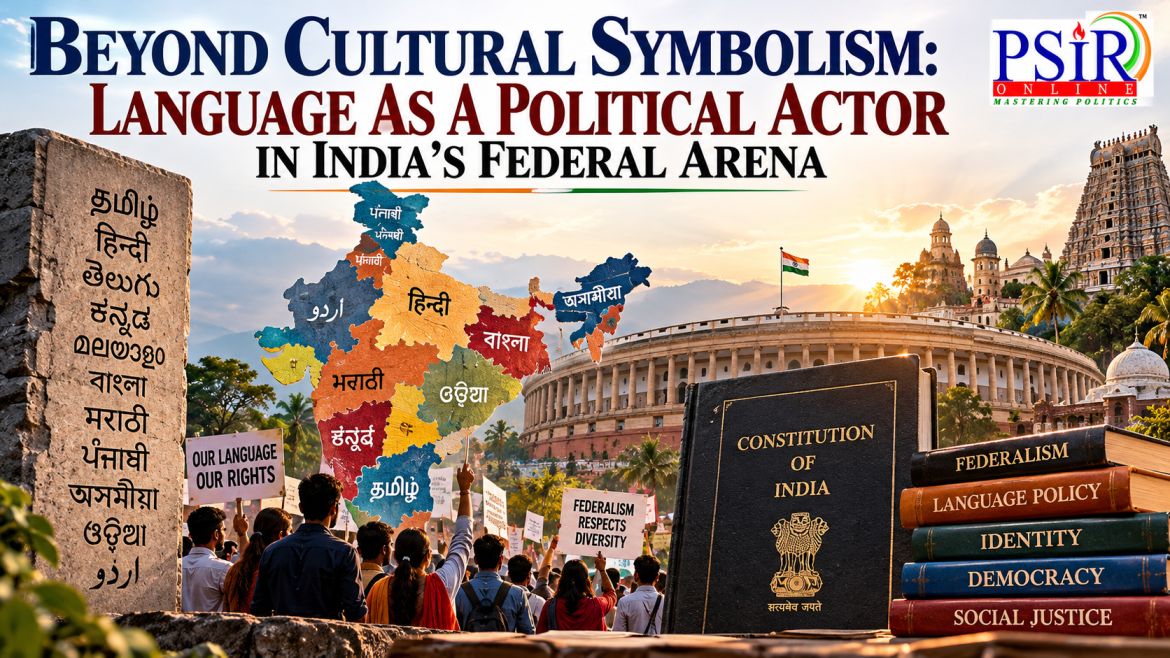
In comparative political sociology, language is rarely an inert medium of speech; it is an active political actor that defines state boundaries, regulates access to public resources, and structures political power. In India, the linguistic reorganisation of states in 1956 appeared to settle territorial boundaries, but contemporary polity reveals that linguistic identity has not receded into history. Rather than functioning merely as an emotional or cultural marker, language operates as an instrument of federal bargaining, sub-national assertion, and electoral contestation against institutional centralisation.
Over the past decade, the centralising policies of national governance—seen in the promotion of a uniform three-language formula, Sanskritised and Hindi titles for central statutes (Bharatiya Nyaya Sanhita), and the imposition of Hindi nomenclature across Centrally Sponsored Schemes—have collided directly with regional linguistic sub-nationalisms. Concurrently, the looming anxiety over parliamentary delimitation under the 84th Constitutional Amendment has transformed language into a defensive shield. Peninsular and non-Hindi-speaking states fear that a strict population-based headcount will punish them for developmental and demographic success while transferring legislative dominance to the Hindi-speaking northern heartland. Consequently, language has re-emerged as a primary political weapon through which regional power centres contest the terms of Indian federalism.
THE POLITICAL ECONOMY OF LANGUAGE: THE TRIPLE AXIS OF CONTESTATION
To understand how language operates as a political actor across Indian states, its modern mobilization can be analyzed through three structural axes:
1. The Representational Axis (Federalism and Delimitation): Southern states mobilize vernacular identity to highlight that redrawing Lok Sabha boundaries exclusively on population share threatens to dilute non-Hindi legislative representation, eroding the historical accommodation foundational to India's "holding together" federal compact.
2. The Administrative and Material Axis (Public Goods and Examinations): Grassroots agitations focus on equal competitive access, successfully compelling central agencies like the Staff Selection Commission (SSC), Railways, and Institute of Banking Personnel Selection (IBPS) to conduct exams in regional Eighth Schedule languages rather than solely in English and Hindi.
3. The Civic and Spatial Axis (Urban Demographics and Nativism): In high-growth metropolitan corridors (such as Bengaluru and Mumbai), language acts as a protective boundary for local "sons of the soil" against rapid inter-state migration, driving mandates on commercial signboards and private-sector job reservation demands.
LANGUAGE AS A POLITICAL ACTOR: STATE-WISE CONTESTATION
Tamil Nadu Tamil Nadu remains the primary paradigm of linguistic regionalism in India, where the defense of Tamil identity functions as the foundational grammar of state power and federal assertion. Grounded in the legacy of the Dravidian Movement and the historic anti-Hindi agitations of 1937 and 1965, the state maintains a strict two-language formula (Tamil and English), rejecting the Centre's National Education Policy (NEP) three-language model. In contemporary politics, linguistic identity is mobilized by ruling and opposition parties alike to resist institutional centralization, opposing Hindi nomenclature in Union schemes and federal criminal statutes (Bharatiya Nyaya Sanhita), while spearheading peninsular opposition to upcoming parliamentary delimitation on the grounds that demographic counts unfairly penalize non-Hindi-speaking states.
Kerala In Kerala, linguistic identity operates primarily as a constitutional shield within cooperative federalism and administrative governance rather than through overt vernacular chauvinism. While Malayalam identity has historically coexisted smoothly with universal English education and high migration rates, linguistic assertion has intensified over the Union Government's administrative homogenization. The state government and regional civil platforms have raised sharp objections against the imposition of Hindi in central recruitment examinations, banking services, and Union communications. Linguistic federalism in Kerala functions as a defense of equal public-sector access and state administrative autonomy, firmly intertwined with anxieties that national demographic redistricting will dilute the legislative influence of linguistically distinct southern polities.
Karnataka In Karnataka, Kannada has evolved from a cultural marker into an aggressive instrument of civic sub-nationalism and electoral mobilization. Rapid demographic shifts and migration into the technology corridors of Bengaluru have spawned urban anxieties, leading grassroots groups like the Kannada Sahitya Parishat and regional activists to demand strict vernacular safeguards. The state has witnessed legislative mandates enforcing 60% Kannada-prominent commercial signboards, demands for reservation for Kannadigas in private-sector jobs, and sustained protests against central banking entrance tests being conducted only in Hindi and English. Mainstream parties continuously compete to demonstrate regional loyalty, deploying linguistic pride to counter pan-national narratives while maintaining regional border disputes over Marathi-speaking Belagavi.
Andhra Pradesh In Andhra Pradesh, Telugu linguistic identity has historically anchored anti-centralist mobilization—from Potti Sreeramulu's 1952 martyrdom that catalyzed the linguistic reorganisation of Indian states to N.T. Rama Rao's founding of the Telugu Desam Party (TDP) on the plank of Telugu Vari Aatma Gouravam (Telugu self-respect). In the contemporary arena, Telugu identity remains a vital mobilizing force, though it balances cultural pride with pragmatic demands for English-medium foundational schooling to drive economic mobility. Despite factional competition between the TDP and YSRCP, Telugu pride is mobilized strategically to negotiate federal allocations, protect the Vishakhapatnam steel plant from disinvestment, and counter perceived central cultural dominance.
Telangana In Telangana, language functioned as an internal regional differentiator, driving the political cleavage that ultimately fractured composite Andhra Pradesh. The movement for separate statehood mobilized distinct Telangana Telugu (infused with Deccani Urdu and regional idioms) against the perceived linguistic and cultural hegemony of coastal Andhra Telugu. Under the Bharat Rashtra Samithi (BRS) regime, native dialect, regional folk traditions, and local historical symbols were systematically institutionalized to build state legitimacy. Contemporary politics continues to deploy native linguistic authenticity as an electoral litmus test, using vernacular sub-nationalism to resist the organizational expansion of national parties and defend state-level sovereignty.
Odisha Odisha possesses a historic tradition of linguistic mobilization, having formed India's first linguistic province under British rule in 1936, a legacy reinforced when Odia achieved Classical Language status in 2014. Under Naveen Patnaik’s Biju Janata Dal (BJD), Odia Asmita (Odia pride) was deployed as a political moat against national party encroachment. However, the 2024 assembly elections marked a pivotal political inversion: the Bharatiya Janata Party (BJP) turned Odia Asmita into a successful electoral weapon against the incumbent administration, alleging that non-Odia bureaucrats held excessive influence over state governance. Language in Odisha has thus operated both as an instrument of regional party consolidation and as a disruptive weapon for regime change.
Maharashtra In Maharashtra, language has served as a potent driver of nativist mobilization, pioneered by the Samyukta Maharashtra movement and later institutionalized by Bal Thackeray’s Shiv Sena under the Marathi Manoos (sons of the soil) doctrine. In contemporary politics, despite deep factional fragmentation within the original regional parties, linguistic assertion remains central to grassroots legitimacy. The grant of Classical Language status to Marathi in late 2024 emerged as a high-stakes competitive credit-claiming contest ahead of state elections, while civic bodies, transport unions, and regional formations continuously enforce Marathi signage, state recruitment preferences, and cultural dominance against perceived metropolitan Hindi dilution.
West Bengal In West Bengal, Bengali linguistic identity has experienced a sharp political resurgence as the Trinamool Congress (TMC) developed a doctrine of Bangla sub-nationalism to resist the electoral growth of the BJP. Framing national centralizing drives as an alien imposition of Hindi-heartland values, the state leadership has positioned itself as the custodian of Bengali culture, social values, and linguistic dignity. Grassroots groups such as Bangla Pokkho actively campaign against the dominance of Hindi in central government offices, railways, and public sector employment within Bengal. Language has transformed the electoral arena into a contest between vernacular autonomy (Bhumiputra) and pan-Indian consolidation.
Assam In Assam, language constitutes the foundational, historically volatile political fault line between Assamese identity, Bengali-speaking populations of the Barak Valley, and indigenous tribal tongues. The legacy of the 1960 Official Language movement and the 1985 Assam Accord continues to shape contemporary politics, where the enforcement of Assamese as the sole state administrative language frequently collides with regional pluralism. The debate over the Citizenship (Amendment) Act (CAA) demonstrated how linguistic sub-nationalism mobilizes against perceived demographic marginalization of native Assamese speakers, even as competing tribal communities seek constitutional autonomy and educational reservation independent of the Assamese linguistic mainstream.
Rajasthan In Rajasthan, language has transformed from an informal dialect cluster into an active political movement demanding constitutional recognition for Rajasthani under the Eighth Schedule. Historically subsumed under the Hindi umbrella for census and administrative purposes, local writers, student bodies, cultural platforms, and cross-party legislators increasingly argue that treating Rajasthani merely as a dialect has caused cultural erosion, educational alienation, and competitive disadvantage for rural youth in regional exams. The movement has made Eighth Schedule inclusion an electoral bargaining chip across the Marwar, Mewar, and Shekhawati belts, demonstrating that even within the traditional Hindi heartland, vernacular assertion can challenge pan-Hindi standardization to secure institutional and economic recognition.
Punjab In Punjab, language has functioned as an existential political determinant, anchoring statehood itself through the historic Punjabi Suba movement led by the Shiromani Akali Dal (SAD) that resulted in the 1966 trifurcation of east Punjab. In contemporary state politics, the primacy of Punjabi written in the Gurmukhi script serves as an ideological barrier against cultural dilution and central standardization. Under the Punjab State Language (Amendment) Act, the state government mandated Punjabi as the primary script on all public and private commercial signboards, milestones, and institutional boards, enforcing penalties for non-compliance. Language policy is actively wielded by both regional forces and the ruling administration to signal vernacular loyalty, resist Hindi-centric central curricula, and reassert cultural sovereignty amid agrarian unrest and shifting demographic balances.
Bihar, Jharkhand, and Uttar Pradesh Across the Hindi-belt states, language operates not through resistance to the Union, but through fierce internal sub-categorization and contestations between standard Hindi and regional vernaculars. In Bihar, the demand for Eighth Schedule recognition of Bhojpuri and Magahi—counterbalanced by the established constitutional status of Maithili—frequently becomes an instrument of sub-regional mobilization and caste patronage. In Jharkhand, language has emerged as a direct electoral battleground over state identity (Jharkhandi Asmita): the controversial inclusion and subsequent withdrawal of Bhojpuri and Magahi from the list of regional languages for district-level recruitment exams demonstrated how tribal and indigenous groups (advocating for Santhali, Mundari, Ho, Kudmukh, and Nagpuri) deploy linguistic criteria to guard local public employment against demographic inflows from neighboring states. Meanwhile, in Uttar Pradesh, while standard Hindi underpins pan-regional political hegemony, the periodic suppression or revival of Urdu as a second official language serves as a sharp proxy cleavage for communal and secular electoral bargaining.
PSIR THEORETICAL DIMENSION & EXAMINATION LINKAGES
|
PSIR Theoretical Dimension & Concepts |
How It Connects to Examination Answers (PSIR Paper 1 / Paper 2) |
|
"Holding Together" vs. "Coming Together" Federalism (Alfred Stepan; Louise Tillin) |
The Fragility of Bargained Nationhood: Stepan categorized India as a "holding-together" federation founded on explicit institutional accommodation of regional diversities rather than pre-existing sovereign states merging. Use this to explain how top-down administrative homogenisation (imposing Hindi terminology in criminal codes or uniform school curricula) fractures the foundational constitutional bargain forged during the 1956 linguistic reorganisation of states. |
|
Multiculturalism & Group-Differentiated Rights (Will Kymlicka; Charles Taylor) |
Linguistic Autonomy vs. Majoritarian Standardization: Evaluates central language directives through Kymlicka’s theory of minority cultural rights. Argues that in deeply plural societies, treating language merely as a technical medium of governance undercuts sub-national cultural dignity, validating demands for vernacular polyethnic rights and regional linguistic parity in central administration and exams. |
|
Social Cleavage Theory & Party System Transformation (Seymour Martin Lipset & Stein Rokkan) |
Linguistic Fault Lines as Electoral Assets: Explains how socio-cultural cleavages (language and region) become permanently institutionalized into party systems. Shows why regional satraps—such as the DMK in Tamil Nadu or TMC in West Bengal—consistently deploy vernacular sub-nationalism (bhumiputra politics) as an electoral counterweight against the pan-national consolidation of the BJP. |
|
Demographic Federalism & Representational Justice (Hannah Pitkin – Concept of Representation; Arend Lijphart) |
The Delimitation-Language Conundrum: Connects peninsular pushback against the post-freeze parliamentary delimitation to descriptive versus substantive representation. Illustrates how demographic penalties on southern, non-Hindi-speaking states threaten to translate population headcount into permanent legislative hegemony for the Hindi-speaking northern heartland. |
|
Nativism & "Sons of the Soil" Politics (Myron Weiner; Paul Brass) |
Civic Boundaries and Migration Anxieties: Explains vernacular assertion in economic metropolitan hubs (e.g., Kannada signboard mandates in Bengaluru or Marathi mobilization in Mumbai) through Weiner’s classic "sons of the soil" thesis. Demonstrates how rapid demographic inflows transform cultural identity into protectionist demands for local employment and symbolic dominance. |
|
Substantive Equality vs. Formal Universalism (B.R. Ambedkar; Ronald Dworkin) |
Level Playing Field in Public Employment: Bridges constitutional equality (Articles 14 and 16) with language politics. Connects mass regional protests to the principle that conducting central recruitment tests (SSC, Railways, IBPS) only in Hindi and English creates structural inequality of opportunity for non-Hindi rural aspirants. |
|
State Legibility & High Modernism (James C. Scott – Seeing Like a State) |
Dilemmas of Bureaucratic Centralisation: Analyzes the Union Government’s impulse to enforce administrative uniformity (e.g., Hindi nomenclature in Centrally Sponsored Schemes and federal statutes) as high-modernist statecraft seeking administrative legibility. Explains how this top-down standardization sparks sub-national friction by disregarding organic vernacular realities. |
|
Consociational Democracy & Regional Autonomy (Arend Lijphart – Patterns of Democracy) |
Mutual Vetoes and Segmental Parity: Applies consociational power-sharing principles to India’s official language policy. Argues that preserving continental political cohesion requires institutionalizing mutual regional consent and linguistic vetoes (the two-language compromise) rather than simple majoritarian legislative imposition |
CONCLUSION
The resilience of language across these states demonstrates that linguistic identities cannot be treated as archaic remnants destined to fade under modern industrialization or uniform national digital programs. Instead, vernacular languages provide the cognitive and institutional vocabulary through which ordinary citizens encounter state power, seek social justice, and resist administrative centralisation. When public examinations, bureaucratic appointments, or national nomenclature neglect vernacular legitimacy, language transforms instantly from a medium of cultural expression into an organized political counterweight.
Language in Indian polity is not an obstacle to national integration, but the foundational principle upon which democratic integration was negotiated. The recurrent friction surrounding the National Education Policy, central administrative nomenclature, and constituency delimitation reinforces Alfred Stepan’s formulation: India endures as a "holding together" federation precisely because it recognized linguistic diversity rather than enforcing a singular majoritarian mold. Attempting to substitute this negotiated pluralism with administrative or linguistic homogenization risks unravelling the delicate constitutional compromise reached in 1956. Ultimately, preserving Indian unity requires acknowledging that regional languages and federal political arenas are not subordinate peripheries, but equal, co-sovereign anchors of the democratic republic.
RELATED READING & ANALYTICAL ANGLES
· Constitutional Articles & Statutory Mechanisms:
o Articles 343 to 351 (Part XVII - Official Language): The constitutional compromise balancing Hindi as the official language of the Union with the indefinite continuation of English under the Official Languages Act, 1963; Union directives under Article 351 versus state language autonomy under Article 345.
o The Eighth Schedule & Article 344/351: The politics of linguistic inclusion; contemporary agitations for the inclusion of non-scheduled vernaculars (e.g., Rajasthani, Bhojpuri, Tulu) and the creation of "Classical Language" tiers (Odia, Marathi, etc.) as political bargaining tools.
o Articles 29 & 30: Cultural and educational rights protecting distinct languages, scripts, and cultures of minorities from assimilationist central policies.
o Articles 82 & 170: The mechanics of parliamentary seat freezes and the upcoming delimitation dilemma intersecting with regional linguistic power balances.
· Commissions & Policy Frameworks:
o States Reorganisation Commission (SRC) Report (1955): The foundational rationale behind reorganizing Indian state boundaries along linguistic lines to democratize governance and deepen vernacular participation.
o Three-Language Formula (National Policy on Education 1968, NEP 2020): The persistent friction between Centre-mandated multilingualism and state-level formulas (e.g., Tamil Nadu’s statutory two-language model).
o Parliamentary Committee on Official Language: Recurring recommendations regarding Hindi as the medium of instruction in central technical institutes and administrative correspondence, and resulting federal friction.
· Key Theoretical Formulations & Scholarly Works:
o Paul R. Brass: Language, Religion and Ethnic Identity: The Politics of Choice (analyzes how linguistic identities are consciously selected, manipulated, and politicized by regional political elites).
o Alfred Stepan, Juan J. Linz, & Yogendra Yadav: Crafting State-Nations: India and Other Culturally Diverse Polities (evaluates the "state-nation" model that accommodates multiple cultural-linguistic identities within a single constitutional framework).
o Myron Weiner: Sons of the Soil: Migration and Ethnic Conflict in India (foundational framework on nativist mobilisations, inter-state migration, and linguistic protectionism in employment).
o Sanjib Baruah: In the Name of the Nation and Durable Disorder (indispensable for unpacking language fault lines, indigenous sub-nationalism, and ethnic citizenship contests in Assam and the North East).
PRACTICE QUESTIONS FOR PSIR
1. "Language in Indian politics is not merely an emotional or cultural marker, but an active instrument of federal bargaining." Comment.
2. Examine the 'sons of the soil' thesis in the context of recent urban civic assertions and language mandates across Indian metropolises.
3. "The looming challenge of parliamentary delimitation has transformed language into a defensive shield of demographic federalism." Discuss.
4. "The post-colonial Indian state's project of nation-building continuously oscillates between the impulse for administrative-linguistic unity and the democratic imperative of recognizing vernacular sub-nationalisms." Evaluate this dialectic using contemporary state-level case studies across Peninsular, Eastern, and North-Eastern India.
