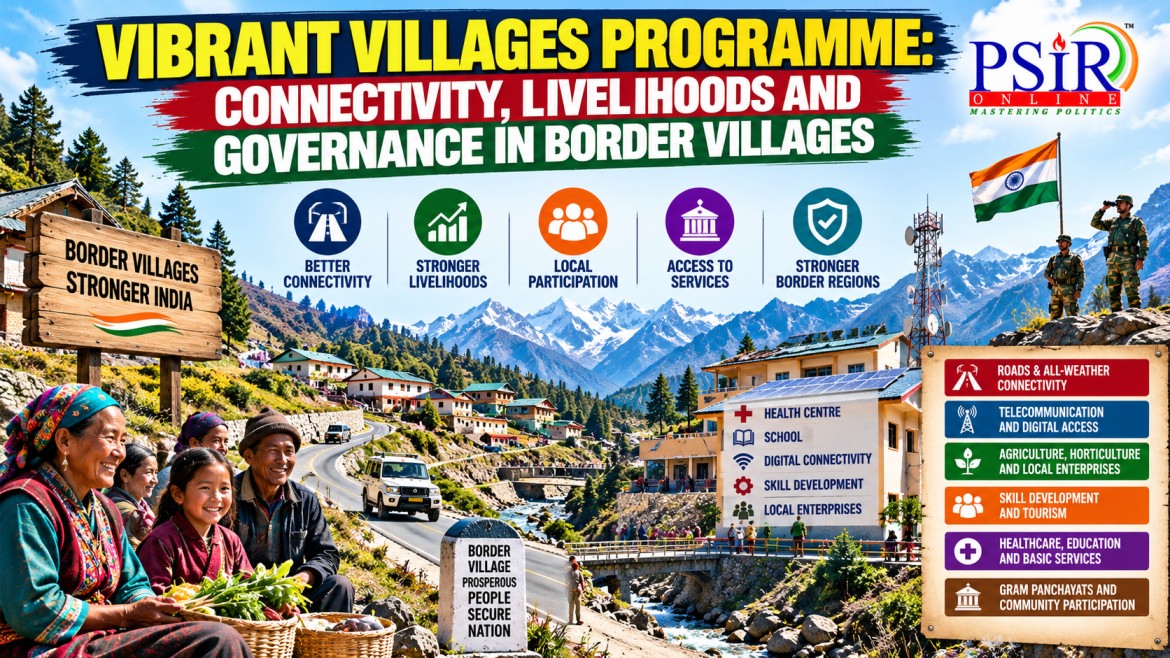
India's border villages face a distinctive development challenge. Difficult terrain, sparse populations, limited transport links and inadequate access to healthcare, education, markets and digital services can constrain residents' economic opportunities. In some areas, these difficulties also contribute to migration, weakening the social and economic vitality of border settlements.
The Vibrant Villages Programme (VVP) seeks to address these challenges by linking infrastructure development with livelihood generation and improved access to public services. Launched in 2023, VVP-I initially focused on selected villages along India's northern border. The Union Cabinet approved Vibrant Villages Programme-II (VVP-II) on 2 April 2025, extending the programme to selected villages along other international land borders. VVP-II has an outlay of ₹6,839 crore up to financial year 2028–29 and covers 1,954 identified villages across 15 states and two Union Territories.
The programme reflects an important shift in border-area policy: border villages are not merely remote settlements at the edge of national territory; they are also homes, productive communities and sites of everyday citizenship. The central governance question is whether strategic investment can deliver durable improvements in residents' quality of life while strengthening the resilience of border regions.
FROM REMOTE SETTLEMENTS TO DEVELOPMENT PRIORITIES
VVP-I was approved as a Centrally Sponsored Scheme in February 2023. It initially identified 662 villages in 46 blocks across Arunachal Pradesh, Himachal Pradesh, Sikkim, Uttarakhand and Ladakh. Its interventions include road connectivity, housing and village infrastructure, energy, telecommunications, healthcare, education, tourism, skill development and agriculture-related livelihoods.
VVP-II broadens this approach to selected villages in areas abutting international land borders beyond those already covered under VVP-I. Its coverage includes states and Union Territories facing different geographical, economic and security conditions, from Himalayan settlements to villages along India's western and eastern borders.
The two phases have distinct funding arrangements. VVP-I is a Centrally Sponsored Scheme, while VVP-II is a Central Sector Scheme with full central funding. VVP-II also seeks to achieve saturation of relevant individual and household welfare schemes and improve connectivity through convergence with existing programmes.
The programme's area-specific approach recognises that a uniform development model may not suit every border settlement. Priorities in a high-altitude village may differ from those in a flood-prone settlement or a village with stronger potential for agricultural trade and tourism.
However, identifying a village for development is only the beginning. Implementation must account for terrain, seasonal accessibility, population needs, environmental constraints and the long-term cost of maintaining infrastructure.
CONNECTIVITY AND ACCESS TO EVERYDAY PUBLIC SERVICES
Connectivity is fundamental to the programme because physical isolation can reinforce economic and social disadvantage. Roads connect residents to markets, schools, hospitals and administrative offices, while mobile and internet connectivity can improve access to information, digital payments and public services.
The Ministry of Home Affairs reported on 28 July 2026 that VVP-I had sanctioned 111 road projects worth ₹2,481.93 crore to provide all-weather connectivity to 134 previously unconnected villages. The same report stated that 528 villages had 4G mobile connectivity, 625 had piped drinking-water coverage and 621 had access to on-grid or off-grid electricity. It also reported 40 sanctioned Mobile Medical Units in Arunachal Pradesh and 146 school infrastructure projects.
These figures demonstrate the range of interventions being undertaken, but they require careful interpretation. A sanctioned project is not necessarily a completed asset, and coverage does not automatically establish service quality. A road may remain difficult to use during extreme weather; a mobile signal may not guarantee affordable, reliable internet; and a health facility may still face shortages of staff or medicines.
Effective monitoring must therefore examine functionality, accessibility and reliability, not just construction or coverage. Residents should be able to reach essential services throughout the year, and the infrastructure created should remain usable under local climatic and geographical conditions.
LIVELIHOODS, LOCAL ECONOMIES AND MIGRATION
Connectivity can create economic opportunities, but infrastructure alone cannot ensure that border villages become economically sustainable. VVP promotes livelihood generation through tourism, cultural heritage, skill development, entrepreneurship, agriculture, horticulture, medicinal plants, cooperatives, self-help groups (SHGs) and farmer-producer organisations (FPOs).
A locally grounded strategy could connect agricultural producers to wider markets, support community-managed tourism, strengthen traditional crafts or develop value chains for region-specific products. Cooperatives and producer organisations can help small producers pool resources, improve bargaining power and access marketing and processing facilities.
Tourism can generate income in suitable locations, but it also requires trained workers, reliable transport, sanitation, waste management and safeguards for local culture and fragile ecosystems. Similarly, skill-development programmes must connect training to actual employment or viable enterprises rather than treating enrolment as the final measure of success.
The programme's stated objective of creating incentives for residents to remain in their villages also raises an important distinction. People should be able to remain because local life offers meaningful opportunities, not because migration is discouraged. Residents must retain the freedom to move for education, employment and personal reasons.
An effective livelihood strategy should therefore measure changes in household income, employment continuity, market access and enterprise survival. It should also assess whether benefits reach women, young people, small producers and economically disadvantaged households.
LOCAL PARTICIPATION AND DECENTRALISED GOVERNANCE
VVP envisages village-level planning through a collaborative process involving district administrations and Gram Panchayats. Village Action Plans are intended to reflect local development priorities, while convergence with existing government schemes helps mobilise resources across departments. The programme's original framework also emphasised the role of Panchayats and Gram Sabhas in implementation.
This approach is significant because residents possess practical knowledge about local terrain, seasonal mobility, traditional economic activities and gaps in public services. Their participation can help administrators identify which interventions are most urgently required and which assets communities can realistically maintain.
Yet participation should not be reduced to consultation after priorities have already been determined. Residents need opportunities to influence project selection, identify beneficiaries, monitor expenditure and report implementation problems. Gram Sabhas and local institutions can provide forums for these functions, subject to applicable laws and administrative arrangements.
Local participation also requires safeguards against unequal influence. Better-connected households or dominant local groups may have greater access to officials and decision-making forums. Women, remote hamlets, tribal communities and economically weaker households may face barriers to participation.
A transparent process should publish village-level plans, project costs, implementation status and maintenance responsibilities in accessible formats. Public grievance mechanisms and social audits, where applicable, can further strengthen accountability.
CONVERGENCE, COORDINATION AND MAINTENANCE
Border-area development involves multiple sectors and levels of government. VVP-II seeks to coordinate interventions in livelihoods, roads, energy, healthcare, financial inclusion, education, telecommunications, tourism and local infrastructure. Its convergence-based design allows existing schemes and departmental programmes to contribute to common village-level priorities.
VVP-II also provides for a High-Powered Committee chaired by the Cabinet Secretary to consider suitable relaxations in the guidelines of relevant schemes to address the specific challenges of border villages. This recognises that conventional programme rules may not always accommodate difficult terrain, dispersed populations or high construction and service-delivery costs.
However, convergence creates coordination challenges. Different departments may follow separate approval processes, financial schedules and performance indicators. Without clear responsibility for each project, delays and gaps can arise between construction, service provision and maintenance.
The solution is not simply to combine funding sources. It is to establish a shared village development plan with clearly assigned departmental responsibilities, implementation milestones and maintenance arrangements. Panchayats and local institutions should know which agency is responsible when a road deteriorates, a facility becomes non-functional or a livelihood project loses support.
The sustainability test is whether assets continue to deliver public value after the initial project expenditure has ended.
BORDER SECURITY, REGIONAL EQUITY AND MEASURING OUTCOMES
The programme explicitly links development in border villages with national security. Better connectivity, public services and livelihood opportunities can strengthen the resilience of border communities and support closer interaction between residents and public institutions. The government has also described local residents as important contributors to border vigilance and the prevention of cross-border crime.
Nevertheless, development policy must preserve the distinction between residents' rights and the state's security objectives. Border communities should be treated as citizens with legitimate social and economic aspirations, rather than merely as instruments of surveillance or territorial control.
Regional equity requires that residents of remote border villages have meaningful access to public services comparable to those available elsewhere, while recognising that service-delivery models may need to be adapted to local conditions. Development priorities should emerge from a balance between strategic requirements, community preferences and ecological sustainability.
Assessment must go beyond the number of projects sanctioned, funds released or activities conducted. In a Lok Sabha reply published on 3 February 2026, the Ministry of Home Affairs stated that no impact assessment had been carried out under VVP-I at that time. The government reported more than 8,500 activities, including service-delivery camps, training, health and veterinary camps, fairs and tourism promotion, but these activities alone could not establish the programme's long-term impact.
A robust evaluation framework should measure:
· Connectivity: Year-round road access, travel time to essential services and the reliability of mobile and internet networks.
· Livelihoods: Changes in household income, employment, enterprise survival and market access.
· Public services: Availability and quality of healthcare, education, drinking water, electricity and digital services.
· Demographic trends: Changes in migration patterns, interpreted alongside employment, education and household choices.
· Local governance: Participation in planning, transparency of expenditure, grievance resolution and maintenance of public assets.
· Security and resilience: Community trust, emergency preparedness and the ability of local institutions to function during disruptions.
Baseline data and repeated assessments are necessary to establish whether observed changes are attributable to the programme or are also influenced by other economic, demographic and policy factors.
UPSC ANGLES
|
Dimension |
Relevance to VVP |
|
Border management and national security |
Connects development, community resilience and public-service delivery with the management of India's international land borders. |
|
Regional equity |
Addresses the disadvantages associated with remoteness, difficult terrain and unequal access to infrastructure and services. |
|
Cooperative federalism |
Requires coordination among the Union government, state governments, district administrations and relevant line ministries. |
|
Local self-government |
Village Action Plans and Gram Panchayat participation illustrate decentralised planning and the importance of community oversight. |
|
Internal migration |
Examines how local employment and public services may influence residents' decisions to remain in or leave border villages, without treating migration itself as a failure. |
|
Livelihood and rural development |
Links tourism, agriculture, horticulture, SHGs, cooperatives and FPOs with local economic diversification. |
|
Administrative reforms |
Convergence, tailored scheme guidelines and clear departmental responsibility illustrate the challenges of coordinated implementation. |
|
Social justice |
Requires attention to women, tribal communities, remote hamlets and economically disadvantaged households in project selection and benefit distribution. |
|
Sustainable development |
Calls for infrastructure and tourism models suited to local ecosystems, disaster risks and long-term maintenance needs. |
|
Public policy evaluation |
Highlights the need to distinguish sanctioned projects and reported activities from completed works, functioning services and measurable social outcomes. |
CONCLUSION
The Vibrant Villages Programme recognises that border-area development requires more than isolated infrastructure projects. Roads, telecommunications, healthcare, education and livelihood opportunities must work together to make local economies more resilient and public services more accessible.
Its effectiveness will depend on the quality of implementation: whether village plans reflect residents' priorities, whether convergence produces coordinated delivery, whether infrastructure remains functional and whether economic opportunities are sustainable. Equally important is the need to evaluate outcomes rather than relying solely on administrative activity figures.
A border village becomes vibrant when its residents can access reliable services, pursue dignified livelihoods, participate in local decisions and choose their future with confidence. Development-led border policy is most durable when national priorities and everyday citizenship reinforce one another.
REFERENCES AND FURTHER READING
GS2 MAINS PRACTICE QUESTIONS
10 marks | 150 words
15 marks | 250 words
