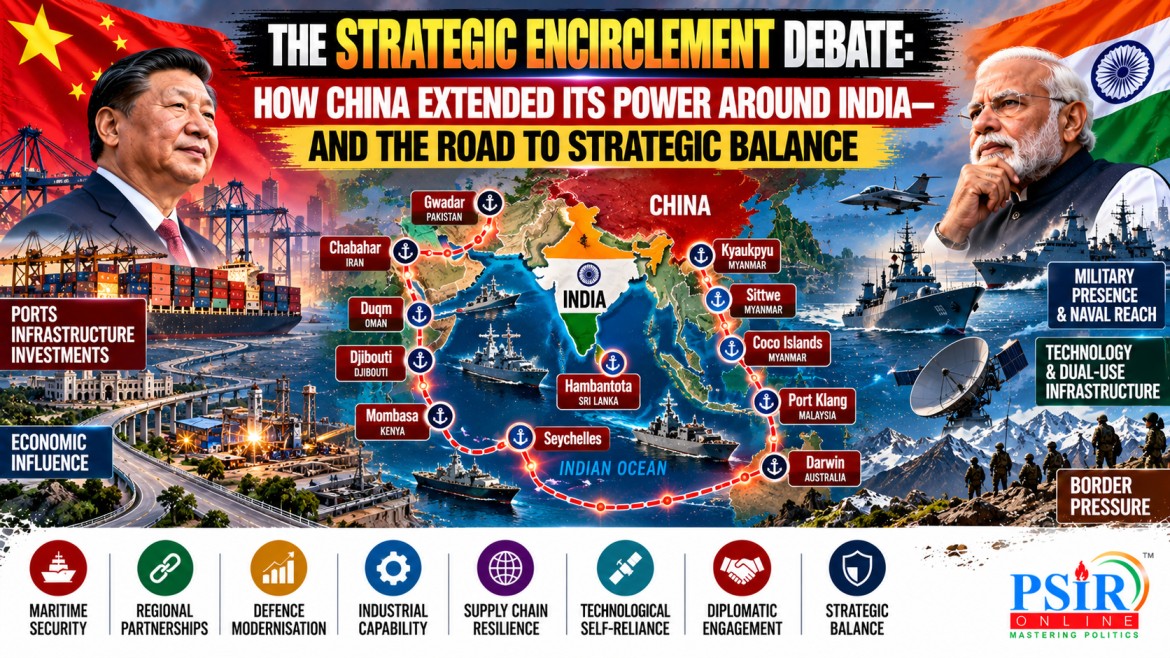
India’s strategic environment is increasingly shaped by the expansion of Chinese economic, technological, military and diplomatic capabilities across Asia and the Indian Ocean. China’s growing presence in Pakistan, its infrastructure partnerships in South Asia, its expanding naval operations and its overseas logistics network have generated concerns about the possibility of a strategic encirclement of India. The expression “String of Pearls” has become a prominent shorthand for these concerns.
Yet the strategic challenge extends far beyond a chain of ports. China has developed a powerful industrial base capable of supplying ships, aircraft, missiles, electronics, telecommunications systems, vehicles, batteries and other technologies at scale. This industrial capacity supports military modernisation, overseas infrastructure development and commercial relationships across multiple regions. Its economic presence can create diplomatic access, while its technological and manufacturing capabilities expand the options available to its armed forces.
India has responded through military modernisation, partnerships with maritime powers, infrastructure initiatives, defence indigenisation and stronger engagement with Indian Ocean countries. Nevertheless, differences in industrial scale, defence expenditure, shipbuilding capacity, supply-chain depth and overseas logistics remain important.
The central question is whether India can develop a strategic position capable of balancing China’s expanding regional reach without entering an unsustainable arms race. The answer depends on recognising that military power, industrial capability, maritime geography and diplomatic partnerships are interconnected components of national power.
THE STRATEGIC POWER GAP: BEYOND MILITARY NUMBERS
The comparison between India and China is not simply a comparison between two armed forces. It concerns the broader systems that generate and sustain military power. China’s manufacturing base, technological ecosystem, defence-industrial capacity and infrastructure networks provide it with advantages that extend beyond the number of weapons or platforms currently deployed.
Military expenditure illustrates the scale of the difference. According to the Stockholm International Peace Research Institute (SIPRI), China spent an estimated US$336 billion on its military in 2025, while India spent approximately US$92.1 billion. China’s expenditure was therefore around 3.6 times India’s. These are estimates of military expenditure, not direct measures of combat effectiveness or operational readiness.
|
Indicator |
China |
India |
|
Estimated military expenditure, 2025 |
US$336 billion |
US$92.1 billion |
|
Industrial foundation |
Extensive manufacturing base spanning electronics, machinery, shipbuilding and advanced industrial equipment |
Expanding manufacturing base, with uneven domestic capability across advanced defence technologies |
|
Defence production |
Large-scale production across aircraft, naval vessels, missiles, drones and electronic systems |
Growing domestic production of aircraft, missiles, naval platforms, artillery and other systems, alongside continuing import dependence in selected areas |
|
Maritime reach |
Expanding blue-water navy and an overseas military support facility in Djibouti |
Strong regional maritime position, with expanding surveillance, naval cooperation and logistical partnerships |
|
Strategic infrastructure |
Overseas commercial and logistics networks with potential dual-use significance |
Port, connectivity and development partnerships, including initiatives in the Indian Ocean and beyond |
Sources: SIPRI, Trends in World Military Expenditure 2025; official defence and maritime policy material. Industrial and strategic assessments are qualitative rather than a common numerical ranking.
China’s advantage is reinforced by the relationship between civilian manufacturing and defence production. Large industrial ecosystems can supply electronics, engines, sensors, communications equipment, machine tools and other components required by military manufacturers. Commercial shipyards, industrial research and extensive supplier networks can also support aspects of naval modernisation.
India has important capabilities of its own, including missile development, nuclear-powered submarine operations, indigenous warship construction, space-based assets and an expanding defence manufacturing sector. The challenge is that advanced military systems require more than final assembly: they depend on reliable engines, semiconductors, sensors, materials, software, maintenance systems and a stable industrial supply chain.
Consequently, the strategic gap is partly an industrial gap. Military expenditure can finance new capabilities, but durable power depends on the ability to design, manufacture, maintain and replenish those capabilities over time.
THE STRING OF PEARLS: PORTS, INFRASTRUCTURE AND STRATEGIC ACCESS
The term “String of Pearls” is commonly used to describe Chinese infrastructure and maritime relationships extending across the Indian Ocean, including facilities and projects in Pakistan, Sri Lanka, Myanmar and other regional states. It is an analytical label used in strategic discussions, rather than a formal Chinese declaration of a unified encirclement strategy.
The concern arises because ports, logistics facilities, telecommunications networks and transport corridors can serve both commercial and strategic purposes. Infrastructure built to facilitate trade may also provide refuelling, maintenance, surveillance or logistical opportunities during periods of tension. The strategic significance of any particular facility depends on its location, ownership, access arrangements, operational capabilities and the political choices of the host government.
Gwadar in Pakistan is particularly significant to Indian strategic assessments. Located near the Arabian Sea approaches to the Strait of Hormuz, it forms part of the China–Pakistan Economic Corridor and provides China with an infrastructure partnership close to important maritime routes. Its proximity to Pakistan and the wider Arabian Sea makes it relevant to regional military planning. However, a commercial port should not automatically be described as an operational Chinese naval base.
Hambantota in Sri Lanka became a focus of debate after a Chinese state-owned enterprise obtained a 99-year lease and a controlling stake in the port’s operating company in 2017. The arrangement arose from Sri Lanka’s financial and infrastructure circumstances and generated concerns about long-term strategic access. The lease does not, by itself, establish that the port is a permanent Chinese naval base.
Kyaukpyu in Myanmar is strategically important because port and industrial development connects with oil and gas pipelines leading towards China’s Yunnan province. These links provide an alternative route for some energy imports and reduce exclusive dependence on maritime passage through the Strait of Malacca. Their commercial and strategic significance must nevertheless be assessed in light of the project’s actual operational development and Myanmar’s political conditions.
Djibouti represents a more direct form of Chinese military presence. China established its first acknowledged overseas military support base there in 2017. Its location near the Bab el-Mandeb Strait and major Red Sea shipping routes supports overseas naval deployments, anti-piracy operations and logistical activities.
These cases are strategically different. A port under commercial management, an infrastructure corridor, a logistics-access arrangement and a permanent military installation do not have identical military implications.
|
Location |
Strategic significance |
Important qualification |
|
Gwadar, Pakistan |
China–Pakistan connectivity and proximity to Arabian Sea shipping routes |
Commercial infrastructure does not automatically establish a permanent Chinese naval base |
|
Hambantota, Sri Lanka |
Long-term Chinese commercial operating presence near Indian Ocean shipping lanes |
The 99-year lease is an operating arrangement, not proof of permanent military basing |
|
Kyaukpyu, Myanmar |
Port development and pipelines connecting the Bay of Bengal with southwestern China |
Military implications depend on future access, facilities and operational arrangements |
|
Djibouti |
Established Chinese overseas military support facility near major maritime routes |
Its presence is direct evidence of overseas military logistics, unlike ordinary commercial port investment |
The strategic concern is therefore not that every “pearl” is a military outpost. It is that a network of commercial facilities, political relationships and potential access arrangements may expand China’s options during a crisis.
For India, the appropriate response requires persistent maritime awareness, reliable partnerships and the ability to assess the actual military significance of infrastructure, rather than treating every Chinese investment as proof of an imminent blockade or encirclement.
MANUFACTURING POWER AND THE GLOBAL PROJECTION OF CHINESE INFLUENCE
China’s strategic reach is closely connected to its position as a major manufacturing power. The ability to manufacture at scale provides Beijing with economic leverage, supports defence modernisation and creates opportunities for international partnerships. This is a critical distinction between possessing diplomatic influence and possessing the industrial means to sustain that influence.
China’s shipbuilding sector illustrates the relationship. Commercial shipyards, maritime engineering firms, steel production, electronics suppliers and specialised manufacturing facilities form an industrial ecosystem that can support a broad maritime economy. Although commercial and military shipbuilding are not interchangeable, industrial scale, trained labour, component supply and engineering capacity can create advantages relevant to naval production.
The same pattern appears in electronics, drones, batteries, telecommunications equipment, solar technology and industrial machinery. China’s large manufacturing base allows it to supply foreign markets, participate in infrastructure projects and provide equipment to overseas partners. These relationships can generate maintenance requirements, technical dependencies and continuing commercial engagement.
Defence exports can also strengthen diplomatic relationships. Equipment supplied to another country may lead to training, maintenance, spare-parts contracts, joint exercises and long-term technical cooperation. Such relationships can provide the supplier with influence, although they do not guarantee political alignment or military access.
India has expanded defence production and exports, with domestic companies and public-sector enterprises supplying a wider range of systems. Indian capabilities in missiles, naval platforms, artillery, radar, electronic systems and selected aerospace technologies offer a foundation for further development. However, India still depends on foreign sources for certain advanced technologies and components, while production scale and delivery capacity vary across sectors.
The wider lesson is that strategic autonomy cannot be sustained by procurement alone. It requires an industrial ecosystem capable of supporting research, production, maintenance, technological upgrading and replenishment during prolonged periods of competition.
FROM THE INDIAN OCEAN TO THE INDO-PACIFIC: CHINA’S EXPANDING STRATEGIC REACH
China’s strategic presence extends beyond the Indian Ocean. Its economic and diplomatic relationships across Southeast Asia, Africa, West Asia, Europe and the Pacific provide commercial access and multiple channels of engagement. The Belt and Road Initiative has supported infrastructure and connectivity projects in many countries, although individual projects differ in financial viability, local benefits and strategic significance.
In Southeast Asia, China’s geographical proximity and industrial links connect it to regional production networks and maritime routes. In Africa and West Asia, infrastructure, energy, trade and defence relationships broaden its engagement. In the Pacific and other regions, diplomatic and commercial partnerships provide additional avenues for influence.
This does not mean that China controls the countries with which it trades or that commercial relationships automatically translate into military access. Host states retain their own interests and can diversify partnerships, negotiate conditions and resist arrangements they consider unfavourable. Nevertheless, a broad international network creates more opportunities for China to protect its interests and support overseas operations.
India retains significant geographical advantages in the Indian Ocean. Its peninsular position, proximity to major sea lanes and relationships with island and littoral states provide important strategic assets. The Andaman and Nicobar Islands, in particular, offer a position near the western approaches to the Strait of Malacca. India also has established maritime cooperation with several regional partners.
Yet geography becomes strategic power only when supported by capabilities. Surveillance aircraft, satellites, submarines, surface vessels, logistics, secure communications and reliable intelligence are necessary to convert location into sustained maritime awareness. Naval deployments also require replenishment, maintenance, access agreements and coordination with partner countries.
India’s participation in maritime partnerships, including the Quad, and its engagement with countries such as France, Australia, Japan and the United States provide opportunities to strengthen information-sharing and interoperability. These partnerships are not formal alliances directed automatically against China; their participants retain distinct interests and policy choices.
India’s task is to combine geographical advantage with credible operational capability and trusted regional partnerships. A maritime presence that cannot be sustained through logistics, maintenance and information-sharing offers less strategic value than a smaller but reliable and integrated capability.
INDIA’S STRATEGIC CONSTRAINTS: INDUSTRY, INFRASTRUCTURE AND REGIONAL TRUST
India’s response to China’s expanding reach faces several constraints that cannot be resolved through military deployments alone.
First, the defence-industrial base must deepen. Indigenous production has expanded, but advanced engines, propulsion systems, specialised electronics, semiconductors and certain aerospace technologies remain difficult areas. Developing domestic capacity requires long-term research investment, predictable procurement, collaboration between public and private firms, and stable demand for Indian-designed systems.
Second, maritime logistics require sustained attention. Overseas access, replenishment agreements, repair facilities and compatible systems can improve the endurance of naval deployments. India must also maintain surveillance and operational readiness across a vast maritime area, where commercial traffic, fishing activity, piracy risks and natural disasters place demands on maritime institutions.
Third, regional diplomacy must be economically credible. Smaller Indian Ocean countries seek infrastructure, investment, employment, connectivity and development assistance. If India cannot deliver projects on time or offer financing and technology suited to local priorities, other partners will remain attractive regardless of geopolitical concerns.
Fourth, India must strengthen economic ties with its neighbours. Trade, energy interconnections, port connectivity, disaster relief, digital systems and skills cooperation can deepen relationships and create practical benefits. Strategic influence is more durable when partner countries see cooperation as useful to their own development rather than as a choice imposed by competition between major powers.
Fifth, India needs to avoid excessive dependence on any single external supplier. Diversification of defence procurement can reduce vulnerabilities, but it must be accompanied by domestic maintenance, technology absorption and supply-chain resilience. Replacing dependence on one country with dependence on several foreign suppliers does not automatically produce strategic autonomy.
Finally, the strategic challenge requires coordination across ministries, the armed forces, industry, scientific institutions and state governments. Defence policy, maritime infrastructure, export promotion, critical technology and regional diplomacy cannot operate as isolated domains.
The essential issue is not simply whether India spends more. It is whether public investment creates reliable capabilities, stronger industrial depth and lasting regional confidence.
A ROADMAP FOR STRATEGIC BALANCE
India does not need to reproduce China’s entire strategic model. Its political institutions, economic structure, resources and diplomatic relationships differ. The objective should be to develop a balanced strategy that combines deterrence, industrial capability, regional cooperation and economic resilience.
First, accelerate defence-industrial development. Procurement should reward reliable domestic capability, technology transfer and lifecycle support, while encouraging competition and innovation. Joint development and production with trusted partners can be useful where domestic capabilities are still developing.
Second, strengthen maritime domain awareness. Satellites, coastal radar, aircraft, unmanned systems, information-sharing and regional coordination should provide a clearer operational picture across the Indian Ocean. Maritime awareness must be connected to the ability to respond, not treated as an end in itself.
Third, build a resilient logistics network. Access arrangements, replenishment agreements, repair capacity and cooperation with regional partners can increase the endurance of Indian deployments. These arrangements should be transparent, reciprocal where possible and responsive to host-country priorities.
Fourth, make India a reliable development partner. Timely delivery of infrastructure, affordable financing, digital public infrastructure, healthcare cooperation, climate resilience and capacity-building can strengthen relationships with Indian Ocean states. Regional trust is a strategic asset that cannot be manufactured through military pressure alone.
Fifth, deepen economic and technological resilience. Critical minerals, semiconductors, shipbuilding, electronics, communications and energy technologies deserve coordinated attention. Diversified supply chains and domestic technical capabilities reduce vulnerability during crises and support a stronger defence-industrial base.
Sixth, maintain diplomatic flexibility. India should continue cooperating with partners on maritime security while retaining the ability to engage China on trade, climate change, regional stability and other shared concerns. Strategic competition does not eliminate the value of diplomacy.
|
Priority |
Practical direction |
Strategic outcome |
|
Defence manufacturing |
Expand domestic design, component supply, maintenance and joint production |
Greater readiness and lower critical dependence |
|
Maritime awareness |
Integrate surveillance, intelligence and information-sharing |
Earlier detection of activity and stronger situational awareness |
|
Logistics |
Develop reciprocal access, repair and replenishment arrangements |
More sustainable regional deployments |
|
Regional partnerships |
Deliver infrastructure and development cooperation reliably |
Greater trust and more durable relationships |
|
Technology resilience |
Strengthen domestic and diversified supply chains |
Reduced vulnerability to external disruption |
|
Diplomacy |
Combine deterrence with dialogue and regional consultation |
Strategic flexibility and lower risk of miscalculation |
Strategic balance is not achieved through a single port, weapon system or diplomatic grouping. It emerges from the cumulative strength of institutions, industrial capacity, military readiness, economic resilience and international relationships.
THEORETICAL ANGLES
|
Theory or concept |
Application to the India–China strategic gap |
|
Realism |
China’s military modernisation and overseas access arrangements can be understood as efforts to protect national interests and expand strategic options; India responds through capability development and partnerships. |
|
Balance of Power |
India’s defence modernisation and maritime cooperation seek to prevent a concentration of strategic power that could constrain its freedom of action. |
|
Offensive Realism |
China’s expanding capabilities and overseas presence can be analysed through debates about regional primacy, although specific infrastructure projects must be assessed individually rather than assumed to be evidence of a unified expansionist plan. |
|
Security Dilemma |
Measures taken by China to protect trade and overseas interests may be interpreted by India as potential encirclement, prompting countermeasures that can intensify mutual suspicion. |
|
Sea Power Theory |
Maritime geography, ports, shipbuilding, naval logistics and control of sea lines of communication influence a state’s ability to project power and protect trade. |
|
Complex Interdependence |
Commercial infrastructure and economic relationships create both mutual benefits and strategic vulnerabilities, complicating a purely military interpretation of China’s overseas presence. |
|
Strategic Autonomy |
India’s effort to diversify defence procurement, strengthen domestic production and maintain multiple partnerships reflects the pursuit of independent decision-making. |
CONCLUSION
China’s expanding strategic reach around India reflects the interaction of industrial power, defence modernisation, maritime access, overseas infrastructure and diplomatic relationships. The “String of Pearls” concept captures one dimension of India’s concerns, but it should not obscure the differences between commercial ports, potential dual-use facilities and established military bases.
The deeper challenge is that China possesses an industrial system capable of supporting both economic influence and sustained military modernisation. India has significant geographical, technological and diplomatic advantages, but these must be converted into reliable capabilities through manufacturing, logistics, research, maritime awareness and regional cooperation.
India’s response should not rest on alarmist claims that it is already encircled, nor on the assumption that diplomacy alone can compensate for gaps in industrial capacity. It requires a long-term strategy combining credible deterrence, domestic technological capability, trusted partnerships and practical development cooperation.
The objective is not to mirror every Chinese deployment or match every expenditure. It is to ensure that India can protect its interests, sustain its presence, support its partners and retain freedom of action in a changing strategic environment.
Strategic balance will ultimately depend not only on where China builds its ports or deploys its ships, but on whether India builds the industrial, maritime and diplomatic capabilities needed to shape the regional order.
RELATED READING
PRACTISE QUESTIONS FOR GS2 MAINS
PRACTISE QUESTIONS FOR PSIR
