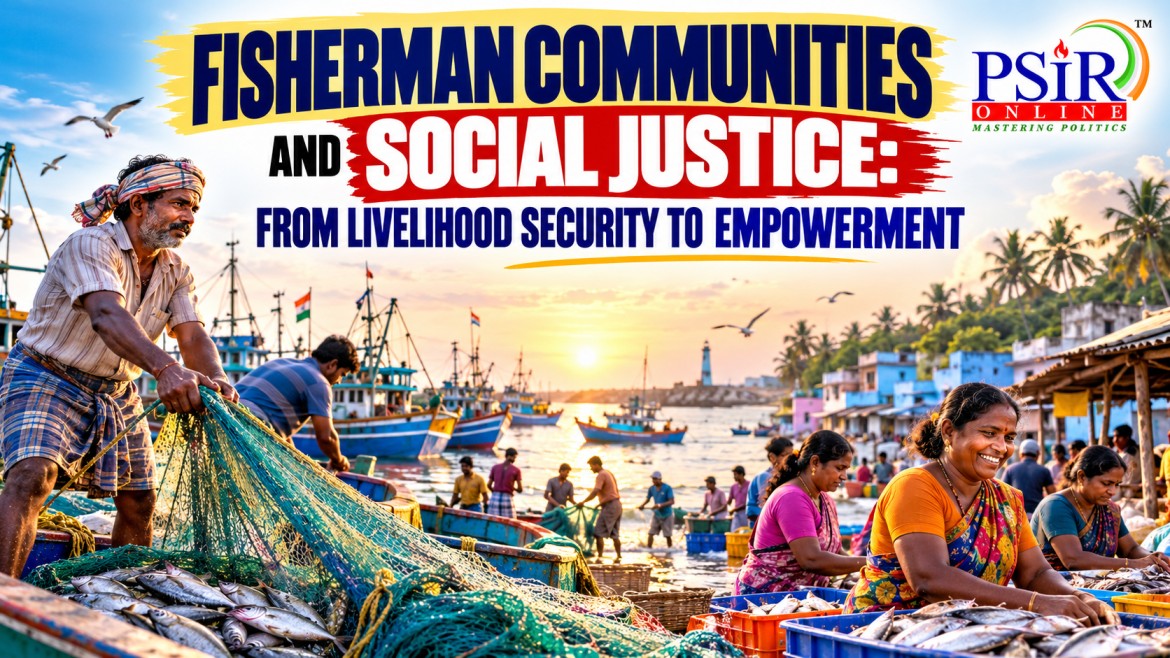
India's fishing communities occupy a distinctive position within the country's social and economic landscape. Fishing is not merely an occupation; for millions of coastal households, it is a way of life closely connected with traditional knowledge, community institutions, coastal ecosystems and local economies.
Yet fishing remains a high-risk and largely informal occupation. Traditional fishers face unpredictable weather, seasonal fishing bans, rising input costs, limited access to formal credit, post-harvest losses and dependence on intermediaries. Small-scale fishers are particularly vulnerable because they often possess limited productive capital and have weak bargaining power in formal markets.
UNION GOVERNMENT’S APPROACH TOWARDS UPLIFTMENT
The Union Government's response has increasingly moved beyond fisheries production towards livelihood security, capital formation, entrepreneurship, social protection and technological modernisation.
The creation of the Ministry of Fisheries, Animal Husbandry and Dairying in 2019 provided a dedicated institutional framework for the sector. Its flagship intervention, the Pradhan Mantri Matsya Sampada Yojana (PMMSY), with an outlay of ₹20,050 crore, seeks to modernise fisheries while strengthening the livelihoods of fishing communities.
The Union's approach can broadly be understood through two interconnected pillars:
Capital Formation & Entrepreneurship + Social Security
The first seeks to make fishing economically productive and market-oriented. The second seeks to protect fishing households against the risks inherent in a seasonal and hazardous occupation.
1. Capital Formation & Entrepreneurship
Traditional marine fishing suffers from low capital intensity, high post-harvest losses (20–25%), and reliance on informal middlemen. The Union Government tackles asset creation and entrepreneurship through specific financial and infrastructure mechanisms:
Capital Subsidy Model under PMMSY: PMMSY provides back-ended capital subsidies for acquiring productive assets (mechanized boats, biofloc units, recirculating aquaculture systems (RAS), cold rooms, insulated vans, and cages):
· General Category: Up to 40% of the project unit cost is subsidized.
· Special Categories (SC, ST, and Women): Up to 60% of the project unit cost is subsidized to induce targeted capital formation.
Deep-Sea Fishing & Fleet Modernization: To divert coastal traditional fishermen away from heavily depleted territorial waters (especially trawling) toward the Exclusive Economic Zone (EEZ):
· Support is provided to traditional fisher groups, SHGs, and cooperatives to acquire Deep-Sea Tuna Longliners and Gillnetters.
· Subsidies are also extended for retrofitting traditional boats with bio-toilets, refrigeration units, and modern navigational/communication equipment (e.g., ISRO’s NAVIC transponders and satellite receivers).
Fisheries and Aquaculture Infrastructure Development Fund (FIDF): Created with a corpus of ₹7,522+ crore, FIDF addresses macro-level infrastructure gaps:
· Provides concessional loans with up to 3% interest subvention via NABARD, NCDC, and scheduled banks.
· Funds the development of modern fishing harbors, fish landing centers, ice plants, cold storages, and automated processing plants to prevent distress sales.
Entrepreneurship Promotion & Institutional Collectives: Fish Farmer Producer Organizations (FFPOs): On the lines of agricultural FPOs, the Union supports the aggregation of small-scale fishers and fish farmers into producer companies to give them collective bargaining power, bulk input procurement, and direct market linkage.
· Fisheries Start-up & Incubation: Setting up fisheries business incubators (such as the LINAC-NCDC Fisheries Business Incubation Centre in Gurugram) to mentor tech-enabled seafood processing, cold chain logistics, and direct-to-consumer (D2C) marketing ventures.
· Pradhan Mantri Matsya Kisan Samridhi Sah-Yojana (PMMKSSY): A sub-scheme under PMMSY specifically structured to formalize micro and unorganized fish vendors, providing micro-grants and performance incentives to adopt digital transactions and formal business registration.
Focus on Fisherwomen Entrepreneurs: Women are prioritized for value-added post-harvest operations—dry fish processing yards, kiosk distribution networks, seaweed farming rafts, and retail vending kiosks—with the maximum 60% subsidy cap.
· Working Capital via KCC: The Kisan Credit Card (KCC) facility was extended to fishers and fish vendors, providing short-term collateral-free working capital loans (up to ₹2 lakh at an effective interest rate of 4% after subvention) to eliminate dependence on local moneylenders for ice, fuel, and daily fish auction bids.
2. Social Security Measures by the Union
Because fishing is classified as an unorganized, high-hazard occupation subject to seasonal weather bans and sea perils, the Union provides structural social security:
Group Accident Insurance Scheme (GAIS): Implemented under PMMSY, this covers traditional fishers, fish workers, and coastal vendors aged 18 to 70 across coastal states:
· ₹5,00,000 in the event of accidental death or permanent total disability.
· ₹2,50,000 for permanent partial disability.
· ₹25,000 for hospitalization expenses resulting from an accident.
· Zero Cost to Fishers: The annual premium is fully borne by the Central and State Governments (traditionally a 60:40 or 50:50 sharing ratio), requiring no out-of-pocket contribution from the beneficiary.
Livelihood and Nutritional Support During Fishing Ban/Lean Periods: During the annual marine fishing ban (monsoon breeding ban of 61 days) and rough weather lean periods:
· The Union participates in a tripartite/bipartite Savings-cum-Relief scheme.
· Beneficiary fishers contribute a nominal monthly sum over their working months (e.g., ₹1,500 total), which is matched by matching contributions from the Centre and State, and disbursed during the non-fishing months (typically ₹4,500 total) to ensure basic nutritional security.
Sea Safety & Disaster Communication: Free or highly subsidized distribution of transponders, distress alert transmitters (DATs), and satellite-based communication systems (NAVIC) to marine boats so vessels operating beyond the 12-nautical-mile limit receive cyclonic warnings and can send SOS alerts to the Indian Coast Guard.
· Establishing cyclone shelters and basic social amenities in recognized coastal fishing hamlets.
STRUCTURAL LIMITATIONS OF THE UNION APPROACH
Despite the expansion of financial assistance, infrastructure and social protection, significant structural challenges remain.
Credit hesitancy is one such problem. Commercial banks may remain reluctant to lend to small traditional fishers because of perceived repayment risks and the absence of conventional collateral such as immovable property. More importantly, there is a concern regarding the distribution of capital support itself.
Capital-intensive fisheries programmes can potentially favour larger boat owners, organised enterprises and aquaculture developers who have greater capacity to prepare projects, access institutional finance and provide matching investment.
Small-scale fishers using traditional catamarans and country craft may have much weaker access to these opportunities. This creates a fundamental social-justice question:
Does fisheries modernisation empower the smallest fisher, or does it primarily increase the productive capacity of those who already possess capital?
Therefore, the success of fisheries policy cannot be measured only by investment, production or export growth. It must also be measured by whether the small and traditional fishing household gains productive assets, better market access, safer working conditions, stronger bargaining power and greater social security.
ROLE OF STATE GOVERNMENTS
While the Union Government provides the national policy framework and major financial support through PMMSY and related schemes, States are critical for translating these interventions into actual livelihood security for fishing communities.
State governments are responsible for identifying beneficiaries, implementing fisheries projects, supporting cooperatives and fisher groups, developing landing centres and local infrastructure, facilitating access to credit and subsidies, and delivering welfare and safety measures at the ground level.
Their role is particularly important because fishing communities face State-specific challenges arising from local marine ecology, coastal geography, fishing practices and market conditions.
|
State Name |
Capital Formation & Entrepreneurship |
Social Security Measures |
|
Tamil Nadu |
• Capital Formation & Fleet Upgrades: Provides massive capital subsidies (up to 50%) for the motorization of traditional country crafts (OBMs/IBMs) and long-distance deep-sea gillnetter/tuna longliner conversions to steer fishers away from the Palk Bay trawling zone. • Operational Input Subsidies: Extensive sales tax exemption/rebates on High-Speed Diesel (HSD) for mechanized boats (up to 18,000–21,600 liters/year) and subsidized industrial kerosene quotas for motorized country crafts. • Micro-Enterprises for Fisherwomen: Distribution of subsidized insulated ice boxes, modern fish vending kiosks, and interest-free/micro-credit bank linkage through the Tamil Nadu Women Development Corporation (TNCDW) and coastal SHGs for value-added dry fish processing and seaweed cultivation. |
• Lean Season & Fishing Ban Relief: Disburses direct cash transfers—providing ₹7,000 per family during the annual 61-day marine breeding ban, complemented by the Special Fishermen Lean Period Assistance Scheme (₹6,000 per family) during monsoons. • Tamil Nadu Fishermen Welfare Board (TNFWB): Statutory social security providing accidental death/missing at sea relief (₹2 to ₹5 lakh), natural death aid, disability compensation, educational scholarships, and marriage/maternity assistance. • Distress & Conflict Compensation: Daily subsistence allowances and legal aid for the families of Tamil fishermen arrested or detained by the Sri Lankan Navy, alongside financial relief for seized or damaged boats. |
|
Kerala |
• Matsyafed Integrated Model: The Kerala State Co-operative Federation for Fisheries Development (Matsyafed) extends subsidized bankable term loans with NCDC backing for custom craft-gear packages, motorization (up to 50% engine subsidy), and community-owned net factories. • Elimination of Middlemen: Matsyafed operates primary beach-level fish auction centers and retail chain outlets ("Fish Marts" and value-added kiosks), securing 100% direct realization of dockside prices for the fishermen. • Women Micro-Credit & Mobility: Micro-finance schemes at nominal (or zero) interest for women vendors, paired with dedicated public transport infrastructure like the "Vanitha Bus" to ferry fish vendors directly from harbor landings to city retail markets. |
• Kerala Fishermen's Welfare Fund Board (Matsyaboard): A model social security institution funding dedicated monthly old-age pensions for active marine and inland fishers, widow pensions, and educational aid (scholarships and coaching for professional degrees). • Matsyafed Input Security Scheme (MISS): A dedicated risk fund protecting fishers against loss or accidental destruction of engines, crafts, and nets at sea due to rough weather or marine hazards.
|
|
Andhra Pradesh |
• Operational Subsidies & Input Relief: Under YSR Matsyakara Bharosa, provides a direct front-end diesel subsidy of ₹9 per liter through 81+ designated coastal fuel filling stations, substantially slashing operational voyage costs for motorized and mechanized boat owners. • Aqua Infrastructure & Quality Control: Heavy power tariff subsidies (slashed to ₹1.50 per unit) for brackish-water and coastal aqua-farmers; established 46 integrated testing "Aqua Labs" across coastal districts to test water, soil, seed, and feed quality. • Leased Canals & Marketing: Allots government-managed saline canals on long-term concessional leases to traditional inland and coastal fisher societies for hatcheries, cage culture, and fingerling stocking. |
• Ban Period Direct Cash Transfer: Disburses an unconditional direct benefit transfer of ₹10,000 per family during the annual 61-day marine fishing ban (April–June) to all mechanized, motorized, and traditional raft/non-motorized boat workers. • Enhanced Accidental Ex-Gratia: Provides ₹10 lakh ex-gratia compensation to the next of kin of any active marine fisherman (aged 18–60) who loses their life or goes missing while fishing at sea. • Universal Saturation Delivery: Uses the village/ward secretariat network and coastal volunteer cadre to deliver pension kanuka, seasonal relief, and accidental documentation at the doorstep. |
|
Odisha |
• Matsyadubi & Mechanization: Provides 50% capital subsidies for the motorization of traditional country craft and conversion of bottom trawlers into ocean-going longliners. • Aquaculture Enterprise Grants: Under the state's Fishery Policy, offers back-ended capital subsidies (up to 40–50%) to unemployed rural youth, SHGs, and Primary Fishermen Cooperative Societies (PFCS) for commercial biofloc units, inland fish seed hatcheries, and cage culture in reservoirs. • Fisherwomen SHG Leasing: Prioritizes women-led Mission Shakti Self Help Groups for long-term operational leases of gram panchayat water bodies (tanks and ponds) for community pisciculture and direct retail vending. |
• Marine Sanctuary & Ban Compensation: Provides a dedicated seasonal livelihood assistance grant (₹15,000 per family) for marine fishers affected by the mandatory 7-month prohibition on sea fishing near the Gahirmatha Marine Sanctuary and olive ridley sea turtle nesting mouths (Rushikulya and Dhamra). • Disaster Early-Warning Infrastructure: Installs marine emergency warning sirens, VHF wireless sets, and GPS/NAVIC receivers across traditional fishing villages bordering the cyclone-prone Bay of Bengal coast. • State Fisher Welfare Trust: Provides direct group accident insurance coverage (₹2 to ₹4 lakh), educational stipends for children of marine fishers, and seasonal interest-subsidized emergency consumption loans during adverse weather. |
|
Gujarat |
• Heavy Fuel & Sales Tax Subsidies: Extensive state-level VAT/Sales tax reimbursement schemes on High-Speed Diesel and kerosene for Gujarat’s large mechanized fleet (especially based in Veraval, Porbandar, and Mangrol), directly reducing input expenditures for long voyages. • Harbor Industrialization: Significant state equity investments in the modernization and dredging of major fishing harbors, breakwaters, automated auction halls, and industrial cold-chain corridors under the Gujarat Maritime Board (GMB). • High-Sea Communication & Asset Grants: Up to 75% subsidies for traditional and deep-sea vessels to install transponders, Automatic Identification Systems (AIS), and satellite communicators for navigation near the International Maritime Boundary Line (IMBL). |
• Pakistani Custody Relief Scheme: Disburses a daily maintenance subsistence allowance (₹300 to ₹400/day) to the families of Gujarati fishermen apprehended and detained by the Pakistan Maritime Security Agency (PMSA) along the Sir Creek/Arabian Sea border. • Vessel Capture Compensation: One-time capital compensation / rehabilitation ex-gratia provided to boat owners whose mechanized boats are permanently seized or impounded by Pakistan. • Group Insurance & Port Safety: Universal zero-premium personal accident insurance cover (₹4 to ₹5 lakh) for all coastal-registered crew members and fish laborers working on offshore vessels. |
|
State Name |
Capital Formation & Entrepreneurship |
Social Security Measures |
|
Karnataka |
• Tax-Free Diesel Delivery: Reimburses 100% of sales tax on high-speed diesel (HSD) for mechanized and motorized boats up to a ceiling of 2.0 lakh liters per boat annually, distributed through coastal fishermen cooperative bunk outlets. • Matsya Siri & Modern Craft: Extends 50% capital subsidies for purchasing modern deep-sea tuna longliners, motorized fiberglass reinforced plastic (FRP) crafts, and eco-friendly insulated boxes. • Cooperative Credit (Ksheera/Matsya Bandhu): Extends interest-free (0% interest) short-term working capital loans up to ₹50,000 to fisherwomen vendors via coastal Primary Fishermen Cooperative Societies and DCC banks to eliminate private informal credit. |
• Matsya Ashraya Housing Scheme: Fully state-funded coastal pucca housing scheme offering unit grants (up to ₹1.2 to ₹1.5 lakh) to homeless and low-income marine fishermen households along the Karavali coast. • Distress Relief Fund (CM Relief for Fishers): Provides ₹6 lakh ex-gratia compensation for deaths or missing fishers during deep-sea operations, along with salvage financial aid for capsized hulls. • Lean Period DBT Support: Matches Union assistance during the 61-day monsoon ban, supplemented by targeted coastal food grain distribution through public distribution system (PDS) fair-price shops. |
|
Maharashtra |
• Diesel VAT Refund Model: Full online rebate/refund of Value Added Tax (VAT) on diesel used by registered mechanized fishing boats, processed directly via biometric bank-linked portals. • Cold Chain & Post-Harvest Grants: Provides 40–50% capital subsidies for insulated refrigerated vans, flake-ice plants, and solar drying units under the State Co-operative Fisheries Federation (Maha Matsya). • Sagarmitra & Tech Onboarding: Grants for modern wireless VHF sets, distress alert transmitters (DATs), and GPS fish-finders, along with specialized credit lines for Koli women fish-vending self-help groups (Bachat Gats). |
• Disaster & Sea-Hazard Compensation: Direct state ex-gratia (up to ₹5 lakh) for loss of life or permanent disability due to maritime storms and vessel collisions along the Konkan coast. • Missing Fisherman Family Subsistence: Monthly subsistence maintenance allowances provided to families of fishers untraced for over 6 months following high-sea cyclonic events. • Coastal Housing & Hamlet Infrastructure: Village-level amenities including clean landing yards, community auction shelters, and net-mending sheds for traditional Koliwadas. |
|
Goa |
• Modern FRP Canoe & Gear Subsidy: Up to 50% capital assistance (60% for SC/ST and Fisherwomen) for the construction/purchase of new FRP/wooden fishing canoes (under 26 feet) and modern net outfits. • Motorization & Outboard Motors (OBM): Grants up to 50% subsidy for the acquisition of 2-stroke and 4-stroke outboard marine engines to replace manual oars. • Retail Modernization for Women: Distribution of subsidized customized two-wheelers fitted with insulated iceboxes and solar-powered retail kiosks for traditional Goan fish vendors (Ramponkars/Khazan vendors). |
• Goa Fishing Ban Relief: Direct financial assistance disbursed to crew workers and traditional fishers facing seasonal unemployment during the mandatory 61-day monsoon ban (June–July). • Traditional Fishermen Welfare Corpus: Special medical treatment assistance, maternity benefits for women vendors, and funeral assistance disbursed through the Directorate of Fisheries. • Asset Protection Grant: Compensation up to 50% of assessed valuation for physical damages sustained by traditional registered canoes and nets due to rough sea squalls or coastal erosion. |
|
West Bengal |
• Benfish Cooperative Infrastructure: The State Fisheries Development Corporation (BENFISH) finances landing jetties, mechanical net-making factories, and retail kiosk chains (Benfish Outlets), connecting coastal fishers directly to urban consumer markets in Kolkata and Howrah. • Estuarine & Coastal Brackish Aquaculture: Direct subsidies and training for youth and cooperative societies in Kakdwip, Namkhana, and Digha for saline polyculture, crab fattening, and modern tiger shrimp hatcheries. • Motorization Grants: Subsidies for retrofitting traditional country boats operating across the Sunderbans delta with marine diesel engines and insulated fish chests. |
• Samudra Sathi Scheme: Disburses a direct cash transfer of ₹5,000 per month (for 2 months, totaling ₹10,000) to marine fishers during the annual breeding prohibition period (mid-April to mid-June). • Sunderbans Hazard & Tiger Attack Compensation: Dedicated ex-gratia relief (up to ₹4 to ₹5 lakh) for estuarine fishers and crab-catchers killed or disabled by tiger/crocodile attacks or severe cyclonic surges in the tidal zones. • Group Personal Accident Coverage: Completely state-sponsored premium for accidental loss of life at sea, paired with institutional support for emergency satellite communication along the northern Bay of Bengal. |
HOW DO GOVERNMENTS COLLECTIVELY EMPOWER FISHING COMMUNITIES?
The empowerment of fishing communities cannot be achieved through a single subsidy or welfare scheme. Their vulnerability is multidimensional: they face low productive capital, seasonal income, occupational hazards, weak bargaining power, post-harvest losses, dependence on informal credit and exposure to climate and marine risks.
Therefore, government intervention has to operate simultaneously across the economic, social, financial, technological and human-security dimensions.
|
Dimension of empowerment |
How government interventions create empowerment |
|
1. Productive Asset Ownership |
PMMSY capital subsidies help fishers acquire boats, cages, cold rooms, aquaculture systems and other productive assets. Higher assistance for SCs, STs and women seeks to reduce unequal access to capital. The objective is to move fishing households from low-capital livelihoods towards asset-based livelihoods. |
|
2. Access to Affordable Credit |
KCC facilities, FIDF and institutional finance reduce dependence on informal moneylenders. Access to working capital for fuel, ice, maintenance and fishing operations allows fishers to retain greater control over their economic activity. Credit therefore becomes a tool of economic autonomy. |
|
3. Collective Bargaining Power |
FFPOs, cooperatives and SHGs enable small fishers to aggregate production, procure inputs collectively and negotiate with markets. This addresses one of the fundamental weaknesses of small-scale fishing—the individual fisher's limited bargaining power against traders and intermediaries. |
|
4. Market and Value-Chain Empowerment |
Fishing communities are increasingly supported not merely as producers but as participants in processing, storage, transportation, branding and direct marketing. Cold chains, ice plants, landing centres and processing infrastructure can reduce distress sales and allow fishers to capture a greater share of the value generated by their produce. |
|
5. Women's Economic Empowerment |
Support for fisherwomen in dry-fish processing, seaweed cultivation, vending kiosks and other post-harvest activities recognises women as economic actors within the fisheries value chain. Targeted subsidies and working-capital support can transform traditionally informal activities into more organised livelihoods and enterprises. |
|
6. Occupational and Social Security |
GAIS, health-related protection and livelihood support during fishing bans reduce the consequences of accidents, disability and seasonal income interruption. Social security ensures that one accident or one fishing season does not push an entire household into economic distress. |
|
7. Technology and Safety |
NAVIC-enabled transponders, distress alert systems and satellite communication improve the ability of fishing vessels to receive warnings and communicate emergencies. Technology therefore serves not only productivity but also the protection of human life. |
|
8. Entrepreneurship and Diversification |
Fisheries incubators, PMMKSSY and support for micro-enterprises create opportunities beyond the traditional act of catching fish. Processing, cold-chain logistics, retail, aquaculture and digital marketing can diversify household income and reduce dependence on a single hazardous occupation. |
|
9. Ecological and Livelihood Security |
Fishing bans are necessary for marine-resource sustainability, but savings-cum-relief mechanisms recognise that conservation can temporarily reduce household income. The combination of resource conservation + livelihood support makes environmental regulation more socially sustainable. |
|
10. From Welfare Recipient to Economic Citizen |
The combined approach changes the policy objective itself. The fisher is not viewed merely as someone requiring compensation or relief, but as a producer, entrepreneur, worker, consumer, credit recipient and rights-bearing citizen who should participate in the wider fisheries economy. |
However, empowerment is meaningful only when the smallest and most vulnerable fisher benefits. If capital subsidies, credit and modern infrastructure disproportionately reach larger boat owners and better-capitalised enterprises, the fisheries sector may modernise without producing equivalent social empowerment. Therefore, the ultimate test of fisheries policy should be:
Not merely how much fish India produces, but whether the fisher who catches the fish gains greater security, bargaining power, income and dignity from the fisheries economy.
UPSC DIMENSION
The development of fishing communities is not merely a fisheries-policy issue. It brings together livelihood security, social justice, economic empowerment, cooperative institutions, environmental sustainability, gender equality and the constitutional vision of a welfare state.
|
UPSC Dimension |
How to connect fishing-community empowerment with this dimension |
|
1. Constitutional Dimension – Articles 14, 21, 38, 39 and 46 |
Article 14 provides the broader principle of equality, which becomes relevant when examining unequal access to credit, productive assets, infrastructure and government support among fishing communities. Article 21, through the right to life with dignity, can be connected with occupational safety, protection against livelihood shocks and access to basic living conditions in coastal settlements. Article 38 directs the State to promote social justice and reduce inequalities, while Article 39(a) emphasises adequate means of livelihood. Article 39(b) is particularly relevant to the equitable distribution of material resources for the common good. Article 46 strengthens the case for targeted support to socially and economically disadvantaged sections, including where fishing communities overlap with SC/ST populations. Thus, fisheries welfare can be presented as an application of the Constitution's broader commitment to social and economic justice. |
|
2. Social Justice and Inclusive Development |
Fishing communities should not be viewed only as beneficiaries of a productive sector. Many small-scale fishers face occupational hazards, seasonal income, weak bargaining power, informal credit dependence and inadequate access to productive capital. Government interventions such as targeted PMMSY subsidies, insurance, livelihood support, credit and collective organisations seek to reduce these structural disadvantages. The important UPSC linkage is therefore substantive equality: treating every fisher identically may not produce equality when some households lack boats, cold storage, formal credit or market access. Targeted assistance to women, SCs and STs demonstrates how public policy can use differentiated support to create more equal economic opportunities. |
|
3. Economic Empowerment and Inclusive Growth |
Fisheries policy connects directly with the question of whether economic growth creates opportunities for the smallest producers. Capital subsidies, KCC, FIDF, cold chains, processing facilities and FFPOs attempt to move fishers from low-productivity primary production towards asset ownership, value addition and entrepreneurship. Students can therefore use fishing communities as an example of inclusive growth, where the objective is not simply to increase fish production or exports but to ensure that primary producers capture a greater share of the value generated by the sector. The distinction between production growth and distribution of economic gains is particularly important for answers on inclusive development. |
|
4. Cooperative Institutions, Collective Action and Governance |
Individual small fishers often possess limited bargaining power against traders, financiers and larger market actors. FFPOs, cooperatives and SHGs address this problem by enabling collective procurement, marketing and access to finance. This connects fisheries policy with broader UPSC themes of cooperative institutions, decentralisation and participatory governance. The State's role is not necessarily to replace community institutions but to provide finance, infrastructure, technology and institutional support through which communities can strengthen their own economic organisation. This provides an important governance lesson: empowerment is stronger when communities participate in managing and benefiting from development rather than remaining passive recipients of government assistance. |
|
5. Gender and Social Inclusion |
Fisherwomen are often heavily involved in drying, processing, vending, marketing and other post-harvest activities, even when their contribution is less visible than fishing at sea. Targeted subsidies and support for women-led enterprises can therefore transform women's role from unpaid or informal contributors into recognised economic actors and entrepreneurs. In a UPSC question on women's economic empowerment, care work, informal employment or inclusive development, fisheries can provide a concrete example of how policy can strengthen women's control over productive assets, credit and income-generating activities. The focus should be not merely on “women as beneficiaries” but on women as producers, entrepreneurs and participants in value chains. |
|
6. Environmental Sustainability and Livelihood Security |
Fishing communities demonstrate the difficult relationship between ecological conservation and livelihood protection. Measures such as seasonal fishing bans may be necessary to protect breeding cycles and long-term marine resources, but they also temporarily remove the primary source of income for fishing households. Savings-cum-relief mechanisms therefore illustrate an important principle of sustainable development: environmental regulation must account for the livelihood costs imposed on vulnerable communities. This can be connected to questions on climate change, blue economy, sustainable development, common-pool resources and environmental justice. The larger argument is that conservation becomes socially sustainable when affected communities receive adequate livelihood protection and participate in resource management. |
|
7. Policy Design, Implementation and Cooperative Federalism |
Fisheries development illustrates the difference between policy formulation and policy delivery. The Union establishes national frameworks such as PMMSY, provides financial assistance and develops institutions, while State governments identify beneficiaries, implement schemes, support cooperatives and provide local infrastructure and welfare measures. This makes fisheries a useful example for questions on cooperative federalism, last-mile delivery and implementation capacity. At the same time, the variation between States shows that national schemes must be adapted to different coastal ecologies, fishing practices, community structures and local economies. The key governance lesson is that central funding alone does not guarantee empowerment; effective implementation requires State capacity, local institutions and community participation. |
WAY FORWARD
1. Put small-scale fishers at the centre of fisheries policy
Capital subsidies and infrastructure should prioritise traditional and artisanal fishers who have the weakest access to productive assets and institutional finance.
2. Strengthen community-based institutions
FFPOs, cooperatives and SHGs should be deepened so that fishers gain greater bargaining power in input procurement, marketing, processing and exports.
3. Expand affordable and collateral-light credit
KCC and other institutional credit mechanisms need stronger last-mile delivery so that dependence on informal moneylenders is reduced.
4. Build an integrated fisheries value chain
Investment should move beyond boats and harvesting towards cold chains, storage, processing, branding and direct markets, enabling fishing households to capture greater value.
5. Recognise fisherwomen as economic actors
Women should receive greater access to productive assets, credit, technology, training and market infrastructure in post-harvest fisheries activities.
6. Make social protection portable and comprehensive
Accident insurance, livelihood support during fishing bans, health protection and disaster assistance should reach all eligible workers, including those in informal and mobile occupations.
7. Combine conservation with livelihood security
Fishing restrictions must be accompanied by adequate income support and alternative livelihood opportunities so that environmental conservation does not disproportionately burden vulnerable households.
8. Strengthen climate and disaster resilience
Cyclones, changing marine ecosystems and extreme weather increasingly threaten coastal livelihoods. Early-warning systems, safe infrastructure, insurance and livelihood diversification must therefore become integral to fisheries policy.
9. Ensure technology reaches the smallest fisher
Modern navigation, communication, cold-chain and processing technologies should not remain concentrated among larger operators. Public policy must prevent a digital and technological divide within the fisheries sector.
The larger objective should be: Asset ownership + affordable credit + market power + social security + ecological sustainability = resilient fishing communities.
CONCLUSION
Fishing communities are not merely beneficiaries of welfare. They are producers, entrepreneurs, workers, consumers and custodians of India's coastal and marine economy.
Government intervention has therefore increasingly moved beyond traditional fisheries development towards a broader model combining productive assets, institutional credit, infrastructure, collective organisation, women's economic participation, insurance, safety and livelihood protection.
Yet the real test of fisheries policy lies at the bottom of the pyramid. Modernisation should not simply increase production or capital investment; it must ensure that the small traditional fisher, fisherwoman, fish vendor and coastal household gain greater income security, bargaining power and dignity.
The objective of fisheries development should not merely be to produce more fish, but to ensure that the people whose livelihoods depend on the sea can live with greater security, resilience and dignity.
FURTHER READING
· Pradhan Mantri Matsya Sampada Yojana (PMMSY)
· Ministry of Fisheries, Animal Husbandry and Dairying
· Fisheries and Aquaculture Infrastructure Development Fund (FIDF)
· Pradhan Mantri Matsya Kisan Samridhi Sah-Yojana (PMMKSSY)
· Kisan Credit Card for Fishers and Fish Vendors
· Group Accident Insurance Scheme
· Fish Farmer Producer Organisations (FFPOs)
· Fisheries cooperatives and Self-Help Groups
· Deep-Sea Fishing and Fleet Modernisation
· Fisherwomen and the fisheries value chain
· Blue Economy and sustainable fisheries
· Marine conservation and livelihood security
· Climate change and coastal communities
· Coastal disaster resilience and social protection
GS PAPER II – MAINS PRACTICE QUESTIONS
10 Marks | 150 Words
1. Fishing communities in India face a combination of livelihood insecurity, occupational hazards and limited access to institutional finance. Examine the role of government intervention in addressing these challenges.
2. How can targeted financial assistance and collective institutions such as FFPOs contribute to the social and economic empowerment of traditional fishing communities?
15 Marks | 250 Words
3. “The development of fishing communities requires a shift from fisheries production to livelihood-centred fisheries governance.” Discuss in the context of India's fisheries policies.
4. Climate vulnerability, seasonal fishing restrictions and market dependence make fishing communities particularly vulnerable to livelihood shocks. Examine how social protection and sustainable fisheries governance can address this vulnerability.
