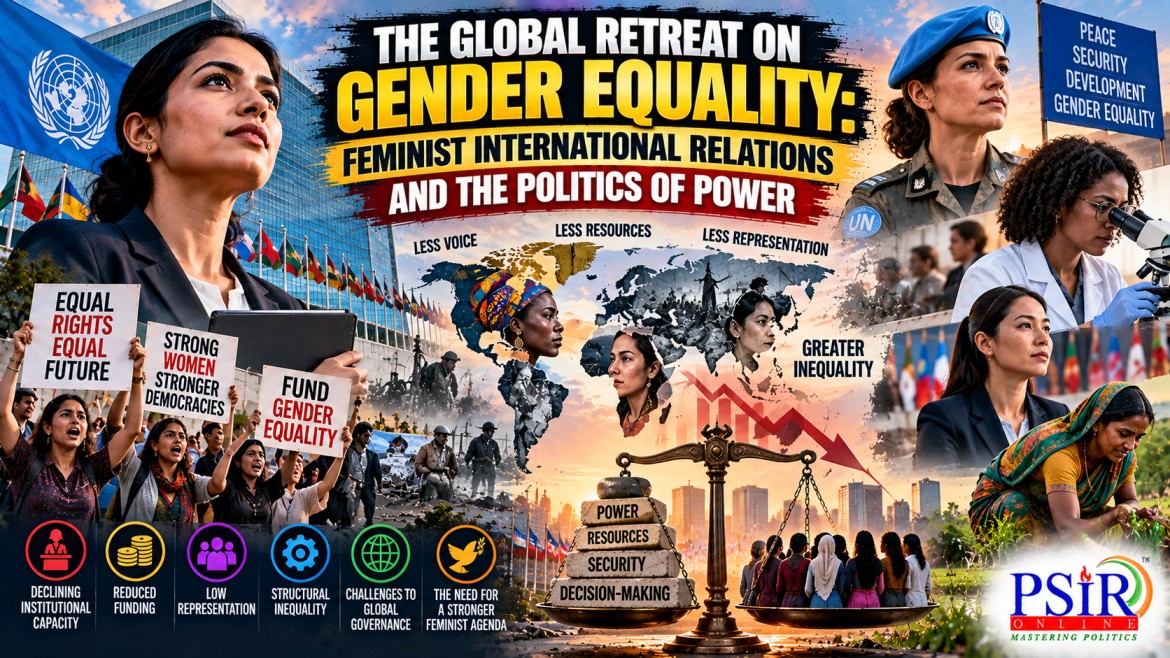
Gender equality has long been recognised as a fundamental human right and a prerequisite for sustainable development. International frameworks such as the Convention on the Elimination of All Forms of Discrimination against Women (CEDAW), the Beijing Declaration and Platform for Action, and Sustainable Development Goal 5 have established commitments to women's rights, political participation and equal opportunities. Yet formal commitments have not translated into equal control over political institutions, financial resources or global decision-making.
The Gender Snapshot 2026, released by UN Women and the United Nations Department of Economic and Social Affairs (UN DESA) on 17 September 2026, highlights a worrying reversal. Institutional mechanisms established to advance gender equality are losing authority, funding is declining, and women's representation in influential positions remains limited. The report estimates that, at the current pace, gender equality remains approximately 171 years away.
This retreat raises a fundamental question for International Relations: can global governance be considered inclusive when women remain under-represented in the institutions that determine international security, economic policy and development priorities? Feminist International Relations approaches this question by examining how power is distributed, whose interests shape international institutions, and how apparently gender-neutral policies may reproduce structural inequalities.
THE GENDER SNAPSHOT 2026: EVIDENCE OF INSTITUTIONAL RETREAT
The Gender Snapshot 2026 demonstrates that the challenge extends beyond slow progress in representation. It concerns the weakening of institutions responsible for translating gender-equality commitments into public policy.
|
Indicator |
Key finding reported in 2026 |
|
Institutional authority |
32% of national gender-equality mechanisms reported erosion of institutional power over the preceding two years. |
|
Institutional budgets |
Around one in four reported operating-budget cuts, while nearly one in ten lost control over their budgets. |
|
UN institutional capacity |
42% of UN entities reported weakening of their gender-equality efforts amid funding cuts. |
|
International financing |
Funding for gender equality fell to its lowest level since 2021; women's rights organisations were particularly affected. |
|
National leadership |
Six in seven countries were led by men. |
|
Parliamentary representation |
Women held 27.4% of seats in national parliaments globally as of 1 January 2026. |
|
High-level corporate leadership |
Women occupied only 6% of chief executive officer positions globally. |
Source: UN Women and UN DESA, The Gender Snapshot 2026; UN Sustainable Development Goals Report 2026.
These indicators reveal a distinction between formal recognition and effective institutional capacity. A government may retain a ministry for women's affairs, gender-equality legislation and international treaty commitments while reducing the personnel, authority and resources necessary to implement them.
The findings do not establish that every country is experiencing an identical reversal. They nevertheless indicate a wider international challenge: the institutions responsible for advancing equality may lose effectiveness even when the language of equality remains embedded in official commitments.
FEMINIST INTERNATIONAL RELATIONS: GENDER AS A STRUCTURE OF POWER
Feminist International Relations challenges the assumption that international politics can be adequately understood through states, military capabilities and economic interests alone. It examines how gendered hierarchies influence security, diplomacy, political authority and the distribution of resources.
Traditional approaches frequently treat the state as a unified actor and international institutions as neutral arenas of cooperation. Feminist perspectives ask whose experiences inform these institutions, who occupies positions of authority, and whose concerns are excluded from policy priorities.
The retreat identified by the Gender Snapshot can therefore be interpreted as a struggle over the distribution of political power. Reduced funding for women's organisations may weaken their capacity to influence legislation, document violations, participate in negotiations and hold governments accountable. Reduced institutional authority can also make gender-sensitive policy less effective across health, employment, education, peacebuilding and economic governance.
Feminist International Relations does not assume that women constitute a single political group with identical interests. Class, race, nationality, disability, ethnicity and economic position shape women's experiences differently. Its central contribution is to demonstrate that gender is an organising dimension of power, rather than a peripheral issue to be added after major political and economic decisions have been made.
FUNDING, INSTITUTIONAL CAPACITY AND THE POLITICS OF GLOBAL GOVERNANCE
Financial resources determine whether international commitments can be implemented. Gender-equality institutions require adequate budgets, trained personnel, reliable data, legal authority and access to decision-making forums. When these capacities decline, governments and international organisations may retain ambitious declarations while their ability to deliver measurable outcomes weakens.
The Gender Snapshot 2026 reported that funding for gender equality had fallen to its lowest level since 2021. The UN system is also affected: 42% of UN entities reported weakened gender-equality efforts. These findings connect the gender-equality debate with the wider problem of development-finance constraints and institutional effectiveness.
Funding reductions can produce a cumulative effect. Women's rights organisations may lose staff and regional networks; survivors may face reduced access to support; monitoring and documentation may become less comprehensive; and local organisations may find it harder to participate in international policy processes. The consequences are particularly serious in conflict-affected settings, where women-led organisations frequently provide services, document abuses and sustain community-level peacebuilding.
This is also a question of global governance. International organisations depend on member-state commitments, assessed contributions, voluntary funding and cooperation with civil society. When financial priorities shift, institutions may have limited capacity to protect programmes that lack powerful political sponsors. Budget decisions therefore influence which international commitments receive practical support and which remain largely declaratory.
At the same time, funding changes must be assessed carefully. Not every reduction has the same cause, and national budget decisions, donor priorities and organisational restructuring vary. The central issue is whether adequate, predictable and accountable financing remains available to fulfil established gender-equality commitments.
WOMEN'S UNDER-REPRESENTATION AND THE CONTROL OF POLITICAL AUTHORITY
Representation is not simply a matter of numerical inclusion. It also concerns access to the positions where decisions about security, finance, trade, technology and public expenditure are made.
The Gender Snapshot 2026 found that women held 27.4% of national parliamentary seats globally as of January 2026. It also reported that six in seven countries were led by men. Women remained particularly under-represented in portfolios associated with major concentrations of state power: close to nine in ten defence ministers and more than eight in ten finance ministers were men.
These patterns demonstrate the difference between descriptive representation and substantive influence. Descriptive representation concerns whether decision-making bodies reflect the population's diversity. Substantive representation concerns whether institutions respond to the needs, rights and interests of those represented. Neither outcome can be assumed solely from the number of women holding office.
Structural barriers remain significant. The cost of election campaigns can exclude candidates without access to substantial financial resources. Gender-based violence in public life, unequal care responsibilities, discriminatory political networks and limited access to party leadership can further restrict participation. Women who enter political institutions may also face unequal access to influential committees, senior portfolios and informal decision-making networks.
These inequalities extend beyond national politics. Women remain under-represented in international security leadership, senior judicial positions, corporate governance and the highest levels of multilateral institutions. The selection of senior international officials is therefore an important test of whether organisations committed to equality reflect that principle in their own leadership.
Meaningful participation requires more than appointments or symbolic inclusion. It involves equal access to authority, resources, agenda-setting and accountability. Without these conditions, representation may increase without substantially changing the distribution of power.
FEMINIST CRITIQUES OF INTERNATIONAL SECURITY AND ECONOMIC ORDER
Feminist International Relations broadens the meaning of security by examining how conflict, displacement, economic insecurity and political exclusion affect people differently. Conventional security debates often privilege territorial defence, military capabilities and interstate competition. Feminist analysis also considers gender-based violence, care work, access to livelihoods and the safety of displaced populations.
This perspective has practical implications for international peace and security. Women's participation in peace negotiations and peacebuilding can broaden the range of issues addressed, including civilian protection, justice, community recovery and access to public services. However, women's presence alone does not guarantee a durable settlement or an inclusive outcome. Participation must be meaningful, and its effects depend on the political context and institutional arrangements.
The economic dimension is equally important. International trade, debt arrangements, development assistance and technological change distribute costs and benefits unevenly. Women concentrated in insecure employment or unpaid care work may face disproportionate pressures when public services contract or development programmes lose funding. Women's organisations may also have fewer resources to influence the design of economic policies that affect their livelihoods.
The global retreat on gender equality consequently intersects with structural inequality in the international political economy. Decisions taken by governments, donors and multilateral institutions can shape access to employment, healthcare, education, social protection and political participation. A gender-responsive international order requires these consequences to be assessed as part of economic and security governance, rather than treated as separate social concerns.
INTERNATIONAL ACCOUNTABILITY: FROM COMMITMENTS TO IMPLEMENTATION
International gender-equality frameworks provide standards against which governments and institutions can be assessed. CEDAW establishes international obligations concerning discrimination against women. The Beijing Declaration and Platform for Action articulates a broad agenda for advancing women's rights. The 2030 Agenda for Sustainable Development places gender equality at the centre of SDG 5 and connects it with progress across the other Sustainable Development Goals.
Yet international commitments do not automatically produce domestic implementation. Governments retain substantial discretion over budgets, institutional design and enforcement. International organisations also depend on political cooperation and financial support from member states. Monitoring can identify gaps, but implementation requires domestic institutions, political incentives and sustained resources.
Several measures can strengthen accountability:
· Protect institutional independence: gender-equality mechanisms need clear mandates, adequate staffing, access to senior decision-makers and the authority to coordinate policy.
· Make financing transparent: governments and international organisations should disclose allocations, spending and results, including the consequences of funding reductions.
· Strengthen women's rights organisations: predictable funding and protection of civic space can preserve independent monitoring and participation.
· Expand meaningful representation: transparent appointments, inclusive political processes and measures against violence in public life can reduce barriers to leadership.
· Improve data and evaluation: sex-disaggregated data and gender-responsive budgeting can help identify who benefits from public expenditure and where implementation fails.
The challenge is to connect international norms with enforceable obligations, effective institutions and measurable outcomes. Progress depends not only on adopting new declarations but also on protecting existing gains and ensuring that institutions have the capacity to implement them.
THEORETICAL ANGLES
|
Theory or concept |
Application to the issue |
|
Feminist International Relations |
Examines how gendered hierarchies shape international institutions, diplomacy, security and resource allocation. |
|
Liberal Institutionalism |
Explains how international rules and organisations can promote cooperation, while highlighting the implementation gaps that arise when institutions lack authority or funding. |
|
Critical Theory |
Investigates how established power structures reproduce inequality and how institutional arrangements may privilege dominant groups. |
|
Structural Power |
Connects control over financial resources, institutional mandates and agenda-setting to the capacity to define international priorities. |
|
Representation and Democratic Legitimacy |
Distinguishes numerical inclusion from substantive influence and examines the legitimacy of decision-making bodies that remain socially unrepresentative. |
|
Global Governance |
Analyses the relationship between states, multilateral institutions, donors and civil society in implementing gender-equality commitments. |
|
Intersectionality |
Explains how gender interacts with class, race, disability, nationality and other social positions to produce unequal experiences and political access. |
CONCLUSION
The global retreat on gender equality is not adequately explained as a temporary slowdown in social progress. The Gender Snapshot 2026 points to a more structural problem involving institutional authority, financial resources and unequal access to political leadership.
Feminist International Relations makes visible the relationship between these developments and the wider distribution of international power. It questions the neutrality of institutions in which authority remains concentrated, highlights the political consequences of funding decisions, and connects women's participation with the legitimacy and accountability of global governance.
The issue is not whether gender equality should be treated as separate from security, economic development or international cooperation. It is whether these fields can achieve their stated objectives while excluding substantial sections of the population from decision-making. An inclusive international order requires more than formal commitments: it requires the institutional capacity, financing and political authority necessary to make equality effective.
RELATED READING
PRACTICE QUESTIONS FOR GS2 MAINS
PRACTICE QUESTIONS FOR PSIR
