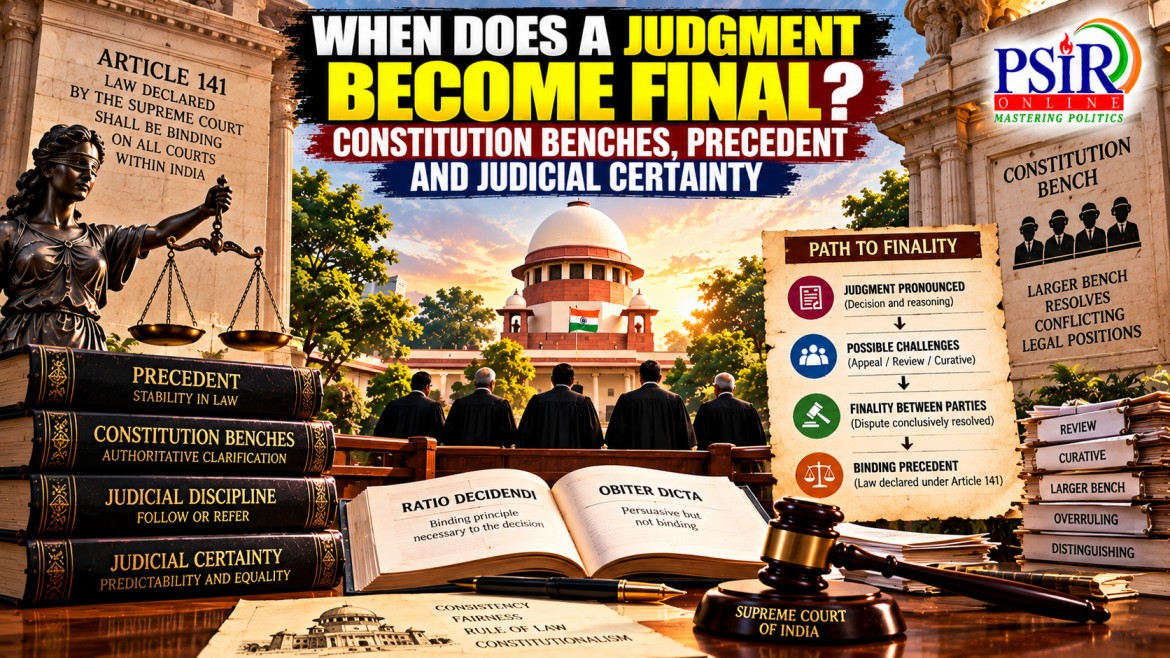
When does a judgment become final? Is it when a court announces its decision, when the parties can no longer challenge it, or when the legal principle it establishes becomes binding on future courts? These questions concern different dimensions of finality and must not be treated as interchangeable.
The Indian constitutional system distinguishes between the final disposal of a dispute, the binding force of a legal principle, and the possibility of reconsidering an earlier ruling through constitutionally recognised judicial procedures. Article 141 declares that the law laid down by the Supreme Court is binding on all courts within India. Yet the scope of that binding law depends on what the Court actually decided, the reasoning necessary to reach its conclusion, the strength of the Bench and the procedural status of the decision.
The developments spanning September and October 2026 offer a particularly useful illustration. In Arjun Flour Mills v. State of Odisha, a seven-judge Bench heard arguments on 22 September 2026 and reserved judgment. In the long-running Tamil Nadu Legislative Assembly privilege proceedings, another seven-judge Bench disposed of the case as infructuous on 6 October 2026 while leaving the substantial constitutional questions open. The first matter remained undecided after the hearing; the second was closed without resolving the underlying constitutional questions. These outcomes demonstrate why procedural finality and authoritative settlement of law are not the same thing.
WHAT DOES IT MEAN FOR A JUDGMENT TO BE FINAL?
Judicial finality has at least three distinct dimensions.
First, finality between the parties. A court may conclusively determine the rights and liabilities of the litigants before it. Once the applicable avenues of appeal, review or other permissible challenge have been exhausted or become unavailable, the dispute ordinarily reaches finality. The principle of res judicata, where applicable, prevents parties from repeatedly reopening matters already finally decided between them. However, the precise effect depends on the nature of the decision, the jurisdiction exercised and the procedural rules governing the case.
Second, finality of the judicial process. A judgment may be pronounced but remain subject to an appeal, review or other legally available proceeding. A review petition is not an ordinary second appeal; it operates within narrow legal grounds. The Supreme Court has also recognised a limited curative jurisdiction in exceptional circumstances after the dismissal of a review petition. Consequently, the announcement of a judgment does not mean that every possible judicial process has necessarily ended.
Third, finality as a precedent. A judgment may declare a legal principle that governs subsequent cases. This precedential effect is distinct from the question of whether the original litigants can continue challenging the outcome. A judgment can bind other courts on the legal issue it actually settles even while a party seeks a permissible review, subject to any stay, modification or later order affecting its operation.
These dimensions answer different questions: Has the dispute been resolved? Can the decision still be challenged? What legal rule must other courts follow? A judgment's finality cannot be understood without identifying which of these questions is being asked.
ARTICLE 141: WHAT EXACTLY BECOMES BINDING?
Article 141 provides: “The law declared by the Supreme Court shall be binding on all courts within the territory of India.”
The provision gives the Supreme Court's legal reasoning a national precedential effect. Its purpose is not simply to establish institutional hierarchy; it also promotes consistency, equality before the law and predictability in legal relationships. Similar cases should ordinarily be decided according to the same governing legal principle unless a legally recognised distinction or subsequent authoritative development justifies a different outcome.
However, Article 141 does not make every sentence in every Supreme Court judgment binding law. The binding element is principally the ratio decidendi: the legal principle necessary to decide the case in light of the material facts and issues before the Court.
This must be distinguished from several other elements of a judgment:
· Ratio decidendi: the legal rule or principle necessary to support the decision. It forms the core of binding precedent.
· Obiter dicta: observations that are not essential to the decision. They may carry considerable persuasive authority, especially when made by a Constitution Bench, but are not automatically binding in the same manner as the ratio.
· Findings of fact: determinations concerning the particular evidence and circumstances of a case. They do not automatically establish universal rules for unrelated disputes.
· The operative order: the formal relief or direction granted by the Court. It determines the immediate legal consequences for the parties, while the ratio may govern future cases.
· A reference or procedural order: an order that transfers or refers a legal question for authoritative consideration may settle a procedural issue without resolving the substantive legal question itself.
The distinction is essential because a judgment may contain broad constitutional observations while deciding a narrow legal issue. Later courts must identify the principle necessary to the actual outcome rather than extract isolated sentences and treat them as an independent rule.
In Director of Settlements, A.P. v. M.R. Apparao (2002), the Supreme Court explained the binding character of the law declared under Article 141. The binding principle must be understood in the context of the question decided; a decision cannot be treated as authority for propositions it did not actually establish.
WHY BENCH STRENGTH MATTERS
The Supreme Court does not sit as one undifferentiated body in every case. It decides matters through Benches of different strengths. The number of judges matters because the Court has developed a settled rule of judicial discipline: a Bench of lesser strength cannot overrule a binding decision of a Bench of greater strength.
A two-judge Bench must ordinarily follow a relevant decision of a three-judge Bench. If it believes the earlier decision is incorrect and cannot properly be followed, it should identify the issue and seek reference to a Bench of appropriate strength rather than disregard the precedent. A larger Bench may reconsider and, where legally justified, overrule a smaller Bench's ruling.
The rule also applies to decisions delivered by Benches of equal strength. A coordinate Bench should follow the earlier decision. If it disagrees with the legal position, the proper course is to seek reference to a larger Bench through the Chief Justice of India, rather than effectively overrule the earlier decision itself.
This is the larger-Bench rule, a central feature of judicial discipline. It does not mean that a larger Bench is always correct simply because it has more judges. Its institutional function is to ensure that a significant change in binding law occurs through an authorised process, after the issue has been properly placed before a Bench competent to reconsider it.
The Supreme Court has repeatedly affirmed this principle in Union of India v. Raghubir Singh (1989), Pradip Chandra Parija v. Pramod Chandra Patnaik (2002) and Central Board of Dawoodi Bohra Community v. State of Maharashtra (2005). These decisions explain why a smaller Bench cannot resolve its disagreement with an earlier larger Bench by simply announcing a contrary legal view.
Bench strength therefore has direct consequences for legal certainty. Without this discipline, different Benches could issue incompatible rules on the same legal question, leaving lower courts, governments, businesses and citizens uncertain about which principle governs.
CONSTITUTION BENCHES: HOW CONFLICTING LEGAL POSITIONS ARE RESOLVED
Article 145(3) requires a minimum of five judges to hear a case involving a substantial question of law as to the interpretation of the Constitution. The provision establishes the constitutional foundation for Constitution Benches. Larger Benches may also be constituted to resolve conflicts between earlier decisions or address questions of exceptional legal importance.
A Constitution Bench is not merely a larger courtroom. It is a mechanism for authoritative clarification where the legal system requires a stable and coherent answer. A five-judge Bench may reconsider a decision of a smaller Bench; a seven-judge Bench may reconsider a five-judge decision; and a still larger Bench may be constituted when required by the applicable principles of judicial discipline.
The purpose is not to prevent legal development. It is to ensure that legal development takes place through a process that respects precedent and produces an authoritative answer. Once a larger Bench settles the relevant question, smaller Benches must follow its binding ratio unless a subsequent decision of an appropriately constituted larger Bench changes the law or a valid distinction makes the precedent inapplicable.
The developments of September and October 2026 demonstrate why the existence of a Constitution Bench does not, by itself, mean that the underlying law has been settled.
On 6 October 2026, the seven-judge Bench disposed of the long-running Tamil Nadu Assembly privilege proceedings as infructuous after the Assembly had withdrawn the resolution that gave rise to the dispute. The Court left the substantial constitutional questions open for consideration in an appropriate future case. The disposal ended those proceedings, but it did not establish a definitive new rule resolving the relationship between legislative privilege and freedom of the press.
In Arjun Flour Mills v. State of Odisha, the seven-judge Bench heard arguments on 22 September 2026 and reserved judgment on the constitutional competence of States to impose an additional levy calculated on a validly imposed sales or purchase tax. Reserving judgment means that the Court has concluded the hearing for the time being but has not yet delivered its final decision on the substantive question.
The two cases demonstrate different procedural positions. A matter can be closed without its underlying legal issue being decided, and a fully heard case can remain unresolved while judgment is reserved. The number of judges is important, but the legal effect of a proceeding ultimately depends on what the Court actually decides and records in its order.
PRECEDENT, DISTINGUISHING AND OVERRULING: THREE DIFFERENT OPERATIONS
Judicial certainty requires clarity about how a later court may respond to an earlier judgment. Three operations must be distinguished.
Following a precedent means applying the binding legal principle to a later case where the relevant legal issue and material facts fall within its scope. A lower court cannot disregard the Supreme Court's ratio merely because it prefers another interpretation.
Distinguishing a precedent means explaining why an earlier decision does not govern the case presently before the court. The later case may involve materially different facts, a different statutory provision, a distinct constitutional context or a legal issue not resolved by the earlier ruling. A genuine distinction respects precedent because it identifies the limits of the earlier decision instead of denying its authority.
Overruling a precedent means rejecting its legal rule and replacing it with a different one. Under the Supreme Court's larger-Bench rule, a binding Supreme Court decision cannot be overruled by a Bench of lesser strength. The decision to overrule must come through an appropriately constituted Bench that is competent in strength to reconsider the earlier ruling.
These operations are not interchangeable. A court cannot disguise disagreement as a distinction when the earlier ratio directly governs the matter. Nor should it treat every factual difference as sufficient to avoid precedent. At the same time, applying an earlier judgment mechanically to circumstances it never addressed can distort rather than preserve the law.
The doctrine of precedent thus combines stability with legal reasoning. It demands that courts explain why a prior principle applies, why it does not apply, or why the issue must be referred for reconsideration. The process makes judicial development more transparent and reduces the risk of arbitrary inconsistency.
HOW CAN THE LAW CHANGE WITHOUT DESTROYING CERTAINTY?
A system that never permits reconsideration would preserve old legal rules even when they become unworkable, inconsistent with constitutional principles or unsuitable for changed circumstances. Conversely, a system in which every Bench can freely depart from earlier rulings would undermine predictability and equal treatment.
Indian constitutional law manages this tension through structured mechanisms. A larger Bench can reconsider and overrule an earlier precedent. The Supreme Court can clarify the scope of a prior ruling, distinguish it from a new case, or interpret a statutory or constitutional provision in light of a new question. Review and curative proceedings operate within their own limited legal frameworks. Constitutional amendments, where validly enacted, may also alter the legal framework in which earlier judgments were delivered, subject to judicial review and applicable constitutional limitations.
The doctrine of precedent is therefore not a command that the law must remain frozen. It is a rule governing who may change binding law, by what process, and with what legal authority.
The principle of legal certainty also does not require courts to preserve every past interpretation indefinitely. It requires that changes be reasoned, procedurally legitimate and publicly intelligible. Where a larger Bench overrules an earlier decision, it should identify the previous rule, explain the basis for departure and clarify the new legal position. Questions about the prospective or retrospective operation of a ruling depend on the nature of the case and the doctrine applied; they cannot be answered by assuming that every overruling operates only prospectively.
This is how constitutional interpretation remains dynamic without becoming unpredictable. The Constitution continues to be interpreted as new disputes arise, but the authority of the interpreting court is exercised within rules designed to protect consistency, equality and public confidence.
UPSC DIMENSION
|
Constitutional provision or concept |
Significance |
|
Article 141 |
Makes the law declared by the Supreme Court binding on all courts within India. |
|
Article 145(3) |
Requires at least five judges for a case involving a substantial question of law as to the interpretation of the Constitution. |
|
Ratio decidendi |
Identifies the legal principle necessary to the decision; it forms the core of binding precedent. |
|
Obiter dicta |
Refers to observations not essential to the outcome; such observations may be persuasive but are not automatically binding as ratio. |
|
Larger-Bench rule |
Prevents a smaller Bench from overruling a binding decision of a larger Bench. |
|
Coordinate-Bench discipline |
Requires a Bench of equal strength to follow an earlier binding decision or seek reference to a larger Bench if it disagrees. |
|
Distinguishing precedent |
Allows a court to explain why an earlier ruling does not govern a materially different case without overruling it. |
|
Overruling precedent |
Replaces an earlier legal rule through a Bench competent in strength to reconsider it. |
|
Review and curative jurisdiction |
Provide limited avenues for reconsideration after judgment; they are not ordinary appeals. |
|
Judicial certainty |
Promotes consistency, equality before law, predictability and public confidence in adjudication. |
|
September–October 2026 major-Bench proceedings |
Illustrate the difference between disposing of a case while leaving questions open and reserving judgment before deciding the substantive law. |
CONCLUSION
A judgment becomes final in more than one sense. It may finally determine the dispute between the parties, become binding through its declaration of law, or remain subject to limited judicial procedures for reconsideration. These dimensions must be kept separate to understand the true legal effect of a decision.
Article 141 gives binding force to the law declared by the Supreme Court, but that force must be identified through the ratio decidendi and interpreted in light of the decision's context. Bench strength determines who may reconsider a binding precedent, while judicial discipline ensures that disagreement is resolved through authorised reference rather than inconsistent rulings by smaller or coordinate Benches.
The September–October 2026 proceedings demonstrate the practical importance of these distinctions. Closing a case as infructuous does not necessarily settle its constitutional questions; reserving judgment does not mean the substantive law has already been declared. The legal system requires precision about what has been decided, what remains open and which rule binds future courts.
Judicial certainty does not mean that the law can never change. It means that the law changes through a recognised, reasoned and authoritative process.
RELATED READING
PRACTISE QUESTIONS FOR GS2 MAINS
PRACTISE QUESTIONS FOR PSIR
