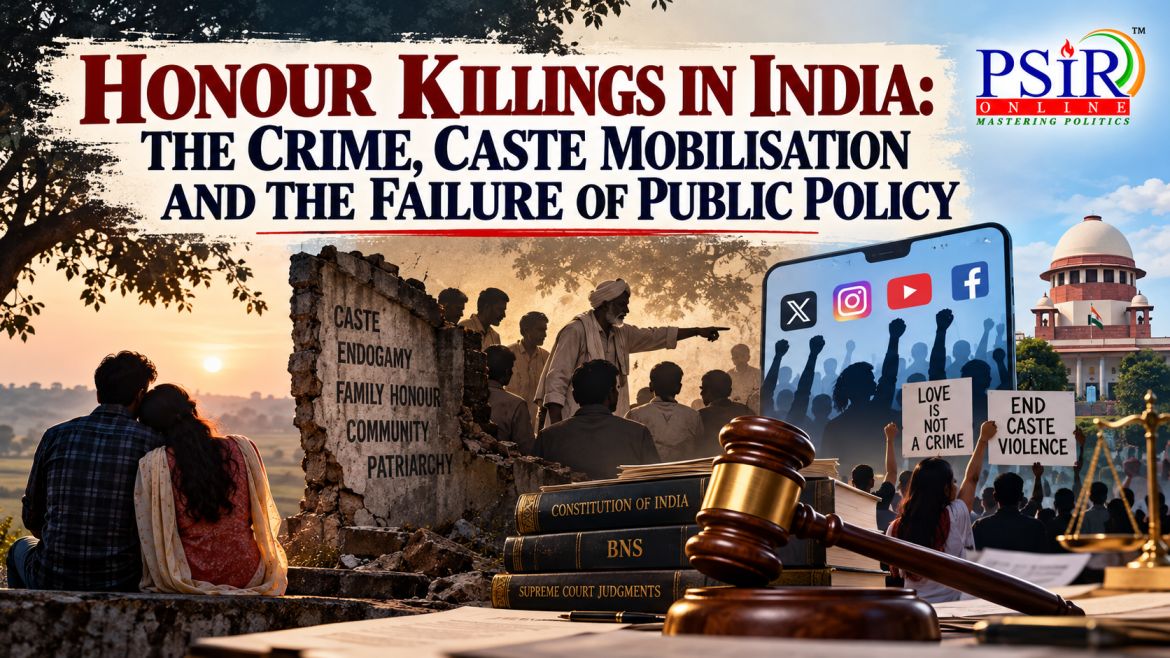
In post-colonial India, the exercise of individual autonomy in choosing a life partner remains one of the most perilous frontiers of citizenship. When young men and women marry across prohibited lines of caste, sub-caste, or village exogamy, their choice often provokes violent retaliation disguised as retribution for community dishonour. Commonly termed "honour killings," these murders represent a structural intersection of caste supremacy, patriarchal authority, and political accommodation.
Far from being sporadic acts of domestic fury, honour crimes are deliberate, communal executions designed to restore a disrupted social hierarchy. Despite decades of constitutional jurisprudence affirming adult choice, these murders persist because social and electoral incentives regularly overpower statutory mandates.
UNDERSTANDING HONOUR KILLINGS IN INDIA: CASTE ENDOGAMY, PATRIARCHY, AND COMMUNITY SANCTIONS
To understand honour killings in India, one must examine the institutional mechanics of caste endogamy. As Dr. B.R. Ambedkar articulated in Castes in India: Their Mechanism, Genesis and Development, endogamy is the foundational pillar of the caste system. Caste does not merely regulate marriage; caste is the social reproduction of hierarchy through compulsory marital boundaries. Transgressing these borders threatens the integrity of caste identity and disrupts inherited land rights, kinship alliances, and social standing.
This caste preservation operates entirely through the subjugation of female bodily autonomy. Within traditional family authority, a woman’s sexuality and reproductive capacity are treated as collective community property:
· The Repository of Honour: The concept of izzat (honour) or maanam (dignity) is disproportionately pinned to a daughter's conduct. A woman who exercises choice (svayamvara in its modern, secular sense) ruptures the patriarchal compact wherein senior male kinsmen control marital alliances to consolidate property and caste status.
· The Asymmetry of Retaliation: The violence is acutely gendered and caste-stratified. An inter-caste union where a woman from a dominant caste marries a man from an oppressed caste (traditionally classified in classical sociology as a pratiloma union) triggers far more savage reprisals than an anuloma marriage (dominant man, subordinate woman). The perceived descent of the woman drags down the entire family's caste ranking in the local ritual and social economy.
· Extra-Judicial Enforcers: Customary dispute institutions—most visibly the khap panchayats in Haryana, western Uttar Pradesh, and Rajasthan, or informal kattai panchayats in parts of Tamil Nadu—function as community arbiters. These assemblies enforce strict village, gotra (clan), and caste endogamy. Couples violating gotra exogamy (marrying within the same ancestral lineage, which the khap equates to incest) or caste endogamy face punitive boycotts (hukka-pani bandh), expulsions, extortionate fines, or direct decrees sanctioning violent retribution.
LANDMARK CASES WITH CONVICTIONS: TRIAL COURTS VS. APPELLATE REALITIES
The judicial track record reveals a recurring pattern: trial courts, faced with direct physical evidence and local outrage, deliver strict verdicts, only for appellate courts (High Courts and the Supreme Court) to acquit accused family members or reduce capital sentences due to systemic evidentiary degradation.


The gap between trial-court convictions and appellate outcomes highlights the fragility of circumstantial evidence. In honour killings, primary witnesses—siblings, mothers, and neighbours—regularly turn hostile during appellate progression, leaving circumstantial links like call-detail records (CDRs) and recovery memos vulnerable to technical dismissals.
CASTE CONSCIOUSNESS AND COUNTER-MOBILISATION
Honour killings cannot be understood as isolated domestic murders; they are backed by sophisticated social ecosystems and competitive political dynamics.
Caste Associations and Digital Enclaves
· Organised Caste Assertion: Caste associations across agrarian middle-castes frequently mobilize around marital policing. In north India, khaps periodically pass resolutions demanding amendments to the Hindu Marriage Act, 1955, to outlaw same-gotra marriages. In southern states, dominant intermediate-caste associations have publicly organized agitations claiming that their young women are targeted by inter-caste "alliances of deception."
· Algorithmic Reinforcement: Social media (YouTube channels, WhatsApp networks, Instagram reels) has changed how caste consciousness is reproduced. Young men are targeted with algorithms valorizing martial caste ancestry, ancestral valour, and the duty to defend "caste purity." When an inter-caste marriage occurs, private community groups do not merely lament it; they circulate pictures, home addresses, and incitements to retributive violence.
Heterogeneity Within Communities
Crucially, dominant intermediate castes are not ideologically uniform:
· Generational and Urban Fractures: Educated youth and urban migrant workers within these communities frequently reject khap edicts, viewing honour-based policing as obsolete feudalism.
· Women's Dissidence: Mothers and sisters have, in select instances, covertly aided eloping couples, defying patriarchal family mandates despite severe threats of social ostracization.
· Intra-Caste Class Stratification: Wealthy families often negotiate or quietly accept inter-caste marriages if socio-economic standing is matched, whereas precarious landowning and rural families view marital control as their sole remaining marker of social capital.
Anti-Caste Counter-Mobilisation
In response, Dalit groups, anti-caste collectives, and civil-rights organizations have developed counter-mobilisations:
· Legal and Grassroots Intervention: Platforms like the Evidence NGO in Tamil Nadu, the All India Democratic Women's Association (AIDWA), and various Ambedkarite organisations document honour violence, provide emergency legal aid, and escort inter-caste couples to police stations.
· Radicalizing the Survivor: Figures like Kousalya (survivor of the 2016 Udumalpet attack) transformed personal tragedy into frontline social movements, travelling across rural pockets to campaign against caste pride, establish shelter networks, and run anti-caste advocacy centres.
GOVERNMENT ACTION AND INACTION: THE POLITICAL ECONOMY OF NEGLECT
The persistent failure of public administration to prevent honour killings stems from localized political compromises and institutional bias.
· Administrative Complicity and Localised Bias: Local police personnel often share the caste affinities and social conditioning of the dominant agrarian community. When an inter-caste couple approaches a police station seeking protection, the standard administrative response is not the immediate registration of an FIR or deployment of a protection detail. Instead, station house officers (SHOs) routinely alert the woman’s family, attempt extra-legal "counseling" to dissolve the marriage, or illegally detain the male partner under manufactured kidnapping charges (e.g., falsely filing abduction cases under Section 363/366).
· The Perverse Electoral Incentive: Rural local bodies and municipal wards rely heavily on unified community vote-banks. Because khap panchayats and dominant-caste federations hold decisive mobilization sway over voting blocks, local MLAs, MPs, and panchayat representatives systematically avoid condemning honour violence. Strong legislative action is seen by local political elites as an existential electoral risk.
· The Missing Preventive Architecture: Administrative action remains almost exclusively reactive. District Magistrate-led intelligence units track communal and political unrest, but they almost never monitor inter-caste marriages or rural khap meetings. Because no standard administrative key performance indicator (KPI) penalizes district collectors or superintendents of police for honour crimes occurring in their jurisdictions, preventive intervention is neglected.
EXISTING LAWS AND THEIR INSTITUTIONAL LIMITATIONS
India possesses no dedicated, standalone federal statute penalizing honour killings. Instead, the legal response relies on a fragmented patchwork of general criminal law, civil-rights statutes, and judicial guidelines.
The Bharatiya Nyaya Sanhita (BNS), 2023
The transition from the Indian Penal Code (IPC) to the Bharatiya Nyaya Sanhita (BNS) introduced an explicit provision aimed at group-directed killings:
· Section 103(2) BNS: Explicitly penalizes murder committed by a group of five or more persons acting in concert on the grounds of race, caste, community, sex, place of birth, language, religion, or personal belief, prescribing punishments ranging from life imprisonment to death.
· The Structural Flaw: While Section 103(2) acknowledges group-directed identity murders, it fails to encompass the nuanced spectrum of honour crimes. Honour killings are frequently committed by two or three family members—or outsourced to a single contract killer—exempting them from the strict five-person threshold. Furthermore, BNS leaves related offences—such as forced confinement, ceremonial tonsuring, public stripping, social boycotts, and coercive annulments—to disjointed penal provisions.
The SC/ST (Prevention of Atrocities) Act, 1989 / 2015
When the victim belongs to a Scheduled Caste and the perpetrators to a non-SC/ST background, the SC/ST PoA Act provides crucial statutory leverage:
· It mandates special courts, provides for statutory compensation, and penalizes public servants for willful neglect of duties (Section 4).
· However, it remains inapplicable to intra-caste honour killings (e.g., gotra violations within intermediate castes) or inter-religious honour killings involving non-SC communities.
JUDICIAL DIRECTIONS: SHAKTI VAHINI V. UNION OF INDIA (2018)
In Shakti Vahini, a three-judge bench of the Supreme Court recognized the choice of a life partner as an integral dimension of Article 21 (Right to Life and Personal Liberty) and Article 19 (Freedom of Speech and Choice). The Court laid down mandatory preventative, remedial, and punitive guidelines:
1. Preventive: District administrations must identify vulnerable areas, intelligence wings must track khap gatherings, and prohibitory orders must be issued against assemblies attempting to police adult marriages.
2. Remedial: Setting up dedicated "Safe Houses" in every district, backed by a 24-hour toll-free helpline to shelter threatened couples.
3. Punitive: Disciplinary departmental inquiries and criminal liability for police officers who fail to act on protection petitions.
The Implementation Deficit: Because the Court's directives have not been codified into a binding federal act, state governments have largely treated them as voluntary advisories. Most districts lack operational safe houses, helplines lead to unmanned police desks, and no uniform witness protection protocol is routinely extended to couples on the run.
STATE-LEVEL MEASURES: THE RAJASTHAN PRECEDENT
In 2019, Rajasthan enacted the Rajasthan Prohibition of Interference with the Freedom of Matrimonial Alliances in the Name of Honour and Tradition Bill. While this legislation represented the first state-level attempt to criminalize honour-policing assemblies, it focused heavily on assembly penalties and lacked dedicated institutional machinery for sustained witness protection, financial rehabilitation, and the surveillance of contract-assassination networks.
A PRACTICAL POLICY FRAMEWORK: TRANSFORMING RIGHTS INTO REALITY
Eradicating honour killings requires moving past nominal judicial condemnation to establish a binding statutory and administrative architecture.
COMPREHENSIVE THREE-TIER ANTI-HONOUR OFFENCE ARCHITECTURE
1.. STATUTORY FOUNDATION
Standalone Federal Act: Reverse Burden of Proof for Present Kinsmen Criminalise Khap Assembly, Social Boycott, & Extortionate Counseling
▼
2. PREVENTIVE & INSTITUTIONAL
District Vulnerability Mapping • Non-Police Safe Houses • SOS Helpline • Automatic Departmental Inquiries for Wilful Police Negligence
▼
3. REHABILITATIVE & DIGITAL
Witness Protection Scheme Execution • Transitional Living Stipends • Regulated Open-Source Threat Monitoring • Vernacular Anti-Pride Drives
A. Dedicated Legislative Enactment
Parliament must pass a standalone Prohibition of Crimes in the Name of Honour and Tradition Act:
· Broadening Offence Definitions: Explicitly penalize the entire spectrum of honour-based coercion, including social boycott, unlawful assembly, forced marriage, coercive counseling, and contract procurement.
· Evidentiary Realism: Incorporate a statutory presumption clause (analogous to dowry-death provisions under Section 113B of the Indian Evidence Act / Section 118 of the Bharatiya Sakshya Adhiniyam). If an adult who registered a formal threat complaint is murdered, the burden of proof regarding innocence must shift to the immediate kinsmen who issued those threats.
B. Safe Houses and Civil Administration
· Administrative Independence: Safe houses mandated under Shakti Vahini must be managed by the Social Welfare Department and civil society organizations rather than located inside local police stations. Threat-facing couples often avoid police premises due to fear of collusion with their families.
· Direct Judicial Oversight: Establish a 24/7 Fast-Track Protection Roster under the direct administrative charge of the Chief Judicial Magistrate (CJM) in every district. A couple filing an affidavit of threat should receive court-ordered protective custody within three hours, bypassing police discretion.
C. Direct Police Accountability and Training
· Statutory Liability for Negligence: Codify Section 4-style neglect provisions: if an inter-caste couple is killed after seeking formal administrative protection, the jurisdictional SHO and station duty officer should face automatic suspension and departmental prosecution for criminal dereliction of duty.
· Dedicated Special Investigation Units (SIUs): Transfer the investigation of inter-caste violence out of local rural police stations to district-level SIUs headed by an officer not below the rank of Deputy Superintendent of Police (DSP), mitigating local caste entanglements.
D. Digital Threat Surveillance Consistent with Civil Liberties
· Open-Source Intelligence on Violent Calls: State Cyber Crime Cells must track open digital incitements to caste-based honour violence on public forums, monitoring calls for bounties, lynchings, or tracking coordinates of runaway couples.
· Civil Liberties Safeguards: Such monitoring must strictly target public incitements to physical violence under clear judicial warrants. It must not degenerate into broad personal surveillance, phone tapping, or warrantless invasions of end-to-end encrypted messaging.
E. Long-Term Social Support and Economic Protection
· Transitional Living Stipends: Provide married couples facing family displacement with a state-sponsored transitional stipend and vocational security support for two years to reduce their material dependence on coercive family networks.
· Active Enforcement of the Witness Protection Scheme (2018): Provide relocated couples with identity protection, relocated residences, and state-funded travel escorts to court hearings until trial and appellate stages are concluded.
The endurance of honour killings in twenty-first-century India exposes the limits of a purely formal constitutionalism. When the social institution of caste endogamy relies on physical violence to maintain its authority, it challenges the sovereign state's legal monopoly and denies citizens their basic rights. Until state machinery treats the freedom to love as an enforceable constitutional right—and backs that right with uncompromising criminal liability for caste enforcers—individual liberty in India will continue to remain subordinate to the tyranny of inherited status.
PSIR DIMENSION: THEORETICAL CONCEPTS & EXAMINATION LINKAGES
|
PSIR Theoretical Dimension & Concepts |
How It Connects to Examination Answers (PSIR Paper 1 / Paper 2) |
|
Caste Endogamy & Social Reproduction (B.R. Ambedkar – Castes in India) |
The Foundational Mechanism of Hierarchy: Connects violent resistance against inter-caste unions to Ambedkar’s thesis that endogamy is the generative mechanism of caste. Shows that honour crimes are not isolated familial anger, but structural violence deployed to preserve social closure, hereditary status, and caste boundaries. |
|
"Private is Political" & Patriarchal Family Authority (Carole Pateman; Susan Moller Okin) |
Dismantling the Public-Private Divide: Deconstructs liberal distinctions between the private domestic sphere and public politics. Demonstrates that family authority operates as a coercive political institution where a woman’s bodily autonomy and reproductive choice are subordinated to maintain lineage and community standing. |
|
The Weberian Coercive Monopoly & Competing Sovereignties (Max Weber – Politics as a Vocation) |
Extra-Judicial Enclaves Challenging the State: Analyzes how customary bodies (khap panchayats, village assemblies) function as parallel sovereigns exercising illegitimate monopolies on physical violence, public boycotts, and execution decrees, directly challenging the modern state's sovereign rule of law. |
|
Social Movement Theory & Subaltern Mobilisation (Sidney Tarrow; Gail Omvedt) |
Anti-Caste Resistance & Grassroots Legal Aid: Explains how anti-caste organisations, Dalit rights groups, and survivor-activists transform private tragedy into collective political mobilization, utilizing institutional legal avenues, emergency shelters, and public advocacy to contest dominant-caste hegemony. |
|
Democratic Clientelism & The Soft State (Gunnar Myrdal; Joel Migdal) |
Electoral Calculus Over Constitutional Enforcement: Illustrates how localized vote-bank reliance forces state actors (police officers, local legislators) to accommodate dominant agrarian caste federations. Demonstrates how societal pressure immobilizes formal state capacity and results in institutional failure to protect vulnerable citizens. |
|
Constitutional Morality vs. Social Morality (B.R. Ambedkar; Supreme Court of India) |
Individual Rights Over Communal Custom: Bridges constitutional theory and judicial directives (Shakti Vahini v. Union of India). Highlights the friction between majoritarian social morality (customary caste pride) and constitutional morality (Articles 19 and 21), emphasizing that personal autonomy cannot be made hostage to community approval. |
CONCLUSION
Honour killings in India expose the sharp divide between formal constitutional democracy and substantive social freedom. When the exercise of adult choice in marriage is met with state-tolerated violence and community-sanctioned retribution, the fundamental promise of universal citizenship is compromised. The persistence of these crimes reflects not an absence of judicial pronouncements, but a failure of public policy, administrative accountability, and political will to challenge entrenched caste power. Eradicating honour-based offences requires moving beyond reactive criminal prosecution to establish a dedicated, preventive statutory architecture—one that penalizes collective coercion, insulates vulnerable couples from local administrative bias, and places constitutional morality above the tyranny of customary social order.
RELATED READING & ANALYTICAL ANGLES
· Constitutional Articles & Judicial Doctrines:
o Articles 14, 15, and 21: Guarantees of equality before the law, non-discrimination on grounds of caste or sex, and the fundamental right to life, personal liberty, and bodily autonomy.
o Article 19(1)(a): Freedom of individual expression, encompassing personal autonomy and the choice of a life partner without family or communal coercion.
o Lata Singh v. State of U.P. (2006): Landmark Supreme Court ruling directing police and administrative machinery to protect inter-caste and inter-religious couples from family harassment and threats of violence.
o Shakti Vahini v. Union of India (2018): Definitive three-judge bench judgment establishing preventative, remedial, and punitive directives against khap panchayats and honour-based crimes.
· Statutory & Penal Frameworks:
o Bharatiya Nyaya Sanhita, 2023 (BNS) — Section 103(2): Penal provision governing murders committed by groups of five or more persons on grounds of caste, community, or personal belief, and its limitations concerning individual contract killings.
o The Scheduled Castes and the Scheduled Tribes (Prevention of Atrocities) Act, 1989 / 2015: Statutory protections and penalties for wilful neglect of duty by public servants in caste-directed atrocities.
o Witness Protection Scheme, 2018: Procedural safeguards governing identity protection, relocation, and secure testimony for vulnerable witnesses and survivors.
o Rajasthan Prohibition of Interference with the Freedom of Matrimonial Alliances in the Name of Honour and Tradition Act, 2019: The first state-level legislative attempt to criminalize unlawful assemblies and social boycotts targeting inter-caste marriages.
· Political Sociology & Analytical Angles:
o The Agrarian Political Economy of Caste Pride: How the erosion of traditional agrarian land security leads dominant intermediate castes to enforce strict marital boundaries to preserve shrinking social and material capital.
o Contractual Outsourcing of Violence: The emerging operational pattern of families hiring criminal gangs to execute honour murders to legally insulate immediate kin from direct conspiracy charges.
o Digital Caste Enclaves: How vernacular social media networks and hyper-local algorithmic ecosystems amplify caste pride and organize coordinated surveillance against inter-caste couples.
PRACTICE QUESTIONS FOR PSIR
