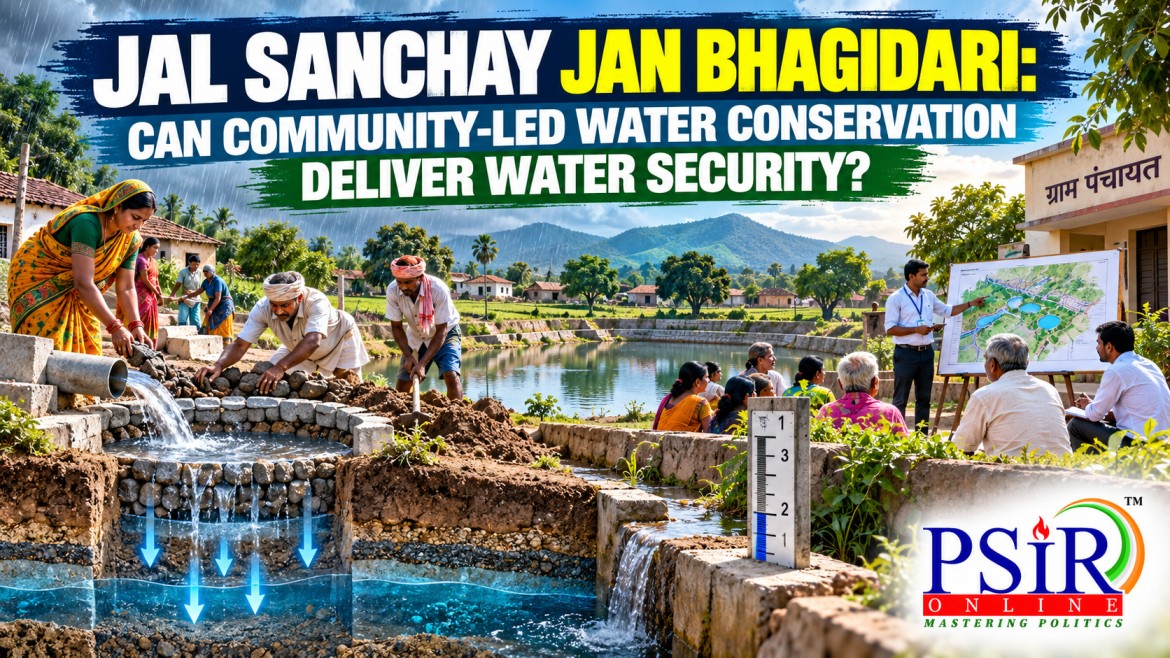
Water security is not determined merely by the quantity of water stored in reservoirs or supplied through pipelines. It also depends on how communities manage local water resources, regulate competing demands and maintain conservation infrastructure over time. In India, groundwater depletion, irregular rainfall, urbanisation and growing agricultural demand make local water management an important governance challenge.
Launched on 6 September 2024 in Surat, Gujarat, Jal Sanchay Jan Bhagidari (JSJB) seeks to strengthen community participation in water conservation through low-cost groundwater recharge and rainwater-harvesting structures. It encourages collaboration among government institutions, local communities, private contributors and civil society.
The initiative subsequently expanded through JSJB 2.0 in 2025 and was integrated with the Jal Shakti Abhiyan: Catch the Rain campaign as Jal Sanchay Jan Bhagidari: Catch the Rain (JSJB: CTR) in June 2026. The central question is whether mass participation and local ownership can translate into measurable, sustainable water security.
FROM INDIVIDUAL CONSERVATION TO COLLECTIVE WATER GOVERNANCE
JSJB promotes locally appropriate interventions such as rooftop rainwater harvesting, recharge pits, recharge shafts and the revival of defunct borewells. These interventions aim to capture rainfall, improve groundwater recharge and strengthen local water-storage capacity.
The initiative follows a whole-of-government and whole-of-society approach, bringing together public institutions, Panchayati Raj Institutions, urban local bodies, educational institutions, community organisations and private contributors. Its guiding principles include Community, Corporate Social Responsibility (CSR) and Cost, commonly described as the 3Cs.
This approach recognises that water conservation cannot be achieved through government construction alone. Local residents possess knowledge about drainage patterns, seasonal water availability, traditional water bodies and changing community needs. Their participation can help identify suitable locations and encourage responsible use of shared assets.
However, participation must involve more than mobilising people for construction drives. Communities also need meaningful roles in planning, prioritisation, monitoring and maintenance. Otherwise, public participation risks becoming a temporary campaign rather than a durable governance arrangement.
PROGRESS AND THE LIMITS OF CONSTRUCTION-BASED INDICATORS
JSJB's reported expansion illustrates the scale of mobilisation. According to a Ministry of Jal Shakti backgrounder published on 3 September 2026:
· JSJB 1.0: More than 27 lakh groundwater recharge structures were reported by May 2025.
· JSJB 2.0: More than 1.5 crore structures were reported by May 2026.
· JSJB: CTR: More than 1.58 crore artificial groundwater recharge structures were reported as of 3 September 2026.
These figures indicate the geographical reach and administrative mobilisation of the initiative. Nevertheless, reported construction is an output indicator, not conclusive evidence of improved water security.
A recharge structure may be poorly located, inadequately maintained or unsuitable for local geological conditions. Its effectiveness also depends on rainfall, soil permeability, aquifer characteristics and the quality of incoming water. A large number of structures therefore cannot automatically be equated with a corresponding increase in groundwater availability.
The government has also stated that the structures reported under JSJB 2.0 were undergoing physical verification and field validation in its July 2026 account of the campaign. Consequently, reported progress must be distinguished from independently established hydrological outcomes.
A credible assessment should examine groundwater-level trends, seasonal recovery, the functionality of structures, water quality, local extraction patterns and the durability of benefits across successive years.
THEORETICAL PERSPECTIVE: COLLECTIVE ACTION AND THE COMMONS
JSJB provides a practical illustration of the collective-action problem. Groundwater is a shared resource: numerous users draw from the same aquifer, while the consequences of excessive extraction may affect the wider community. Individual users can have incentives to extract more water for immediate benefit, even when collective restraint would protect the resource over the long term.
This problem is associated with the broader concept of the tragedy of the commons, popularised by Garrett Hardin. Where access and extraction are poorly regulated, individual incentives can contribute to collective depletion.
However, Elinor Ostrom's research on common-pool resources demonstrates that communities can govern shared resources under appropriate institutional conditions. Successful arrangements often involve clearly understood rules, participation by affected users, monitoring, accessible dispute-resolution mechanisms and graduated sanctions for violations.
Applied to JSJB, this perspective suggests that constructing recharge structures is only one part of water governance. Communities must also develop locally appropriate water budgets, protect recharge zones, prevent contamination and encourage sustainable extraction.
Theoretical lesson: collective action becomes sustainable when participation is supported by credible rules, monitoring, accountability and institutions capable of resolving conflicts.
Community participation should not be romanticised, however. Local inequalities may allow powerful landowners or dominant groups to influence the location of projects and the distribution of benefits. Institutional safeguards are therefore essential to ensure that the interests of small farmers, landless households, women and marginalised communities are represented.
CONVERGENCE OF GOVERNMENT PROGRAMMES AND LOCAL RESOURCES
Water conservation requires coordination across departments because groundwater recharge, employment, watershed management, agriculture and urban planning are interconnected.
JSJB uses convergence with existing government programmes and other sources of support. Official accounts identify mechanisms including MGNREGA, the District Mineral Foundation (DMF), Compensatory Afforestation Fund Management and Planning Authority (CAMPA) funds, CSR contributions, philanthropy and community participation. The 2026 JSJB: CTR framework also identifies convergence with programmes and funding mechanisms such as Per Drop More Crop under the Pradhan Mantri Krishi Sinchayee Yojana (PMKSY), the repair, renovation and restoration of water bodies under PMKSY, Finance Commission grants and state government schemes.
Such convergence can help combine financial resources, technical expertise and local labour. For example, a village-level water plan could connect rainwater harvesting with watershed treatment, restoration of a pond and improved irrigation practices.
Yet, convergence creates its own administrative challenges. Departments may have different objectives, implementation calendars and reporting requirements. Without a clearly identified local coordinating institution, responsibility for construction quality and subsequent maintenance can become fragmented.
Effective convergence therefore requires a shared local water plan, clear assignment of responsibilities, transparent fund utilisation and coordination between technical departments and elected local bodies.
PANCHAYATS, MAINTENANCE AND COMMUNITY ACCOUNTABILITY
The long-term value of a water-conservation asset depends on its condition after construction. Recharge pits can become clogged, harvesting systems may be neglected, and restored water bodies may lose storage capacity through silt accumulation or encroachment.
Panchayats and urban local bodies can help institutionalise maintenance by identifying responsible agencies, arranging periodic inspections and involving residents in reporting problems. Village-level water committees and community organisations can support these processes, provided their roles are clearly defined and coordinated with the relevant public authorities.
A practical local water-security plan should include:
· Scientific site selection: Use local hydrological assessments and technical advice to determine the suitability of recharge structures.
· A maintenance register: Record each asset's location, condition, maintenance schedule and responsible agency.
· Community monitoring: Enable residents to report damage, contamination, blockages and encroachment.
· Transparent financing: Identify resources for recurring maintenance rather than relying exclusively on initial construction funds.
· Inclusive decision-making: Ensure that women, small farmers and disadvantaged households can influence priorities and report unequal access.
Local ownership is most meaningful when communities have both a voice in decisions and a clearly defined mechanism for ensuring that public assets remain functional.
FROM COUNTING STRUCTURES TO MEASURING WATER SECURITY
The next stage of JSJB should place greater emphasis on outcomes alongside construction targets. A useful monitoring framework would distinguish four levels:
|
Monitoring dimension |
What should be measured? |
|
Outputs |
Structures constructed, repaired and verified; funds utilised |
|
Functionality |
Proportion of structures working effectively after monsoon seasons |
|
Hydrological outcomes |
Groundwater-level changes, seasonal recovery and water quality, interpreted in local geological and rainfall contexts |
|
Social outcomes |
Reliability of local water access, distribution of benefits, participation and maintenance accountability |
These indicators should be interpreted carefully. Groundwater levels can change because of rainfall, extraction, local geology and other interventions. Changes near a recharge structure do not, by themselves, establish that the structure caused the improvement.
Baseline measurements, repeated observations and suitable comparison sites can strengthen evaluation. Public dashboards should distinguish proposed, ongoing, completed, physically verified and functional works. They should also disclose the methods used to measure outcomes.
Water security further requires demand management. Recharge infrastructure cannot indefinitely compensate for excessive extraction, water-intensive cropping patterns or the degradation of catchments. Conservation must therefore be linked to efficient irrigation, appropriate land-use planning, protection of water bodies and locally negotiated rules for groundwater use.
UPSC ANGLES
|
Dimension |
Relevance to JSJB |
|
Constitutional and federal |
Water is primarily a State subject. The initiative illustrates the role of central support alongside state-level planning, implementation and local responsibilities. |
|
Local self-government |
Panchayats and urban local bodies can support local planning, community participation, monitoring and maintenance, subject to applicable laws and institutional arrangements. |
|
Governance |
Demonstrates participatory governance, interdepartmental convergence, citizen engagement and the challenges of coordinating multiple funding sources. |
|
Environment and climate |
Rainwater harvesting, groundwater recharge and water-body restoration can contribute to climate resilience, but outcomes depend on local hydrology and ecological suitability. |
|
Collective action |
Ostrom's work on common-pool resources helps explain the importance of locally legitimate rules, monitoring, accountability and dispute resolution. |
|
Equity and social justice |
Unequal influence over land, project selection and water access can affect who benefits. Inclusive representation and transparent allocation are essential. |
|
Public finance and accountability |
Physical verification, transparent expenditure, maintenance funding and outcome-based monitoring help distinguish completed works from effective public assets. |
|
Policy implementation |
Convergence across MGNREGA, PMKSY, CAMPA, DMF and other mechanisms requires coordination, clear responsibilities and reliable monitoring. |
|
Sustainable development |
Connects with SDG 6 on clean water and sanitation, particularly sustainable water management and community participation. |
CONCLUSION
Jal Sanchay Jan Bhagidari offers a framework for connecting local participation with government support in water conservation. Its reported scale demonstrates substantial mobilisation, but the long-term test is whether the resulting structures remain functional, improve groundwater conditions and distribute benefits fairly.
Theoretical insights from collective-action research suggest that communities can manage shared resources when participation is supported by legitimate rules, monitoring and accessible mechanisms for resolving disputes. For JSJB, this means moving beyond construction targets towards scientific evaluation, demand management, inclusive decision-making and dependable maintenance.
Community participation can contribute to water security, but participation alone is not sufficient. Sustainable outcomes require institutions that turn collective effort into accountable, measurable and enduring water governance.
REFERENCES AND FURTHER READING
GS2 MAINS PRACTICE QUESTIONS
10 marks | 150 words
15 marks | 250 words
