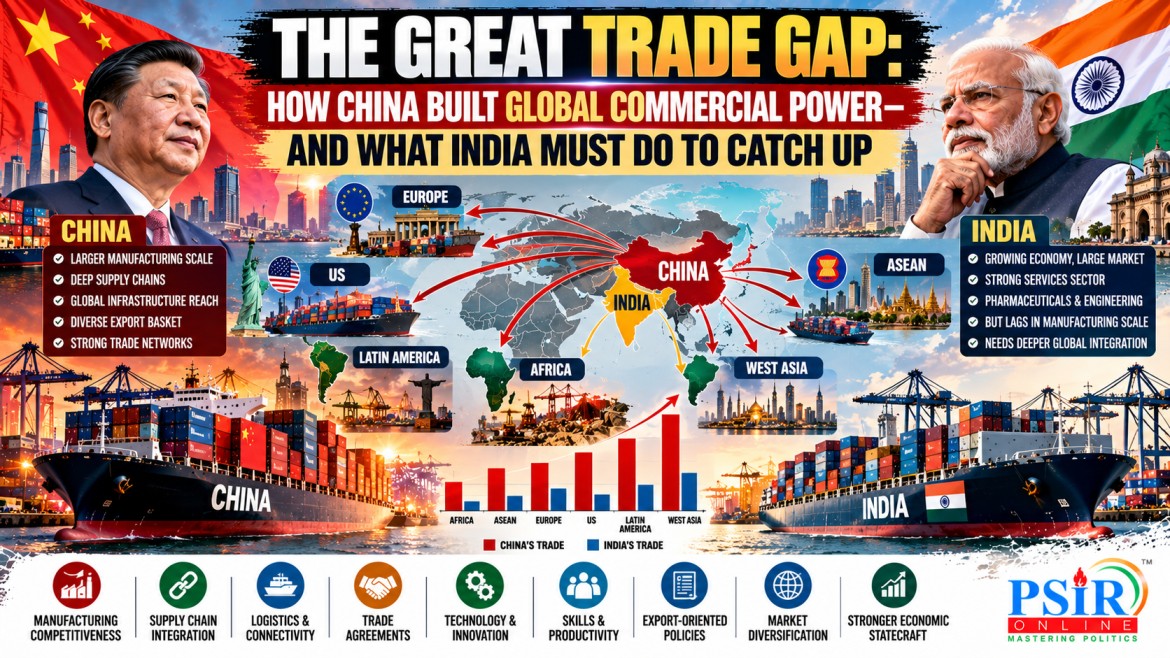
The global economic landscape presents a striking paradox. India possesses a vast domestic market, a large workforce, expanding technological capabilities and an increasingly influential diplomatic profile. Yet, across several major trading regions, China has established a substantially deeper commercial presence. From Southeast Asia and Africa to Europe, the United States, Latin America and West Asia, Chinese manufactured goods, industrial components, infrastructure equipment and consumer products occupy a central position in international commerce.
The difference is not simply a matter of population or the size of the domestic market. It reflects the cumulative effects of manufacturing scale, export-oriented industrialisation, integrated supply chains, logistics infrastructure, technological upgrading and sustained engagement with foreign markets. China has developed an economic system capable of supplying products across multiple stages of production, from basic components to sophisticated machinery, electric vehicles, batteries and telecommunications equipment.
India has achieved significant progress in pharmaceuticals, information technology services, petroleum products, automobiles, engineering goods and selected electronics. Its merchandise and services exports have expanded, while initiatives such as production-linked incentives, infrastructure investment and trade agreements seek to strengthen manufacturing competitiveness. Nevertheless, the scale and composition of India’s export economy remain different from China’s.
The central question is therefore not why India trades less with every region in every category, but why China has converted its manufacturing capacity into a much broader and deeper global commercial network. Understanding this gap requires examining regional trade patterns, the structural sources of China’s advantage and the reforms necessary for India to increase its global economic presence.
THE GLOBAL TRADE GAP: EVIDENCE ACROSS MAJOR REGIONS
China’s position as a global trading power is reflected in both the scale of its merchandise trade and the geographical reach of its export networks. In 2024, China’s total merchandise trade reached approximately US$6.16 trillion, according to Chinese customs data. Its commercial relationships extend across advanced economies, developing countries, regional production networks and resource-exporting states.
India’s position is more uneven. It has a substantial presence in services, pharmaceuticals, refined petroleum, gems and jewellery, engineering products and labour-intensive exports, but its merchandise exports are less deeply embedded in several major manufacturing supply chains.
The following comparisons illustrate the scale of the difference. Figures are from different official statistical systems and reporting periods, so they should be treated as indicative comparisons rather than perfectly harmonised rankings.
|
Region or market |
China’s trade position |
India’s trade position |
|
ASEAN |
China–ASEAN merchandise trade reached US$772.4 billion in 2024. |
ASEAN–India merchandise trade was approximately US$106.9 billion in 2024. |
|
European Union |
EU–China goods trade totalled approximately €731.1 billion in 2024. |
EU–India goods trade was approximately €120 billion in 2024. |
|
United States |
US–China goods trade totalled approximately US$414.6 billion in 2025. |
US–India goods trade totalled approximately US$149.1 billion in 2025. |
|
Africa |
China–Africa trade reached approximately US$295.6 billion in 2024. |
Indian official statements placed India–Africa trade above US$100 billion in FY 2024–25; other datasets report lower totals. |
|
Latin America and the Caribbean |
China–Latin America and Caribbean trade reached approximately US$518.4 billion in 2024. |
India–Latin America and Caribbean trade stood at approximately US$39.2 billion in FY 2024–25. |
|
Gulf Cooperation Council |
China has extensive energy, industrial goods and infrastructure relationships across the Gulf. |
India–GCC trade reached US$178.56 billion in FY 2024–25, reflecting substantial energy and commercial interdependence. |
Sources: ASEAN Secretariat; Eurostat and European Commission; US Trade Representative; Chinese official trade data; Indian Ministry of Commerce and Industry; and published India–Africa trade reporting. The reporting periods and regional definitions differ.
These figures reveal a substantial gap in the scale of China’s commercial relationships with several regions. They do not, however, mean that India is commercially insignificant or that China leads every sector. India’s services exports, pharmaceutical capabilities and certain specialised products offer important competitive strengths. In the Gulf, for example, India has extensive commercial and people-to-people ties, while its merchandise trade is heavily influenced by energy imports.
The deeper issue is the breadth of China’s export basket and its integration into the production systems of other economies. Chinese firms supply not only finished products but also the components, machinery and intermediate goods required by foreign manufacturers. This creates recurring demand and embeds Chinese suppliers into long-term commercial relationships.
REGIONAL PATTERNS: HOW CHINA BUILT ITS COMMERCIAL PRESENCE
China’s trade advantage becomes clearer when examined through the distinct economic structures of individual regions.
Africa: manufacturing goods, infrastructure and resource partnerships
China has been Africa’s largest trading partner for many years. Its trade combines imports of oil, minerals and agricultural products with exports of machinery, vehicles, electronics, construction materials and consumer goods. Chinese companies have also participated in infrastructure construction, industrial parks, transport networks and energy projects.
These relationships are mutually varied: African countries differ considerably in their export structures, debt positions and industrial capacity, and Chinese commercial engagement has produced both development opportunities and concerns about debt sustainability, local value addition and import dependence.
India also has an established African presence through pharmaceuticals, vehicles, engineering goods, digital services, concessional credit and development cooperation. Its challenge is to expand beyond established sectors and increase the competitiveness and diversity of its exports. India’s development-partnership model can complement commercial engagement, but it cannot substitute for reliable supply, competitive pricing and sustained investment.
ASEAN: integration into regional production networks
Southeast Asia illustrates one of China’s most important advantages. China and ASEAN have become deeply interconnected through electronics, electrical machinery, chemicals, components, industrial equipment and intermediate goods. ASEAN is not merely a destination for Chinese exports; it is also a production base connected to Chinese suppliers and international markets.
India’s trade with ASEAN is significant, but its relationship has not generated the same depth of manufacturing integration. India imports substantial quantities of electronics, machinery, chemicals and other industrial inputs from the region, while the trade deficit has remained a concern. The review of the ASEAN–India Trade in Goods Agreement offers an opportunity to improve market access and rules of origin, but the wider objective must be stronger participation in regional production networks.
Europe: industrial depth and technological competition
China’s commercial presence in Europe rests heavily on machinery, electrical equipment, telecommunications products, consumer electronics, batteries and vehicles. Its export capacity has increasingly extended into clean-energy technologies and other higher-value manufactured goods. This has generated substantial commercial interdependence while also producing disputes over subsidies, market access, industrial competition and economic security.
India’s exports to Europe include chemicals, pharmaceuticals, textiles, machinery, mineral products and engineering goods. The conclusion of India–EU free trade agreement negotiations in January 2026 creates a framework for deeper engagement, subject to the relevant approval and implementation processes. Yet preferential access will yield limited gains unless Indian firms improve productivity, certification, technological sophistication and delivery reliability.
United States: a large market, but different commercial strengths
China has long supplied a wide range of manufactured goods to the US market, including electronics, machinery, furniture, industrial components and consumer products. Tariffs and strategic tensions have altered trade flows, but they have not eliminated the extensive supply-chain connections developed over decades.
India has a substantial export relationship with the United States, particularly in pharmaceuticals, engineering goods, textiles, gems and jewellery, and information technology services. Its services relationship is especially important. However, in merchandise trade, China’s manufacturing scale and breadth remain substantial advantages.
The recent experience of US–China trade tensions also shows that large trade volumes do not guarantee political stability. Tariffs, export controls and investment restrictions can disrupt commercial relationships. India’s opportunity is to become a credible alternative supplier in selected sectors, rather than assume that geopolitical tensions will automatically redirect production to Indian factories.
West Asia and the Gulf: energy, infrastructure and market competition
China’s West Asian commercial relationships combine energy imports with exports of industrial equipment, electronics, vehicles and construction materials. Chinese firms have also developed roles in infrastructure, telecommunications, renewable energy and industrial cooperation.
India, meanwhile, has deep connections with the Gulf through energy imports, food exports, engineering goods, textiles, services, investment and the Indian diaspora. India–GCC trade reached US$178.56 billion in FY 2024–25. This demonstrates that India’s position in the region is substantial, even as China competes across several industrial and infrastructure sectors.
The challenge for India is to use its established relationships to expand exports beyond traditional goods and energy-linked commerce. Cooperation in food processing, pharmaceuticals, renewable energy, digital services, logistics and industrial investment could help strengthen the productive dimension of India–Gulf economic relations.
Latin America: the gap between commodity trade and diversified commerce
China has become a major trading partner for Latin America and the Caribbean through imports of agricultural products, minerals and energy resources and exports of manufactured goods. Trade reached approximately US$518.4 billion in 2024.
India’s trade with the region was approximately US$39.2 billion in FY 2024–25. Its exports include pharmaceuticals, chemicals, engineering products, vehicles and textiles, while imports include minerals, agricultural commodities and energy-related products. The negotiations launched in September 2026 to expand the India–MERCOSUR Preferential Trade Agreement offer an opportunity to deepen access, but the agreement remains under negotiation.
The broader lesson is that diplomatic outreach must be converted into commercially dense relationships. Trade agreements, business networks, logistics and investment in local distribution matter as much as political engagement.
WHY CHINA IS AHEAD: THE STRUCTURAL SOURCES OF ITS ADVANTAGE
China’s trade position is the cumulative outcome of several mutually reinforcing factors rather than a single policy or temporary advantage.
First, manufacturing scale. China developed large industrial clusters that allow suppliers, component makers, assemblers, logistics providers and exporters to operate in close proximity. These clusters reduce coordination costs, shorten production cycles and make it easier to scale output. In many industries, the presence of a complete supplier ecosystem is more important than the cost of labour alone.
Second, supply-chain density. Chinese manufacturers often have access to domestic suppliers for components, tooling, packaging, machinery and intermediate inputs. This reduces dependence on imported components and helps firms respond rapidly to changes in global demand. India has advanced in selected electronics and automotive clusters, but many industries still depend on imported components or fragmented supplier networks.
Third, infrastructure and logistics. Ports, industrial corridors, railways, warehouses, electricity networks and digital customs systems influence the final cost of exported products. China’s investment in industrial and transport infrastructure has helped connect production centres to ports and international markets. India’s infrastructure has improved, but logistics costs, delays and uneven industrial infrastructure remain constraints in several sectors.
Fourth, export-oriented industrial policy. China’s development strategy has combined industrial planning, investment promotion, infrastructure development, export incentives and support for technology-intensive industries. The details and effectiveness of individual policies vary, and some have generated trade disputes. Nevertheless, the long-term outcome has been a broad manufacturing base capable of serving domestic and international markets.
Fifth, technological upgrading. Chinese exports have expanded from low-cost consumer products into electric vehicles, batteries, solar equipment, telecommunications infrastructure, machinery and other technology-intensive goods. Research and development, domestic supplier development and competition among manufacturers have helped firms move into more complex products.
Sixth, market diversification. China has expanded commercial engagement across ASEAN, Africa, Latin America, the Middle East and other regions. The Belt and Road Initiative, bilateral trade arrangements and industrial partnerships have supported parts of this expansion, although trade growth cannot be attributed to infrastructure diplomacy alone.
Finally, firm scale and export experience. Large manufacturing enterprises can spread research, certification, marketing and logistics costs across high production volumes. They can also maintain distribution networks, after-sales service and financing arrangements in foreign markets. Indian firms, especially MSMEs, often face higher relative costs in accessing such networks.
These factors reinforce one another. Manufacturing scale attracts suppliers; suppliers reduce costs; lower costs support exports; exports create revenue for investment and technological upgrading. China’s commercial advantage is therefore not merely a price advantage. It is a system-level advantage created by the interaction of production, technology, logistics and market access.
WHY INDIA HAS NOT CLOSED THE GAP
India’s constraints should not be reduced to a single explanation. They reflect the historical structure of its economy, domestic policy choices, firm-level limitations and the uneven development of manufacturing ecosystems.
India’s growth has been supported strongly by services, including information technology, business services, finance and professional activities. These sectors are major sources of export earnings and should not be treated as weaknesses. However, services success has not automatically generated the scale of employment-intensive manufacturing seen in China.
Manufacturing remains constrained in several sectors by fragmented supply chains, uneven access to land and industrial infrastructure, skill mismatches, regulatory complexity and limited scale among domestic firms. Small and medium enterprises may struggle to finance machinery upgrades, adopt advanced technologies or meet the certification requirements of distant markets.
Import dependence is another challenge. Indian production in electronics, pharmaceuticals, renewable energy and other sectors can rely on imported components, chemicals, machinery or intermediate goods. Imports are not inherently undesirable: competitive access to inputs can improve productivity. The concern arises when domestic value addition remains limited or when concentrated dependencies create supply-chain vulnerabilities.
Trade policy also matters. Inconsistent tariff structures, frequent changes in duties, complex compliance requirements and limited predictability can increase uncertainty for investors and exporters. The withdrawal from the Regional Comprehensive Economic Partnership in 2019 reflected concerns about domestic industry and trade imbalances, but it also meant that India was outside a major regional framework linking several Asian production economies. That decision does not explain the entire trade gap, but it illustrates the difficult balance between protecting domestic industry and integrating into regional value chains.
India’s firms also face challenges in export financing, product standards, overseas distribution and market intelligence. A product may be competitive at the factory gate yet lose its advantage because of shipping costs, delayed delivery, limited branding or difficulties obtaining certification.
Finally, geopolitical strategy cannot replace commercial competitiveness. The idea that countries will automatically shift supply chains from China to India because of political tensions is incomplete. Firms relocate production when India offers reliable infrastructure, competitive costs, skilled workers, supplier depth, policy predictability and access to markets.
India’s challenge is thus to build a more productive manufacturing and export ecosystem while preserving the strengths of its services economy. The objective should be not simply to reduce imports, but to expand domestic capabilities and export value addition.
FROM MARKET ACCESS TO MARKET POWER: WHAT INDIA MUST DO
India needs a coordinated strategy that combines industrial development, trade diplomacy, infrastructure, skills and export promotion. No single incentive or free trade agreement can close the gap by itself.
First, strengthen manufacturing ecosystems. Policy should prioritise sectors where India can develop competitive scale and supplier depth, including electronics, electrical machinery, pharmaceuticals, medical devices, textiles, footwear, chemicals, automotive components, renewable-energy equipment and selected capital goods. Support should extend beyond final assembly to component manufacturing, tooling, testing and research.
Second, connect firms to global value chains. Trade agreements and investment partnerships should be used to attract firms that bring technology, supplier development and export-market access. Domestic enterprises need opportunities to become reliable suppliers to multinational manufacturers. This requires predictable rules, efficient customs, modern testing facilities and stronger industrial clusters.
Third, make logistics a competitive advantage. Port efficiency, multimodal freight corridors, industrial parks, warehousing, cold chains and digital customs systems can reduce the time and cost of exporting. The gains from infrastructure are greatest when transport networks are connected to productive industrial regions and export clusters.
Fourth, improve the quality and predictability of trade policy. Tariff structures should support access to competitively priced inputs while allowing viable domestic industries to develop. Rules of origin, standards and trade remedies should be transparent and enforceable. The review of existing agreements, including the ASEAN–India Trade in Goods Agreement, should focus on measurable market access and practical implementation.
Fifth, develop a region-specific export strategy. India should not treat every market as identical. In Africa, opportunities include pharmaceuticals, agricultural machinery, engineering goods, vehicles, digital systems and local manufacturing partnerships. In ASEAN, priorities should include electronics, automotive components, chemicals and participation in regional production networks. In Europe and the United States, competitiveness will depend on quality, technology, regulatory compliance and reliable delivery. In the Gulf, India can build on food security, pharmaceuticals, engineering, digital services and energy-transition cooperation. In Latin America, trade expansion requires stronger business networks, logistics and market intelligence.
Sixth, help MSMEs become export-ready. Export credit, insurance, common testing facilities, digital market information, e-commerce platforms and support for international certification can lower entry barriers. Larger firms should be encouraged to develop domestic supplier networks, while export promotion institutions should focus on repeat orders and sustained market presence rather than only trade-fair participation.
Seventh, invest in skills and technology. Manufacturing competitiveness depends on technicians, engineers, quality-control specialists, industrial designers and production managers. Vocational training must be linked to actual industrial demand. Research and development, automation, digital manufacturing and energy efficiency should be integrated into industrial policy.
Finally, measure outcomes rather than announcements. Export performance should be evaluated through domestic value addition, product diversification, productivity, repeat orders, export-market survival, technology transfer and quality employment. Investment commitments and production incentives are means to these ends, not substitutes for them.
|
Strategic priority |
Required action |
Desired outcome |
|
Manufacturing depth |
Build supplier clusters and strengthen component production |
Higher domestic value addition and export capacity |
|
Global value chains |
Improve trade facilitation and attract technology-linked investment |
Greater integration into international production |
|
Logistics |
Connect industrial corridors, ports and warehouses |
Lower costs and more reliable delivery |
|
Trade agreements |
Improve implementation and market-specific negotiating strategies |
Usable market access and diversified exports |
|
MSME exports |
Expand finance, certification and market intelligence |
Broader participation in global trade |
|
Technology and skills |
Link training, research and industrial demand |
Higher productivity and movement into complex products |
|
Policy predictability |
Reduce avoidable compliance uncertainty and improve tariff coherence |
Greater investor confidence and export planning |
STRATEGIC IMPLICATIONS: TRADE AS AN INSTRUMENT OF NATIONAL POWER
The trade gap has consequences beyond economic statistics. Manufacturing capability influences technological independence, defence production, energy transition, crisis resilience and a state’s ability to sustain international influence.
China’s commercial networks give it a significant role in the supply of industrial inputs, machinery, electronics, telecommunications equipment and clean-energy technologies. This can create economic leverage, although such leverage is neither unlimited nor uncontested. Dependence also exposes China to market restrictions, countermeasures, regulatory scrutiny and the risks of overcapacity.
For India, a stronger export economy would increase its ability to finance imports, attract productive investment, generate employment and sustain international partnerships. Greater manufacturing depth would also reduce vulnerabilities in selected critical sectors and improve the credibility of India as a long-term economic partner.
Trade diplomacy is most effective when supported by domestic productive capacity. A state may negotiate market access, strategic partnerships and investment commitments, but firms must still produce goods and services that foreign buyers want at competitive prices and reliable quality. Commercial capability is the material foundation of economic statecraft.
India does not need to replicate China’s entire development model. Its democratic institutions, federal structure, service-sector strengths, labour market and environmental priorities differ. The objective should be to adapt successful lessons—industrial clustering, supplier development, export orientation, logistics integration and technological upgrading—to Indian conditions.
Nor should the comparison be framed as a zero-sum contest. India and China can remain economically interdependent even while competing for export markets and strategic influence. The priority for India is to increase its own productive capacity, diversify its economic relationships and reduce avoidable vulnerabilities.
THEORETICAL ANGLES
|
Theory or concept |
Application to the China–India trade gap |
|
Economic statecraft |
Manufacturing, trade agreements, infrastructure and export finance can be instruments of national influence and strategic resilience. |
|
Realism |
Commercial capabilities contribute to national power by strengthening technological capacity, industrial security and geopolitical options. |
|
Complex interdependence |
China’s supply-chain integration creates multiple channels of economic connection, while also producing mutual vulnerabilities and potential leverage. |
|
Comparative advantage |
India’s services strengths and China’s manufacturing depth reflect different patterns of specialisation, but comparative advantage can evolve through investment and industrial policy. |
|
Dependency theory |
Reliance on imported industrial inputs can constrain domestic value addition, while resource-exporting partners may face similar challenges in their relationships with major manufacturing economies. |
|
Developmental-state perspective |
Coordinated industrial policy, infrastructure, skills and technology upgrading help explain how manufacturing ecosystems develop over time. |
|
Strategic autonomy |
A broader export base and diversified supply chains can expand India’s policy choices and reduce excessive dependence on individual markets or suppliers. |
CONCLUSION
China’s lead across several major trading regions is the result of decades of industrial expansion, supply-chain integration, infrastructure development, technological upgrading and sustained engagement with global markets. Its commercial presence in ASEAN, Europe, Africa, the United States and Latin America demonstrates the scale of an economy deeply embedded in international production and distribution networks.
India has important strengths of its own, including services exports, pharmaceuticals, engineering capabilities, a large domestic market and expanding industrial capacity. Its challenge is to translate these strengths into a broader manufacturing base, more competitive exports and deeper integration into regional and global value chains.
The way forward is not indiscriminate protectionism or the assumption that geopolitical tensions will automatically benefit Indian exporters. It is a sustained programme of manufacturing development, logistics reform, predictable trade policy, skills, technology, export finance and market-specific diplomacy.
The ultimate measure of success will not be the number of trade agreements signed or investment announcements made. It will be whether Indian firms can supply more competitive products, enter more markets, increase domestic value addition and maintain durable relationships with overseas buyers.
India’s path to narrowing the great trade gap lies in building an economy that the world increasingly relies on—not merely a market that the world seeks to sell into.
RELATED READING
PRACTISE QUESTIONS FOR GS2 MAINS
PRACTISE QUESTIONS FOR PSIR
