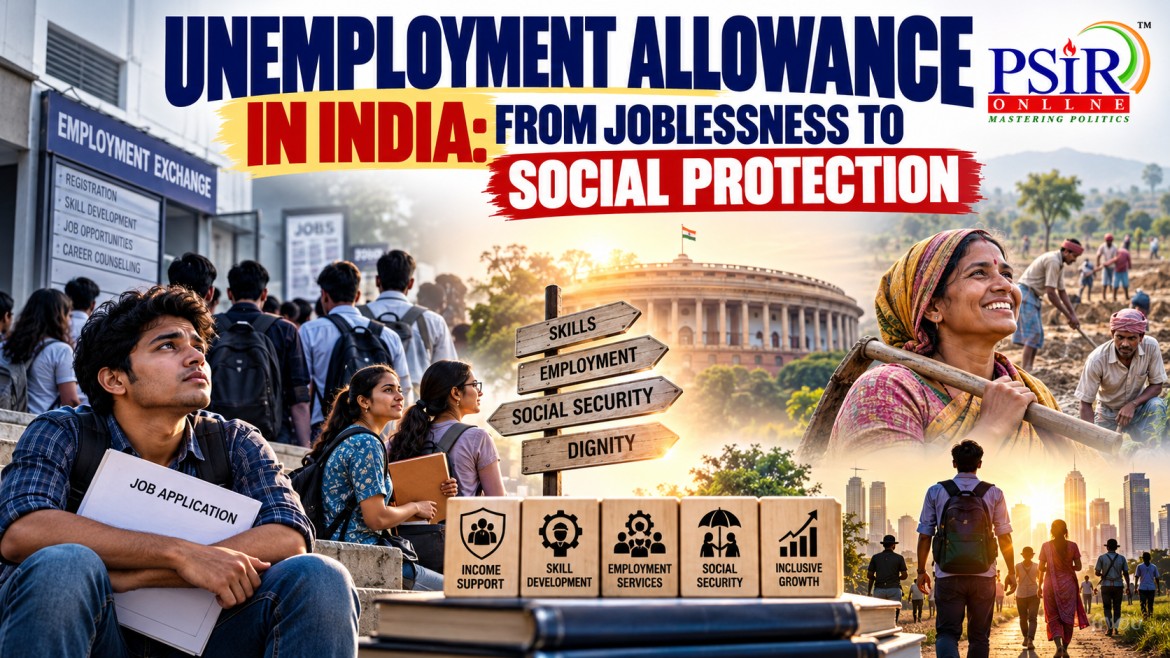
INTRODUCTION: IS UNEMPLOYMENT ALSO A SOCIAL JUSTICE ISSUE?
Unemployment is not merely the absence of a job. For a household dependent on regular earnings, the loss of employment can immediately affect food, housing, healthcare, education and financial security. Prolonged unemployment can also push workers into debt, informal work or distress migration.
In many countries, unemployment insurance provides temporary income support to workers who lose their jobs. India, however, does not have a single, universal nationwide unemployment allowance covering all unemployed citizens. Instead, protection is fragmented across formal-sector social insurance, State-level unemployment allowances, rural employment guarantees and limited access to accumulated social-security savings.
This makes unemployment protection an important social-justice question: when a person loses employment, to what extent does the State protect the person's ability to maintain a basic standard of living and dignity?
WHY INDIA HAS NO UNIVERSAL UNEMPLOYMENT ALLOWANCE
India's employment structure makes a universal unemployment-insurance system difficult to establish. A very large proportion of India's workforce is engaged in the informal or unorganised sector, where employment relationships, wages and contribution records are often not formally documented. Conventional unemployment insurance generally depends on identifiable employment, payroll contributions and a system capable of verifying both employment and job loss. As a result, India's approach has historically developed through targeted rather than universal protection.
The present framework broadly consists of:
· employment-linked protection for eligible formal-sector workers;
· State-level unemployment allowances for certain categories of educated unemployed youth;
· employment guarantees for rural households;
· and temporary access to accumulated social-security savings after job loss.
The result is a fragmented system in which the nature of a person's previous employment often determines the kind of protection available after unemployment.
FORMAL WORKERS: ESIC-BASED UNEMPLOYMENT PROTECTION
For workers covered under the Employees' State Insurance Corporation (ESIC), India has a formal mechanism of income support following certain forms of unemployment.
Atal Beemit Vyakti Kalyan Yojana (ABVKY)
ABVKY provides unemployment relief to eligible insured workers who experience involuntary loss of employment.
Under the scheme framework described in the source material:
· the benefit can extend up to 50% of the average daily wage;
· it is available for a maximum period of 90 days;
· eligibility is linked to prior ESIC insurance and contribution requirements.
Rajiv Gandhi Shramik Kalyan Yojana (RGSKY)
RGSKY provides a longer-duration form of support for certain categories of insured workers who lose employment because of circumstances such as closure of an establishment, formal retrenchment or permanent invalidity. The scheme also provides for continued medical care for the worker and family during the eligible period. Together, these mechanisms demonstrate the logic of employment-linked unemployment protection:
employment → contribution → social insurance → protection after job loss.
However, this model necessarily excludes workers who have never been part of the formal contributory system.
STATE-LEVEL “BEROJGARI BHATTA”
A second category of unemployment protection is provided by State governments through schemes commonly described as Berojgari Bhatta. These programmes generally target educated unemployed youth who have registered with employment exchanges and satisfy conditions relating to educational qualification, age, household income and duration of unemployment.
Around 12 to 14 states in India run or have notified formal unemployment allowance (Berojgari Bhatta) schemes for educated job seekers registered with employment exchanges. The two-column breakdown below lists major Indian states, their respective scheme names, monthly stipend amounts, and operational launch dates:
|
State Name |
Scheme Details (Name, Stipend Amount & Operational Date) |
|
Tamil Nadu |
• Scheme: Unemployment Assistance Scheme for Job Seekers (வேலைவாய்ப்பற்ற இளைஞர்களுக்கான உதவித்தொகை திட்டம்) • Stipend: ₹200 (SSLC Fail), ₹300 (SSLC Pass), ₹400 (HSC/Diploma), ₹600 (Degree/PG) per month; ₹600–₹1,000/month for Differently-Abled (payable quarterly) • Operational Date: Originally introduced in 2006 (G.O. Ms. No. 92, Labour and Employment Dept); revised periodically |
|
Karnataka |
• Scheme: Yuva Nidhi Scheme
• Operational Date: January 12, 2024 |
|
Rajasthan |
• Scheme: Mukhyamantri Yuva Sambal Yojana (formerly Akshat Yojana) • Stipend: ₹4,000/month (Men); ₹4,500/month (Women, Transgender, and Divyangjan) • Operational Date: February 1, 2019 (updated with mandatory skill internship in 2021) |
|
Chhattisgarh |
• Scheme: Chhattisgarh Berojgari Bhatta Yojana • Stipend: ₹2,500/month (for up to 2 years) • Operational Date: April 1, 2023 |
|
Haryana |
• Scheme: Saksham Yuva Scheme (Educated Youth Allowance & Honorarium) • Stipend: ₹900 (12th Pass), ₹1,500 (Graduate), ₹3,000 (Postgraduate) per month (plus up to ₹6,000 for 100 hours of monthly honorary work) • Operational Date: November 1, 2016 |
|
Himachal Pradesh |
• Scheme: Himachal Pradesh Berojgari Bhatta Yojana • Stipend: ₹1,000/month for General youth; ₹1,500/month for PwD (physically challenged) youth • Operational Date: April 1, 2017 (originally notified under HP Unemployment Allowance Scheme) |
|
Uttar Pradesh |
• Scheme: UP Berojgari Bhatta Yojana (via Sewayojan Portal) • Stipend: ₹1,000 to ₹1,500/month • Operational Date: Re-notified under the Rozgar Sangam model in 2015 / 2018 |
|
Kerala |
• Scheme: Kerala Unemployment Allowance Scheme (via Employment Exchanges) • Stipend: ₹120/month (Class 10/SSLC failed), ₹150 to ₹400/month for higher levels (maintained as a basic token welfare allowance) • Operational Date: Originally introduced in 1982; governed by Kerala Panchayats/Municipalities Welfare Rules |
|
Punjab |
• Scheme: Punjab Unemployment Allowance Scheme
• Operational Date: Pre-1990s Employment Exchange relief rules |
|
Assam |
• Scheme: Assam Youth Unemployment Allowance / Mukhya Mantri Karmajyoti • Stipend: ₹1,000 to ₹1,500/month for designated beneficiaries • Operational Date: Notified periodically across specific state budget cycles |
Key Operational Observations
1. Southern States Divergence: Karnataka's Yuva Nidhi represents the newest generation of direct benefit transfer (DBT) safety nets with relatively high stipends (₹3,000/month), whereas long-running older schemes in Tamil Nadu and Kerala operate on token sums (₹120–₹600/month) established decades ago.
2. Conditionalities: Most modern schemes (e.g., Rajasthan, Haryana) tie the cash transfer to mandatory 3 to 4 hours of daily government-assigned administrative support, internships, or skill training rather than unconditional cash relief.
RURAL WORKERS: VB–G RAM G AND THE RIGHT TO EMPLOYMENT
The rural employment guarantee now operates under the Viksit Bharat–Guarantee for Rozgar and Aajeevika Mission (Gramin) [VB–G RAM G] Act, 2025, which came into force nationwide on 1 July 2026, replacing MGNREGA. The new framework provides a statutory guarantee of 125 days of wage employment per financial year to every eligible rural household whose adult members volunteer to undertake unskilled manual work, compared with the earlier 100-day guarantee.
Importantly, the Act retains the demand-driven character of the employment guarantee and provides for unemployment allowance when employment is not provided within the stipulated period. The allowance is therefore not a separate universal unemployment cheque; it is a legal fallback attached to the statutory employment guarantee.
The framework also links employment security with the creation of durable rural assets, water security, core rural infrastructure, livelihood-related infrastructure and climate-resilience works. Thus, unemployment protection is combined with rural development and livelihood creation.
This creates an important social-justice principle: The State's responsibility is not merely to compensate people when work disappears; it can guarantee an opportunity to work and provide income protection when that guarantee is not fulfilled.
Therefore, VB–G RAM G represents an employment-based form of social protection, distinct from conventional unemployment insurance for formal-sector workers.
EPF WITHDRAWAL: TEMPORARY LIQUIDITY AFTER JOB LOSS
The Employees' Provident Fund (EPF) provides another form of protection, although it should not technically be confused with unemployment insurance. Under the provision, an unemployed worker can access a portion of accumulated PF savings after leaving employment, providing temporary financial liquidity during the period without work. This mechanism is fundamentally different from ABVKY.
ABVKY = social-insurance benefit
EPF withdrawal = access to the worker's own accumulated savings
Therefore, EPF can help a worker manage an immediate income shock, but it does not create a continuing public unemployment-income floor.
Absolutely boss. These two sections should be more analytical, because they are the heart of the social-justice argument. I would write them like this:
THE SOCIAL-JUSTICE GAP: WHO IS LEFT OUT?
India's unemployment-protection system is not universal. The nature of a person's employment largely determines whether any income support is available when work disappears.
A worker covered by ESIC may qualify for unemployment relief. A rural household can invoke the employment guarantee under VB–G RAM G. Some States provide Berojgari Bhatta to eligible unemployed youth. An EPF member may access accumulated savings after losing employment. But large categories of workers do not necessarily fit neatly into any of these systems.
|
Category |
Nature of the protection gap |
|
Informal workers |
Workers without formal employment records or social-insurance contributions may have no employment-linked unemployment benefit when they lose work. |
|
Gig and platform workers |
Their employment relationship differs from conventional employer–employee arrangements, making traditional unemployment insurance difficult to apply. |
|
First-time job seekers |
A young person entering the labour market has no previous employment contribution and therefore cannot rely on employment-linked insurance. |
|
Educated unemployed youth |
State allowances exist in some places, but eligibility, amount and duration vary considerably. |
|
Workers moving between jobs |
Short periods of unemployment can create immediate income insecurity even when a person has skills and employment experience. |
|
Migrant workers |
Loss of employment can be particularly disruptive when the worker is away from the home State and lacks access to local support systems. |
|
Self-employed and casual workers |
A decline in earnings may produce the same economic hardship as unemployment, but conventional unemployment insurance generally does not cover loss of self-employment income. |
This creates an important distinction between unemployment and employability. A person may be willing and capable of working but still remain without employment because of lack of jobs, regional economic weakness, skill mismatch or changing labour-market demand. Therefore, unemployment protection cannot be designed only around the question: “Did the worker lose a formal job?” It must also ask: “Does this person have a realistic opportunity to obtain another livelihood?”
The social-justice concern is particularly significant because unemployment can trigger a chain of vulnerabilities:
job loss → income loss → debt → reduced consumption → disruption of education/healthcare → migration or distress employment → greater household insecurity.
A fragmented safety net may protect some workers at one point in this chain while leaving others completely outside it. The central weakness of India's present framework is therefore not the complete absence of unemployment protection. It is its uneven coverage.
FROM ALLOWANCE TO EMPLOYMENT SECURITY
Unemployment allowance can provide temporary relief, but an allowance by itself cannot solve unemployment. A monthly payment may help a household purchase food, pay rent or meet immediate expenses. But if the person remains unemployed for a prolonged period, income support alone does not restore economic independence. Therefore, the policy objective should move from unemployment allowance to employment security. This requires a combination of interventions:
|
Component |
Why it matters |
|
Temporary income support |
Protects households from an immediate income shock after job loss. |
|
Skill development and reskilling |
Helps workers adapt when existing skills no longer match labour-market demand. |
|
Employment services |
Employment exchanges and digital platforms should actively connect job seekers with vacancies rather than merely register unemployed persons. |
|
Job creation |
Sustainable unemployment reduction ultimately requires adequate demand for labour and expansion of productive employment. |
|
Social insurance |
Health, pension, accident and unemployment protection can prevent temporary job loss from becoming a household crisis. |
|
Livelihood support |
Credit, self-employment assistance and entrepreneurship support can create alternatives where wage employment is limited. |
|
Portable social protection |
Migrant and mobile workers should be able to retain access to social-security benefits when they move across States or occupations. |
|
Support for first-time job seekers |
Young people entering the labour market need career counselling, apprenticeships, placement support and skills rather than only cash assistance. |
|
Protection for emerging workers |
Gig, platform and other non-standard workers require social-protection mechanisms suited to changing employment relationships. |
The objective should therefore be to build a continuum of employment security:
Education → Skills → Job matching → Employment → Social insurance → Temporary unemployment support → Reskilling → Re-employment
This is particularly important because the labour market is changing rapidly. Technological change, automation, platform work and shifts in industrial structure can make some occupations less viable while creating demand for new skills. A socially just employment system must therefore protect workers not only from poverty after job loss, but also from permanent exclusion from the labour market.
The larger policy shift
India's approach can ultimately move through three stages:
Unemployment relief
→ protecting the worker after losing income
Employment security
→ helping the worker find and retain decent work
Labour-market resilience
→ enabling workers to continuously adapt to economic and technological change
Thus, the purpose of unemployment protection should not be to create permanent dependence on allowances.
UPSC DIMENSION
Unemployment allowance can be connected to several broader themes in the UPSC syllabus. The key is to understand that unemployment allowance is not merely a welfare payment; it represents questions of constitutional obligation, social security, labour rights, poverty prevention, inclusive growth and the nature of the welfare state.
|
UPSC Dimension |
How to connect unemployment allowance with the dimension |
|
1. Constitutional Dimension – Article 41, Article 21 and Directive Principles |
Article 41 is the most direct constitutional link. It directs the State, within its economic capacity and development, to make effective provision for the right to work and public assistance in cases including unemployment, old age, sickness and disablement. Therefore, unemployment allowance can be discussed as an expression of the constitutional vision of a social-welfare state. Article 21 provides the broader dignity dimension: prolonged unemployment can affect food, shelter, healthcare, education and the ability to live with dignity. Unemployment protection can therefore be viewed as part of creating the conditions necessary for a dignified life. The Directive Principles, particularly Articles 38 and 39, further connect employment protection with reducing inequality, securing adequate livelihood and promoting social and economic justice. Thus, in a question on DPSPs, welfare state, dignity or social justice, unemployment allowance can be presented as a mechanism through which constitutional aspirations are translated into socio-economic protection. |
|
2. Social Justice and Inclusive Welfare State |
Unemployment does not affect all workers equally. A formal-sector worker covered by social insurance may receive unemployment protection, while an informal worker, casual labourer or first-time job seeker may receive little or no income support. This creates a social-protection gap. Therefore, unemployment allowance can be linked to the broader UPSC theme of inclusive welfare: whether the State's social-security architecture protects only those already inside formal institutions or also reaches workers who remain outside them. The issue also demonstrates the transition from a residual welfare model—helping people only after severe deprivation—to a preventive social-protection model, where temporary income support prevents job loss from becoming poverty, debt and social exclusion. |
|
3. Labour and Social Security – Changing Nature of Employment |
India's labour market is increasingly characterised by informal employment, contractual work, gig work, platform work and occupational mobility. Traditional unemployment insurance was designed around a relatively stable employer–employee relationship in which contributions could be collected through payroll. This model becomes difficult to apply when workers move between employers, work through platforms or earn through multiple informal activities. Therefore, unemployment allowance can be connected to the broader UPSC issue of labour-market transformation and social security for new forms of work. The important analytical argument is that social protection should increasingly follow the worker rather than merely the employment contract. This also connects unemployment protection with portable social security, the Code on Social Security and the challenge of extending welfare to informal and gig workers. |
|
4. Poverty, Inequality and Inclusive Growth |
Unemployment is an important transmission mechanism through which economic shocks become household poverty. Loss of employment can reduce consumption, increase indebtedness and force families to cut expenditure on education, nutrition and healthcare. Unemployment allowance therefore acts as a temporary income stabiliser, preventing a short-term employment shock from becoming long-term poverty. In an examination question on inequality or inclusive growth, students can use unemployment protection to show that growth must create not only jobs but also resilience against employment shocks. At the same time, allowance alone cannot reduce structural inequality: it must be combined with employment creation, skills, productive assets and access to social services. Thus, unemployment protection represents the redistributive and stabilising side of inclusive growth, while employment generation represents its productive side. |
|
5. Rural Development and Livelihood Security – VB–G RAM G |
The rural employment guarantee provides a distinctive Indian model of social protection because it combines employment with income security. Under VB–G RAM G, the State does not merely compensate a rural household for unemployment; it provides a statutory opportunity to obtain wage employment, with unemployment allowance functioning as a fallback when the employment guarantee is not fulfilled. This makes the issue relevant to questions on rural development, livelihood security, poverty reduction and decentralised governance. Students should distinguish this from conventional unemployment insurance: formal-sector schemes compensate eligible workers after job loss, whereas an employment guarantee attempts to provide work itself. This distinction allows unemployment allowance to be connected with the larger question of whether social policy should merely provide income support or create an entitlement to productive work. |
|
6. Governance and Cooperative Federalism |
India's unemployment-protection architecture is distributed across different levels of government. The Union operates employment-linked social insurance and national social-security frameworks, while States design and implement their own unemployment allowances and play a major role in labour-market and employment services. Under VB–G RAM G, implementation also depends heavily on State and local institutions. This makes unemployment protection relevant to questions on cooperative federalism, decentralisation, implementation capacity and last-mile governance. The variation between State-level Berojgari Bhatta schemes also raises an important governance question: should social protection depend heavily on the State in which a citizen lives, or should there be a stronger national minimum floor of unemployment protection? Thus, unemployment allowance can be used to analyse the tension between federal flexibility and minimum social-security guarantees. |
WAY FORWARD
India does not necessarily need to immediately move towards a single universal unemployment cheque. The more important priority is to build a coherent, portable and inclusive unemployment-protection architecture.
1. Establish a minimum social-protection floor
Workers facing involuntary unemployment should have access to a basic level of temporary income protection, particularly those without adequate savings or employment-linked insurance.
2. Expand protection beyond formal employment
Informal, casual, migrant, self-employed, gig and platform workers require mechanisms that do not depend entirely on a conventional employer–employee relationship.
3. Strengthen employment services
Employment exchanges should evolve from registration centres into active employment-service institutions providing career counselling, skill assessment, vacancy matching, apprenticeships and placement assistance.
4. Link allowance with employability
Where appropriate, unemployment support can be combined with reskilling, upskilling, apprenticeships and job-search assistance, helping beneficiaries move back into employment rather than remaining outside the labour market.
5. Strengthen portable social security
Benefits should increasingly follow the worker rather than the location or employer, particularly for migrant and mobile workers.
6. Create more productive employment
Income support can cushion unemployment, but sustainable reduction in unemployment requires employment-intensive growth, MSME development, manufacturing, services, rural non-farm employment and entrepreneurship.
7. Improve State-level schemes
State unemployment allowances should have transparent eligibility criteria, adequate benefit levels, simple application procedures and effective employment-linkage mechanisms.
8. Use technology for better targeting and job matching
Digital employment platforms can integrate registration, skill profiles, vacancies, training opportunities and social-security benefits while ensuring that digital exclusion does not prevent access.
CONCLUSION
India's approach to unemployment protection is currently fragmented rather than universal. Formal-sector workers may receive employment-linked insurance, some States provide Berojgari Bhatta, VB–G RAM G provides an employment guarantee for rural households, and EPF provides access to accumulated savings during unemployment.
These mechanisms serve different purposes, but together they reveal an important principle: unemployment is not merely an economic statistic; it is a social-risk event that can threaten household welfare and human dignity.
The challenge for India is therefore to move from fragmented relief towards a comprehensive social-protection system that protects workers across changing forms of employment.
The goal of unemployment policy should not be to make joblessness financially comfortable, but to ensure that temporary loss of work does not become permanent loss of dignity, livelihood and opportunity.
FURTHER READING
· Article 41 of the Constitution – Right to work and public assistance in cases of unemployment
· Directive Principles of State Policy – Social and economic justice
· Code on Social Security, 2020 – Broader framework for social security
· Employees' State Insurance Corporation (ESIC) – Employment-linked social insurance
· Atal Beemit Vyakti Kalyan Yojana (ABVKY) – Unemployment relief for eligible insured workers
· Rajiv Gandhi Shramik Kalyan Yojana (RGSKY) – Unemployment-related protection under ESIC
· VB–G RAM G Act, 2025 – Rural employment guarantee and unemployment allowance
· EPFO and unemployment-related withdrawals
· State-level Berojgari Bhatta schemes
· Informal-sector social security
· Gig and platform workers
· Portable social protection for migrant workers
· Employment-intensive growth and inclusive development
GS PAPER II – MAINS PRACTICE QUESTIONS
10 Marks | 150 Words
1. “Unemployment protection is an important component of the welfare state's commitment to social justice.” Discuss with reference to India's constitutional framework and existing mechanisms.
2. India's unemployment-protection architecture is fragmented across formal-sector insurance, State-level allowances and employment guarantees. Explain.
15 Marks | 250 Words
3. Article 41 envisages public assistance in cases of unemployment, but India's unemployment-protection system remains uneven and employment-linked. Critically examine.
4. “India needs to move from unemployment allowance to employment security.” Discuss in the context of informalisation, gig work and the changing nature of India's labour market.
