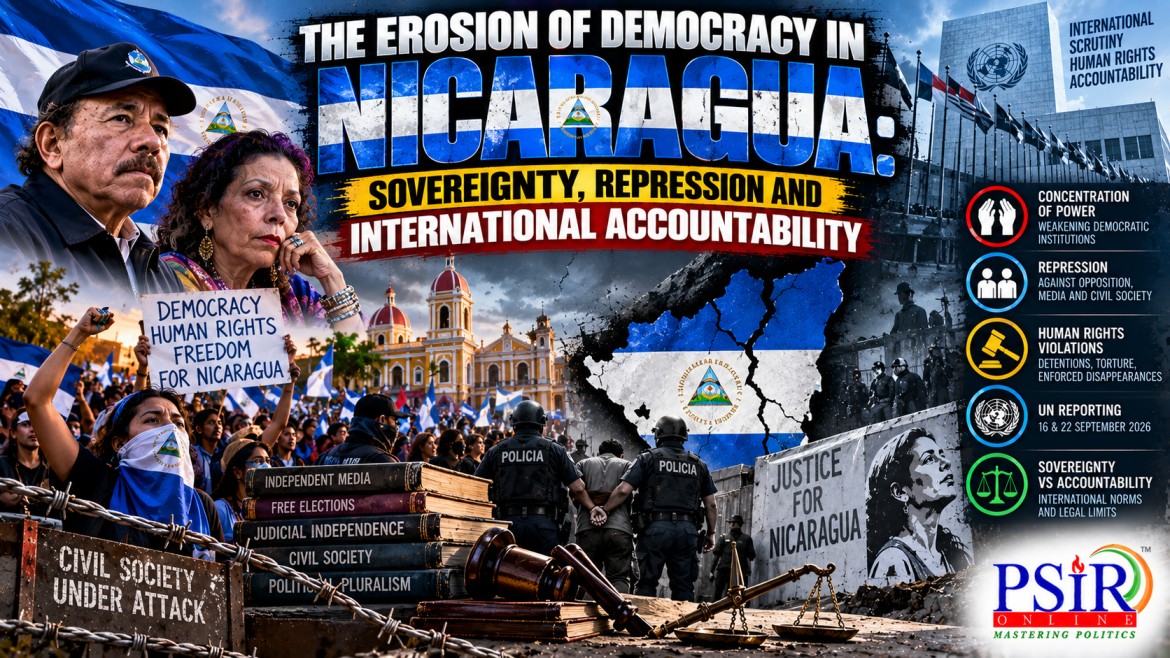
Democracy depends on more than elections. It requires independent institutions, constitutional checks and balances, political pluralism, freedom of expression, an autonomous civil society and the ability of citizens to challenge state power without fear of retaliation. When these safeguards weaken, electoral institutions may continue to exist while their capacity to hold governments accountable progressively declines.
Nicaragua illustrates this challenge. Since the mass protests of April 2018, the country has experienced a sustained deterioration in political freedoms, civil society autonomy and institutional independence. The government led by co-presidents Daniel Ortega and Rosario Murillo has faced repeated international criticism over restrictions on opposition activity, the closure of civic organisations, arbitrary detention and the treatment of political opponents.
Two United Nations developments in September 2026 brought these concerns into sharper focus. On 16 September, the UN human rights office reported the progressive dismantling of democratic institutions and the concentration of power within the executive and governing party. On 22 September, the UN Group of Human Rights Experts on Nicaragua reported evidence of enforced disappearances, torture and arbitrary detention of political opponents, describing the documented campaign as crimes against humanity.
These findings raise fundamental questions about democratic accountability, state sovereignty and the international protection of human rights. They also expose the limits of international institutions when governments restrict domestic remedies, reject external scrutiny or disengage from accountability mechanisms.
Nicaragua therefore represents a broader problem in international relations: how can the international community respond when national institutions are alleged to have become instruments of repression, while respecting the legal principles governing sovereignty and non-intervention?
THE CONCENTRATION OF POWER AND THE WEAKENING OF DEMOCRATIC CHECKS
Democratic government depends on the distribution and limitation of political authority. Legislatures scrutinise executive decisions, courts provide independent legal remedies, electoral institutions protect political competition and civil society enables citizens to organise outside the state. These institutions are not merely administrative arrangements; they are mechanisms through which public power is made accountable.
The UN human rights office warned on 16 September 2026 that Nicaragua’s democratic institutions and rule of law had been progressively dismantled. Its assessment described the concentration of power within the executive and governing party and the weakening of institutional checks that might otherwise protect citizens against abuses.
The transformation is particularly significant because institutional erosion can occur through legal and constitutional changes as well as through direct coercion. Amendments to constitutional arrangements, restrictions on political participation, changes to electoral rules and the removal of institutional autonomy can alter the distribution of power while preserving the formal appearance of constitutional government.
Human Rights Watch’s 2026 country assessment also described extensive restrictions on civil society and political freedoms. It reported that thousands of non-governmental organisations had lost legal registration since 2018 and that media outlets and universities had been affected by government action.
The September 2026 reporting also raised concerns about constitutional changes that extend presidential terms and permit the exclusion of individuals from public office on grounds defined by the authorities. Such measures can narrow political competition when legal categories are applied in ways that disadvantage opposition figures.
The central democratic problem is therefore not simply whether elections take place. It is whether citizens have a meaningful opportunity to organise, contest power, access independent courts and replace political leaders through genuine competition.
Democratic erosion occurs when institutions that formally remain in place lose the autonomy and authority necessary to constrain executive power.
REPRESSION OF CIVIL SOCIETY, MEDIA AND POLITICAL OPPOSITION
Civil society organisations, independent media, universities, religious institutions and opposition groups provide channels through which citizens communicate grievances, organise collectively and scrutinise government decisions. Restrictions on these institutions reduce the space for public debate and weaken the social foundations of democratic accountability.
Nicaragua’s political crisis intensified after the protests of April 2018. Subsequent years saw the detention of opponents, restrictions on public demonstrations, closures of organisations and pressure on independent journalism. The effects have extended beyond formal political parties to human rights defenders, religious figures, Indigenous leaders, former public officials and members of the Nicaraguan diaspora.
The UN Group of Human Rights Experts reported on 22 September 2026 that state institutions, including police, prosecutors and intelligence agencies, had been involved in a coordinated campaign against political opponents. The experts documented allegations and evidence concerning arbitrary detention, torture, enforced disappearance and persecution on political grounds.
The report described the conduct as crimes against humanity. This is a finding by an independent UN investigative mechanism; individual criminal responsibility and any eventual legal determination remain matters for competent judicial processes.
The deterioration of civic space also has a transnational dimension. Human Rights Watch has reported threats, surveillance and pressure against Nicaraguans living abroad. Restrictions on nationality, property and the ability to return can create continuing vulnerabilities for exiles and their families.
|
Area of civic life |
Democratic function |
Reported concern in Nicaragua |
|
Independent media |
Scrutinises public authority and provides information |
Closures, restrictions and pressure on journalists |
|
Civil society organisations |
Organises citizens and monitors rights |
Cancellation of legal registrations and constraints on independent activity |
|
Political opposition |
Offers alternatives and enables competition |
Detention, exclusion and restrictions on political participation |
|
Universities and religious institutions |
Supports independent thought and community organisation |
Reported institutional pressure and restrictions |
|
Human rights defenders and exiles |
Documents violations and raises international concerns |
Threats, surveillance, arbitrary measures and transnational repression |
These restrictions reinforce one another. When media and civic organisations are weakened, abuses become harder to document. When courts lack independence, victims may struggle to obtain remedies. When opposition groups face detention or exclusion, electoral competition becomes less meaningful.
The contraction of civic space is therefore both a consequence and a mechanism of democratic erosion. It weakens the capacity of society to resist further concentration of power.
SOVEREIGNTY, HUMAN RIGHTS AND THE LIMITS OF NON-INTERVENTION
State sovereignty remains a foundational principle of international relations. It protects the legal independence of states, establishes territorial jurisdiction and limits the authority of other states to intervene in domestic affairs. Yet contemporary international law also recognises that states have obligations concerning human rights under treaties to which they are parties.
The tension is especially pronounced when the institutions responsible for protecting citizens are themselves implicated in alleged violations. The government may invoke sovereignty and non-intervention, while international organisations argue that human rights obligations are matters of legitimate international concern.
Nicaragua’s relationship with international accountability mechanisms has deteriorated. Human Rights Watch has reported that the government expelled international monitors, disengaged from key human rights bodies and rejected accountability mechanisms. These developments make independent verification, cooperation and the implementation of recommendations more difficult.
The legal distinction between criticism and intervention is important. Public reporting, diplomatic engagement, treaty-body scrutiny and investigations conducted under an authorised international mandate do not automatically amount to unlawful intervention. Their legitimacy depends on the applicable legal framework, institutional mandate and conduct of the actors involved.
Nor does every human rights concern authorise the use of force. The UN Charter prohibits the threat or use of force against the territorial integrity or political independence of states, subject to the Charter’s recognised exceptions. The principle of sovereignty therefore continues to constrain the instruments available to external actors.
At the same time, sovereignty does not eliminate a state’s obligations under international human rights law. Where credible evidence indicates serious violations, international scrutiny can serve the purpose of documenting abuses, preserving evidence and identifying possible routes to accountability.
The Nicaraguan case illustrates a fundamental tension in global governance: sovereignty protects political independence, but it does not erase a state’s international legal obligations. The challenge is to ensure that accountability measures remain grounded in law, evidence and appropriate institutional authority.
INTERNATIONAL ACCOUNTABILITY: WHAT CAN THE UNITED NATIONS DO?
The United Nations has several mechanisms for addressing serious human rights concerns, including investigations mandated by the Human Rights Council, reporting by the Office of the High Commissioner for Human Rights, treaty-monitoring bodies and diplomatic scrutiny by member states. These mechanisms can document violations, identify patterns, preserve evidence and recommend measures to prevent further abuses.
The Group of Human Rights Experts on Nicaragua was established by the Human Rights Council in 2022 to investigate alleged human rights violations and abuses committed in the country since April 2018. Its work has included examining the structures and actors involved in alleged violations and identifying avenues for accountability.
The September 2026 findings extend this work by documenting alleged coordination among state institutions and the use of detention, torture and enforced disappearance against opponents. Such reporting can contribute to an evidentiary record, support future investigations and inform decisions by governments and international bodies.
However, UN investigative groups do not themselves function as criminal courts. Their findings do not automatically produce arrests, prosecutions or compensation for victims. Enforcement depends on the jurisdiction of competent courts, state cooperation, applicable treaties and the availability of evidence.
Several accountability pathways may be relevant:
· UN human rights mechanisms: continue independent monitoring, reporting and recommendations, while preserving evidence and documenting patterns of abuse.
· Domestic judicial proceedings: courts in states with an appropriate legal basis may investigate certain serious international crimes, subject to jurisdictional requirements and due process.
· International legal procedures: cases may be pursued where a competent court has jurisdiction and the relevant legal conditions are satisfied.
· Targeted diplomatic measures: governments and regional organisations may use lawful diplomatic and other measures to encourage cooperation and protect affected individuals.
· Protection for victims and exiles: states can strengthen asylum procedures, protect threatened human rights defenders and investigate credible allegations of transnational repression within their jurisdiction.
The International Criminal Court should not be treated as an automatic avenue for prosecuting every alleged crime in Nicaragua. Its jurisdiction depends on the Rome Statute, territorial or personal jurisdiction, temporal limits and other legal requirements. Likewise, the International Court of Justice addresses disputes between states, not the criminal responsibility of individual officials, and requires an applicable basis of jurisdiction.
The UN’s role is consequently important but limited. International scrutiny can strengthen documentation and raise the costs of impunity, but it cannot substitute for effective legal jurisdiction and cooperation in enforcement.
REGIONAL ORGANISATIONS, DIPLOMACY AND THE POLITICS OF RESPONSE
Regional institutions can contribute to accountability by coordinating diplomatic pressure, supporting human rights monitoring and maintaining channels for dialogue. In the Americas, the Organisation of American States (OAS) and the Inter-American human rights system have played important roles in documenting concerns and articulating regional standards.
Nicaragua’s disengagement from regional and international mechanisms has complicated these efforts. Withdrawal from or rejection of institutional processes can reduce opportunities for dialogue and monitoring, although it does not necessarily remove all applicable international obligations or prevent other states from pursuing lawful accountability measures.
External responses also face political constraints. Governments may differ in their priorities, relationships with Nicaragua and willingness to impose diplomatic or economic costs. Some may emphasise human rights and democratic standards; others may prioritise non-intervention, regional stability or broader diplomatic relationships.
These differences can weaken coordinated action. They may also produce inconsistent responses when governments condemn abuses in one context but adopt a more restrained position in another.
A credible regional strategy would combine independent monitoring with sustained diplomatic engagement, support for civil society and protection for people at risk. It would also distinguish between measures aimed at government officials and those that could impose broad costs on the population.
Accountability efforts require careful attention to evidence and legal standards. Measures that are poorly targeted or lack a clear legal basis can undermine confidence in international institutions and provide opportunities for governments to portray scrutiny as politically motivated.
The challenge is therefore not simply to increase external pressure. It is to maintain consistent standards, credible evidence and coordinated responses while preserving the distinction between legitimate accountability and unlawful interference.
PATHWAYS TOWARDS ACCOUNTABILITY AND DEMOCRATIC RECOVERY
The restoration of democratic safeguards in Nicaragua would require institutional change, protection of civic freedoms and credible avenues for remedy. External actors can support these objectives, but durable change also depends on the ability of Nicaraguan society to organise, participate and pursue political alternatives without coercion.
Several priorities emerge from the documented concerns.
Restoring institutional independence: courts, electoral bodies and oversight institutions need the capacity to operate without improper political interference. Independent institutions are essential to investigating allegations, protecting due process and resolving disputes.
Reopening civic space: independent media, universities, civil society organisations, religious institutions and political groups require the freedom to operate lawfully without arbitrary closure or intimidation.
Ending arbitrary detention and enforced disappearance: credible allegations require independent investigation, access to detainees, disclosure of information about missing persons and effective remedies for victims.
Protecting exiles and people at risk: asylum procedures, safeguards against arbitrary deprivation of nationality and protection from transnational threats can reduce the vulnerability of those who have fled the country.
Preserving evidence and supporting legal accountability: international mechanisms and competent domestic authorities should maintain reliable records and follow applicable evidentiary and procedural standards.
Strengthening regional cooperation: the UN, OAS, Inter-American human rights bodies and individual states can coordinate monitoring, diplomatic engagement and protection measures within their respective mandates.
These priorities are interdependent. Electoral reform cannot by itself restore democracy if opposition groups cannot organise. Freedom of expression remains vulnerable if independent courts cannot protect it. Accountability is difficult when victims fear retaliation or evidence cannot be preserved.
Nor can external institutions guarantee democratic recovery through declarations alone. The practical value of international engagement depends on sustained attention, coordination, protection of affected individuals and the availability of lawful mechanisms capable of addressing violations.
Democratic recovery requires more than a change in political leadership; it requires institutions capable of limiting power and protecting rights regardless of who governs.
THEORETICAL ANGLES
|
Theory or concept |
Connection to Nicaragua |
|
Democratic theory |
The weakening of checks and balances, political pluralism and civic freedoms illustrates why democracy requires more than periodic elections. |
|
Liberalism |
Independent institutions, individual rights, constitutional limits and civil society are central to liberal conceptions of accountable government. |
|
Authoritarianism and executive aggrandisement |
The concentration of power and weakening of institutional constraints demonstrate how democratic safeguards can be eroded from within formal political structures. |
|
State sovereignty and non-intervention |
Nicaragua’s relationship with international monitoring highlights the tension between domestic jurisdiction and international human rights obligations. |
|
International human rights norms |
UN investigations and regional mechanisms demonstrate how international standards can be used to document violations and demand accountability. |
|
Constructivism |
Norms concerning democracy, human rights and legitimate state conduct shape diplomatic responses and international judgments about political authority. |
|
International institutionalism |
UN and regional mechanisms facilitate investigation and coordination, but their impact depends on mandates, state cooperation and enforcement capacity. |
|
Norm diffusion and compliance |
International scrutiny can strengthen shared standards, but domestic institutions and political incentives influence whether those standards are implemented. |
CONCLUSION
Nicaragua’s political crisis demonstrates how democratic erosion can proceed through the concentration of executive power, restrictions on civil society and the weakening of institutional checks. The September 2026 UN findings added to the documented concerns about arbitrary detention, enforced disappearance, torture and the persecution of political opponents.
The case also reveals the limits of international human rights protection. UN mechanisms can investigate and report; regional organisations can maintain scrutiny; and states can pursue lawful diplomatic and legal measures. Yet none of these instruments automatically ensures compliance, arrests or democratic restoration.
The tension between sovereignty and accountability cannot be resolved by treating either principle as absolute. Sovereignty remains essential to the international legal order, but it does not remove human rights obligations. International responses, in turn, must respect jurisdictional limits, evidentiary standards and the prohibition on unlawful intervention.
The central challenge is to convert documented violations into meaningful protection and lawful accountability while preserving the space for political participation and institutional recovery. The credibility of international human rights norms ultimately depends not only on their universal articulation, but also on the capacity to protect victims, preserve evidence and pursue accountability through legitimate legal mechanisms.
RELATED READING
PRACTICE QUESTIONS FOR GS2 MAINS
PRACTICE QUESTIONS FOR PSIR
