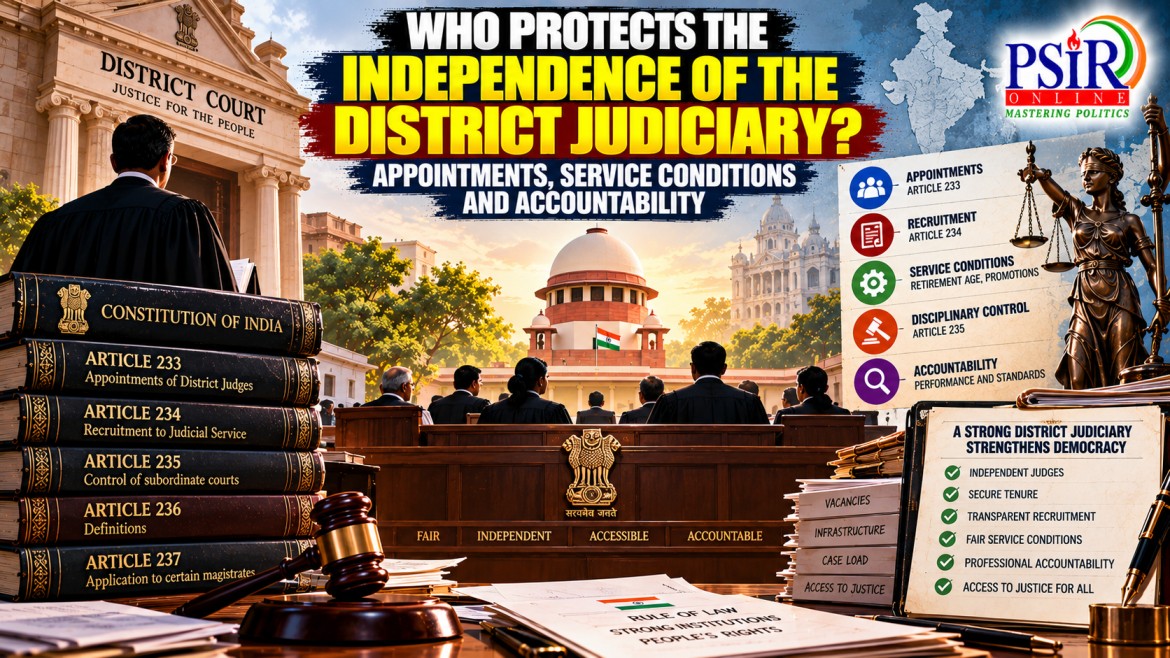
Judicial independence is meaningful only when it extends beyond the Supreme Court and High Courts to the courts that handle the overwhelming majority of ordinary litigation. District judges and other subordinate judicial officers determine civil disputes, criminal cases, family matters and appeals that directly affect citizens' rights and everyday lives. Their independence depends not only on impartial adjudication but also on secure service conditions, fair recruitment, professional autonomy and protection against improper executive influence.
In September 2026, the Supreme Court revisited the retirement age of district judicial officers in All India Judges Association v. Union of India. On 1 September, a three-judge Bench directed seven States to raise the retirement age from 60 to 62 years, subject to a suitability and performance assessment by the relevant High Court at age 60. The Court also directed other States and Union Territories to reconsider their positions. The decision brought renewed attention to Articles 233–237, which establish the constitutional framework governing appointments, recruitment and control of the subordinate judiciary.
THE SEPTEMBER 2026 RETIREMENT-AGE DEBATE
The September proceedings arose from long-running litigation over the service conditions of judicial officers across India. On 1 September 2026, the Supreme Court noted that most High Courts supported increasing the retirement age from 60 to 62, although State Governments and Union Territory administrations had expressed differing views. Some cited financial costs, while others raised concerns about recruitment opportunities for younger candidates and parity with other public employees.
The Court directed Chhattisgarh, Karnataka, Madhya Pradesh, Maharashtra, Sikkim, Tamil Nadu and West Bengal to amend their service rules to provide for retirement at 62, subject to assessment of suitability and performance by the relevant High Court at age 60. Pending the rule amendments, eligible officers in those States were permitted to continue until 62, subject to the assessment. Judicial officers who retired on or after 31 March 2026 in those States were also given an option to seek rejoining, subject to specified conditions. Other States and Union Territories were directed to reconsider their positions and report compliance.
The Court relied on the specialised constitutional position of judicial officers and the need to retain experienced personnel amid vacancies in the judicial service. It rejected the argument that their service conditions should automatically mirror those of other State employees. The decision did not establish a universal retirement age of 62 for every district judicial officer across India; its directions specifically identified seven States, while requiring others to reconsider their positions.
The larger significance lies in the principle that service conditions must be evaluated in relation to the effective administration of justice and judicial independence, rather than treated as an ordinary question of employee benefits. The case also illustrates how the Supreme Court can use continuing proceedings to address structural issues affecting the functioning of the subordinate judiciary.
ARTICLES 233–237: THE CONSTITUTIONAL DESIGN
The Constitution creates a distinct framework for the subordinate judiciary. It distributes responsibilities among the Governor, State Governments, High Courts and, in specified circumstances, the State Public Service Commission. The arrangement seeks to preserve a role for constitutionally designated authorities while preventing the executive from exercising unfettered control over judicial careers.
|
Article |
Constitutional function |
|
Article 233 |
Appointments, postings and promotions of district judges are made by the Governor in consultation with the High Court. Direct recruitment from the Bar is subject to constitutional eligibility requirements, including at least seven years as an advocate or pleader. |
|
Article 234 |
Recruitment of persons other than district judges to the judicial service is made by the Governor in accordance with rules framed after consultation with the State Public Service Commission and the High Court. |
|
Article 235 |
Vests control over district courts and courts subordinate to them in the High Court, including important aspects of posting, promotion and disciplinary control, subject to the constitutional framework. |
|
Article 236 |
Defines key expressions, including “district judge” and “judicial service”, for the purposes of the constitutional provisions on subordinate courts. |
|
Article 237 |
Enables the Governor, by public notification, to apply the provisions of the relevant chapter and rules made under them to specified classes of magistrates, subject to the conditions in the Article. |
Article 233 is particularly important because the Governor does not exercise appointment authority in isolation: consultation with the High Court is constitutionally required. Article 234 similarly embeds the High Court in recruitment to the judicial service. Most significantly, Article 235 places the control of subordinate courts in the High Court, creating an institutional safeguard against routine executive interference in judicial careers.
These provisions do not remove every role of the State Government. Governments participate in rule-making, funding and administrative arrangements within the applicable constitutional and statutory framework. The central principle is that executive participation must coexist with the High Court's constitutionally protected role in matters of judicial control.
WHY SERVICE CONDITIONS ARE A QUESTION OF JUDICIAL INDEPENDENCE
Judicial independence is often discussed through the tenure, salaries and appointment processes of Supreme Court and High Court judges. Yet district judicial officers also require safeguards against arbitrary transfers, disciplinary pressure, insecure promotion prospects and service rules that undermine their ability to decide cases impartially.
In All India Judges Association v. Union of India, the Supreme Court has repeatedly considered the conditions necessary for a professional and independent judicial service. The September 2026 retirement-age order drew on the distinction between judicial officers and ordinary government employees, stressing the constitutional character of judicial service and the importance of retaining experienced officers while ensuring suitability and performance.
The Court's approach attempts to balance two objectives: preserving institutional experience and maintaining standards of competence. An increase in retirement age does not mean that continuation must be automatic. The assessment condition provides a mechanism for the High Court to evaluate whether an officer should remain in service beyond the existing retirement age.
At the same time, assessment mechanisms must themselves be fair, transparent and based on relevant professional criteria. If continued service depends on vague or inconsistently applied standards, the safeguard may become a source of uncertainty. Independence requires both protection from arbitrary interference and accountability for professional performance.
THE ROLE OF HIGH COURTS AND STATE GOVERNMENTS
The constitutional arrangement is not one of complete separation between the judiciary and the executive. Instead, it creates a division of responsibilities. High Courts exercise constitutionally protected control over the subordinate judiciary, while State Governments retain roles in the legislative, financial and administrative arrangements needed to sustain judicial institutions.
The September 2026 order illustrates this relationship. The Supreme Court directed the seven consenting States to amend their service rules and required the remaining States and Union Territories to reconsider their positions. The High Courts were assigned the role of assessing the suitability and performance of judicial officers reaching age 60 in the States covered by the directions.
The arrangement raises a broader institutional question: how can the judiciary remain independent when its service conditions require executive action? The constitutional answer lies in the allocation of roles. State Governments cannot disregard binding judicial directions, but neither does the High Court independently perform every legislative or financial function. The constitutional system requires cooperation within defined boundaries.
This division also creates a need for timely rule amendments, adequate budgetary provision, transparent recruitment and regular reporting on sanctioned and working judicial strength. Delays in implementing service reforms can weaken the practical benefits of constitutional safeguards. Effective independence therefore depends not only on formal constitutional language but also on administrative compliance and institutional capacity.
ACCOUNTABILITY, VACANCIES AND ACCESS TO JUSTICE
The independence of the district judiciary must be assessed alongside its ability to deliver timely and accessible justice. Vacancies, inadequate infrastructure, uneven recruitment, delays in promotion and inconsistent service conditions can affect court functioning and place additional burdens on litigants. Retaining experienced judicial officers may help preserve institutional knowledge, but it cannot substitute for filling vacancies or improving the wider judicial system.
The September 2026 proceedings also highlighted a recurring tension between retaining experienced officers and creating opportunities for new entrants. These goals need not be treated as mutually exclusive. A credible judicial workforce policy can combine fair performance assessment, regular recruitment, transparent promotion rules and adequate sanctioned strength.
Accountability must also be distinguished from executive control. Judicial officers should be answerable through constitutionally appropriate disciplinary and administrative mechanisms, but such mechanisms must not be used to influence the outcome of individual cases. High Court control under Article 235 is central to this balance. The objective is neither unreviewable discretion nor executive supervision of adjudication, but a system that protects impartial decision-making while enforcing professional standards.
Ultimately, the district judiciary is where constitutional promises become practical remedies. Its independence depends on secure service conditions, capable personnel, fair evaluation and institutional arrangements that permit judges to decide cases according to law rather than external pressure.
UPSC DIMENSION
|
Constitutional provision or concept |
Significance |
|
Articles 233–234 |
Establish the constitutional framework for appointments and recruitment to the district and subordinate judicial services. |
|
Article 235 |
Protects the High Court's control over subordinate courts, an important safeguard of judicial independence. |
|
Article 236 |
Defines terms relevant to the constitutional scheme governing subordinate courts. |
|
Article 237 |
Provides for the application of the relevant constitutional provisions to specified classes of magistrates. |
|
Separation of powers |
Explains why judicial careers require protection from improper executive influence. |
|
All India Judges Association v. Union of India |
Major line of Supreme Court proceedings on judicial service conditions, pay, recruitment and retirement age. |
|
September 2026 retirement-age directions |
Directed seven States to raise district judicial officers' retirement age to 62, subject to High Court assessment, and required other States/UTs to reconsider. |
|
Judicial independence |
Depends on secure tenure, fair service conditions, institutional autonomy and protection against arbitrary interference. |
|
Judicial accountability |
Requires fair performance assessment and disciplinary procedures without compromising decisional independence. |
|
Access to justice |
Links vacancies, judicial capacity and service reforms to timely adjudication and effective remedies for citizens. |
CONCLUSION
The independence of the district judiciary is a constitutional necessity, not merely a matter of employment policy. Articles 233–237 establish a framework in which appointments, recruitment and judicial control are distributed among designated constitutional authorities, with the High Court occupying a central role in protecting subordinate judicial independence.
The September 2026 retirement-age directions in All India Judges Association v. Union of India demonstrate how service conditions can become a constitutional issue when they affect institutional experience, recruitment and the administration of justice. The order's limited scope must be respected: seven States were directed to raise the retirement age to 62 subject to assessment, while others were asked to reconsider their positions.
A durable judicial system requires more than extending tenure. It requires transparent recruitment, adequate staffing, fair performance assessment, timely implementation of service rules and protection against improper interference. An independent district judiciary is the foundation on which equal access to justice and the rule of law rest.
RELATED READING
PRACTISE QUESTIONS FOR GS2 MAINS
PRACTISE QUESTIONS FOR PSIR
