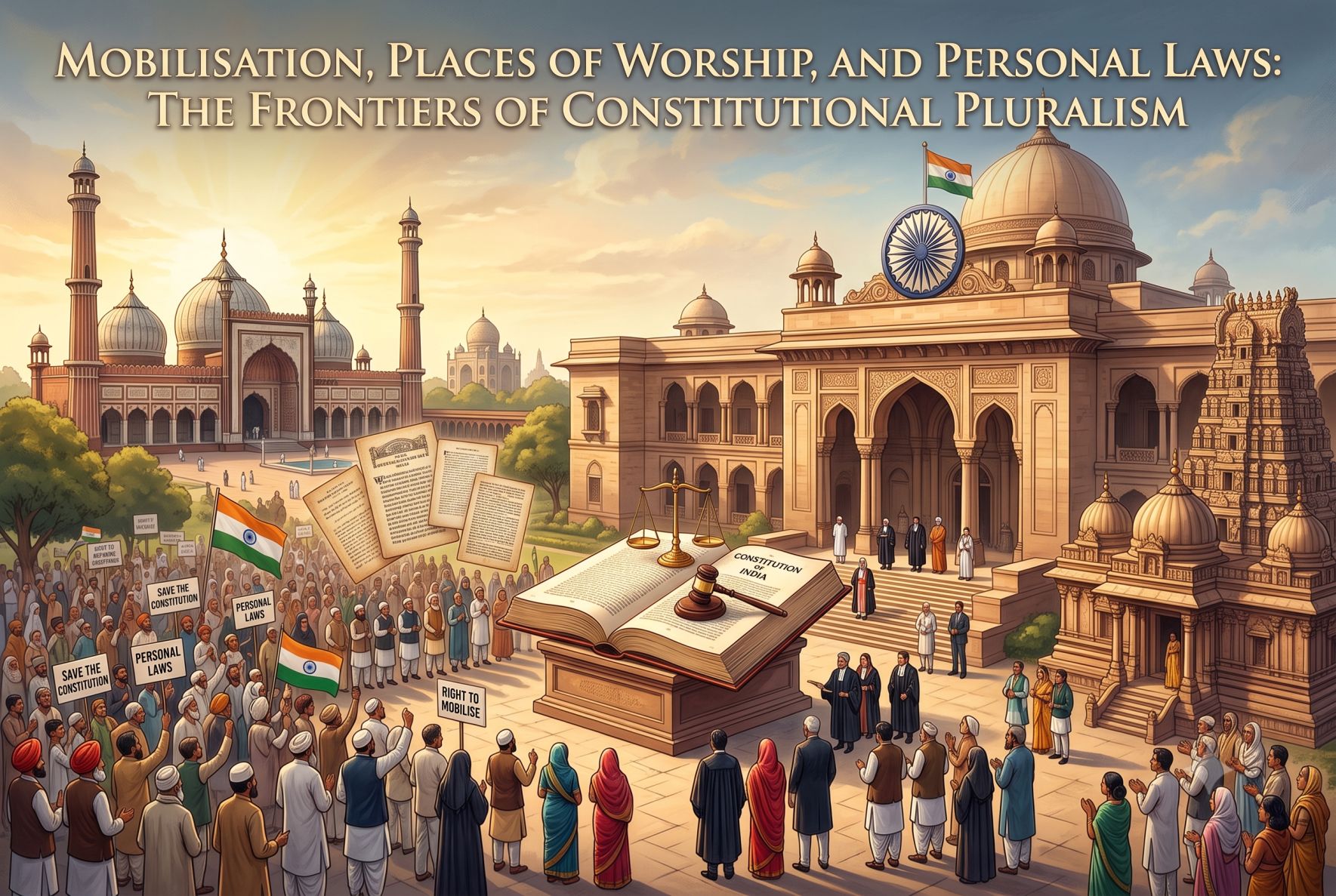
In September, the All India Muslim Personal Law Board (AIMPLB) initiated a nationwide campaign centered on the protection of the Constitution, religious autonomy, and personal laws. Launched from Jantar Mantar in New Delhi, the movement brought together prominent clerical leaders, community representatives, and affiliated civil bodies to articulate opposition to state-led Uniform Civil Code (UCC) measures, raise concerns regarding disputed religious sites such as the Sambhal Shahi Jama Masjid, and protest proposed administrative changes to Waqf governance.
By taking to the streets, submitting administrative memorandums, and drafting white papers on minority rights, the AIMPLB positioned itself as an institutional pressure group seeking to shape the public discourse around secularism, religious liberty, and personal law autonomy.
THE TWO FLASHPOINTS: UCC AND THE SAMBHAL MOSQUE DISPUTE
1. The Uniform Civil Code (UCC)
The push for a Uniform Civil Code—originating from Article 44 under the Directive Principles of State Policy—aims to replace distinct community-based civil codes governing marriage, divorce, inheritance, maintenance, and adoption with a standardized secular framework.
· Following enactments such as the Uttarakhand UCC legislation and proposals in other states, the debate moved from theoretical legal discourse into concrete statutory reality.
· The AIMPLB and opposing civil groups view the UCC as an existential threat to religious practice, asserting that civil laws within the Islamic tradition are drawn from foundational texts and protected under constitutional provisions guaranteeing religious freedom.
2. The Sambhal Shahi Jama Masjid Dispute
The controversy in Sambhal, Uttar Pradesh, emerged following civil court petitions claiming the historic Jama Masjid was constructed atop the remains of the Harihar temple.
· Court-ordered advocate-commissioner surveys led to severe localized friction, public unrest, and administrative crackdowns.
· At the heart of the dispute lies the statutory shield of The Places of Worship (Special Provisions) Act, 1991, which mandates that the religious character of any place of worship as it existed on August 15, 1947, must remain unchanged.
· Legal challenges in Sambhal, alongside analogous petitions in Varanasi and Mathura, have tested whether procedural surveys to ascertain the historical identity of a site violate the substantive protection offered by the 1991 Act.
MOBILISATION, COUNTER-MOBILISATION, AND THE DILEMMA OF THE NEUTRAL ARBITER
In contentious socio-religious disputes, the democratic arena rarely witnesses isolated dissent; rather, the exercise of the constitutional right to assemble, protest, and articulate collective grievances under Articles 19(1)(a) and 19(1)(b) inevitably generates competitive counter-mobilisation. When faith-based bodies or civil society formations take to the public square to oppose legislative measures such as the UCC or contest interventions at disputed shrines, opposing socio-political groups frequently mobilize their own ranks to assert majoritarian prerogatives, legal uniformity, or historical redress.
This dialectic fundamentally complicates the role of the modern democratic state. While classical liberal theory models the sovereign state as a detached, neutral umpire maintaining an equal playing field, intense identity conflicts test this premise. The state faces a structural dual-imperative: it must safeguard public order and protect civil commons from lawlessness under its legitimate monopoly over force, while simultaneously remaining an impartial guardian of fundamental freedoms and cultural rights without appearing partisan.
When street assertions turn volatile—as seen in localized clashes over site surveys or aggressive demonstrations over legal codification—every administrative action risks suspicion. Enforcing preventive measures or regulatory restrictions can be interpreted by minority groups as selective suppression, whereas administrative forbearance is frequently criticized by counter-mobilising groups as appeasement or state paralysis. The governance challenge thus transcends routine crowd management: the state must maintain genuine constitutional neutrality, ensuring that the necessary regulation of competitive assemblies does not compromise its duty to protect plural civic expression.
THE PERSONAL LAW DEBATE: ARGUMENTS TO AND FRO
The question of whether a pluralistic democracy should permit faith-based personal codes or mandate uniform civil laws reflects a classic constitutional tension between individual rights and community autonomy.

Arguments Advocating for a Uniform Civil Code
· Constitutional Equality and Non-Discrimination: Proponents argue that Articles 14 (equality before the law) and 15 (prohibition of discrimination based on religion or sex) require universal legal standards. Under traditional personal laws, women across different communities may experience unequal protections regarding succession, inheritance shares, maintenance rights, and polygamy.
· National Integration and Common Civic Identity: Advocates maintain that personal laws create fragmented legal enclaves where a citizen's civil entitlements depend on their religion. Standardizing family law is viewed as a necessary step toward an integrated, secular republic, fulfilling the mandate envisaged by the Constitution's framers under Article 44.
· Sovereign Primacy Over Secular Activities: Under Article 25(2)(a), the state retains the explicit constitutional authority to regulate secular activities associated with religious practices, including property management, contracts, and financial settlements related to divorce.
Arguments Advocating for the Retention and Internal Reform of Personal Laws
· Protection of Freedom of Conscience: Opponents of a mandatory UCC emphasize that Articles 25 and 26 protect not only belief, but the freedom to practice and observe personal legal traditions rooted in religious faith. For observant citizens, family and succession rules are an inseparable part of religious obedience.
· Respect for Pluralism and Federalism: Scholars and community representatives contend that Indian secularism has historically operated through "principled distance" and accommodation, rather than aggressive homogenization. Enforcing a single code across diverse tribal, linguistic, and religious groups risks erasing legitimate cultural diversity and infringing on Article 29 safeguards.
· The Principle of Internal Reform vs. External Imposition: The AIMPLB and other community institutions argue that legal evolution should occur organically from within the community through consensual dialogue and social education, rather than top-down statutory fiat. They cite Dr. B.R. Ambedkar’s assurances during the Constituent Assembly debates that Article 44 was conceived as an aspirational principle that should remain voluntary, requiring the consent of affected groups before implementation.
CONSTITUTIONAL PLURALISM AND THE SECULAR REPUBLIC
The contemporary friction over the AIMPLB's mobilisations, the Sambhal mosque litigation, and the Uniform Civil Code demonstrates that Indian secularism is not an absolute, static settlement. It is an ongoing institutional negotiation between two essential democratic imperatives:
1. The sovereign state's duty to guarantee equal civic rights, prevent gender-based discrimination, and maintain public order.
2. The constitutional obligation to protect minority identities, respect distinct cultural ways of life, and preserve institutional spaces for plural legal traditions.
Whether through judicial review in the Supreme Court, parliamentary scrutiny, or civil society engagement, the resolution of these questions will continue to define how modern India reconciles individual equality with collective freedom of faith.
PSIR DIMENSION: THEORETICAL CONCEPTS & EXAMINATION LINKAGES
|
PSIR Theoretical Dimension & Concepts |
How It Connects to Examination Answers (PSIR Paper 1 / Paper 2) |
|
Western Secularism vs. Principled Distance (Rajeev Bhargava; Charles Taylor) |
Contextual Secularism vs. Rigid Separation: Contrasts the French laïcité (strict exclusion) and American wall of separation with the Indian model of "principled distance." Explains why the Indian state intervenes in socio-religious practices to promote gender justice (Article 44) while simultaneously guaranteeing denominational autonomy (Article 26) and personal law protections (Articles 25, 29). |
|
Multiculturalism & Differentiated Citizenship (Will Kymlicka; Iris Marion Young) |
Polyethnic Rights vs. Assimilation: Uses Kymlicka’s framework of minority group-differentiated rights to defend the retention of personal laws. Demonstrates that in culturally divided post-colonial states, universal citizenship without internal exemptions risks imposing majority cultural norms under the guise of uniform legal neutrality. |
|
Substantive Equality vs. Formal Universalism (B.R. Ambedkar; Ronald Dworkin) |
Gender Justice within Identity Frameworks: Reconciles the tension between Article 14 (formal legal equality) and cultural autonomy under Article 25. Frames the UCC debate not merely as a clash between state and community, but as an intra-group struggle to eliminate structural discrimination against women in marriage, inheritance, and succession. |
|
Deliberative Counter-Publics & Religious Pressure Groups (Nancy Fraser; Jürgen Habermas) |
Faith-Based Mobilisation in the Public Sphere: Analyzes the All India Muslim Personal Law Board (AIMPLB) as an institutional pressure group and subaltern counter-public. Illustrates how minority institutions mobilise street protests, memorandums, and public campaigns to deliberate and contest legislative measures outside formal parliamentary channels. |
|
The Weberian Coercive Monopoly & The Neutral Arbiter Dilemma (Max Weber – Monopoly on Legitimate Violence; Joel Migdal) |
Competitive Mobilisation and State Neutrality: Explores the administrative friction when minority demonstrations trigger counter-mobilisation by majoritarian groups. Connects this to the state's structural dilemma: balancing public order and statutory enforcement with its obligation to remain a non-partisan constitutional umpire. |
|
Non-Retrogression & Statutory Constitutionalism (Upendra Baxi; Supreme Court of India) |
Preserving the Secular Equilibrium via the 1991 Act: Evaluates The Places of Worship (Special Provisions) Act, 1991 through Baxi's lens of non-retrogression. Demonstrates how statutory freezes on religious identity protect constitutional pluralism by preventing historical grievances from destabilizing contemporary civil peace. |
|
Consociationalism & Minority Veto (Arend Lijphart – Patterns of Democracy) |
Internal Reform vs. Top-Down Imposition: Connects Dr. B.R. Ambedkar’s Constituent Assembly assurances on Article 44—that personal law reforms should remain voluntary—with consociational principles. Shows that lasting legal modernization in plural societies requires cross-community elite consensus rather than majoritarian legislative imposition. |
CONCLUSION
The contemporary friction over the Uniform Civil Code, disputed sacred sites like Sambhal, and community-led mobilisations reveals that Indian secularism is not a settled, static doctrine, but a continuous constitutional negotiation. At its core, the debate exposes the delicate balance between two vital democratic imperatives: the sovereign state's duty to guarantee non-negotiable individual equality, gender justice, and civic order, and its constitutional commitment to honor minority identity, community autonomy, and plural traditions. In navigating this terrain, the endurance of India's democratic fabric depends on avoiding both uncritical majoritarian homogenization and unyielding orthodoxy. A truly plural republic must cultivate an institutional architecture where statutory reforms evolve through inclusive internal deliberation, places of worship remain shielded from retrospective revanchism, and the state upholds its fundamental role as a scrupulously neutral arbiter of constitutional morality.
RELATED READING & ANALYTICAL ANGLES
· Constitutional Provisions & Doctrines:
o Articles 14, 15, and 21: Guarantees of equality before the law, non-discrimination on grounds of religion or sex, and the substantive right to live with personal dignity.
o Articles 25, 26, and 29: Freedom of conscience, denominational autonomy to manage religious affairs, and the preservation of distinct cultural, linguistic, and scriptural identities.
o Article 44: Directive Principle of State Policy obligating the state to endeavor to secure a Uniform Civil Code for citizens across India.
o The Doctrine of Non-Retrogression: Emerging judicial principle holding that constitutional rights, once expanded and statutorily solidified, cannot be systematically rolled back.
· Key Legislation & Statutory Benchmarks:
o The Places of Worship (Special Provisions) Act, 1991: Statutory freeze preserving the religious character of places of worship as they existed on August 15, 1947, designed to insulate the secular public sphere from retrospective title disputes.
o Uttarakhand Uniform Civil Code Act, 2024: State-level legislative precedent establishing standard civil regulations on marriage, succession, live-in relationships, and divorce.
o The Muslim Personal Law (Shariat) Application Act, 1937: Baseline statute governing application of personal laws to Muslims in India.
· Landmark Judicial Pronouncements:
o Shah Bano Case (1985) & Shayara Bano v. Union of India (2017): Supreme Court benchmarks reconciling gender equity and maintenance rights with faith-based personal codes.
o M. Siddiq (D) Thr. Lrs. v. Mahant Suresh Das & Ors. (Ayodhya Verdict, 2019): Supreme Court five-judge bench affirming that the Places of Worship Act, 1991 is an affirmative statutory obligation upholding constitutional secularism.
o S.R. Bommai v. Union of India (1994): Judicial entrenchment of secularism as an unalterable basic feature of the Indian Constitution.
· Key Theoretical Texts & Formulations:
o Rajeev Bhargava (ed.): Secularism and Its Critics (The conceptual formulation of Indian secularism as "principled distance").
o Will Kymlicka: Multicultural Citizenship: A Liberal Theory of Minority Rights (The analytical distinction between internal restrictions and external protections).
o Nivedita Menon: Recovering Subversion: Feminist Politics Beyond the Law (Critical feminist interrogations of uniform civil codes versus gender-just internal personal law reforms).
PRACTICE QUESTIONS FOR PSIR
