When citizens deposit their savings with a financial or cooperative institution, they depend on the institution’s ability to honour its obligations. When deposits remain unpaid, the challenge is not merely financial: it also concerns regulatory oversight, administrative accountability, access to remedies and public confidence in institutions.
The Central Registrar of Cooperative Societies (CRCS)–Sahara Refund Portal was launched on 18 July 2023 to facilitate refunds to eligible depositors of four Sahara Group multi-state cooperative societies. The initiative followed a Supreme Court order dated 29 March 2023 directing that ₹5,000 crore be transferred from the Sahara-SEBI Refund Account to the CRCS for disbursement against legitimate depositor claims.
On 8 September 2026, the Ministry of Cooperation announced that ₹9,267 crore had been refunded to 41,56,711 depositors through Aadhaar-seeded bank accounts. Approximately 20 lakh applications remained to be processed, and the Ministry reported that verification and refund processing had resumed after the portal was restored.
The portal illustrates how digital public administration can facilitate the verification and payment of claims. It also raises important questions about rejected applications, administrative interruptions, access to remedies and the restoration of institutional trust. The central challenge is to make the refund process verifiable, accessible and accountable without compromising the protection of genuine depositors.
WHAT IS THE CRCS–SAHARA REFUND PORTAL?
The portal was established to receive and process legitimate refund claims from depositors of four multi-state cooperative societies:
· Sahara Credit Cooperative Society Limited, Lucknow.
· Saharayan Universal Multipurpose Society Limited, Bhopal.
· Humara India Credit Cooperative Society Limited, Kolkata.
· Stars Multipurpose Cooperative Society Limited, Hyderabad.
The refund mechanism operates under the authority of the CRCS, within the Ministry of Cooperation, and in compliance with the Supreme Court’s directions. The Court’s order provided for the disbursement of funds against verified claims, subject to proper identification and proof of deposits. The process is supervised and monitored by former Supreme Court judge Justice R. Subhash Reddy, with the assistance of an amicus curiae.
The portal has three principal functions.
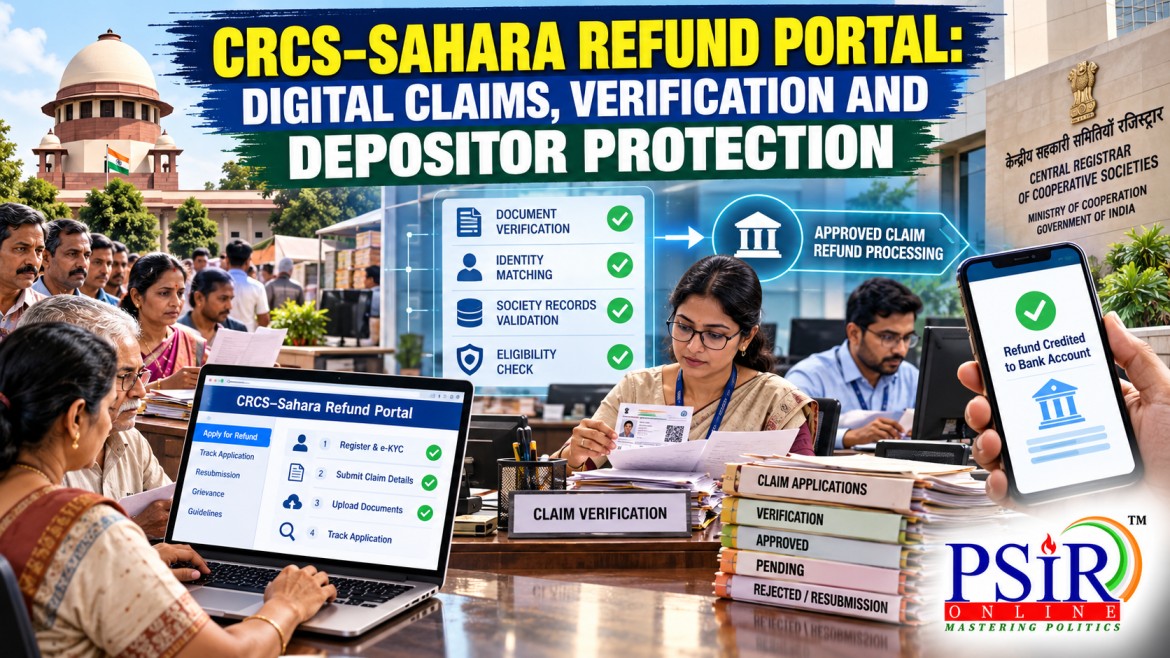
First, digital claim submission. Eligible depositors can submit applications and upload the prescribed evidence online, avoiding the need to submit the entire application through a conventional paper-based process.
Second, verification of claims. The system enables the authorities to examine identity information, deposit documentation and the records supplied by the relevant societies.
Third, direct payment. Once a claim is verified and approved, the eligible refund is credited to the depositor’s Aadhaar-seeded bank account.
The portal is therefore not an automatic reimbursement facility. An application does not establish eligibility by itself, and submission does not guarantee that the entire amount claimed will be paid. The claim must satisfy the prescribed verification requirements and remain within the applicable refund arrangements.
DIGITAL VERIFICATION AND THE SEPTEMBER 2026 PROGRESS REPORT
The refund mechanism uses Aadhaar-based electronic Know Your Customer (e-KYC) and matching of depositor, membership and bank-account details against information supplied by the respective societies. Deposit certificates or receipts and other prescribed documents are scrutinised under the applicable Standard Operating Procedure (SOP).
This verification serves an important purpose: it helps establish whether the applicant is identifiable, whether the deposit is supported by the available records and whether payment can be made to the appropriate bank account.
The Ministry’s September 2026 update reported the following progress:
|
Indicator |
Reported position |
|
Total amount refunded |
₹9,267 crore |
|
Depositors paid |
41,56,711 |
|
Applications remaining for processing |
Approximately 20 lakh |
|
Status of processing |
Verification and refund processing resumed after portal restoration |
These figures demonstrate the scale of the refund operation, but they need to be interpreted carefully.
The number of depositors paid is an output indicator. It does not tell us how many applicants are still waiting for a decision, how many claims have been rejected or how quickly pending cases will be resolved. Similarly, the amount refunded does not establish that every eligible depositor has recovered the full amount owed.
The Ministry’s February 2026 disclosure recorded 1,45,15,611 applications and 4,06,25,476 claims submitted through the portal. These are different measures: one application may include multiple claims. They should not be treated as equivalent to the number of individual depositors or the number of applications awaiting a decision.
A credible evaluation must therefore distinguish between applications received, claims verified, applications requiring correction, eligible claims approved and payments actually made. Such distinctions would provide a clearer picture of the scheme’s progress and the administrative workload that remains.
REJECTED CLAIMS, RESUBMISSION AND ACCESS TO REMEDIES
A verification-based refund system must protect against fraudulent claims, but it must also give genuine depositors a fair opportunity to correct mistakes.
The CRCS–Sahara Refund Portal provides a separate Resubmission Portal, launched on 15 November 2023, through which applicants can rectify deficiencies communicated to them during the processing of their applications. The Ministry’s September 2026 advisory directs depositors to use the official refund portal for fresh claims and the official resubmission portal for correcting deficiencies when instructed.
This is an important feature of administrative fairness. An application may require correction because a document is incomplete, information does not match the society’s records, or a prescribed detail has not been supplied in the required form. Such deficiencies should be distinguished from a determination that the claim is ineligible.
An effective correction process should provide:
· Clear reasons for deficiencies: Applicants should understand what information or document is missing or inconsistent.
· Practical correction procedures: The resubmission process should explain what must be corrected and how supporting documents should be supplied.
· Status visibility: Applicants should be able to determine whether a corrected application has been received and is awaiting review.
· Accessible assistance: Depositors who have limited digital literacy or difficulty accessing documents may need reliable support.
· Appropriate escalation: Unresolved administrative problems should have a clear route for review or grievance handling under the applicable framework.
The published portal mechanism establishes an opportunity to rectify deficiencies. However, the existence of a resubmission facility does not, by itself, demonstrate that every rejection is adequately explained or that every corrected application is resolved within a particular time.
For depositor protection, the next step is to make the correction process predictable and transparent. Applicants should not be left uncertain about whether a case is incomplete, under verification, approved or awaiting payment.
Depositors should also use only the official portals and avoid intermediaries who promise guaranteed refunds in exchange for fees or sensitive information. The Ministry has specifically warned applicants to follow the prescribed process and use the authorised portals.
OPERATIONAL DISRUPTIONS AND THE LIMITS OF DIGITAL GOVERNANCE
The restoration of the portal in September 2026 highlights an important issue in digital administration: an online service remains dependent on the institutions, personnel and infrastructure that support it.
According to the Ministry’s 8 September release, the functioning of the relevant Sahara cooperative societies was affected from November 2025 after their premises were sealed in connection with matters described as unrelated to the societies. The Ministry also identified operational and administrative constraints, including outstanding hardware and annual maintenance contract dues, renewal of IT infrastructure and licences, and human-resource and other administrative problems. These difficulties disrupted the systems required for verification and processing.
The episode demonstrates that putting an application form online does not eliminate institutional dependencies. Claim verification may require access to legacy records, functioning information systems, staff capable of examining documents and coordination among multiple authorities.
The restoration of the portal involved addressing these operational and technology-related impediments. The Ministry reported that pending verification and refund processing had resumed. This is evidence of restored processing activity, but not proof that all pending claims have been cleared or that the entire refund exercise is complete.
Three lessons emerge.
First, digital continuity requires institutional resilience. Essential infrastructure, licences, maintenance arrangements, data backups and staffing must be maintained so that claim processing does not stop when operational difficulties arise.
Second, responsibility must remain visible. Applicants need to know which authority is responsible for verification, correction, approval and payment, especially when delays involve more than one institution.
Third, service restoration should be followed by performance reporting. The authorities could publish regular information on pending applications, resubmissions, rejection reasons, processing times and payments made. Such reporting would help depositors assess whether restored operations are translating into the timely resolution of claims.
Digital systems can improve administrative coordination, but they cannot substitute for institutional capacity or clear responsibility.
COOPERATIVE GOVERNANCE, DEPOSITOR PROTECTION AND INSTITUTIONAL TRUST
The CRCS–Sahara refund process offers a case study in the relationship between cooperative governance, administrative remedies and public trust.
Multi-state cooperative societies are governed by the Multi-State Cooperative Societies Act, 2002, and the applicable rules and bye-laws. The Ministry of Cooperation has explained that cooperative societies retain their institutional responsibilities, while the CRCS exercises the powers and functions provided under the legal framework. The refund mechanism operates within the specific arrangements established through the Supreme Court’s directions.
This distinction matters. A central refund mechanism can facilitate the settlement of eligible claims, but restoring confidence in cooperative institutions also requires sound governance, reliable records, appropriate oversight and accountability for failures.
The theoretical concept of institutional trust is useful here. Citizens are more likely to trust an administrative process when its decisions are understandable, its procedures are consistent, its records can be verified and its remedies are accessible. Trust cannot be restored merely through the announcement of a large refund figure.
For the CRCS–Sahara mechanism, this means that institutional performance should be judged through several questions:
· Are eligible claims being processed fairly and consistently?
· Are deficiencies communicated clearly enough for applicants to correct them?
· Are pending cases being resolved within reasonable and transparent timeframes?
· Can applicants track the status of their claims and obtain assistance when difficulties arise?
· Are payment and verification figures reported in ways that distinguish applications, claims and individual beneficiaries?
The Supreme Court’s monitoring arrangement provides an additional layer of oversight to the refund process. Yet the wider challenge remains: the administrative mechanism must combine verification with responsiveness, ensuring that safeguards against improper payments do not create unnecessary barriers for genuine depositors.
Restoring trust is therefore a continuing process. It depends on the quality of decisions, the treatment of unresolved cases and the ability of institutions to demonstrate that claims are being handled fairly.
UPSC ANGLES
|
Dimension |
Relevance to the CRCS–Sahara Refund Portal |
|
Legal and institutional framework |
Illustrates the role of the CRCS, the Multi-State Cooperative Societies Act, 2002, and Supreme Court-directed arrangements in facilitating eligible depositor refunds. |
|
Cooperative governance |
Highlights the relationship between the autonomy of cooperative societies, their responsibilities to members and regulatory oversight. |
|
Digital governance |
Demonstrates how online applications, e-KYC, document uploads and direct bank transfers can support claims processing. |
|
Transparency and accountability |
Shows why clear rejection reasons, claim-status information and regular reporting are important in administrative decision-making. |
|
Social justice and depositor protection |
Raises concerns about the ability of small depositors and digitally disadvantaged applicants to access remedies and correct deficiencies. |
|
Administrative capacity |
Highlights the dependence of digital services on IT infrastructure, maintenance, licences, staffing and access to reliable records. |
|
Institutional trust |
Connects transparent procedures, predictable decisions and effective grievance handling with public confidence in cooperative institutions. |
|
Performance evaluation |
Calls for separate measures of applications received, claims processed, beneficiaries paid, unresolved cases and processing times. |
CONCLUSION
The CRCS–Sahara Refund Portal represents an attempt to facilitate the return of eligible deposits through a digital, paperless and verification-based process operating under Supreme Court-directed arrangements. By September 2026, the Ministry reported ₹9,267 crore refunded to more than 41.56 lakh depositors, while approximately 20 lakh applications remained to be processed.
The initiative illustrates both the potential and the limits of digital public administration. Online claims, electronic verification and direct transfers can support traceability and reduce dependence on conventional paper-based procedures. But successful delivery also requires reliable records, functioning IT infrastructure, adequate staffing, transparent correction procedures and accessible remedies.
The next measure of progress should be the timely and fair resolution of pending applications, supported by transparent reporting on verification, resubmission, rejection and payment.
The real test of depositor protection is not merely how many refunds have been transferred, but whether every eligible claim receives a fair, transparent and accountable decision.
OFFICIAL REFERENCES AND FURTHER READING
GS2 MAINS PRACTICE QUESTIONS
1. 10 marks, 150 words: Explain how the CRCS–Sahara Refund Portal uses digital verification and direct bank transfers to facilitate eligible depositor refunds.
2. 10 marks, 150 words: Why are correction and resubmission mechanisms important for fairness in digital claims-processing systems?
3. 15 marks, 250 words: Examine the opportunities and limitations of digital public administration in protecting depositors and restoring institutional trust.
4. 15 marks, 250 words: “Effective depositor protection requires both verification safeguards and accessible administrative remedies.” Discuss with reference to the CRCS–Sahara Refund Portal.
