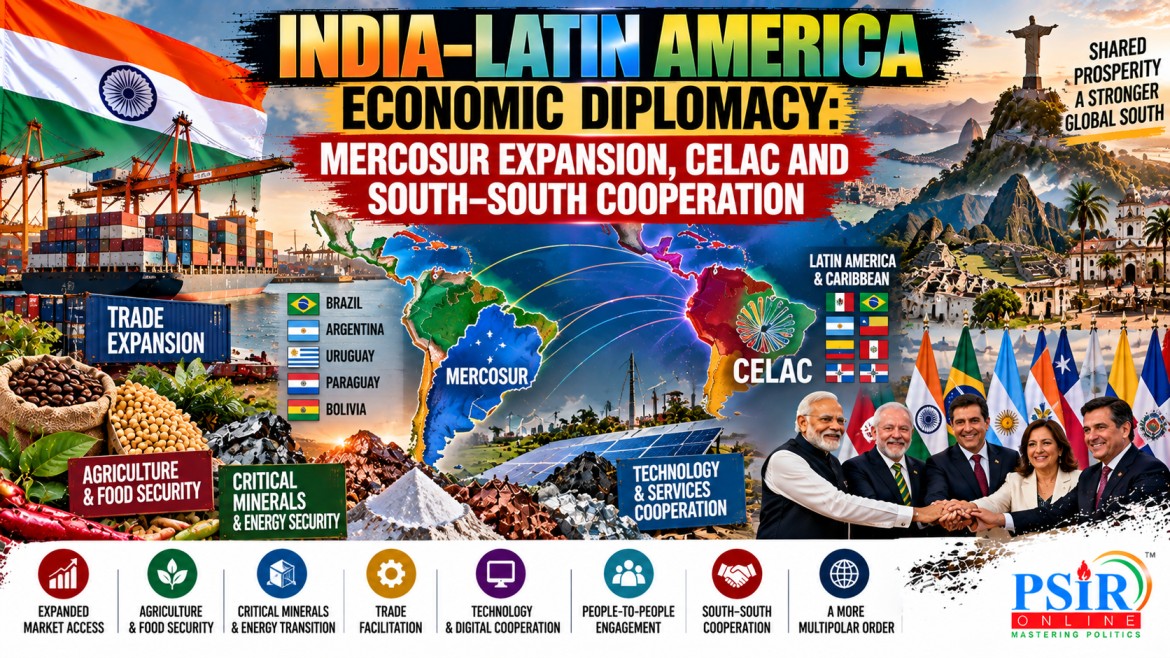
India’s engagement with Latin America and the Caribbean has acquired renewed significance amid global trade fragmentation, competition for critical minerals, energy insecurity and the search for diversified export markets. Although geographical distance and high logistics costs have historically constrained commercial relations, the region offers opportunities in agriculture, energy, pharmaceuticals, information technology, digital public infrastructure and industrial cooperation.
Two developments in September 2026 illustrate this evolving relationship. On 14 September, India and MERCOSUR launched negotiations to expand their existing Preferential Trade Agreement (PTA). On 22 September, India’s engagement with the Community of Latin American and Caribbean States (CELAC) during the United Nations General Assembly’s High-Level Week emphasised stronger economic and development partnerships, South–South cooperation and greater coordination on global challenges.
These developments represent two complementary dimensions of India’s regional strategy. MERCOSUR provides a framework for expanding commercial access and trade facilitation, while CELAC offers a wider political platform connecting India with Latin America and the Caribbean. Together, they illustrate how economic diplomacy can support market diversification, strategic autonomy and a more representative international order.
However, institutional engagement alone cannot overcome the structural barriers to stronger trade. The long-term outcome will depend on the scope of trade negotiations, transport connectivity, business awareness, regulatory cooperation and the ability to convert diplomatic commitments into measurable economic outcomes.
THE SEPTEMBER 2026 DEVELOPMENTS: FROM EXISTING AGREEMENTS TO DEEPER COOPERATION
The India–MERCOSUR Preferential Trade Agreement was signed on 25 January 2004 and entered into force on 1 June 2009. Its existing framework provides preferential tariff concessions on 450 tariff lines for India and 452 tariff lines for the MERCOSUR side. Although the agreement created a formal basis for trade, its limited product coverage has restricted the breadth of preferential access.
On 14 September 2026, India’s Commerce and Industry Minister Piyush Goyal and Uruguay’s Foreign Minister Mario Lubetkin, representing MERCOSUR’s Pro Tempore Presidency, announced the launch of negotiations to expand the agreement. The two sides began finalising the Terms of Reference (ToR), which will determine the scope and structure of the proposed expansion. The announcement marked the beginning of negotiations, not the conclusion of an expanded agreement.
The same day, India and MERCOSUR signed a First Additional Protocol providing for the acceptance of electronic Certificates of Origin with the same legal validity as paper certificates, subject to completion of domestic procedures. This is a practical step towards paperless trade, lower administrative costs and more efficient customs processes.
The CELAC engagement on 22 September complemented this commercial initiative. India highlighted the potential for stronger economic and development partnerships, with bilateral trade between India and the wider CELAC region reported to have crossed US$50 billion annually. Cooperation was discussed across areas where the two sides possess complementary capabilities, including technology, pharmaceuticals, digital infrastructure, critical minerals, agriculture and sustainable energy.
|
September development |
Significance for India’s foreign policy |
|
Launch of negotiations to expand the India–MERCOSUR PTA, 14 September |
Creates an opportunity to broaden preferential market access and deepen commercial engagement |
|
Protocol on electronic Certificates of Origin, 14 September |
Supports digital trade facilitation and reduces documentary barriers |
|
India–CELAC foreign ministers’ engagement, 22 September |
Strengthens political coordination and the wider framework for regional economic and development cooperation |
|
Emphasis on South–South cooperation |
Connects bilateral commercial interests with shared concerns over development and global governance |
The significance of September lies in the combination of technical trade facilitation and wider institutional diplomacy. One addresses the practical costs of doing business; the other seeks to build the political relationships needed to sustain long-term cooperation.
MERCOSUR EXPANSION AND THE POTENTIAL FOR TRADE DIVERSIFICATION
MERCOSUR is a South American regional integration bloc associated with the economic and political cooperation of Argentina, Brazil, Paraguay, Uruguay and Bolivia. Brazil and Argentina are particularly significant for India because of their market size, industrial capacity, agricultural production and natural-resource base.
India’s trade with MERCOSUR reached approximately US$21.8 billion in 2025–26, demonstrating that the relationship has developed beyond a marginal commercial connection. Nevertheless, the existing PTA covers only a narrow range of products relative to the diversity of goods traded between the two sides.
An expanded agreement could explore broader tariff concessions, improved rules of origin, customs simplification and other areas of mutual interest. The precise scope will depend on the negotiations and the final terms agreed by the parties.
For Indian exporters, potential areas include pharmaceuticals, chemicals, engineering goods, automobiles and components, textiles, machinery and selected manufactured products. Latin American markets may also provide opportunities for Indian information technology services, digital solutions, healthcare technologies and business services, although services liberalisation would depend on the eventual negotiating scope.
The relationship is not exclusively about Indian exports. MERCOSUR countries are important suppliers of agricultural commodities, minerals, energy-related resources and other primary products. Brazil and Argentina, for example, have significant roles in global agricultural markets, while parts of South America possess resources relevant to battery manufacturing, electrification and the energy transition.
|
Area of cooperation |
Potential benefit |
|
Manufactured goods |
Greater opportunities for Indian engineering, pharmaceutical, chemical and automotive exporters |
|
Agricultural commodities |
More predictable commercial relations and improved supply-chain planning |
|
Critical minerals and energy |
Opportunities for diversified sourcing and investment partnerships |
|
Digital and professional services |
Expansion of technology, healthcare and business-service cooperation where regulatory conditions permit |
|
Trade facilitation |
Lower documentation costs and more predictable customs procedures |
Trade diversification is particularly important when major markets introduce tariffs, industrial restrictions or other barriers. Wider access to Latin American markets could help Indian businesses reduce their dependence on a small number of export destinations.
However, an expanded PTA would not automatically become a comprehensive free trade agreement. Its effectiveness would depend on the depth of tariff concessions, product coverage, rules of origin and the treatment of non-tariff barriers. The central negotiating challenge is to convert a limited preferential arrangement into a commercially meaningful framework without overlooking domestic sensitivities on either side.
CELAC AND THE INSTITUTIONALISATION OF SOUTH–SOUTH COOPERATION
CELAC brings together countries of Latin America and the Caribbean in a regional political and diplomatic forum. Unlike a conventional bilateral relationship or a trade agreement, CELAC provides India with an opportunity to engage with a wider group of countries through a common institutional channel.
This matters because India’s relations with Latin America and the Caribbean have traditionally developed through a combination of bilateral diplomacy, individual trade arrangements, technical cooperation and multilateral engagement. A region-wide platform can help identify shared priorities, coordinate proposals and reduce the fragmentation of diplomatic initiatives.
The September 2026 engagement highlighted the possibilities for strengthening economic and development partnerships. India’s capabilities in pharmaceuticals, information technology, digital public infrastructure, affordable healthcare and skills development may complement regional demand for technology, infrastructure and public-service delivery. Latin American and Caribbean countries, in turn, offer opportunities in agriculture, food resources, renewable energy, critical minerals and other natural resources.
The relationship also extends beyond commerce. Climate adaptation, disaster response, food security, public health, education and reform of multilateral institutions provide areas for sustained cooperation. Such collaboration can be particularly relevant for small island developing states in the Caribbean, which face disproportionate exposure to extreme weather events, debt pressures and climate-related risks.
Institutionalisation is nevertheless essential. Meetings need to generate follow-up mechanisms, sector-specific projects, business exchanges and measurable outcomes. Regular consultations, a stronger business dialogue, scientific cooperation and practical development partnerships could provide continuity between high-level diplomatic engagements.
The central value of CELAC is therefore not that it replaces bilateral relations, but that it adds a regional layer to India’s diplomacy, allowing shared interests to be pursued collectively while preserving the distinct priorities of individual countries.
ECONOMIC DIPLOMACY, CRITICAL MINERALS AND STRATEGIC DIVERSIFICATION
India’s Latin America strategy must be understood against the background of increasing competition over energy, minerals, technology and supply chains. The transition towards electric mobility, renewable energy and advanced manufacturing has increased the strategic significance of resources such as lithium, copper and other minerals used in batteries, electronics and industrial production.
Latin American countries possess important mineral and agricultural resources, while India offers a large market, industrial capabilities, pharmaceutical production, technology services and investment potential. This creates opportunities for complementary economic partnerships, provided that cooperation delivers value to both sides.
For India, diversified sourcing can reduce excessive dependence on individual suppliers. For Latin American economies, cooperation with India may broaden the range of investment and technology partners available to support industrial development.
However, resource diplomacy cannot be reduced to securing raw materials. Long-term partnerships should also consider local processing, technology transfer, skills development, environmental safeguards and the participation of local businesses. Agreements that concentrate benefits in extraction alone may provide limited gains in employment and domestic industrial capacity.
Economic cooperation can also strengthen India’s strategic autonomy. Broader commercial relationships provide additional options when trade disputes or geopolitical tensions affect established supply chains. Yet diversification should not be confused with replacing one form of dependence with another. Its value lies in creating a wider range of reliable economic relationships.
The relationship with Latin America therefore offers an opportunity to connect resource security with industrial cooperation and development diplomacy. Achieving this requires a move beyond transactional commodity purchases towards investment, processing, research and long-term institutional engagement.
STRUCTURAL BARRIERS AND THE LIMITS OF REGIONAL ENGAGEMENT
Despite considerable potential, India–Latin America relations face several persistent constraints.
Geographical distance and logistics costs remain major obstacles. Long shipping routes, limited direct connectivity and complex distribution networks can reduce the competitiveness of Indian exports. Even when preferential tariffs are available, freight costs and delivery times may limit commercial gains.
Second, the absence of comprehensive market information constrains smaller exporters. Indian MSMEs may have limited knowledge of Latin American consumer preferences, certification procedures, language requirements and distribution systems. Similarly, businesses in Latin America may face difficulties navigating India’s regulatory and commercial environment.
Third, differences in regulatory standards, customs procedures and rules of origin can create barriers even when tariff concessions exist. The September protocol on electronic Certificates of Origin is a useful step, but digital documentation alone cannot resolve all administrative and regulatory obstacles.
Fourth, the two regions are not economically homogeneous. Brazil’s industrial and agricultural profile differs from that of smaller South American economies, while Caribbean states face distinct challenges related to scale, tourism dependence, climate vulnerability and transport costs. A single regional strategy must therefore be supported by differentiated country-level approaches.
Finally, negotiations can be affected by domestic political priorities. Governments must balance export interests, industrial competitiveness, food security and sensitive sectors. An expanded agreement may take time to negotiate, and its eventual scope may differ from initial expectations.
Overcoming these barriers requires a combination of trade diplomacy, logistics improvements, export promotion, regulatory dialogue and business-to-business engagement. Institutional ambition must be matched by implementation capacity if the partnership is to produce durable economic benefits.
A PRACTICAL ROADMAP FOR INDIA–LATIN AMERICA ENGAGEMENT
India’s approach should combine regional diplomacy through CELAC with targeted commercial negotiations through MERCOSUR and bilateral engagement with individual countries. This would allow common priorities to be addressed collectively while adapting cooperation to national economic structures.
First, the India–MERCOSUR negotiations should identify commercially meaningful sectors and address practical obstacles to trade. Clear rules of origin, transparent customs procedures and realistic tariff commitments would help businesses understand the benefits of an expanded arrangement.
Second, India should strengthen its regional export strategy through market intelligence, trade fairs, commercial missions and support for MSMEs. Pharmaceuticals, engineering goods, chemicals, textiles and digital services could be developed through sector-specific approaches rather than a uniform regional export model.
Third, resource partnerships should move towards investment and value addition. Cooperation on critical minerals, renewable energy and agricultural processing could include research, skills development, local manufacturing and environmental standards.
Fourth, the CELAC framework should be supported by regular institutional engagement. Business forums, agricultural cooperation, energy dialogue, science and technology exchanges and digital cooperation could help translate diplomatic meetings into continuing programmes.
Finally, progress should be measured through practical indicators: growth in bilateral and regional trade, utilisation of tariff preferences, new investment projects, lower customs-processing costs, diversification of export products and the number of sustained development partnerships.
|
Priority |
Practical measure |
Intended outcome |
|
Trade expansion |
Define commercially relevant sectors and negotiating priorities under the MERCOSUR PTA expansion |
Broader and more usable preferential market access |
|
Trade facilitation |
Implement electronic Certificates of Origin after domestic procedures are completed |
Reduced paperwork and transaction costs |
|
Export diversification |
Expand market intelligence and MSME support |
Wider participation in Latin American markets |
|
Resource partnerships |
Promote processing, research and investment alongside resource sourcing |
Greater domestic value addition and supply-chain resilience |
|
Regional cooperation |
Establish regular follow-up mechanisms under India–CELAC engagement |
More consistent economic and development cooperation |
|
Accountability |
Review trade, investment and programme outcomes periodically |
Clearer evidence of implementation and benefits |
A coordinated approach would allow India to combine the commercial focus of MERCOSUR negotiations with the wider political and development agenda of CELAC. The objective should be a durable partnership based on mutual benefit rather than episodic diplomatic engagement.
THEORETICAL ANGLES
|
Theory or concept |
Application to India–Latin America economic diplomacy |
|
South–South Cooperation |
India and Latin American countries can pursue development partnerships based on shared interests, technical cooperation and reciprocal economic benefits. |
|
Complex Interdependence |
Trade, investment, technology, energy, agriculture and development cooperation create multiple channels of interaction beyond traditional security relations. |
|
Liberal Institutionalism |
MERCOSUR and CELAC provide institutional platforms for predictable cooperation, regular dialogue and coordination on common concerns. |
|
Realism and Economic Statecraft |
Trade agreements and resource partnerships can strengthen national capabilities, diversify suppliers and reduce strategic vulnerabilities. |
|
Dependency Theory |
The relationship raises questions about whether resource trade reinforces primary-commodity dependence or supports industrialisation and value addition. |
|
Regionalism and Multipolarity |
Engagement with MERCOSUR and CELAC broadens India’s connections with regional groupings and supports a more diversified international order. |
|
Strategic Autonomy |
Wider economic relationships can increase India’s choices in trade, investment and resource sourcing without requiring exclusive alignment with any major power. |
CONCLUSION
India’s engagement with Latin America and the Caribbean is gradually acquiring a more institutionalised character. The September 2026 launch of negotiations to expand the India–MERCOSUR PTA and the India–CELAC foreign ministers’ engagement demonstrate complementary efforts to strengthen commercial access, political coordination and development cooperation.
MERCOSUR offers a framework for widening trade preferences and improving trade facilitation, while CELAC provides a regional platform for broader economic and diplomatic engagement. Together, they can support export diversification, resource partnerships, technology cooperation and India’s wider engagement with the Global South.
The outcome, however, will depend on more than diplomatic declarations. Negotiations must produce workable provisions, businesses must be able to use market access, and development partnerships must generate measurable benefits. The long-term objective should be to move beyond commodity-centred exchanges towards diversified trade, local value addition and sustained institutional cooperation.
India–Latin America relations can contribute to a more multipolar economic order, but their success will ultimately be determined by the depth of implementation and the extent to which both sides translate complementary capabilities into shared prosperity.
RELATED READING
PRACTISE QUESTIONS FOR GS2 MAINS
PRACTISE QUESTIONS FOR PSIR
