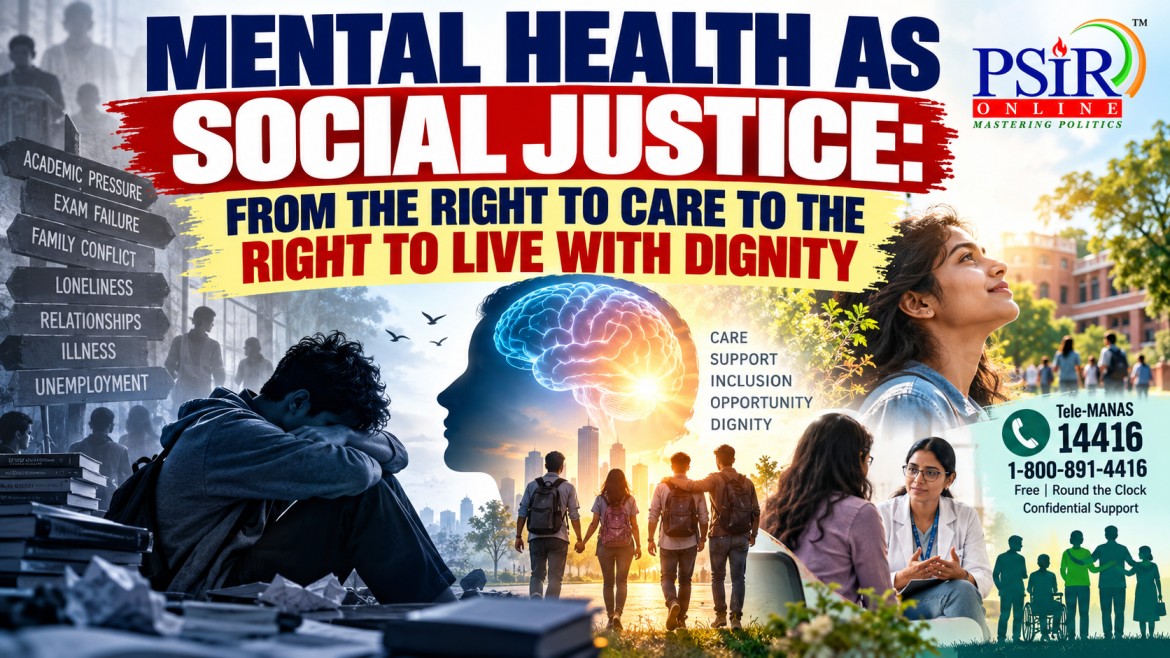
Mental health is no longer merely a question of individual illness or clinical treatment. It is increasingly recognised as an issue of social justice, human dignity and equal access to essential services.
In India, the challenge is particularly significant because a large proportion of people experiencing mental-health conditions do not receive adequate care. Estimates cited in official and research literature place the treatment gap at roughly 70–92 per cent, with distance, cost, shortage of professionals and social stigma acting as major barriers.
The burden is particularly important among young people. Depression, academic pressure, examination failure, family conflict, relationship breakdown, illness and loneliness can interact with one another and contribute to psychological distress. The problem therefore cannot be addressed simply by increasing the number of psychiatric hospitals.
The real question is broader: Can the State ensure that every person facing mental-health difficulties has access to affordable care, social support, dignity and the opportunity to live a meaningful life?
MENTAL HEALTH: FROM A MEDICAL PROBLEM TO A SOCIAL-JUSTICE QUESTION
Mental illness can affect a person's education, employment, relationships, housing, financial security and participation in society. When treatment is unavailable or unaffordable, the consequences extend beyond the individual to the family and community.
The social-justice dimension therefore involves three interconnected inequalities:
|
Dimension |
What it means |
|
Access inequality |
A person living in a district without psychiatrists or psychologists may have very different access to care from someone in a major city. |
|
Economic inequality |
The cost of consultations, medicines, hospitalisation and long-term rehabilitation can prevent poorer households from obtaining continuous care. |
|
Social inequality |
Stigma and discrimination can discourage people from seeking treatment, continuing medication or returning to education and employment. |
This makes mental healthcare fundamentally different from a system based only on hospitals. A person may need medical treatment, but may also need counselling, family support, accommodation, rehabilitation, education, employment assistance and protection from discrimination.
THE TREATMENT GAP: WHEN THE RIGHT TO CARE DOES NOT REACH THE PERSON
India's mental-health challenge is not simply that mental illness exists. The deeper problem is that large numbers of people who need care do not receive appropriate treatment. The treatment gap is estimated at roughly 70–92 per cent. The reasons include:
· lack of awareness;
· Parents don’t take children’s mental issues serously
· stigma and fear of discrimination;
· shortage and uneven distribution of mental-health professionals;
· geographical distance from specialised services;
· cost of treatment and medicines;
· inadequate community-based services;
· limited rehabilitation and supported accommodation;
· and inadequate follow-up after hospital-based treatment.
This produces a crucial social-justice paradox: A right to healthcare has limited meaning if the person cannot physically, financially or socially reach the healthcare system.
YOUTH MENTAL HEALTH: BEYOND THE LONELINESS NARRATIVE
Youth distress has increasingly entered public debate, particularly around higher education. Loneliness is an important factor, but it should not become the single explanation for student distress and suicide. National Crime Records Bureau data identify several recorded circumstances associated with student suicides, including examination failure, academic pressure, family problems, illness and relationship difficulties.
A national task force constituted in the context of suicides in higher-education institutions has also highlighted the scale of psychological distress among students. A survey reported in 2026 found that around 15 per cent of higher-education students had felt overwhelmed or low for weeks during the previous six months, while around 9 per cent reported suicidal thoughts.
The lesson is important: Youth mental health cannot be reduced to an individual inability to cope.
Academic competition, institutional culture, financial insecurity, family expectations, social isolation and access to support can all shape mental well-being. Therefore, the response must move beyond simply telling young people to “be resilient”.
THE MENTAL HEALTHCARE ACT, 2017: WHEN HEALTHCARE BECOMES A RIGHT
The most important legal development in India's mental-health framework is the Mental Healthcare Act, 2017. Its significance lies in shifting the approach from a predominantly institutional and medical model towards a rights-based framework. The Act provides a legal basis for the right to access mental healthcare and treatment from services run or funded by the government. It also emphasises affordability, non-discrimination and community-based care. Its provisions extend beyond the hospital.
|
Rights-based provision |
Social-justice significance |
|
Right to access mental healthcare |
Mental healthcare becomes a legal entitlement rather than merely a government scheme. |
|
Affordable services |
Economic status should not determine access to treatment. |
|
Non-discrimination |
Mental illness should not become a basis for unequal treatment. |
|
Outpatient and inpatient services |
Care must extend beyond psychiatric institutions. |
|
Halfway homes and supported accommodation |
Recovery requires social reintegration, not merely discharge from hospital. |
|
Community-based rehabilitation |
People should be supported within society wherever possible. |
|
Protection from cruel or degrading treatment |
Mental illness does not remove a person's fundamental dignity and rights. |
|
Insurance parity |
Mental illness must receive insurance coverage on the same basis as physical illness. |
The State is not merely expected to treat mental illness; it is expected to protect the rights and dignity of persons living with mental illness.
THE GAP BETWEEN LAW AND REALITY
The rights framework established by the 2017 Act is considerably broader than the infrastructure available on the ground. The Act envisages a system involving community care, outpatient treatment, rehabilitation, supported accommodation and continuity of care. Yet many parts of India continue to have shortages of psychiatrists, psychologists, psychiatric nurses, rehabilitation facilities and community-based services. Insurance coverage illustrates the same distinction.
Ayushman Bharat–PM-JAY includes 22 mental-health procedures in its hospital package. Between 2021–22 and 2023–24, around 1.35 lakh mental-health admissions were authorised, involving approximately ₹120 crore. This represents an important expansion of financial protection. But hospital insurance does not automatically solve the wider mental-health problem. A person living with depression may require:
counselling → medicines → regular follow-up → family support → community rehabilitation → education/employment support
rather than a single hospital admission.
Thus, the central challenge is to move from hospital-centred mental healthcare to a continuum of community-based care.
THE GOVERNMENT'S RESPONSE: FROM DISTRICT CARE TO DIGITAL ACCESS
India's mental-health response operates through several layers rather than a single programme. The National Mental Health Programme (NMHP), launched in 1982, provides the broader policy framework, while the District Mental Health Programme (DMHP) forms the principal district-level delivery mechanism under the National Health Mission.
The DMHP has been sanctioned in 767 districts and is intended to provide services including:
· outpatient mental-health care;
· counselling;
· medicines;
· outreach;
· early identification;
· and follow-up of persons with severe mental illness.
The system also includes government mental hospitals and specialist institutions. There are 47 government mental hospitals, including three central institutes:
· NIMHANS, Bengaluru
· LGBRIMH, Tezpur
· Central Institute of Psychiatry, Ranchi
AIIMS institutions also provide specialist psychiatric services. But geography remains a major challenge. A national system cannot depend exclusively on specialised hospitals located in a handful of major cities. This is where Tele-MANAS becomes particularly significant.
TELE-MANAS: BRINGING MENTAL HEALTHCARE TO THE PHONE
Launched on 10 October 2022, Tele-MANAS represents India's attempt to use digital connectivity to reduce the geographical and psychological barriers to mental-health support. The national helpline operates through: 14416 / 1-800-891-4416
It provides access to trained counsellors and can escalate cases to specialist psychological or psychiatric support and referral services. By 2026, the system had expanded to 36 States and Union Territories, with 53 Tele-MANAS cells and services across 20 languages.
Its significance goes beyond technology. A person who is unwilling or unable to travel immediately to a psychiatric hospital can make a phone call and enter the public mental-health system. This creates a new pathway:
Distress → Telephone support → Counselling → Specialist intervention → Referral → District-level care
STATE MODELS: HOW MENTAL-HEALTHCARE DELIVERY VARIES ACROSS INDIA
The Union Government provides the broad policy framework and financial support, but mental-healthcare delivery ultimately depends heavily on State governments, district institutions and local implementation. This creates considerable variation in how States respond to mental illness and youth distress.
|
State |
Distinctive approach and significance |
|
Kerala |
Kerala has developed a relatively strong community-oriented mental-health layer. DISHA 1056 provides counselling for exam stress, adolescent concerns and suicide prevention, while the Tele-MANAS cell operates through the State Mental Health Programme. The Social Justice Department also supports rehabilitation homes through psychosocial grant-in-aid and schemes such as Pratheeksha for people who are stable but homeless. NGO networks such as Maithri and Thanal add community-level support. |
|
Tamil Nadu |
The Institute of Mental Health, Chennai remains the major institutional anchor. The State combines district mental-health services with Health Helpline 104 and Tele-MANAS, while non-governmental services such as Sneha and Jeevan provide suicide-prevention support. Compared with Kerala, the model is more strongly centred on hospital services + helplines + district-level care. |
|
Karnataka |
Karnataka benefits from the presence of NIMHANS, giving it exceptional specialist capacity. At the same time, Manochaitanya camps at taluk hospitals and ASHA-based outreach attempt to decentralise care. Tele-MANAS reportedly receives more than 340 calls a day, with rural callers forming a significant share. Sa-Mudra and Parivarthan provide additional youth-oriented support. |
|
Maharashtra |
The State combines four regional mental hospitals with medical-college psychiatric units and Tele-MANAS. iCALL at TISS provides an important psychosocial counselling layer, particularly for young people. However, the distribution of services remains uneven, with stronger coverage around Mumbai–Pune than in rural areas. |
|
Delhi |
IHBAS functions as a major clinical institution as well as a Tele-MANAS centre. Helplines such as Sumaitri and Sanjeevani supplement government services. The major challenge is not merely initial access but continuity of care and supported accommodation after hospital discharge, particularly in a highly urban and student-heavy environment. |
|
Gujarat |
The Hospital for Mental Health, Ahmedabad, together with the Rajkot Tele-MANAS cell, provides specialist and digital support. Jeevan Aastha provides an emotional-distress helpline. DMHP and Tele-MANAS remain the principal public pathways, while community rehabilitation remains comparatively less developed. |
|
Telangana |
The State combines the Institute of Mental Health, Erragadda, with Tele-MANAS, State 104 and the Roshni suicide-prevention line. The model relies substantially on hospital and helpline-based intervention, with less emphasis on a large community-rehabilitation infrastructure. |
|
West Bengal |
The Institute of Psychiatry and Pavlov Hospital provide specialist care, while DMHP and Tele-MANAS extend services to districts. NGO crisis lines strengthen support in Kolkata, but district-level follow-up and halfway homes remain important gaps. |
|
Assam |
LGBRIMH, Tezpur functions as a major specialist and regional training institution. DMHP and Tele-MANAS form the State-level delivery layer. Geographical distance and linguistic diversity make multilingual digital access particularly significant for the North-East. |
|
Madhya Pradesh |
Tele-MANAS cells at Gwalior Mental Hospital and MGM Indore provide digital access alongside DMHP medicines and outreach. However, community rehabilitation remains limited, leaving the system substantially dependent on hospitals + telephone support. |
|
Jammu & Kashmir |
IMHANS Kashmir operates a Tele-MANAS cell with substantial demand. Mental-health needs are shaped by conflict-related stress, youth unemployment and geographical barriers, making accessible psychological support particularly important. The 104 service operates alongside Tele-MANAS. |
|
Odisha |
DMHP, the 104 health helpline and Tele-MANAS form the principal public architecture, with the mental-health institute at Cuttack functioning as a referral centre. Suicide-prevention interventions remain largely helpline and district-OPD based, rather than a separate youth-focused mission. |
The larger lesson from these State models is clear: India does not have one uniform mental-healthcare system. Some States are building community rehabilitation, some rely more heavily on specialist hospitals, while others are expanding tele-counselling and district services. The challenge is to convert these fragmented approaches into a stronger continuum of care.
WHAT DOES THIS MEAN FOR LONELY AND DISTRESSED YOUNG PEOPLE?
Tele-MANAS and campus counselling can make the first contact with the State much easier. A student experiencing depression, anxiety or suicidal thoughts can access a counsellor without immediately travelling to a psychiatric hospital.
But access to a telephone is not the same as access to a complete support system.
A young person may need:
counselling → psychiatric care → medicines → family intervention → academic support → safe accommodation → rehabilitation → reintegration into education or employment.
This is where India's mental-health framework still faces a major challenge. The Mental Healthcare Act, 2017 provides a rights-based vision of community care, while actual public expenditure and infrastructure remain much more concentrated around hospitals, district OPDs and helplines.
Therefore, the next stage of India's mental-health policy should be to connect the helpline, district hospital, campus, family, community and rehabilitation system into one continuum of care.
UPSC DIMENSION: MENTAL HEALTH AS A MULTI-DIMENSIONAL SOCIAL-JUSTICE ISSUE
Mental health is not confined to healthcare policy. It intersects with constitutional rights, social justice, governance, federalism, education, youth development, digital inclusion, gender, urbanisation, ethics and sustainable development.
|
UPSC dimension |
Analytical significance |
|
Article 14 – Equality before law |
Mental-healthcare systems must provide equal protection irrespective of economic status, gender, disability, geography or social background. Unequal availability of psychiatrists and rehabilitation facilities raises questions of substantive equality. |
|
Article 15 – Non-discrimination |
Mental illness can intersect with social discrimination and exclusion. Public institutions must ensure that persons with mental-health conditions are not denied opportunities or services because of their condition. |
|
Article 21 – Right to life and dignity |
The most important constitutional dimension. The right to life encompasses living with dignity. Access to mental healthcare, protection from degrading treatment and rehabilitation are therefore connected to the constitutional conception of dignified life. |
|
Article 21A – Right to education |
Student mental health directly affects educational participation. Academic pressure, exclusion and untreated mental illness can undermine the effective enjoyment of the right to education. |
|
Article 38 – Social order based on justice |
Mental-health inequality reflects wider social and economic inequalities. The State's responsibility is not merely clinical treatment but creation of conditions that promote social justice. |
|
Article 39(e) – Protection of workers |
Mental health is also an occupational issue. Work-related stress, unsafe conditions, excessive working hours and workplace discrimination can affect psychological well-being. |
|
Article 41 – Public assistance |
The Directive Principle relating to sickness, disablement and public assistance provides a broader constitutional basis for social protection of vulnerable persons. |
|
Article 47 – Public health |
Mental health forms part of the broader public-health responsibility of the State. Treating it separately from public health can leave a major component of well-being neglected. |
|
Mental Healthcare Act, 2017 |
Represents the shift from a welfare-based approach to a rights-based approach, making mental healthcare a legal entitlement rather than merely a government programme. |
|
Social justice |
Mental illness can produce exclusion from education, employment, housing and social participation. Mental-health policy therefore becomes part of the broader struggle against social exclusion. |
|
Health as human capability |
Mental well-being affects a person's ability to learn, work, form relationships and participate in society. Mental healthcare therefore contributes to expanding human capabilities. |
|
Cooperative federalism |
The Union establishes programmes such as NMHP, DMHP and Tele-MANAS, but States recruit personnel, operate institutions and deliver services. Mental healthcare therefore illustrates the importance of Centre–State coordination. |
|
Decentralisation and local governance |
District hospitals, municipalities, primary-health systems and community organisations determine whether mental-healthcare actually reaches citizens. Effective decentralisation can reduce geographical inequality. |
|
Digital governance |
Tele-MANAS demonstrates how digital technology can reduce geographical barriers and expand access to specialised counselling. However, the digital divide, language, connectivity and privacy must also be addressed. |
|
Education and youth policy |
Student suicides cannot be treated solely as individual psychological failures. Academic competition, examination pressure, institutional culture, financial insecurity and social isolation make youth mental health an educational-governance issue as well. |
|
Gender dimension |
Mental-health experiences can be shaped by gender roles, domestic responsibilities, violence, economic dependence and unequal access to care. A universal mental-health system therefore requires gender-sensitive delivery. |
|
Urbanisation and migration |
Rapid urbanisation can produce isolation, insecure employment and weak community networks, while migrants may face additional barriers to accessing local health services. |
|
Disability and inclusion |
Mental-health conditions can interact with disability and social exclusion. The objective must be participation and independent living rather than institutional isolation. |
|
Ethics of public policy |
Mental healthcare involves questions of autonomy, informed consent, privacy, dignity, confidentiality and the balance between individual liberty and protection during periods of severe mental distress. |
|
Technology and ethics |
Digital counselling and AI-enabled mental-health tools can improve access, but confidentiality, data protection, informed consent and the risk of replacing human care with technology require careful regulation. |
|
SDG 3 – Good Health and Well-being |
Mental health is integral to universal health coverage and well-being. India's mental-health gap directly affects progress towards inclusive health outcomes. |
|
SDG 4 – Quality Education |
Student mental health is closely connected to retention, learning outcomes, educational participation and a safe learning environment. |
|
SDG 10 – Reduced Inequalities |
Unequal access to mental-health professionals, hospitals and rehabilitation facilities creates a significant regional and socioeconomic inequality. |
|
SDG 16 – Inclusive institutions |
Rights-based mental healthcare requires accountable institutions that protect dignity, prevent discrimination and provide accessible remedies. |
|
Inclusive development |
Economic growth cannot be considered genuinely inclusive if people experiencing mental illness remain excluded from education, employment, healthcare and community life. |
|
From welfare to rights |
The Mental Healthcare Act represents a broader evolution in Indian social policy: vulnerable persons are increasingly viewed not merely as recipients of welfare but as rights-bearing citizens. |
WAY FORWARD
India's mental-health policy needs to move from episodic treatment to a continuum of care, connecting prevention, early intervention, treatment, rehabilitation and social reintegration.
1. Strengthen community-based mental healthcare
District-level services should become the backbone of the system, with adequate psychiatrists, psychologists, psychiatric social workers, nurses, medicines and follow-up services. Mental healthcare should move closer to primary healthcare and communities, rather than remaining concentrated in specialist hospitals.
2. Make the Mental Healthcare Act operational
The rights guaranteed under the 2017 Act—affordable care, non-discrimination, community-based treatment, rehabilitation and insurance parity—must be translated into adequate infrastructure and budgets.
3. Move beyond the helpline model
Tele-MANAS is an important first point of contact, but a telephone conversation cannot substitute for long-term care. Every referral from Tele-MANAS should have a clear pathway to district treatment, medicines, psychotherapy and follow-up.
4. Build a comprehensive youth mental-health framework
Schools, colleges and coaching institutions should have accessible counselling, trained teachers, referral mechanisms and systems for identifying students in distress. Academic support must accompany psychological support.
5. Treat suicide prevention as a multi-sectoral responsibility
Suicide cannot be approached only as a psychiatric problem. Health, education, family welfare, employment, social protection and institutional governance must work together to address academic pressure, unemployment, family conflict, social isolation and other vulnerabilities.
6. Expand rehabilitation and supported accommodation
India needs more halfway homes, supported accommodation, community rehabilitation and home-based care, particularly for people who are stable but cannot immediately return to independent living.
7. Reduce regional inequality
Mental-health resources should be distributed according to population need rather than concentrated in metropolitan centres. North-Eastern, rural, tribal and geographically remote areas require particular attention.
8. Integrate mental health with universal health coverage
Mental healthcare should become an integral component of primary healthcare and health insurance rather than functioning as a parallel or specialised service.
9. Fight stigma through social awareness
Public campaigns should normalise help-seeking and challenge the idea that mental illness represents personal weakness or family failure. Community leaders, schools, workplaces and media can play an important role.
10. Protect privacy and dignity in digital mental healthcare
As Tele-MANAS and other digital interventions expand, confidentiality, informed consent, data protection and ethical use of technology must remain central.
The broader objective should be:
Prevention → Early identification → Accessible treatment → Continuity of care → Rehabilitation → Social reintegration
CONCLUSION
India has made an important conceptual transition in mental healthcare—from viewing mental illness primarily as a medical condition requiring institutional treatment to recognising persons with mental illness as rights-bearing citizens entitled to dignity, equality and accessible care.
The Mental Healthcare Act, 2017 provides the rights-based foundation; the District Mental Health Programme provides the territorial delivery structure; Tele-MANAS expands accessibility; and State-level initiatives demonstrate different approaches to community and youth support. Yet the central challenge remains the gap between legal rights and lived access.
A truly inclusive mental-health system must therefore go beyond hospitals and helplines. It must provide care within communities, rehabilitation after illness, support within educational institutions, protection against discrimination and opportunities for social and economic participation.
Mental health is not merely the absence of illness; it is the capacity to live, participate and belong with dignity. India's social-justice challenge is therefore to ensure that the right to mental healthcare becomes a lived reality rather than merely a statutory promise.
RELATED READING
· Mental Healthcare Act, 2017 – Rights-based framework for mental healthcare
· National Mental Health Policy, 2014 – Policy framework for accessible and equitable mental healthcare
· National Mental Health Programme, 1982 – Evolution of India's public mental-health system
· District Mental Health Programme – Community and district-level delivery
· Tele-MANAS – Digital mental-health access and counselling
· Mental health and Article 21 – Right to life, dignity and healthcare
· Mental health and Article 14 – Equality and non-discrimination
· Youth mental health and student suicides – Education, academic pressure and institutional responsibility
· Community-based rehabilitation – From institutionalisation to social reintegration
· Mental health and universal health coverage – Integrating psychological care into primary healthcare
· Mental health, disability and social inclusion – Rights, autonomy and participation
· SDG 3 – Good Health and Well-being
· SDG 10 – Reduced Inequalities
GS PAPER II – MAINS PRACTICE QUESTIONS
1. The Mental Healthcare Act, 2017 marks a shift from a welfare-oriented approach to a rights-based approach to mental healthcare in India. Examine. 10 Marks | 150 Words
2. Despite the expansion of programmes such as the District Mental Health Programme and Tele-MANAS, India's mental-health treatment gap remains significant. Identify the major barriers to universal mental healthcare. 10 Marks | 150 Words
3. “Mental health is increasingly a question of social justice rather than merely a question of public health.” Discuss in the context of India's constitutional framework and government interventions. 10 Marks | 150 Words
4. India's mental-health framework has expanded access through district services, digital counselling and rights-based legislation, but significant gaps remain in community care and rehabilitation. Critically examine the challenges and suggest measures to build an inclusive mental-health system. 15 Marks | 250 Words
