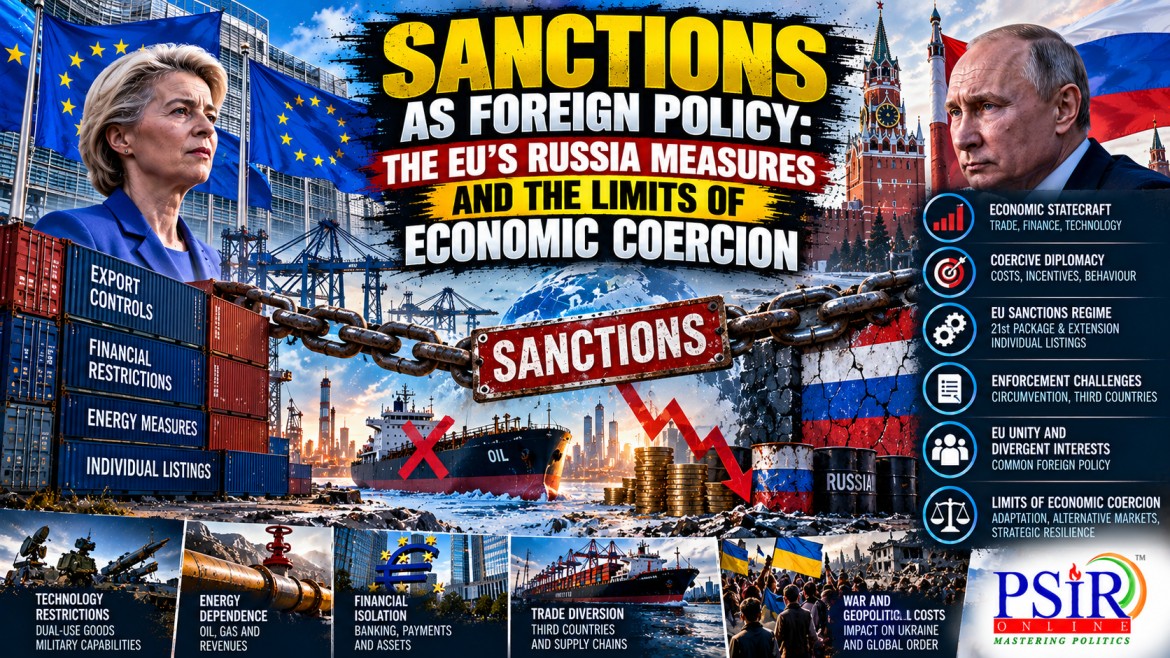
Economic sanctions have become a prominent instrument of contemporary foreign policy. Governments use restrictions on trade, finance, investment, technology and individual mobility to impose costs on other states without resorting directly to military force. Sanctions can signal international opposition, restrict access to strategic resources and technologies, constrain military capabilities and create incentives for diplomatic negotiations.
The European Union’s sanctions against Russia following its full-scale invasion of Ukraine in February 2022 represent one of the most extensive contemporary applications of economic statecraft. The measures target individuals, companies, financial institutions, energy revenues, military-industrial capabilities and trade in strategically important goods. Their stated objectives include reducing Russia’s capacity to finance the war, restricting access to critical technologies and increasing pressure for a change in behaviour.
A significant September 2026 development occurred on 22 September, when the Council of the European Union extended individual listings targeting those responsible for undermining or threatening Ukraine’s territorial integrity, sovereignty and independence until 22 September 2029. The restrictions cover more than 3,000 individuals and entities and include asset freezes, travel restrictions and prohibitions on making funds or economic resources available to listed persons and entities.
The extension demonstrates the EU’s continuing commitment to economic pressure, but it also raises a wider question about the relationship between economic costs and political outcomes. Sanctions can constrain a state without necessarily compelling it to change its strategic objectives. Their effectiveness depends on the targeted state’s vulnerabilities, the unity of the sanctioning coalition, the availability of alternative markets and the political conditions under which sanctions might be lifted.
The EU–Russia case therefore offers an important examination of coercive diplomacy, economic statecraft, institutional cohesion and the limits of non-military power in international relations.
SANCTIONS AS AN INSTRUMENT OF COERCIVE DIPLOMACY
Sanctions are restrictive measures imposed to influence the behaviour of governments, organisations or individuals. They may be designed to deter an action, compel a change in behaviour, weaken a target’s capabilities or signal opposition to conduct considered unacceptable.
Economic sanctions differ from military force because they seek to influence behaviour through economic costs rather than direct physical destruction. Their effects may nevertheless extend to financial stability, industrial production, technological development, employment, trade and public expenditure.
The EU’s Russia measures illustrate the range of instruments available.
|
Instrument |
Principal purpose |
Potential limitation |
|
Asset freezes and travel restrictions |
Restrict the financial resources and international mobility of designated individuals |
May impose costs without changing the leadership’s strategic calculations |
|
Financial restrictions |
Limit access to capital, payment systems and financial services |
Alternative channels and domestic financing may reduce their impact |
|
Trade and export controls |
Restrict access to selected goods, equipment and technologies |
Substitution, smuggling and third-country supply routes may weaken enforcement |
|
Energy measures |
Reduce revenue from targeted energy exports and increase the cost of market access |
Alternative buyers and changes in global prices can offset some losses |
|
Restrictions on military-industrial entities |
Disrupt procurement and production linked to military capabilities |
Domestic production and alternative suppliers may partially compensate |
|
Anti-circumvention measures |
Prevent sanctioned goods and financial services from reaching the target indirectly |
Monitoring complex international networks is difficult |
The purpose of sanctions is not necessarily to cause general economic collapse. Measures may be designed to constrain particular capabilities, impose costs on decision-makers or change the incentives surrounding a specific policy.
Coercive diplomacy requires a connection between the costs imposed and the behaviour sought. A government must understand what action would reduce or end the pressure, believe that compliance is preferable to continued resistance and possess the capacity to change its behaviour.
Where these conditions are absent, sanctions may generate economic damage without achieving the political objective. The effectiveness of sanctions must therefore be assessed against their stated objectives, not simply by the number of restrictions imposed or the economic costs reported.
THE EU’S RUSSIA SANCTIONS: FROM TARGETED LISTINGS TO ECONOMIC PRESSURE
The EU’s sanctions regime developed from measures introduced in 2014 following Russia’s annexation of Crimea and destabilisation of eastern Ukraine. After the full-scale invasion of February 2022, the Union substantially expanded the scope and intensity of its restrictions.
The measures subsequently covered a wide range of sectors and actors, including financial services, energy, trade, transport, military-industrial production, advanced technologies and individuals associated with the Russian state or its war effort.
The European Commission announced the adoption of the 21st sanctions package on 23 July 2026. It included additional listings, anti-circumvention measures and restrictions involving energy, financial services, trade and the military-industrial complex. The Commission reported that EU exports to Russia in 2025 were 66% below their 2021 level and imports were 83% lower. These figures demonstrate the substantial contraction in direct bilateral trade, although they do not by themselves establish how much of the change was caused by sanctions rather than other economic and geopolitical factors.
The Commission also reported that EU payments to Russia for energy in 2025 were 85% below their 2021 level. Such changes reflect the combined effects of sanctions, reductions in dependence on Russian energy, market adjustments and shifts in trading relationships.
The September decision addressed a different but related dimension: the continuation of individual listings under the EU’s restrictive measures concerning Ukraine’s territorial integrity. The Council extended those listings for 36 months, until September 2029, following a review of the persons and entities concerned.
These developments reveal that sanctions are not a single instrument but a layered policy combining individual restrictions, sectoral measures, export controls and enforcement mechanisms. Different instruments seek to affect different parts of the target’s economic and political system.
Their effects also vary over time. Financial restrictions can disrupt access to particular markets rapidly, whereas restrictions on advanced technology may produce cumulative effects through higher procurement costs, reduced efficiency and difficulties in replacing specialised components.
ECONOMIC COSTS VERSUS POLITICAL CONCESSIONS
A central problem in sanctions policy is the distinction between imposing costs and compelling political change. A sanctions regime may reduce trade, raise transaction costs, restrict technological access or increase pressure on public finances. Yet the targeted government may continue its policy if it considers the strategic objective more important than the economic consequences.
Russia’s response illustrates this difficulty. It has sought alternative export markets, adjusted trade relationships, expanded domestic production in selected sectors and developed mechanisms to reduce dependence on some Western suppliers. These adaptations do not mean that sanctions have had no effect. They demonstrate that the relationship between economic pressure and political behaviour is mediated by the target’s capacity to adapt.
The European Commission has argued that sanctions have constrained Russia’s ability to finance the war and procure critical technologies. Such assessments are relevant evidence of the EU’s stated objectives and its evaluation of the measures. They should nevertheless be distinguished from proof that sanctions alone have determined Russia’s strategic decisions.
Several factors shape whether economic pressure translates into political concessions.
The target’s economic resilience: A state with substantial natural resources, domestic production capacity, fiscal reserves or alternative export markets may absorb some costs more easily than a state dependent on a narrow range of external relationships.
The perceived importance of the disputed objective: Governments may accept significant economic losses when their leaders regard the policy at stake as essential to national security, territorial claims, regime survival or international status.
The availability of alternatives: Sanctions are more constraining when the target cannot readily replace suppliers, financial services, technologies or export markets.
The credibility of the sanctioning coalition: If the target expects restrictions to weaken over time or believes coalition members will disagree over enforcement, it may be less willing to make concessions.
The clarity of the political demand: Sanctions are harder to evaluate when objectives are broad, conditions for relief are ambiguous or the target doubts that compliance would lead to the removal of restrictions.
These factors explain why sanctions can have significant economic effects without producing immediate strategic change. They may weaken a target’s capabilities, influence its longer-term choices or increase the cost of continued confrontation, even when they do not compel a rapid reversal of policy.
The central analytical distinction is therefore between economic effectiveness and political effectiveness. The former concerns the extent to which restrictions alter economic activity or access to resources; the latter concerns whether they produce the desired change in behaviour.
SANCTIONS EVASION, THIRD COUNTRIES AND THE LIMITS OF ENFORCEMENT
Sanctions operate through international economic networks that are difficult to monitor completely. Goods may pass through intermediaries, companies may change ownership structures, and financial transactions may be routed through multiple jurisdictions. The availability of alternative markets can also reduce the impact of restrictions imposed by a limited coalition.
The EU has consequently strengthened its anti-circumvention efforts. The European Commission coordinates implementation with national authorities, works with industry and businesses, monitors changes in trade flows and engages with third countries where goods restricted by the EU may be reaching Russia indirectly.
The July 2026 sanctions package added 51 entities associated with Russia’s military-industrial complex or sanctions circumvention, including entities in several third countries. This illustrates the growing importance of monitoring supply chains and intermediaries rather than concentrating exclusively on direct trade between the EU and Russia.
Enforcement nevertheless presents several challenges.
· Trade diversion: Exports may be redirected through third countries or reclassified through complex supply chains.
· Ownership opacity: Corporate structures and beneficial ownership arrangements can make it difficult to identify the ultimate recipient of funds or goods.
· Dual-use technology: Civilian goods can also have military applications, complicating the identification of prohibited transactions.
· Uneven national enforcement: Differences in administrative capacity, legal procedures and compliance practices may produce gaps between EU-wide rules and implementation.
· External participation: Countries outside the sanctions coalition are not automatically bound by every EU restriction, although EU rules apply to persons and activities within their jurisdiction and may create compliance obligations for connected transactions.
The EU’s sanctions policy therefore depends on both legislation and enforcement capacity. A restriction that exists on paper may have limited practical effect if the relevant transactions cannot be identified or if substitute channels remain readily available.
At the same time, enforcement must distinguish deliberate circumvention from legitimate trade and comply with applicable legal safeguards. Excessively broad restrictions can create uncertainty for businesses, affect third parties and generate disputes over the proportionality of particular measures.
Sanctions effectiveness depends not only on the severity of restrictions but also on the capacity to enforce them consistently across complex international networks.
EU FOREIGN POLICY: UNITY, UNANIMITY AND NATIONAL INTERESTS
The EU’s sanctions policy illustrates both the potential and the institutional constraints of collective foreign policy. Acting together gives the Union access to a large market and enables it to coordinate financial, technological and trade restrictions across 27 member states. However, the adoption and renewal of EU foreign-policy sanctions generally require unanimity among member states in the Council.
This requirement can strengthen collective legitimacy by ensuring that governments formally agree to common measures. It can also create opportunities for disagreement, delay or bargaining when national interests diverge.
The September 2026 extension demonstrated this tension. Before the decision, EU ambassadors had failed to reach agreement on the planned renewal, prompting a short extension while negotiations continued. Reporting identified disagreements concerning the possible delisting of a sanctioned individual. The Council ultimately extended the relevant individual measures until September 2029.
The episode shows that maintaining a common sanctions policy requires continuous political coordination. Member states may differ in their exposure to energy-market changes, commercial relationships, domestic political pressures, legal concerns and assessments of diplomatic strategy.
These differences do not necessarily imply that a member state rejects the Union’s overall position. Governments may agree on the broad objective while disagreeing over particular listings, implementation details, the duration of restrictions or the costs imposed on domestic industries.
The EU must therefore reconcile two demands: the need for collective credibility and the need to accommodate legitimate differences among member states.
Several institutional questions follow. How can the Union reduce the risk of repeated last-minute disputes? How can it maintain predictable sanctions policy while preserving the Council’s decision-making framework? How can enforcement remain consistent when national authorities possess primary responsibilities for implementation?
The issue extends beyond Russia. If external actors believe that EU sanctions can be weakened through internal disagreement, the deterrent effect of future measures may decline. Conversely, maintaining restrictions without clear objectives or review mechanisms may reduce flexibility in diplomacy.
The institutional challenge is to preserve unity while ensuring that sanctions remain legally grounded, politically sustainable and connected to identifiable foreign-policy objectives.
HUMANITARIAN CONSEQUENCES, LEGAL SAFEGUARDS AND DIPLOMATIC EXIT STRATEGIES
Sanctions are often designed to target governments, influential individuals or strategically important sectors rather than populations as a whole. Nevertheless, economic restrictions can have wider consequences through changes in prices, supply chains, financial access and commercial activity.
Humanitarian safeguards are therefore important. EU sanctions frameworks contain exemptions or authorisation mechanisms for certain humanitarian activities, depending on the applicable legal instrument. Their practical effectiveness depends on clear guidance, banking compliance, administrative capacity and the willingness of suppliers to continue permitted transactions.
Over-compliance can create difficulties when banks, insurers or businesses avoid transactions that are legally permissible because they fear penalties or reputational risks. Effective implementation must therefore distinguish prohibited activity from legitimate humanitarian and civilian transactions.
Legal safeguards also matter for targeted individuals and entities. Asset freezes and travel restrictions are subject to EU legal procedures, including opportunities to challenge listings before the EU courts. Regular review and clear evidentiary grounds help maintain the legality and legitimacy of restrictive measures.
The wider strategic question concerns the relationship between sanctions and diplomacy. Sanctions can be used to signal resolve, deter further conduct, constrain capabilities or create incentives for negotiations. Their value depends partly on whether the sanctioning parties can define conditions under which restrictions might be suspended, modified or lifted.
An effective exit strategy does not require immediate concessions or automatic sanctions relief. It requires a clear relationship between the policy objective, the behaviour sought and the conditions governing review. Without such clarity, sanctions may become an enduring expression of opposition rather than an instrument linked to a specific diplomatic process.
The design of sanctions should therefore consider proportionality, humanitarian protection, legal review and the possibility of diplomatic engagement. Economic pressure is most strategically meaningful when its purpose, enforcement and potential conditions for relief are clearly connected to the desired political outcome.
THEORETICAL ANGLES
|
Theory or concept |
Connection to EU sanctions against Russia |
|
Economic statecraft |
Trade, financial restrictions, export controls and asset freezes are instruments through which economic relationships are used to pursue foreign-policy objectives. |
|
Coercive diplomacy |
Sanctions seek to change the target’s calculations by imposing costs, but their success depends on credible demands, available alternatives and the target’s willingness to comply. |
|
Realism |
States may accept economic losses when they regard territorial, security or status objectives as more important than the costs of sanctions. |
|
Liberal institutionalism |
EU coordination demonstrates how institutions enable collective action, while unanimity requirements and divergent national interests can constrain policy. |
|
Normative power Europe |
The EU presents sanctions as a response to violations of sovereignty and territorial integrity, connecting economic pressure to its stated commitment to international law. |
|
Complex interdependence |
Restrictions exploit economic connections, but the existence of alternative suppliers and markets can reduce the leverage available to sanctioning states. |
|
Two-level games |
EU governments must negotiate a common external policy while responding to domestic economic interests, political pressures and national legal concerns. |
|
Constructivism |
The legitimacy and interpretation of sanctions are shaped by international norms, political narratives and competing understandings of sovereignty and lawful conduct. |
CONCLUSION
The EU’s Russia sanctions demonstrate how economic statecraft has become an important instrument of contemporary international relations. Through financial restrictions, export controls, energy measures, individual listings and anti-circumvention mechanisms, the Union has sought to constrain Russia’s economic resources and military-industrial capabilities while sustaining support for Ukraine.
The September 2026 extension of individual listings illustrates the continuity of this policy, but it also highlights the challenges of maintaining a common position among 27 member states. Sanctions must operate through complex international networks, remain legally defensible and adapt to the target’s efforts to find alternative markets and suppliers.
Their effectiveness cannot be measured solely by economic damage. A comprehensive assessment must distinguish changes in trade and financial access from changes in political behaviour. It must also account for enforcement, coalition unity, humanitarian consequences and the relationship between sanctions and diplomatic negotiations.
Sanctions are neither inherently ineffective nor automatically decisive. Their outcomes depend on the interaction of economic vulnerability, strategic priorities, international cooperation and political incentives. The central test of economic coercion is whether the costs imposed can meaningfully influence the behaviour they are intended to change, without undermining the legal and political foundations of the policy itself.
RELATED READING
PRACTICE QUESTIONS FOR GS2 MAINS
PRACTICE QUESTIONS FOR PSIR
