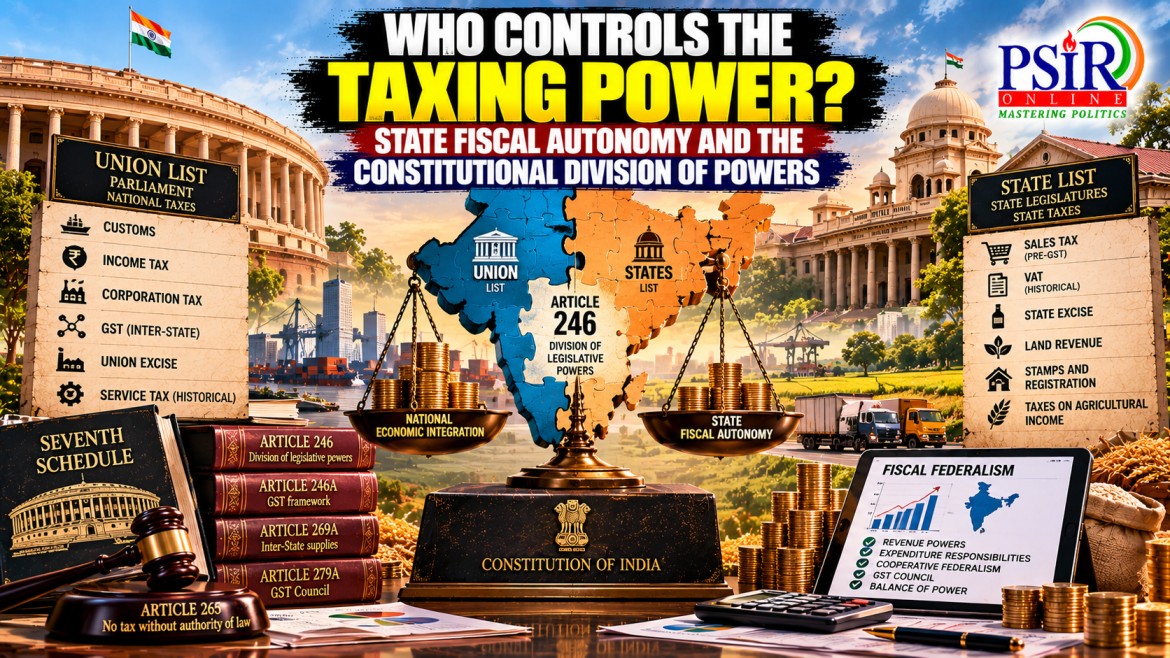
Taxation is one of the most consequential expressions of legislative power. It determines how governments mobilise resources, finance public services and respond to regional economic needs. In a federal Constitution, however, the power to tax is not unlimited: each level of government must act within the legislative authority assigned to it.
The Supreme Court's seven-judge Constitution Bench reserved judgment on 22 September 2026 in Arjun Flour Mills v. State of Odisha, a long-running dispute concerning the competence of State Legislatures to impose an additional tax, surcharge, levy or cess calculated on an existing sales or purchase tax. The reference raises a fundamental question: does the power to impose a tax necessarily include the power to impose an additional levy calculated on that tax? The answer has implications for legislative competence, the interpretation of taxing entries and the balance between State fiscal autonomy and constitutional limits.
THE ARJUN FLOUR MILLS DISPUTE: WHY THE CASE MATTERS
The dispute arose from Section 5-A of the Orissa Sales Tax Act, 1947, inserted in 1997. The provision imposed additional tax on dealers according to their annual turnover. The challenge questioned whether the State Legislature possessed the constitutional authority to impose an additional levy calculated on the sales tax payable by a dealer.
In 1998, the Supreme Court referred the issue to a larger Bench because earlier decisions appeared to point in different directions. In 1999, the matter was referred for consideration by a seven-judge Bench. The central question was whether a surcharge, additional tax, levy or cess calculated on a validly imposed sales or purchase tax falls within the State Legislature's taxing competence.
The reference brings three important decisions into focus. In S. Kodar v. State of Kerala (1974), the Supreme Court upheld an additional sales tax imposed under State legislation. In Hoechst Pharmaceuticals Ltd. v. State of Bihar (1983), it upheld a State surcharge provision in the context of the arguments and concessions before the Court. In India Cements Ltd. v. State of Tamil Nadu (1990), the Court's treatment of a cess calculated on royalty raised questions about the relationship between the subject of a levy and the constitutional entry under which it is imposed.
The seven-judge reference is intended to address the resulting doctrinal difficulty. On 22 September 2026, after hearing arguments, the Bench reserved judgment. The legal question therefore remains pending; the Court has not yet announced a final answer.
ARTICLES 246 AND 265: THE CONSTITUTIONAL FOUNDATIONS OF TAXATION
Article 246 distributes legislative competence between Parliament and State Legislatures through the Union List, State List and Concurrent List in the Seventh Schedule. The distribution of taxing powers depends substantially on the specific entries in these lists. Unlike many general legislative subjects, taxation is governed by distinct constitutional entries that identify the matters on which particular legislatures may impose taxes.
Article 265 establishes a fundamental limitation: no tax shall be levied or collected except by authority of law. A valid tax must therefore rest on legislation enacted by a constitutionally competent legislature and must comply with the applicable legal framework. Executive instructions or administrative convenience cannot independently create a tax liability.
Two questions must be distinguished. The first is whether a legislature has the constitutional competence to enact the relevant tax. The second is whether the legislation has been enacted and applied in accordance with the Constitution and other applicable legal requirements. A tax may be authorised by a statute yet remain open to challenge if the statute exceeds legislative competence or violates another constitutional limitation.
The Arjun Flour Mills reference concerns the first question in particular. The fact that an additional levy is calculated as a percentage of an existing tax does not, by itself, resolve whether the legislature has the constitutional authority to impose it. The Court must examine the levy's legal character, its relationship with the relevant taxing entry and the principles established by precedent.
THE SEVENTH SCHEDULE: WHO CAN TAX WHAT?
The Seventh Schedule translates India's federal structure into a constitutional allocation of legislative authority. The Union List contains subjects assigned to Parliament, while the State List contains subjects principally assigned to State Legislatures, subject to the Constitution's specific provisions and exceptions.
Before the introduction of the Goods and Services Tax, Entry 54 of the State List concerned taxes on the sale or purchase of goods other than newspapers, subject to the constitutional conditions then in force. State sales-tax legislation, including the provision challenged in Arjun Flour Mills, operated within this pre-GST framework.
The constitutional position changed significantly with the Constitution (One Hundred and First Amendment) Act, 2016, which introduced the GST framework. Article 246A grants Parliament and State Legislatures power to make laws with respect to GST, subject to the special arrangements for inter-State supplies. Parliament has exclusive legislative power over GST where the supply takes place in the course of inter-State trade or commerce, under Article 246A(2). Article 269A governs the levy and collection of GST on inter-State supplies, while Article 279A establishes the GST Council.
The introduction of GST did not eliminate every State taxing power. Certain taxes, including those relating to alcoholic liquor for human consumption and specified petroleum products, remain outside the operative GST levy framework under the relevant constitutional provisions. States also retain other taxing powers allocated to them by the Constitution.
This distinction is essential when assessing the significance of Arjun Flour Mills. The dispute concerns a pre-GST sales-tax statute, so its immediate statutory setting differs from today's GST system. Nevertheless, its wider constitutional issue—how courts identify the true nature of a levy and determine whether a legislature has competence to impose it—remains relevant to the interpretation of taxing powers.
SURCHARGE, ADDITIONAL TAX AND THE NATURE OF A LEVY
A surcharge is generally an additional charge imposed on an existing tax liability. An additional tax may be structured as a separate levy, while a cess may be earmarked for a particular purpose under the applicable law. These labels, however, do not independently determine legislative competence.
The constitutional analysis must examine the substance and legal character of the levy, rather than relying exclusively on its name or method of calculation. A levy calculated by reference to an existing tax may raise a different competence question from a levy imposed directly on a transaction, commodity, income stream or other taxable subject.
The competing precedents illustrate this difficulty. S. Kodar upheld additional sales tax under the relevant State legislation. Hoechst Pharmaceuticals upheld a surcharge provision in its particular legal context, including the basis on which the issue was argued. In India Cements, the Court's discussion of a cess calculated on royalty demonstrated that the constitutional character of a levy cannot automatically be inferred from the underlying economic activity.
The seven-judge Bench must reconcile these strands of reasoning and clarify how the relevant constitutional entries apply. Its decision could influence the legal analysis of additional levies, although the precise consequences will depend on the Court's reasoning, the scope of its holding and the statutory and constitutional provisions involved. It would be premature to assume that every surcharge is valid or that every additional levy calculated on an existing tax is invalid.
FISCAL FEDERALISM IN THE GST ERA
Fiscal federalism concerns the distribution of revenue-raising powers, expenditure responsibilities and financial resources among different levels of government. In India, States carry substantial responsibilities for public health, agriculture, policing, local government and other public services. Their capacity to discharge these functions depends partly on their access to predictable and constitutionally authorised revenues.
GST altered the structure of indirect taxation by creating a shared framework for many supplies of goods and services. The GST Council provides an institutional forum for the Union and States to deliberate on important GST-related matters. However, the system also generates continuing debates about State autonomy, revenue predictability, compensation arrangements and the extent of independent policy choice available to State governments.
The constitutional allocation of taxing power is therefore more than a technical question of statutory drafting. It affects the balance between national economic integration and State-level fiscal discretion. At the same time, fiscal autonomy must operate within the constitutional division of powers; a State's need for revenue cannot independently confer a taxing power that the Constitution has not granted.
The Arjun Flour Mills dispute should consequently be understood in two contexts. Its immediate legal issue arises from the pre-GST sales-tax regime. Its wider significance lies in the principles governing the identification of a taxable subject, the interpretation of taxing entries and the limits of legislative competence. The Court's eventual reasoning will need to be read carefully before drawing conclusions about its implications for contemporary GST arrangements.
UPSC DIMENSION
|
Constitutional provision or concept |
Significance |
|
Article 246 |
Distributes legislative competence between Parliament and State Legislatures through the Seventh Schedule. |
|
Article 265 |
Establishes that taxation requires authority of law. |
|
Seventh Schedule |
Allocates legislative subjects and specific taxing powers between the Union and States. |
|
Entry 54, State List — pre-GST framework |
Provided the constitutional basis for State taxation of specified sales or purchases of goods before the GST transition. |
|
Article 246A |
Creates the special legislative framework for GST, including the distinct treatment of inter-State supplies. |
|
Article 269A |
Governs the levy and collection of GST on inter-State supplies and its apportionment. |
|
Article 279A |
Establishes the GST Council as an institutional mechanism for Union–State consultation on GST. |
|
S. Kodar v. State of Kerala (1974) |
Relevant precedent upholding additional sales tax under the legislation considered in that case. |
|
Hoechst Pharmaceuticals Ltd. v. State of Bihar (1983) |
Addresses State surcharge legislation and the relationship between a levy and legislative competence. |
|
India Cements Ltd. v. State of Tamil Nadu (1990) |
Relevant to the constitutional characterisation of a levy calculated by reference to another payment. |
|
Arjun Flour Mills v. State of Odisha |
Seven-judge reference concerning State competence to impose an additional levy calculated on existing sales or purchase tax; judgment reserved on 22 September 2026. |
|
Fiscal federalism |
Examines how revenue powers and expenditure responsibilities are distributed within a federation. |
CONCLUSION
The Arjun Flour Mills reference places a fundamental constitutional question before the Supreme Court: how should legislative competence be determined when an additional levy is calculated on an existing tax? Articles 246 and 265, read with the relevant entries in the Seventh Schedule, require taxing power to be traced to a valid constitutional and statutory foundation.
The transition to GST has transformed India's indirect-tax system, but it has not removed the need for clear constitutional boundaries. States require sufficient fiscal capacity to discharge their responsibilities, while taxpayers require certainty that every levy has a lawful basis. The eventual judgment may clarify the relationship between the nature of a levy, the scope of a taxing entry and the authority of State Legislatures.
The constitutional objective is not unrestricted State taxing power or excessive centralisation. It is fiscal autonomy exercised within the rule of law, supported by clear legislative competence, predictable taxation and a coherent federal division of powers.
RELATED READING
PRACTISE QUESTIONS FOR GS2 MAINS
PRACTISE QUESTIONS FOR PSIR
