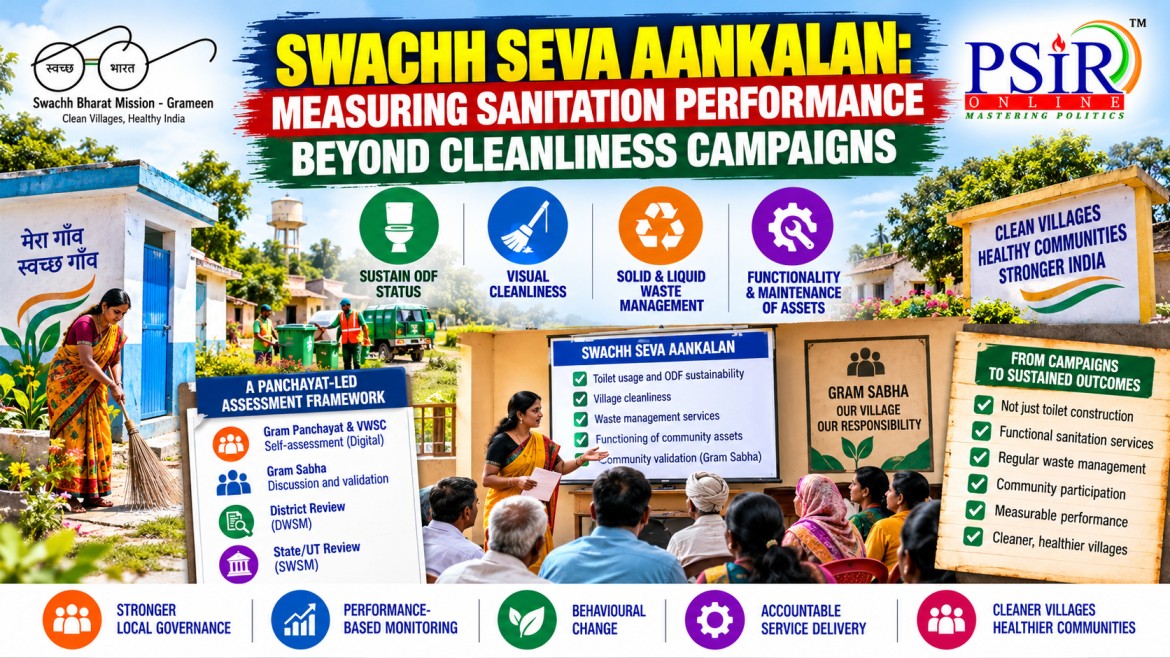
Rural sanitation is not achieved merely by constructing toilets or conducting periodic cleanliness drives. It requires sustained toilet use, reliable waste-management services, functioning community assets and continuous participation by local communities. The governance challenge is to ensure that sanitation infrastructure remains functional long after a campaign or official inspection has ended.
To strengthen this aspect of rural sanitation, the Department of Drinking Water and Sanitation under the Ministry of Jal Shakti launched Swachh Seva Aankalan (SSA) on 15 September 2026, under Swachh Bharat Mission–Grameen (SBM-G) Phase II. Announced on 16 September, the initiative introduces an annual, Gram Panchayat-level digital self-assessment framework for monitoring rural sanitation service delivery. It combines assessment by Gram Panchayats and Village Water and Sanitation Committees (VWSCs) with validation by the Gram Sabha and review by district- and state-level authorities.
The significance of SSA lies in its emphasis on the continued performance of sanitation services, rather than merely recording infrastructure created or campaign activities completed. It also provides an opportunity to examine a broader governance principle: what should governments measure to determine whether a public programme is actually delivering lasting outcomes?
WHAT IS SWACHH SEVA AANKALAN?
Swachh Seva Aankalan is an annual digital assessment framework developed under SBM-G Phase II to help rural local institutions review sanitation conditions and identify service-delivery gaps.
The initiative specifically involves Gram Panchayats that have been declared Open Defecation Free (ODF) Plus (Model), working with their VWSCs and local communities. The assessment covers the sustainability of ODF status, visual cleanliness, solid and liquid waste management, and the functionality and operation and maintenance (O&M) of sanitation and waste-management assets.
Its institutional structure is multi-tiered:
|
Level |
Role in the assessment |
|
Gram Panchayat and VWSC |
Conduct the digital self-assessment of sanitation services, community assets and maintenance. |
|
Gram Sabha |
Discusses and validates the assessment findings, providing a forum for community participation and scrutiny. |
|
District authorities |
Review findings through the District Water and Sanitation Mission (DWSM) and identify gaps requiring corrective action. |
|
State/UT authorities |
Review findings through the State Water and Sanitation Mission (SWSM) and support improvement planning and implementation. |
The framework is designed to connect local assessment with administrative review. Findings are to be made available to district and state authorities, which can use them to identify service-delivery gaps and prepare improvement plans.
An important distinction is that SSA is a self-assessment and monitoring framework, not a new toilet-construction scheme or a standalone cleanliness campaign. Its intended contribution is to strengthen the review, maintenance and improvement of sanitation services already being delivered at the village level.
WHAT DOES THE ASSESSMENT MEASURE?
The assessment focuses on four interconnected dimensions of sanitation performance.
ODF sustainability: The objective is to ensure that villages continue to sustain open-defecation-free behaviour, including continued toilet use by households. A village’s earlier ODF declaration cannot, by itself, establish that these behaviours have been maintained indefinitely.
Visual cleanliness: The ODF Plus (Model) framework includes minimal litter, minimal stagnant wastewater and the absence of plastic-waste dumps in public places, along with the display of prescribed information, education and communication (IEC) messages.
Solid and liquid waste management: The assessment considers sanitation beyond household toilets. This includes the arrangements available for managing solid waste and wastewater, which are important to maintaining a clean village environment.
Functionality and maintenance of assets: The framework explicitly includes the functionality and O&M status of sanitation and community solid- and liquid-waste-management assets. This matters because a facility that has been constructed but is no longer functional cannot reliably deliver its intended service.
These dimensions reflect the broader objective of SBM-G Phase II: sustaining ODF behaviour while improving solid and liquid waste management and visual cleanliness. Under the ODF Plus framework, villages progress through the categories of Aspiring, Rising and Model according to their sanitation arrangements and performance criteria.
SSA adds an annual local review mechanism to this broader framework. However, the launch announcement does not provide a detailed scoring formula, a published national ranking methodology or quantified improvement results from completed assessment cycles. The initiative should therefore be described as a newly launched assessment mechanism, not as an already proven measure of sanitation outcomes.
FROM CLEANLINESS CAMPAIGNS TO CONTINUOUS SERVICE DELIVERY
Cleanliness campaigns can mobilise citizens, remove accumulated waste and bring attention to neglected public spaces. Their limitation is that a short period of intensive activity does not automatically establish a sustainable sanitation system.
A village may look clean immediately after a drive but lack regular waste collection. A community facility may be inaugurated but later become unusable because of inadequate maintenance. Wastewater may be diverted from one location without being managed safely. Households may have access to toilets but not consistently use them.
SSA seeks to address this governance challenge by institutionalising an annual assessment at the Gram Panchayat level. Rather than focusing exclusively on visible cleanliness at a particular moment, the framework includes the sustainability of ODF status, waste-management arrangements and the maintenance of assets.
The distinction can be understood through three stages:
· Infrastructure creation: Toilets, waste-management facilities and related assets are constructed or provided.
· Service delivery: Facilities remain accessible and functional, and sanitation services operate as intended.
· Sustained outcomes: Communities maintain safe sanitation practices, waste is managed appropriately and local environmental conditions improve over time.
The first stage is necessary, but it does not guarantee the other two. SSA is designed to help local institutions examine the continuing performance of sanitation services rather than rely solely on records of infrastructure creation.
This approach also complements Swachhata Hi Seva, the nationwide campaign that mobilises citizens and institutions for cleanliness activities. The two initiatives serve different but complementary purposes: a campaign can generate public participation and visible action, while annual assessment can help institutionalise monitoring and corrective action.
GRAM SABHA VALIDATION AND DECENTRALISED ACCOUNTABILITY
One of the distinctive features of Swachh Seva Aankalan is the proposed validation of assessment findings by the Gram Sabha.
The Gram Panchayat and VWSC may have access to administrative records about sanitation assets, but local residents can also provide information about whether services work in practice. Community discussion can help identify issues such as irregular waste collection, non-functional facilities, stagnant wastewater or gaps between official records and everyday experience.
The Gram Sabha provides a formal setting in which the assessment can be discussed and its findings validated. The subsequent review by district and state authorities is intended to connect local observations with administrative support and improvement planning.
This design is consistent with the decentralised governance framework associated with the 73rd Constitutional Amendment and the role of Panchayati Raj Institutions in local development. Sanitation is included in the Eleventh Schedule of the Constitution, while the actual assignment of responsibilities depends on the relevant state framework. The initiative’s emphasis on Gram Panchayats and Gram Sabhas seeks to strengthen local participation in reviewing sanitation services.
Community validation can also improve accountability by making the assessment more than an internal administrative exercise. However, its effectiveness depends on meaningful participation, access to understandable information and the willingness of officials to act on concerns raised by residents.
A Gram Sabha meeting alone does not guarantee effective scrutiny. If residents lack information, disadvantaged households cannot participate, or identified deficiencies remain unresolved, the validation process may become procedural rather than substantive.
For SSA to work as intended, community findings must feed into clear corrective actions, with responsibility assigned to the relevant authorities and progress reviewed subsequently.
PERFORMANCE-BASED GOVERNANCE: WHAT SHOULD BE MEASURED?
The theoretical connection to performance-based governance helps explain why Swachh Seva Aankalan matters. Public administration increasingly uses measurable indicators to assess whether government programmes are functioning as intended. The value of such indicators depends on whether they capture actual service quality rather than merely count activities.
For sanitation, counting toilets constructed or cleanliness events conducted measures outputs. Examining whether toilets remain functional, waste is collected and treated appropriately, and sanitation behaviour is sustained provides a stronger indication of service performance.
SSA’s focus on annual assessment, community validation and administrative review offers a framework for moving in this direction. Its impact, however, will depend on the quality of the information collected and the action taken in response.
Several implementation safeguards are important.
First, verify findings. Self-assessment should be supported by evidence and, where appropriate, field verification. Otherwise, local reporting may overstate the condition of facilities or overlook persistent problems.
Second, assess maintenance, not just asset availability. A waste-management facility should be evaluated in terms of whether it is functional and maintained, not simply whether it appears in an asset register.
Third, convert findings into corrective action. District and state reviews should lead to practical improvement plans, clearly assigned responsibilities and follow-up on unresolved gaps.
Fourth, ensure inclusive participation. Women, sanitation workers, disadvantaged households and residents of remote settlements should have meaningful opportunities to report service deficiencies. Community participation should not be limited to those who are already well represented in local institutions.
Fifth, distinguish compliance from outcomes. A completed digital form or a validated Gram Sabha record is evidence that an assessment process took place. It is not, by itself, proof that sanitation conditions improved. Longer-term evaluation should examine whether identified gaps are corrected and services remain functional across assessment cycles.
This distinction is central to credible performance measurement. If authorities focus only on completing assessments or achieving favourable classifications, they may inadvertently prioritise reported compliance over the underlying purpose of sanitation policy. A sound assessment system must reward accurate reporting and genuine improvement, including the identification of problems that require additional support.
UPSC ANGLES
|
Dimension |
Relevance to Swachh Seva Aankalan |
|
Constitutional and local governance |
Connects with the 73rd Constitutional Amendment, Panchayati Raj Institutions and the role of Gram Sabhas in participatory local governance. |
|
Administrative reform |
Demonstrates the shift from campaign-oriented mobilisation towards annual assessment, service monitoring and corrective action. |
|
Performance-based governance |
Highlights the distinction between inputs, outputs, service functionality and sustained outcomes. |
|
Social justice |
Raises questions about whether sanitation services remain accessible and functional for disadvantaged households and marginalised communities. |
|
Digital governance |
Uses digital self-assessment to organise local information and make findings available for district- and state-level review. |
|
Behavioural change |
Emphasises sustained toilet use and sanitation practices rather than assuming that infrastructure or awareness campaigns alone guarantee behaviour change. |
|
Environmental governance |
Links rural cleanliness with solid-waste management, liquid-waste management and the maintenance of community assets. |
|
Accountability and citizen participation |
Gram Sabha validation can strengthen public scrutiny, provided findings lead to corrective action and follow-up. |
|
Implementation evaluation |
Encourages assessment of data quality, maintenance, unresolved deficiencies and improvement across annual assessment cycles. |
CONCLUSION
Swachh Seva Aankalan represents an effort to strengthen the monitoring of rural sanitation by placing annual assessment at the Gram Panchayat level and linking it to Gram Sabha validation and district- and state-level review.
Its emphasis on ODF sustainability, visual cleanliness, solid and liquid waste management, and asset maintenance reflects the continuing challenge of converting sanitation infrastructure into reliable public services. The initiative also recognises that local communities have an important role in identifying deficiencies and reviewing service performance.
The test of SSA will not be the number of assessments completed, but whether the process helps identify genuine problems, supports corrective action and improves sanitation services over time.
The central lesson is that sustainable sanitation requires more than cleanliness campaigns: it requires functioning services, responsible local institutions, informed community participation and measurable improvement.
OFFICIAL REFERENCES AND FURTHER READING
GS2 MAINS PRACTICE QUESTIONS
