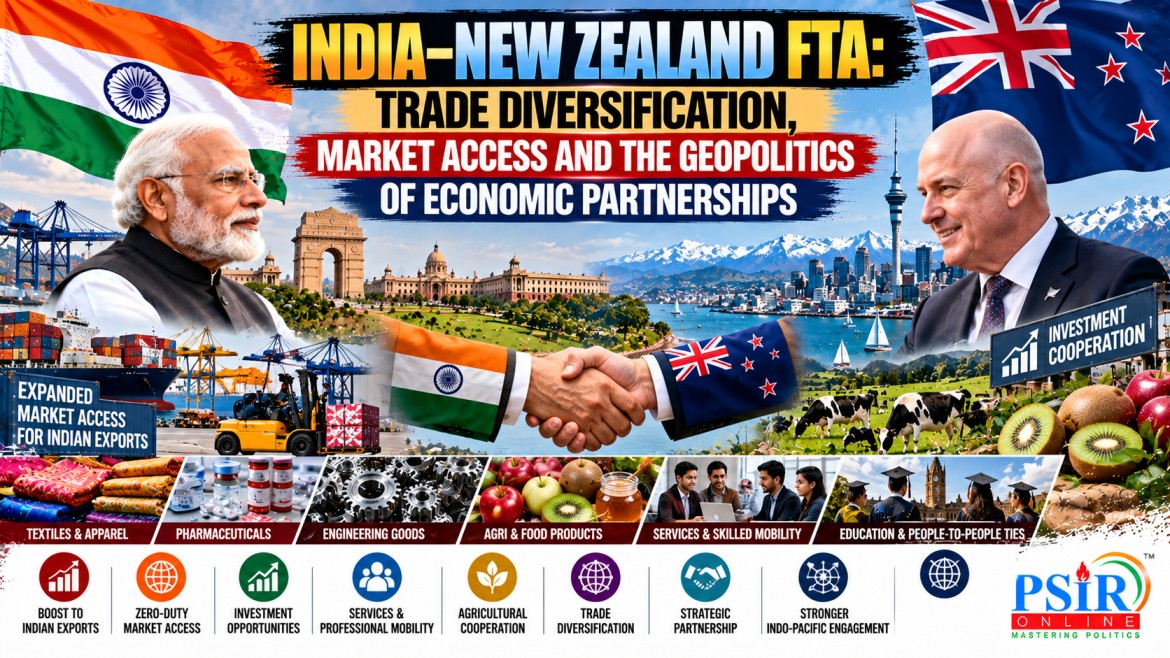
The India–New Zealand Free Trade Agreement (FTA) represents an important development in India’s strategy of trade diversification and economic diplomacy. Signed in New Delhi on 27 April 2026, the agreement is scheduled to enter into force on 20 October 2026, following the completion of domestic procedures in both countries. New Zealand’s Parliament passed the implementing legislation in September, marking a crucial step towards operationalisation.
The agreement comes at a time when the international trading system is being reshaped by tariff disputes, supply-chain restructuring, strategic competition and growing economic nationalism. For India, the objective is not merely to expand bilateral trade but also to strengthen access to developed markets, attract investment, support labour-intensive industries and create additional opportunities for services and skilled professionals.
The agreement is particularly significant because it combines tariff liberalisation with services access, investment cooperation, professional mobility and agricultural productivity initiatives. Its wider importance lies in the attempt to connect commercial relations with a broader strategic partnership. Nevertheless, the benefits will depend on implementation, export competitiveness and the ability of Indian businesses to convert preferential access into sustained market expansion.
THE SEPTEMBER MILESTONE AND THE STRATEGIC CONTEXT
India and New Zealand announced the conclusion of FTA negotiations in December 2025, signed the agreement on 27 April 2026 and moved towards implementation during September. The New Zealand Parliament passed the relevant legislation on 16 September, and both governments subsequently announced 20 October 2026 as the entry-into-force date.
The agreement also follows the elevation of bilateral relations to a Strategic Partnership during Prime Minister Narendra Modi’s July 2026 visit to New Zealand. The accompanying Roadmap to 2030 identifies an aspirational objective of doubling bilateral trade in goods and services to NZ$7 billion by 2030.
The commercial relationship has considerable room for expansion. Bilateral merchandise trade was approximately US$1.1 billion in 2025–26, a modest scale compared with India’s trade with its largest partners. The FTA therefore offers a framework for deepening an existing relationship rather than merely formalising an already extensive commercial interdependence.
For India, New Zealand provides access to a high-income economy, while New Zealand gains a structured opportunity to expand commercial engagement with a large and growing market. The agreement also strengthens India’s network of economic partnerships beyond its traditional concentration on major markets in North America, Europe and East Asia.
The September milestone is consequently more than a procedural development. It signals a transition from negotiations to implementation, where the credibility of the agreement will increasingly be judged by actual trade, investment and employment outcomes.
MARKET ACCESS AND THE DIVERSIFICATION OF INDIAN EXPORTS
The most immediate feature of the agreement is New Zealand’s commitment to provide zero-duty access across all tariff lines covering Indian exports from the date of entry into force. Before the agreement, certain Indian products faced tariffs of up to 10%, affecting their price competitiveness.
The principal opportunities include textiles and apparel, leather and footwear, gems and jewellery, engineering goods, processed foods, pharmaceuticals and selected marine products. Many of these sectors support substantial employment through manufacturing clusters, small enterprises and labour-intensive production.
|
Sector |
Potential significance for India |
|
Textiles and apparel |
Improved price competitiveness and opportunities for employment-intensive exporters |
|
Leather and footwear |
Lower tariff barriers for finished products and intermediate goods |
|
Engineering goods |
Greater access for machinery, components and manufactured products |
|
Pharmaceuticals and medical devices |
Reduced duplication of regulatory inspections and potentially faster market entry |
|
Processed foods and marine products |
Expanded access for eligible products and opportunities for value addition |
|
MSMEs and women-led enterprises |
Potential gains from export diversification, supplier networks and improved market information |
The agreement may help Indian exporters reduce their dependence on a narrow group of destination markets. Diversification is particularly relevant when tariff changes or geopolitical tensions disrupt established export channels. Access to New Zealand could also help smaller businesses gain experience in quality certification, branding, logistics and international distribution.
However, tariff elimination does not automatically create export demand. Indian firms must still meet New Zealand’s product standards, consumer expectations, packaging requirements and delivery schedules. Freight costs, the geographical distance between the two countries, limited brand recognition and the scale of individual firms may constrain the gains.
The agreement should therefore be understood as an enabling framework. Its commercial value will depend on whether exporters can use lower tariffs to build durable distribution networks and compete on quality, reliability and value addition.
INVESTMENT, SERVICES AND THE MOBILITY DIMENSION
The FTA extends beyond merchandise trade. It creates a framework for cooperation in services, investment, professional mobility, education and technology. This is significant for an Indian economy whose international competitiveness increasingly depends on the movement of knowledge, skills and business services.
New Zealand has committed to facilitating US$20 billion in investment into India over 15 years, with intended opportunities in agriculture, manufacturing, infrastructure and start-ups. This is a commitment to facilitate investment rather than an amount already invested; its economic significance will depend on the projects actually realised, their financing, implementation and contribution to domestic production.
The agreement provides market-access commitments for India across approximately 118 services sectors and Most-Favoured-Nation treatment across approximately 139 sectors or sub-sectors. Relevant areas include information technology, professional services, construction, tourism and other service industries. It also provides a dedicated pathway involving 5,000 Temporary Employment Entry visas for skilled Indians and 1,000 Working Holiday visas annually for young Indians, subject to the agreement’s conditions.
Student provisions include the right to work for at least 20 hours per week during study and extended post-study work opportunities for eligible graduates. The agreement also addresses access for Indian pharmaceutical and medical-device exporters by providing for acceptance of inspection approvals from specified comparable regulators.
These provisions are important because modern trade agreements increasingly regulate how services, capital, technology and skilled people move across borders, rather than focusing exclusively on customs duties. They may also help Indian firms expand their international presence without relying entirely on goods exports.
Nevertheless, investment announcements should not be confused with realised capital formation, while mobility provisions do not eliminate every immigration, licensing or professional-recognition requirement. The long-term gains will depend on transparent implementation, employer demand, regulatory cooperation and the capacity of Indian firms and professionals to use the opportunities available.
AGRICULTURAL SENSITIVITIES AND THE POLITICS OF MARKET ACCESS
The agreement illustrates how trade liberalisation is shaped by domestic political constraints. India has excluded several sensitive product categories from tariff concessions, including dairy products, sugar, edible oils, selected agricultural commodities and most animal-meat products. These exclusions reflect concerns about farmer livelihoods, rural incomes and the adjustment costs of import competition.
New Zealand’s agricultural exports to India are subject to calibrated arrangements. Market access for products such as apples, kiwifruit and mānuka honey is managed through tariff-rate quotas, minimum import prices and seasonal conditions. Such provisions seek to balance consumer access and commercial opportunities with safeguards for domestic producers.
The agreement also establishes an Agriculture Productivity Partnership, including cooperation on horticulture, post-harvest practices, supply chains, food safety and sustainable beekeeping. Centres of Excellence and product-specific action plans are intended to strengthen productivity and quality in relevant Indian agricultural sectors.
This approach recognises that agricultural cooperation need not be limited to the removal of tariffs. Technology transfer, improved storage, better planting material, quality certification and reduced post-harvest losses can raise domestic productivity and create export opportunities.
The central challenge is to ensure that these initiatives produce measurable benefits for farmers rather than remaining institutional commitments. Small producers may require extension services, credit, producer organisations, processing facilities and access to reliable buyers to participate effectively.
The agreement thus demonstrates that trade policy is also a form of domestic political bargaining. Governments must reconcile export opportunities with food security, rural employment, consumer interests and the political importance of agriculture. The exclusions and safeguards are not peripheral exceptions; they are integral to the political sustainability of the agreement.
ECONOMIC STATECRAFT AND INDIA’S STRATEGY OF DIVERSIFICATION
The India–New Zealand FTA must be situated within a changing global economy in which states increasingly use trade agreements to strengthen resilience, attract investment and reduce strategic vulnerabilities. Tariffs, export controls, industrial subsidies and restrictions on technology have become instruments of economic statecraft.
For India, expanding trade relationships with developed economies can widen market access and create alternatives when commercial relations with larger partners become uncertain. New Zealand is not a substitute for the United States, the European Union or East Asian economies. Its significance lies in adding another institutionalised economic relationship to India’s wider network of partnerships.
The agreement also links economic and strategic diplomacy. Cooperation in education, agriculture, technology, services and investment can strengthen institutional contacts and increase the number of stakeholders interested in stable bilateral relations. The strategic partnership provides a wider political framework within which commercial cooperation can develop.
At the same time, an FTA does not automatically produce geopolitical alignment. India and New Zealand may continue to differ on specific international issues, domestic regulatory priorities or approaches to multilateral institutions. Economic cooperation can improve the conditions for diplomatic engagement without eliminating differences.
The agreement is therefore best understood as selective interdependence: both countries seek to deepen cooperation in areas of mutual benefit while retaining policy space in sensitive sectors. Its value will be measured not by the symbolism of the signing but by whether it strengthens resilience, productivity and mutually beneficial economic ties.
IMPLEMENTATION CHALLENGES AND THE WAY FORWARD
The transition from negotiated commitments to economic outcomes requires coordination between governments, regulators, exporters, investors and industry bodies. Several priorities will determine whether the agreement fulfils its stated ambitions.
First, export promotion must be sector-specific. Indian firms need accessible information about tariff schedules, rules of origin, product standards, certification and customs procedures. Export-readiness programmes should pay particular attention to MSMEs, women-led enterprises and businesses located outside established export centres.
Second, investment commitments require transparent project pipelines and monitoring. Public reporting on realised investment, employment, technology transfer and regional distribution would distinguish actual economic outcomes from announced intentions.
Third, agricultural cooperation should prioritise measurable productivity improvements. The effectiveness of Centres of Excellence and action plans should be assessed through changes in yields, quality, storage losses, farmer incomes and access to higher-value markets.
Fourth, the two governments must ensure that tariff-rate quotas and safeguards operate predictably. Clear administrative procedures can reduce uncertainty for importers while protecting the interests of affected domestic producers.
Finally, the agreement should be integrated with India’s wider manufacturing, logistics, skilling and export-diversification policies. Market access alone cannot compensate for high transport costs, inadequate testing infrastructure, weak branding or inconsistent product quality.
Implementation capacity is the decisive variable. The FTA creates opportunities, but public institutions and businesses must convert them into export growth, productive investment and better employment. Periodic reviews should therefore focus on actual utilisation rates, sectoral performance, investment delivery and the distribution of benefits.
THEORETICAL ANGLES
|
Theory or concept |
Application to the India–New Zealand FTA |
|
Complex interdependence |
The agreement connects goods, services, investment, education and mobility, creating multiple channels of bilateral cooperation beyond traditional diplomacy. |
|
Economic statecraft |
Preferential market access and investment frameworks are instruments through which states pursue competitiveness, resilience and broader strategic objectives. |
|
Liberal institutionalism |
Common rules, consultation mechanisms and dispute-settlement procedures can reduce uncertainty and facilitate sustained cooperation. |
|
Realism and national interest |
Both countries preserve sensitive sectors and policy autonomy while pursuing commercial gains, demonstrating that economic cooperation remains shaped by national interests. |
|
Asymmetric interdependence |
Differences in market size, export capacity and sectoral strengths may produce uneven benefits, making implementation and adjustment policies important. |
|
Domestic politics and two-level games |
Negotiated concessions reflect international bargaining as well as domestic constraints, particularly the political sensitivity of agriculture and employment. |
|
Strategic autonomy and diversification |
India’s wider network of trade partnerships can reduce concentration risks without requiring exclusive alignment with any major power. |
CONCLUSION
The India–New Zealand FTA represents an attempt to combine market access, investment cooperation and strategic partnership within a single institutional framework. Its September 2026 implementation milestone brings the agreement closer to operation, with entry into force scheduled for 20 October.
The agreement offers opportunities for Indian exporters, service providers, professionals and manufacturers while preserving protections for several sensitive domestic sectors. Its wider importance lies in India’s effort to diversify economic relationships and strengthen its position in a global trading system marked by uncertainty and strategic competition.
Yet the agreement’s success cannot be inferred from tariff concessions or investment commitments alone. Export utilisation, realised investment, productivity gains, employment quality and the distribution of benefits will determine its practical value. The FTA’s ultimate contribution to India’s economic diplomacy will depend on the extent to which formal market access becomes sustained and inclusive economic engagement.
RELATED READING
PRACTISE QUESTIONS FOR GS2 MAINS
PRACTISE QUESTIONS FOR PSIR
