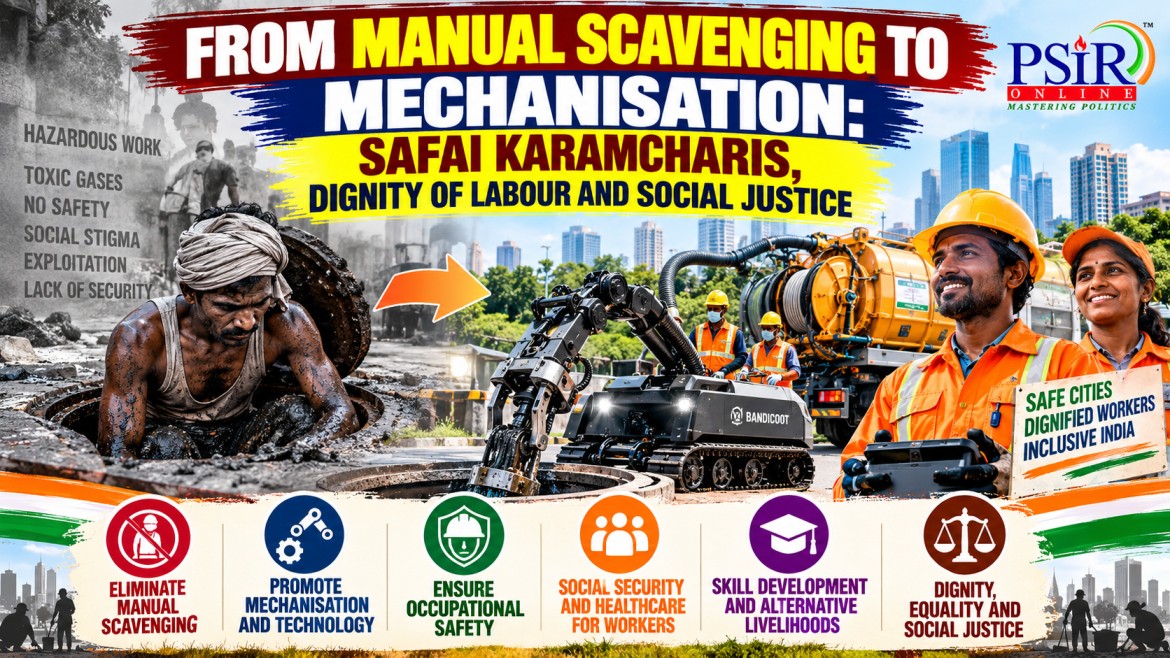
Sanitation is essential to public health, urban life and human dignity. Yet, for decades, the maintenance of India's sanitation systems has also involved workers undertaking some of the country's most hazardous forms of labour. Human beings have entered sewers, manholes and septic tanks to remove accumulated waste, often exposing themselves to toxic gases, pathogens, injuries and death.
The problem is therefore not simply one of sanitation. It is simultaneously an issue of social justice, occupational safety, caste-based exclusion, dignity of labour and technological development.
India has legally prohibited manual scavenging and introduced rehabilitation measures. The Prohibition of Employment as Manual Scavengers and their Rehabilitation Act, 2013 specifically seeks to prohibit the practice and rehabilitate manual scavengers and their families. The law also distinguishes manual scavenging from hazardous cleaning of sewers and septic tanks.
Manual scavenging concerns the manual handling of human excreta in insanitary latrines, open drains, pits and other locations covered by the Act. Hazardous sanitation work also includes the dangerous manual cleaning of sewers and septic tanks when prescribed safety obligations, protective equipment and cleaning devices are not provided. Thus, the contemporary sanitation challenge extends beyond the traditional image of manual scavenging to the broader question of how human beings are protected from hazardous entry into confined sanitation spaces.
The policy response is consequently moving from merely prohibiting a degrading occupation towards creating a mechanised sanitation ecosystem in which hazardous cleaning is performed through machines, trained personnel and appropriate safety systems.
WHY DOES THE PROBLEM PERSIST?
The persistence of hazardous sanitation work reflects a combination of structural and institutional factors:
· inadequate sanitation infrastructure in some areas;
· dependence on manual methods for difficult cleaning operations;
· gaps in mechanisation, particularly in smaller urban and local bodies;
· informal or contractual employment arrangements;
· inadequate occupational safety practices;
· insufficient availability of specialised machinery;
· weak enforcement and accountability;
· and the historical association of sanitation work with socially disadvantaged communities.
Therefore, simply declaring manual scavenging illegal does not automatically eliminate the conditions that produce hazardous sanitation work. The central challenge is to change the technology of sanitation while simultaneously changing the social and economic position of sanitation workers.
FROM THE MANHOLE TO THE MACHINE-HOLE
The Union Government's National Action for Mechanised Sanitation Ecosystem (NAMASTE), launched in 2023–24 by the Ministry of Social Justice and Empowerment in convergence with the Ministry of Housing and Urban Affairs, seeks to prevent hazardous cleaning and promote safe, mechanised sanitation. Its stated objective is to achieve zero fatalities in sanitation work, eliminate direct contact with human faecal matter and ensure that sanitation work is performed by trained and skilled workers.
The approach is broader than simply purchasing machines. It seeks to create an ecosystem involving:
· identification and profiling of sewer and septic-tank workers;
· occupational safety training;
· Personal Protective Equipment (PPE);
· health insurance under Ayushman Bharat–PM-JAY;
· mechanised sanitation equipment;
· Emergency Response Sanitation Units (ERSUs);
· capital subsidy for sanitation-related vehicles and equipment;
· and support for worker entrepreneurship and alternative livelihoods.
The policy objective is therefore clear: The worker should not enter the manhole; the machine should enter the manhole.
TECHNOLOGY AS A TOOL OF SOCIAL JUSTICE
India's emerging sanitation-robotics ecosystem provides an important illustration of this transition. One notable example is Bandicoot, developed by Kerala-based Genrobotics. The robot is designed to enter manholes and perform cleaning operations remotely. Its human-like robotic arm can pick and shovel waste, while cameras and gas-detection systems assist in inspection and safety. The company also describes a compact Bandicoot Mini designed for preventive cleaning in narrow and congested spaces.
The significance of such technology goes beyond efficiency. If a sanitation worker who once had to physically enter a hazardous manhole can instead be trained to operate and maintain sanitation machinery, technology can transform the nature of the occupation itself—from hazardous manual labour to a skilled sanitation profession.
This creates an important social-justice proposition: Mechanisation should not mean replacing the worker; it should mean replacing the dangerous task performed by the worker.
THE PROBLEMS FACED BY SAFAI KARAMCHARIS AND SANITATION WORKERS
The problem of sanitation labour in India has several layers. Manual scavenging is legally prohibited, but hazardous sanitation work continues to pose serious risks to workers who clean sewers, septic tanks and other confined sanitation spaces.
The Prohibition of Employment as Manual Scavengers and their Rehabilitation Act, 2013 prohibits both employment as manual scavengers and hazardous manual cleaning of sewers and septic tanks. It also places responsibility on authorities to identify and rehabilitate manual scavengers.
Yet the persistence of sewer and septic-tank deaths demonstrates the gap between legal prohibition and actual working conditions.
|
Problem |
Nature of the challenge |
|
Exposure to toxic gases |
Workers entering confined spaces can be exposed to poisonous gases and oxygen-deficient environments, creating a potentially fatal occupational hazard. |
|
Deaths and serious injuries |
Sewer and septic-tank cleaning has resulted in continuing fatalities. NCSK reported 471 deaths from hazardous sewer/septic-tank cleaning between 2019 and 31 October 2025. |
|
Inadequate mechanisation |
Machines may be available in major cities, but mechanisation needs to reach smaller urban local bodies, private premises and difficult sanitation locations. |
|
Contractual and informal employment |
Outsourcing can create accountability gaps when contractors employ workers without adequate safety systems, training or protective equipment. |
|
Occupational health risks |
Repeated exposure to sewage, pathogens, toxic substances and unsafe working environments can create long-term health risks. |
|
Social stigma |
Sanitation work continues to carry social stigma, making the issue one of dignity and social equality, not merely occupational safety. |
|
Weak rehabilitation |
Prohibition without sustainable alternative livelihoods can leave vulnerable workers economically dependent on sanitation work. |
|
Inter-generational disadvantage |
Children of workers engaged in unclean and hazardous occupations require educational support so that occupational disadvantage is not reproduced across generations. |
The social composition of the workforce also reveals the structural nature of the problem. In the validated data available under NAMASTE, Scheduled Castes constituted about 68% of identified sewer and septic-tank workers, although the Government correctly emphasises that sewer/septic-tank cleaning is an occupation-based category rather than a caste-based category.
The constitutional promise of equality requires the State to address both the hazardous occupation itself and the historical social conditions that have concentrated such work among particular communities.
The deeper problem: prohibition is not enough
A worker should not have to choose between unemployment and dangerous sanitation work. Therefore, rehabilitation cannot mean simply withdrawing a person from manual scavenging. It must provide: safe employment + skills + social security + access to credit + education for children + occupational dignity.
This is why India's policy approach has increasingly moved from “ban and rehabilitate” towards “mechanise, protect and empower.”
THE GOVERNMENT'S RESPONSE: FROM PROHIBITION TO MECHANISATION
India's response can be understood as a progression:
Prohibition → Identification → Protection → Mechanisation → Rehabilitation → Social Security → Entrepreneurship
The legal foundation remains the 2013 Act, but the contemporary policy framework increasingly focuses on eliminating the need for human beings to undertake hazardous sanitation operations.
1. NAMASTE: India's central mechanisation framework
The most important contemporary intervention is the National Action for Mechanised Sanitation Ecosystem (NAMASTE), launched in 2023–24 by the Ministry of Social Justice and Empowerment in convergence with the Ministry of Housing and Urban Affairs. Its objective is to ensure the safety and dignity of sanitation workers and prevent hazardous cleaning. Its vision: Zero fatalities in sanitation work and elimination of direct human contact with human faecal matter.
NAMASTE therefore does not treat mechanisation as merely a technological upgrade. It treats it as an instrument of social justice.
|
NAMASTE intervention |
Social-justice objective |
|
Profiling of sewer/septic-tank workers |
Identify workers and bring them within the formal protection system |
|
Occupational safety training |
Convert sanitation work into a trained and professional occupation |
|
PPE kits |
Reduce occupational exposure |
|
Safety equipment for ERSUs |
Enable safe emergency sanitation operations |
|
Ayushman Bharat–PM-JAY |
Provide health protection to workers and eligible dependants |
|
Capital subsidy |
Help workers acquire sanitation vehicles and equipment |
|
Self-Help Groups |
Enable collective economic activity |
|
Entrepreneurship support |
Shift workers from hazardous labour to ownership of mechanised sanitation enterprises |
|
14420 helpline/ERSUs |
Create an organised emergency response mechanism |
The Government has therefore attempted to change the model from: “Worker enters sewer → worker faces danger” to: “Machine enters sewer → trained worker operates machine safely.”
2. Mechanisation as livelihood transformation
Central government through Swachhta Udyami Yojana (SUY) provides capital subsidies and entrepreneurship support, so that workers can potentially become operators or owners of sanitation-related equipment and enterprises. Swachhta Udyami Yojana (SUY) is the concessional-finance arm of sanitation entrepreneurship in India. The National Safai Karamcharis Finance and Development Corporation (NSKFDC), under the Ministry of Social Justice and Empowerment, launched it on 2 October 2014. NAMASTE’s capital-subsidy component for “sanipreneurs” is delivered through SUY. The two are meant to work as one package: training and insurance on one side, a subsidised loan to own the equipment on the other.
SUY supports two kinds of projects.
· Pay-and-use community toilets, built and run in public–private partnership, usually with an urban local body. A standard unit of about 10 seats can be financed up to ₹25 lakh.
· Sanitation vehicles and machines — suction-cum-jetting machines, desludging vehicles, and related equipment — so that sewer and septic-tank work is mechanised. Individual loans for this are generally capped around ₹15 lakh; group projects (self-help groups, joint liability groups, cooperatives of the target community) can go higher, with secondary descriptions citing up to ₹50 lakh.
3. Health and social security
NAMASTE provides for Ayushman Bharat–PM-JAY health insurance coverage, occupational safety training and PPE for identified sewer/septic-tank workers. The social-security dimension is particularly important because a sanitation worker's vulnerability does not end when he or she leaves the sewer.
The worker and family require:
· health protection;
· accident and death compensation;
· educational opportunities for children;
· skill development;
· alternative livelihood opportunities;
· access to institutional credit;
· and protection against occupational discrimination.
4. NSKFDC: credit and economic empowerment
The National Safai Karamcharis Finance & Development Corporation (NSKFDC) plays an important role in the economic empowerment dimension. It provides credit facilities to Safai Karamcharis, manual scavengers and their dependants for income-generating activities through State Channelising Agencies. Its interventions include loans, skill development and entrepreneurship support.
5. Education as inter-generational rehabilitation
Social justice also requires preventing sanitation-related occupational disadvantage from passing from one generation to another.
The Ministry provides a pre-matric scholarship component for children of persons engaged in manual scavenging, hazardous cleaning, waste picking and certain other unclean occupations. Thus, the intervention extends beyond the worker: Worker protection today + children's education today = breaking occupational disadvantage tomorrow.
THE STATE GOVERNMENTS: WHERE IMPLEMENTATION ACTUALLY HAPPENS
The Union framework becomes meaningful only when States, Urban Local Bodies and local sanitation systems actually implement it. This is particularly important because sanitation is experienced at the level of the municipality, corporation, town and village, where sewer cleaning, septic-tank maintenance and emergency sanitation operations actually occur.
Kerala: mechanisation and robotics
Kerala provides one of the strongest examples of the technology-led approach. The Kerala Water Authority has deployed Bandicoot robotic technology for manhole cleaning in Thiruvananthapuram. According to KWA, the technology eliminates manual entry into the sewer system and has been used in multiple sewerage sections of the city.
Kerala has also implemented NAMASTE across its Urban Local Bodies. Its official data records profiling of 1,604 sewer/septage workers across 93 ULBs, validation of 1,588 records, processing of Ayushman cards, PPE distribution and formation of Emergency Response Sanitation Units.
Tamil Nadu: mechanised cleaning and worker protection
Tamil Nadu has also developed a long-standing policy framework for mechanised sewer and septic-tank cleaning. The State has prohibited hazardous entry into sewerage systems and issued procedures for mechanised cleaning. Its municipal administration records the procurement of jet-rodding machines for clearing sewer blockages and desilting machines for removing silt from manholes, alongside safety equipment and awareness measures.
More recently, Tamil Nadu has issued Standard Operating Procedures for mechanised desludging of septic tanks, while its municipal administration also lists Sanitation Workers Development Scheme Guidelines.
THE IMPLEMENTATION GAP: FROM POLICY TO ZERO-FATALITY SANITATION
India has moved considerably from the era of legal prohibition towards mechanisation, worker profiling, occupational safety and rehabilitation. Yet the continued occurrence of deaths during sewer and septic-tank cleaning shows that the transition remains incomplete.
The central challenge is that mechanisation is uneven. Large metropolitan corporations may possess suction-cum-jetting machines, desludging equipment and robotic technologies, while smaller urban local bodies, private establishments and difficult sanitation locations may continue to depend on manual intervention.
Three gaps therefore require particular attention:
· Technology gap: mechanised equipment must reach smaller towns and local bodies.
· Implementation gap: contractors and local authorities must be held accountable for unsafe cleaning.
· Rehabilitation gap: workers must receive sustainable livelihoods rather than merely one-time assistance.
The ultimate measure of success should therefore not be the number of machines purchased, but the reduction of human entry into hazardous sanitation spaces and the complete elimination of preventable sanitation deaths.
UPSC DIMENSION
|
Constitutional / governance dimension
|
Relevance to Safai Karamcharis and sanitation workers |
|
Article 14 – Equality before law |
Hazardous sanitation work raises questions of equal protection and equal access to safe working conditions. |
|
Article 17 – Abolition of untouchability |
The historical association of sanitation work with caste-based exclusion makes the issue central to the constitutional rejection of social stigma and untouchability. |
|
Article 21 – Right to life and dignity |
Protection from preventable occupational death and degrading working conditions is integral to a life with dignity. |
|
Article 23 – Prohibition of forced labour |
Exploitative sanitation arrangements raise questions about coercion, vulnerability and conditions of labour. |
|
Article 38 |
Directs the State to promote a social order informed by justice and minimise inequalities. |
|
Article 39(e) |
Requires protection of the health and strength of workers from abuse. |
|
Article 41 |
Provides for public assistance in cases such as unemployment, old age, sickness and disablement, subject to State capacity. |
|
Article 42 |
Calls for just and humane conditions of work. |
|
Article 46 |
Requires promotion of the educational and economic interests of weaker sections and protection from social injustice and exploitation. |
|
DPSP + social justice |
Sanitation-worker policy demonstrates how welfare, occupational safety and dignity must operate together. |
|
Technology and social justice |
Mechanisation converts technology from merely an efficiency tool into an instrument for protecting human dignity. |
|
Cooperative federalism |
Union policy requires effective implementation by States, municipalities and Urban Local Bodies. |
The constitutional question is not merely whether manual scavenging is prohibited; it is whether the State has created conditions in which no person is compelled by poverty, social disadvantage or institutional failure to undertake hazardous sanitation work.
WAY FORWARD
1. Universalise mechanisation
Every municipality and sanitation authority should have access to appropriate mechanised cleaning equipment. Technology must reach small towns, peri-urban areas and decentralised sanitation systems, not remain concentrated in major metropolitan corporations.
2. Make human entry an exceptional and accountable act
Human entry into sewers and septic tanks should be treated as an exceptional situation requiring strict safety protocols, trained personnel, protective equipment and documented authorisation.
3. Strengthen the NAMASTE ecosystem
Worker profiling, occupational training, PPE, health insurance, capital subsidy and Emergency Response Sanitation Units should be implemented comprehensively rather than as isolated components.
4. Convert workers into skilled sanitation professionals
Mechanisation should create new occupational roles—machine operators, technicians, sanitation entrepreneurs and equipment-maintenance workers—so that technology becomes a pathway to upward mobility.
5. Strengthen contractor accountability
Urban Local Bodies must ensure that sanitation contracts contain clear safety obligations, worker-registration requirements, equipment standards and penalties for hazardous manual entry.
6. Ensure rehabilitation beyond compensation
A sustainable rehabilitation package should combine:
skill development + education + credit + entrepreneurship + social security + health protection.
7. Promote Indian sanitation technology
Innovations such as robotic sewer-cleaning systems demonstrate the potential of Indian technology. Government procurement, incubation, testing and financing can help adapt such technologies to different sanitation environments.
8. Build a zero-fatality accountability framework
Every sanitation death should trigger systematic investigation into the contractor, local authority, safety protocol, equipment availability and circumstances of entry, rather than treating the death merely as an unfortunate incident.
CONCLUSION
India's sanitation challenge is ultimately a test of how the country understands development and dignity. A modern sanitation system cannot depend upon human beings entering spaces filled with toxic gases and human waste. At the same time, mechanisation should not simply remove workers from an occupation without providing them with secure and dignified alternatives.
The transition must therefore be:
from manual scavenging to mechanisation,
from hazardous labour to skilled work,
from stigma to dignity,
and from rehabilitation to genuine empowerment.
The real measure of social justice is not how efficiently India cleans its cities, but whether it can ensure that no human being has to risk life and dignity to keep those cities clean.
RELATED READING
For comprehensive UPSC preparation, students should connect the article with
· Prohibition of Employment as Manual Scavengers and their Rehabilitation Act, 2013
· National Action for Mechanised Sanitation Ecosystem (NAMASTE)
· National Commission for Safai Karamcharis (NCSK)
· National Safai Karamcharis Finance & Development Corporation (NSKFDC)
· Swachh Bharat Mission – Urban
· Occupational safety and sanitation-worker protection
· Caste, occupation and social exclusion
· Article 17 and abolition of untouchability
· Article 21 and dignity of life
· Directive Principles and humane conditions of work
· Urban sanitation and municipal governance
· Technology, robotics and public-service delivery
GS2 MAINS PRACTICE QUESTIONS
1. “The elimination of manual scavenging requires more than legal prohibition; it requires mechanisation, rehabilitation and social security.” Discuss. 10 Marks | 150 Words
2. How can mechanisation of sanitation work strengthen the constitutional promise of dignity of labour in India? 10 Marks | 150 Words
3. Despite legislative prohibition and government interventions, hazardous sanitation work continues in India. Examine the structural reasons for its persistence and suggest measures to achieve zero-fatality sanitation. 15 Marks | 250 Words
4. “Technology can eliminate the hazardous task without eliminating the worker.” Discuss this proposition in the context of India's transition from manual scavenging to mechanised sanitation. 15 Marks | 250 Words
