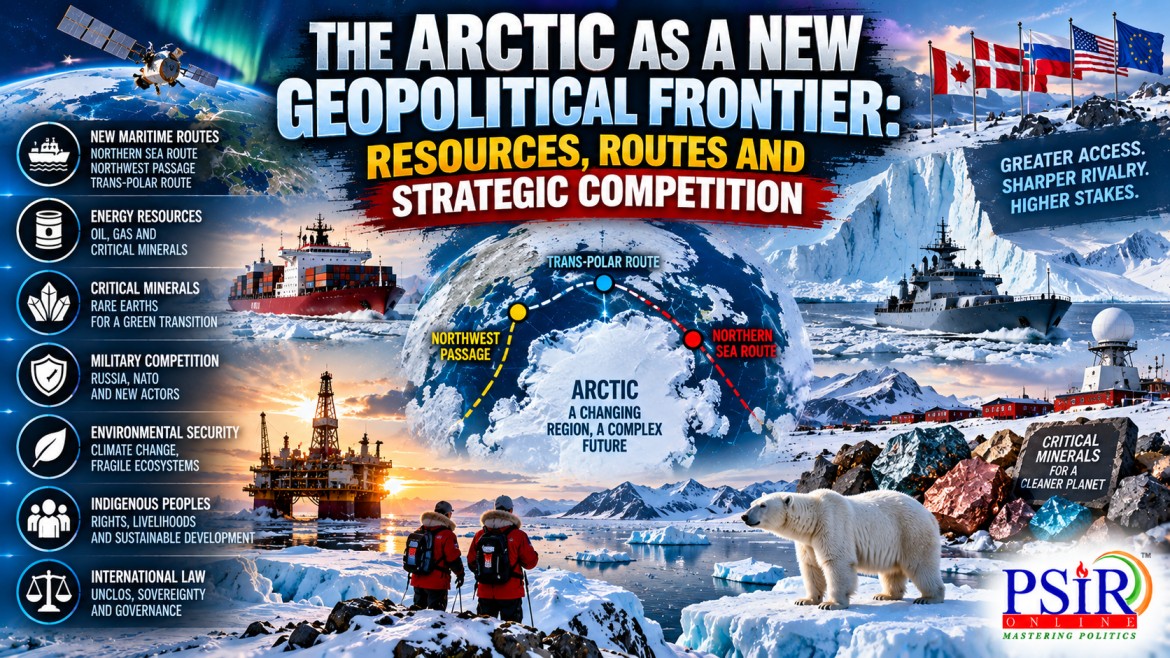
The Arctic, once viewed primarily as a remote region of scientific exploration, environmental significance and limited economic activity, is increasingly central to international politics. Climate change is transforming the region’s physical geography, while maritime connectivity, energy resources, critical minerals and military competition are expanding its strategic importance. The Arctic is no longer peripheral to global geopolitics; it is becoming a space in which environmental change intersects with national security, economic opportunity and international law.
The European Arctic Summit, held in Rovaniemi, Finland, on 13–14 September 2026, reflected this shift. Led by the European Council President and chaired by Finland’s Prime Minister, the summit sought to strengthen a common European Union approach to the Arctic as its geopolitical significance grows. The meeting placed the region within the wider debate over European security, strategic resilience and cooperation in the High North.
The environmental transformation is equally significant. According to the National Snow and Ice Data Center, Arctic sea ice reached a preliminary annual minimum of approximately 4.60 million square kilometres on 12 September 2026, tying for the tenth-lowest extent in the satellite record. The lowest 20 annual minimum extents in that record have all occurred since 2007. Although year-to-year fluctuations remain substantial, the long-term decline is altering the operating environment for shipping, infrastructure and Arctic communities.
These developments create both opportunities and dangers. Reduced ice cover may improve seasonal access to certain maritime routes and natural resources, but it does not make the Arctic an unrestricted commercial highway. Harsh weather, unpredictable ice, limited infrastructure, environmental risks and geopolitical tensions continue to constrain activity.
The central geopolitical question is therefore not simply who can exploit the Arctic’s resources, but who will shape the rules, security arrangements and environmental responsibilities governing an increasingly accessible region.
CLIMATE CHANGE AND THE TRANSFORMATION OF ARCTIC GEOGRAPHY
Climate change is a major driver of the Arctic’s growing strategic significance. Declining sea ice, changing seasonal conditions and the retreat of some ice-covered areas are altering the physical environment in which governments, shipping companies, energy firms and armed forces operate.
The 2026 sea-ice minimum illustrates the continuing transformation. The National Snow and Ice Data Center estimated that Arctic sea ice covered 4.60 million square kilometres at its minimum on 12 September. This was tied for the tenth-lowest minimum in the nearly 48-year satellite record. August 2026 sea-ice extent averaged 5.56 million square kilometres, the seventh-lowest August value in the record.
These measurements require careful interpretation. A single year’s minimum does not determine the future accessibility of a route or establish a permanent change in navigability. Local ice conditions, winds, ocean currents, storms and seasonal variability remain important. Nevertheless, the broader decline in Arctic sea ice is changing the strategic calculations of states and commercial operators.
Climate change produces a geopolitical paradox. The physical conditions that create new possibilities for shipping and resource extraction also increase environmental uncertainty and the risks of accidents. Longer periods of open water may improve access to some areas, while changing weather and unstable ice can complicate navigation.
The transformation also affects Arctic societies. Indigenous Peoples and other northern communities face changes to ecosystems, traditional livelihoods, infrastructure and food security. Decisions about shipping corridors, resource projects and military installations therefore have consequences beyond the strategic calculations of major powers.
The Arctic’s strategic value is partly a consequence of environmental vulnerability. Its growing accessibility does not remove the need for environmental protection; it makes governance and risk management more urgent.
MARITIME ROUTES: COMMERCIAL OPPORTUNITY AND STRATEGIC CONNECTIVITY
The Arctic contains several important maritime corridors, including the Northern Sea Route along Russia’s northern coast, the Northwest Passage through the Canadian Arctic archipelago and the transpolar route across the central Arctic Ocean. Their commercial significance differs according to geography, ice conditions, infrastructure, regulation and the destinations being connected.
The Northern Sea Route has attracted particular attention because it may offer shorter voyages between some Asian and European ports than conventional routes through the Suez Canal. Yet the practical advantages depend on the origin and destination of the cargo, the season, vessel design, icebreaker support, insurance costs and the reliability of port and rescue infrastructure.
A recent illustration came on 11 October 2026, when Reuters reported that a South Korean container ship had completed a commercial round trip between Busan and Europe using an Arctic route. The voyage took approximately 50 days and was presented as a potential step towards more regular Arctic services. However, the voyage also highlighted unresolved questions concerning ice navigation, insurance, fuel consumption, cargo volumes and the geopolitical complications of travelling along Russia’s Arctic coast.
The route’s potential therefore should not be confused with an established replacement for conventional global shipping lanes. Arctic shipping remains exposed to seasonal and operational constraints, and commercial viability varies across routes and types of cargo.
|
Maritime corridor |
Strategic significance |
Principal constraints |
|
Northern Sea Route |
Connects parts of the North Pacific and European maritime systems along Russia’s Arctic coast |
Ice conditions, Russian regulation, infrastructure gaps, sanctions exposure and insurance costs |
|
Northwest Passage |
Provides potential routes through the Canadian Arctic archipelago |
Complex navigation, variable ice, limited emergency infrastructure and differing legal interpretations |
|
Transpolar route |
Could offer a more direct central Arctic crossing under suitable future conditions |
Sea-ice variability, limited infrastructure, difficult rescue operations and uncertain commercial viability |
Maritime connectivity also has military implications. Routes through the High North are connected to North Atlantic sea lines of communication, naval mobility, surveillance and the movement of reinforcements. Ports, satellite links, undersea cables and navigation systems can consequently acquire strategic importance alongside their commercial functions.
Control over connectivity does not necessarily require territorial control over every route. It can also arise from the ability to provide icebreakers, port facilities, navigation information, communications, insurance or access to essential services. These capabilities can influence the practical choices available to other states and commercial operators.
ENERGY RESOURCES, CRITICAL MINERALS AND THE POLITICS OF ACCESS
The Arctic is associated with substantial potential hydrocarbon resources and deposits of minerals that may become increasingly important to energy systems, advanced manufacturing and defence industries. This has encouraged governments and companies to assess the region in the context of energy security, supply-chain diversification and competition over strategic resources.
However, resource potential must be distinguished from commercially recoverable reserves and actual production. Exploration and extraction in the Arctic can involve high capital costs, difficult operating conditions, limited infrastructure, environmental liabilities and substantial uncertainty about future demand. Sanctions and geopolitical tensions can further restrict access to technology, investment and markets.
The strategic value of Arctic resources extends beyond oil and gas. Minerals used in batteries, electronics, renewable-energy equipment and defence technologies have become important to governments seeking to reduce dependence on concentrated supply chains. Arctic territories may therefore feature in wider efforts to secure supplies of critical raw materials.
Resource competition is shaped by several factors:
· Geographical access: proximity to deposits, ports, transport networks and energy infrastructure.
· Technological capability: access to specialised equipment, research, extraction technologies and extreme-weather engineering.
· Capital and markets: the availability of finance, insurance, processing capacity and reliable buyers.
· Environmental regulation: the costs and responsibilities associated with fragile ecosystems and difficult-to-reverse damage.
· Strategic dependence: the extent to which control of a resource or processing facility can influence other states’ industrial or security choices.
Resource development can create employment, infrastructure and public revenue for northern communities. It can also intensify disputes over land use, environmental protection, Indigenous rights and the distribution of economic benefits.
A central tension emerges between the pursuit of resource security and the need to limit environmental harm. The Arctic cannot be treated simply as an untapped reserve for the global economy; decisions about extraction have consequences for regional ecosystems, climate policy and the rights of communities that inhabit the region.
MILITARY COMPETITION AND THE ARCTIC SECURITY DILEMMA
The Arctic has long held military significance because of its location between North America, Europe and Russia. It is relevant to early-warning systems, strategic deterrence, submarine operations, air defence, maritime surveillance and the protection of North Atlantic communication routes.
The regional security environment has changed as NATO has expanded its northern membership and increased its operational focus on the High North. NATO’s official Arctic security overview, updated in July 2026, identifies the strategic importance of the region, the growth of Russian military activity and China’s interest in Arctic energy, minerals and maritime connectivity. NATO launched Arctic Sentry in February 2026 and established a multinational Forward Land Forces presence in Finland in June 2026.
Russia has invested in Arctic military infrastructure and maintains significant interests along its extensive northern coastline. China, which is not an Arctic state, has pursued scientific, economic and maritime interests in the region and seeks access to resources and transport networks. Its activities raise questions about the role of non-Arctic powers in a region traditionally governed primarily by the Arctic states.
The resulting situation can be understood through the security dilemma. Measures taken by one state to strengthen its defence may be interpreted by others as preparations for coercion or military expansion. These perceptions can trigger countermeasures, creating a cycle in which all parties increase their security efforts without necessarily becoming more secure.
Military activity may also have legitimate defensive purposes. Surveillance, search-and-rescue capability, cold-weather training and infrastructure protection can respond to genuine operational challenges. The analytical problem is distinguishing defensive preparations from activities that increase uncertainty, escalation risks or opportunities for coercion.
The Arctic is not, however, a uniform arena of confrontation. States continue to share interests in maritime safety, scientific research, environmental monitoring and emergency response. The Arctic Council remains an important forum for cooperation among the eight Arctic states and Arctic Indigenous Peoples, although it is not a military-security alliance and does not resolve every strategic dispute.
A durable security approach requires credible defence, transparent communication and practical cooperation. Without such mechanisms, the region’s growing strategic importance could make it more vulnerable to miscalculation.
INTERNATIONAL LAW, SOVEREIGNTY AND THE GOVERNANCE OF THE ARCTIC
The Arctic is not a legal vacuum. Coastal states exercise sovereignty over their land territories and territorial seas, while maritime rights and obligations are governed substantially by the United Nations Convention on the Law of the Sea (UNCLOS) and other applicable international law.
UNCLOS establishes rules concerning territorial seas, exclusive economic zones, continental shelves and navigation. Coastal states have sovereign rights over resources within their exclusive economic zones and continental shelves, subject to the convention’s provisions. Extended continental-shelf claims may be submitted under the relevant legal process, but such claims do not automatically confer sovereignty over the water column above the seabed.
Navigation through Arctic waters can raise difficult legal questions. Canada and Russia assert particular regulatory positions concerning parts of the Northwest Passage and Northern Sea Route, while other states have challenged aspects of those positions. The precise legal issues vary by route and by the relevant provisions of international law; the status of every passage should not be treated as identical.
The Arctic Council provides a complementary framework for regional cooperation. Established in 1996, it brings together the eight Arctic states and provides a formal role for Indigenous Peoples’ organisations as Permanent Participants. Its work focuses on environmental protection, sustainable development and cooperation on common regional concerns.
The Council has supported legally binding agreements on aeronautical and maritime search and rescue, marine oil-pollution preparedness and response, and scientific cooperation. These arrangements demonstrate that practical cooperation can continue even when wider geopolitical relationships are strained.
Nevertheless, important gaps remain. The Arctic Council is not designed to settle military disputes, and consensus among its members can limit its ability to respond to major political divisions. International law also cannot eliminate disputes where states disagree over interpretation, compliance or the distribution of strategic advantages.
The challenge is to preserve a rules-based regional order while accommodating legitimate security interests, lawful maritime rights, environmental obligations and the participation of Indigenous communities.
ENVIRONMENTAL SECURITY AND THE RIGHTS OF ARCTIC COMMUNITIES
The geopolitical transformation of the Arctic cannot be understood exclusively through the strategies of major powers. The region is home to more than four million people, including approximately 500,000 Indigenous Peoples, whose communities, livelihoods and cultural practices are closely connected to the Arctic environment.
Changes in sea ice, permafrost, ecosystems and weather patterns affect transportation, food security, housing, infrastructure and traditional livelihoods. Industrial development and military activity can add pressures through pollution, habitat disturbance, infrastructure expansion and risks of accidents.
Environmental security also has an international dimension. Oil spills in remote waters may be difficult to contain, while search-and-rescue operations can be complicated by severe weather and long distances. Increased shipping may require greater investment in emergency response, navigation systems, port capacity and environmental monitoring.
Resource development can bring economic benefits, but these benefits may be distributed unevenly. Decisions made by national governments or external corporations can affect local communities that have limited influence over investment priorities or strategic planning. Consultation and meaningful participation are therefore essential components of legitimate Arctic governance.
The Arctic also illustrates a wider climate paradox: warming creates incentives for economic activity in a region whose ecological stability is being undermined by climate change. Expanded extraction may generate revenue and strategic access, while also creating emissions and environmental risks that complicate global climate objectives.
A sustainable policy must integrate scientific evidence, environmental safeguards, Indigenous participation and long-term community welfare into decisions on infrastructure, resource extraction and security.
Environmental security is not separate from geopolitics; it shapes the legitimacy, costs and long-term consequences of strategic competition.
THEORETICAL ANGLES
|
Theory or concept |
Connection to the Arctic |
|
Classical geopolitics |
The Arctic’s location between North America, Europe and Russia gives it strategic significance for maritime access, military mobility and control of key approaches. |
|
Realism |
States pursue security, influence and access to resources in a region where strategic advantages may affect their relative power. |
|
Security dilemma |
Military deployments and surveillance intended as defensive measures may be interpreted as threats, encouraging counter-deployments and increasing mistrust. |
|
Geoeconomics |
Ports, shipping corridors, energy projects, critical minerals and infrastructure can generate economic leverage as well as commercial returns. |
|
UNCLOS and international society |
International law structures maritime rights, navigation, resource jurisdiction and continental-shelf claims, providing mechanisms to manage overlapping interests. |
|
Environmental security |
Climate change, ecological vulnerability, pollution and extreme-weather risks influence state security, human welfare and the sustainability of economic activity. |
|
Complex interdependence |
Arctic states and external powers share interests in shipping safety, scientific cooperation, environmental monitoring and emergency response despite strategic competition. |
|
Constructivism |
Competing national narratives about sovereignty, regional identity, strategic presence and responsible stewardship influence how Arctic policies are justified. |
CONCLUSION
The Arctic is emerging as a major geopolitical frontier because climate change is altering access to maritime routes and natural resources while strategic rivalry is increasing the importance of military mobility, infrastructure and regional influence. The European Arctic Summit of September 2026 reflects the growing effort to formulate coherent regional approaches to these overlapping challenges.
Yet the Arctic should not be understood as an inevitable arena of conflict. Commercial routes remain constrained by environmental and operational conditions; resource extraction faces economic and ecological limits; and international law provides an established framework for maritime rights and regional cooperation.
The central strategic challenge is to prevent increased accessibility from producing unchecked competition. States need to manage the security dilemma through communication, proportionate defence measures and cooperation on shared risks. They must also ensure that resource development and maritime activity respect international law, environmental obligations and the rights of Arctic communities.
The future of the Arctic will depend on whether its growing strategic importance can be governed through a combination of security, legal restraint, environmental responsibility and inclusive regional cooperation. Its transformation is a test of whether international politics can manage a changing physical geography without allowing strategic rivalry to overwhelm common interests.
RELATED READING
PRACTICE QUESTIONS FOR GS2 MAINS
PRACTICE QUESTIONS FOR PSIR
