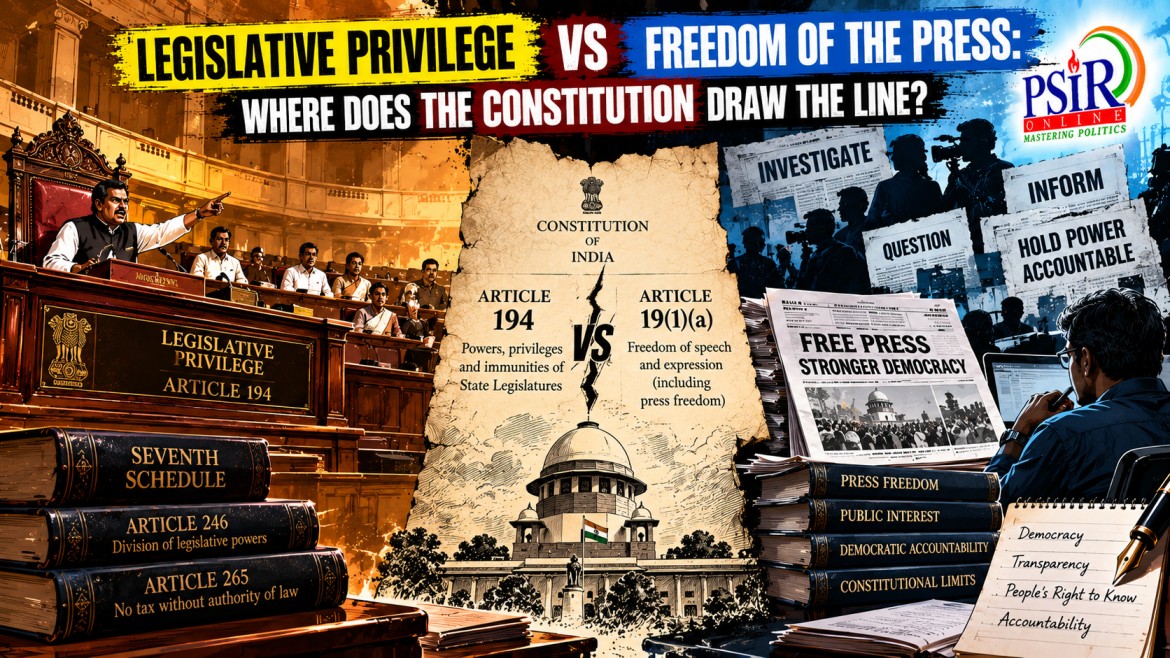
A legislature must be free to conduct its proceedings without intimidation, disruption or external interference. At the same time, a democratic legislature cannot be insulated from public scrutiny, criticism and independent reporting. The constitutional challenge is to protect legislative privilege without allowing it to become a mechanism for restricting freedom of speech and expression.
This tension returned to national attention when a seven-judge Bench of the Supreme Court, on 6 October 2026, disposed of the long-pending Tamil Nadu Assembly privilege proceedings as infructuous while keeping the substantial questions of law open for future adjudication. The Court did not deliver a final ruling on whether legislative privilege under Article 194 can prevail over the freedom guaranteed by Article 19(1)(a). The unresolved constitutional question remains significant: how can legislative autonomy coexist with democratic accountability and press freedom?
THE 2003 TAMIL NADU ASSEMBLY CONTROVERSY
The dispute originated in April 2003, when The Hindu published an editorial criticising the then Tamil Nadu government's conduct towards political opponents and the independent media. The editorial was reproduced in the DMK newspaper Murasoli. The Tamil Nadu Legislative Assembly treated the publications as a breach of its privileges and adopted a resolution imposing imprisonment on journalists associated with the publications.
The journalists approached the Supreme Court, challenging the action on constitutional grounds. The Court intervened at the time to protect them from arrest, and the matter eventually raised a broader question concerning the relationship between legislative privilege and fundamental rights.
The Assembly withdrew the controversial resolution in July 2004. However, the constitutional dispute remained before the courts because the underlying questions extended beyond the immediate controversy. In October 2026, the seven-judge Bench disposed of the proceedings as infructuous in view of the changed circumstances, while expressly leaving the questions of law open for consideration in an appropriate future case.
The distinction is crucial: the case was disposed of, but the constitutional controversy was not conclusively resolved. The order should not be treated as a declaration that legislative privilege always overrides press freedom, or that journalists are immune from all legitimate privilege proceedings.
ARTICLES 19(1)(a) AND 194: TWO CONSTITUTIONAL INTERESTS
Article 19(1)(a) guarantees citizens the right to freedom of speech and expression. Although the Constitution does not separately enumerate a fundamental right called “freedom of the press”, the Supreme Court has recognised press freedom as an essential component of this guarantee. It protects the ability to publish information, scrutinise public institutions and communicate matters of public importance.
Article 19(2), however, permits reasonable restrictions on this freedom on specified grounds. These include public order, defamation, contempt of court, security of the State and other constitutionally listed grounds. Legislative privilege is not independently listed as a ground under Article 19(2). This raises a difficult question about how a privilege-based action affecting publication should be assessed against fundamental rights.
Article 194 deals with the powers, privileges and immunities of State Legislatures and their members and committees. Article 194(1) protects freedom of speech in the Legislature, subject to the Constitution and the rules and standing orders regulating its procedure. Article 194(2) provides immunity for speech made or votes given in the Legislature and protects authorised publication of its reports, papers, votes or proceedings. Article 194(3) addresses other powers, privileges and immunities of the House, its members and committees, subject to the constitutional framework.
These provisions serve an institutional purpose. Legislators must be able to deliberate, investigate and perform their constitutional functions without improper obstruction. But privilege is not a personal entitlement to escape accountability. Its justification lies in the effective functioning of the House, not in shielding public authorities from criticism.
WHAT DOES THE JUDICIAL PRECEDENT SAY?
The principal historical precedent is M.S.M. Sharma v. Sri Krishna Sinha (1959), commonly known as the Searchlight case. The editor of the newspaper Searchlight faced privilege proceedings for publishing portions of a legislative speech that the Speaker had ordered to be expunged. The Supreme Court, by a majority, held that the relevant legislative privilege could prevail over the editor's Article 19(1)(a) claim in the circumstances before it.
The decision remains important because it treated Article 194(3) as a constitutional provision operating alongside Part III. It also exposed the difficulty of reconciling legislative privilege with fundamental rights. The ruling should be read in its historical and doctrinal context rather than treated as a complete answer to every later dispute involving journalists, publication and legislative criticism.
The Supreme Court's later jurisprudence has recognised that legislative privilege is not wholly beyond judicial scrutiny. In Raja Ram Pal v. Hon'ble Speaker, Lok Sabha (2007), the Court affirmed that parliamentary privileges are subject to judicial review where constitutional limits are implicated, while maintaining substantial restraint in relation to internal legislative functioning. Article 212 similarly protects State Legislature proceedings from being challenged in court merely on the ground of an alleged irregularity of procedure; it does not establish blanket immunity from every constitutional challenge.
The unresolved question in the Tamil Nadu proceedings was therefore not simply whether privilege exists. It concerned the scope of that privilege, its relationship with freedom of speech, and the extent to which courts can examine its exercise. Because the seven-judge Bench kept the questions of law open, the October 2026 disposal did not replace or finally settle the existing doctrinal framework.
LEGISLATIVE AUTONOMY, PUBLIC SCRUTINY AND THE PRESS
Legislative privilege has legitimate functions. It protects deliberation, enables committees to examine matters within their remit and allows the House to respond to genuine obstruction of its work. False or distorted accounts of proceedings, unauthorised disclosure of protected material and conduct that actually obstructs legislative functions may raise legitimate institutional concerns, depending on the applicable law and circumstances.
However, the use of privilege against critical reporting creates risks for democratic accountability. If criticism of the government or a legislature is treated as equivalent to contempt of the House, privilege proceedings may discourage investigative journalism and reduce the public's access to information. The danger is especially pronounced where the governing majority can influence the initiation or outcome of privilege proceedings against critics.
A principled approach must distinguish criticism of a legislature from conduct that genuinely obstructs its constitutional functions. Reporting on the conduct of elected representatives, questioning government decisions and publishing opinions about public policy are ordinary features of democratic discourse. A claim of privilege should not, by itself, settle whether the challenged publication was constitutionally protected or whether the action taken was legally justified.
Institutional safeguards can help preserve this distinction. Allegations should be clearly specified; the person concerned should receive a fair opportunity to respond; the House should identify the institutional interest that requires protection; and the response should be proportionate to the alleged breach. These safeguards do not eliminate legislative privilege. They help ensure that it remains connected to its constitutional purpose.
JUDICIAL REVIEW AND THE CONSTITUTIONAL BALANCE
The constitutional balance involves three principles. First, the legislature requires meaningful autonomy to discharge its functions. Second, citizens and the press must remain able to scrutinise elected institutions. Third, courts must respect the separation of powers while ensuring that constitutional boundaries are not treated as optional.
Judicial review should not turn courts into routine supervisors of legislative debate or procedure. Equally, legislative privilege cannot automatically answer every challenge involving personal liberty, fundamental rights or the limits of constitutional authority. The task is to distinguish protected internal functioning from alleged action that exceeds the scope of a privilege or violates a constitutional limitation.
A future authoritative ruling could clarify how courts should identify the purpose of a claimed privilege, assess its relationship with Article 19(1)(a), and determine the relevance of procedural fairness and proportionality. Until such a ruling is delivered, it would be inaccurate to claim that the October 2026 disposal has established a new test or conclusively settled the hierarchy between Articles 19 and 194.
The larger democratic principle is that institutional independence and public accountability are complementary, not mutually exclusive. A legislature is strengthened when it can function without obstruction and when its actions can be examined openly. Press freedom, in turn, does not remove the responsibility to report accurately or comply with valid legal restrictions.
UPSC DIMENSION
|
Constitutional provision or concept |
Significance |
|
Article 19(1)(a) |
Guarantees freedom of speech and expression, including press freedom as recognised by the Supreme Court. |
|
Article 19(2) |
Specifies the grounds on which reasonable restrictions on speech may be imposed; legislative privilege is not separately listed as a ground. |
|
Article 194(1) |
Protects freedom of speech within State Legislatures, subject to constitutional provisions and legislative rules. |
|
Article 194(2) |
Provides specified immunities relating to legislative speech, votes and authorised publication of proceedings. |
|
Article 194(3) |
Concerns other powers, privileges and immunities of State Legislatures, their members and committees. |
|
Article 212 |
Protects legislative proceedings against judicial challenge merely on the ground of an alleged procedural irregularity. |
|
M.S.M. Sharma v. Sri Krishna Sinha (1959) |
Foundational precedent concerning legislative privilege and freedom of the press. |
|
Raja Ram Pal v. Hon'ble Speaker, Lok Sabha (2007) |
Clarifies that legislative privilege does not eliminate judicial review of constitutional limits. |
|
Separation of powers |
Requires respect for legislative autonomy alongside judicial enforcement of constitutional boundaries. |
|
Democratic accountability |
Explains why public scrutiny and independent reporting remain essential to representative government. |
CONCLUSION
The Tamil Nadu Assembly privilege proceedings illustrate the continuing difficulty of balancing legislative autonomy with the freedom to scrutinise public institutions. The Supreme Court's October 2026 disposal ended the particular proceedings without resolving the substantial constitutional questions reserved for a future appropriate case.
Legislative privilege must protect the functioning of representative institutions, not create an unrestricted shield against criticism. Press freedom must enable robust public scrutiny while operating within valid constitutional and legal limits. The constitutional objective is therefore not the absolute supremacy of either institution, but a workable balance grounded in constitutional text, democratic accountability and judicial review.
RELATED READING
PRACTISE QUESTIONS FOR GS2 MAINS
PRACTISE QUESTIONS FOR PSIR
