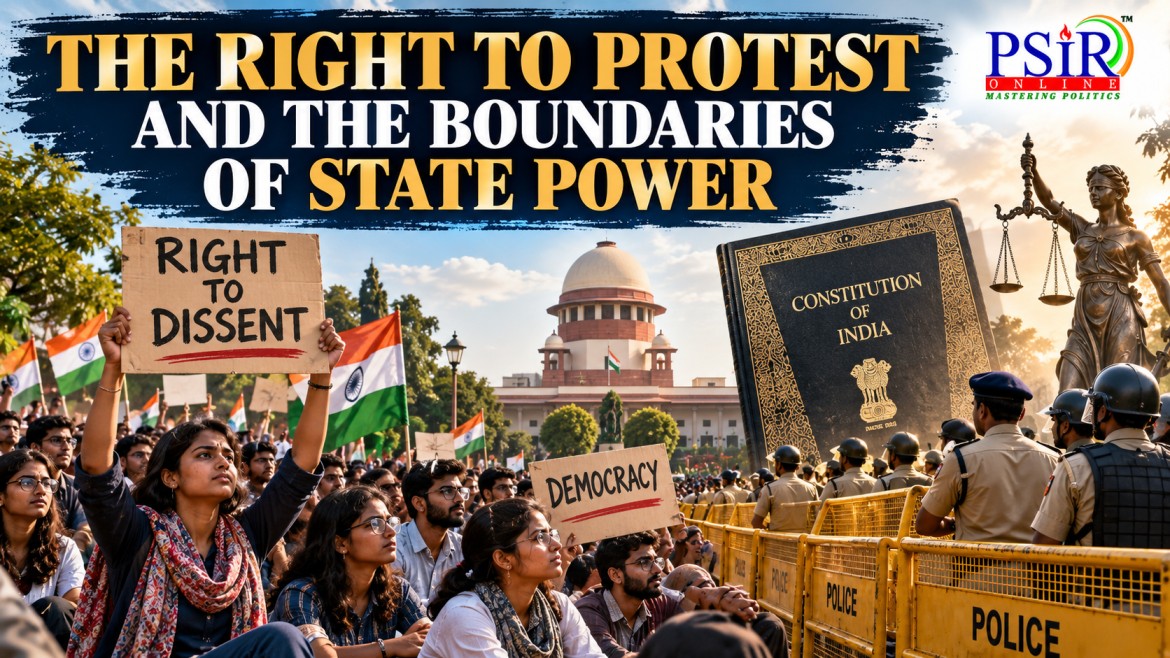
INTRODUCTION: DISSENT AS THE FOUNDATION OF DEMOCRATIC SOVEREIGNTY
In constitutional theory, democratic legitimacy does not begin and end with the ballot box. While periodic elections aggregate majority preferences to constitute a government, substantive democracy demands that citizens retain the unhindered capacity to interrogate authority, register collective grievances, and demand policy accountability between electoral cycles. As Jürgen Habermas underscores in his discourse theory of law, a political system preserves legitimacy only when supported by a communicative public sphere where popular contestation can freely emerge without state intimidation. In the Indian constitutional schema, this deliberative necessity is protected under Part III through Article 19(1)(a)—freedom of speech and expression—and Article 19(1)(b)—the fundamental right to assemble peaceably and without arms.
Yet, the spatial exercise of assembly inevitably encounters the coercive prerogatives of the state. Drawing on Max Weber’s formulation of the modern state as an institutional order commanding a monopoly over the legitimate use of physical force, administrative authorities are charged with preserving civic order, mitigating logistical chaos, and safeguarding public safety. When public order powers are deployed to silence political disagreement, the constitutional balance is compromised.
This dialectic became prominent during the July–August 2026 student demonstrations at Jantar Mantar and related venues following national competitive examination crises. When petitions challenged heavy-handed police actions and arbitrary detentions, the Supreme Court intervened, providing interim protection for detained students and restraining coercive measures while initiating scrutiny into police proportionality and crowd-control guidelines. The episode brings a core question of political theory to the fore: How can a constitutional republic maintain civic peace without subordinating citizens' fundamental right to dissent to bureaucratic convenience?
PUBLIC ORDER VERSUS CIVIL LIBERTIES: THE THEORETICAL DIALECTIC
The Indian Constitution does not grant the executive unlimited authority to prohibit collective mobilization. Under Articles 19(2) and 19(3), the state is restricted to imposing only "reasonable restrictions" on grounds such as public order, national sovereignty, and integrity. In practice, however, administrative machinery frequently displays an institutional preference toward de-politicization, treating ideological and social contestation as routine law-and-order disruptions.
In urban environments, this tension manifests as a contest over public space—a struggle that David Harvey and Henri Lefebvre characterize as disputes over "spatial justice" and the "right to the city". The Jantar Mantar litigation illustrates this divergence:
· The Expressive Imperative: Demonstrators seek symbolic, high-visibility urban spaces to make their claims legible to national institutions and political executives.
· The Commuter-Order Paradigm: Municipal and police authorities prioritize traffic circulation, safety protocols, and transit flow, citing judicial precedents such as Mazdoor Kisan Shakti Sangathan (MKSS) v. Union of India (2018) and Amit Sahni v. Commissioner of Police (2020).
To maintain an equilibrium between state administration and civic liberty, three theoretical principles are essential:
· Peaceful Dissent as Legitimate Discourse: Ideological critique of ruling authorities cannot be treated as an existential threat to public order. Drawing on Ronald Dworkin’s rights jurisprudence, fundamental freedoms function as "trumps" against administrative convenience; the state cannot invoke security measures simply to avoid political embarrassment.
· The Proportionality Benchmark: As articulated by Robert Alexy, any state intervention limiting a fundamental right must meet the fourfold test of proportionality: legitimate goal, rational nexus, necessity (the least restrictive measure), and suitability.
· Democratic Accountability of Police Power: The Weberian monopoly on force remains legitimate only when bounded by constitutional morality. The deployment of preventive detentions, barricades, or kinetic crowd-control must remain subject to statutory accountability and independent judicial scrutiny.
JUDICIAL OVERSIGHT AND DEMOCRATIC ACCOUNTABILITY
Judicial review provides an indispensable check when administrative authorities curtail civil mobilizations. By applying the doctrine of proportionality under Articles 14, 19, and 21, constitutional courts evaluate whether police powers were deployed in defense of genuine public safety or weaponized to suppress assembly.
In the 2026 Jantar Mantar proceedings, the Supreme Court's directives reaffirmed that operational crowd control must comply with the rule of law. By shielding student demonstrators from arbitrary arrests and demanding transparent crowd-control protocols, the Court recognized that maintaining public order does not grant immunity from fundamental rights review.
However, as Alexis de Tocqueville warned, formal judicial edicts cannot preserve a democratic culture if the administrative apparatus remains fundamentally paternalistic. Ensuring institutional accountability requires systemic administrative reforms:
· Institutionalizing clear, non-lethal crowd-control rules of engagement focused on conflict de-escalation.
· Enforcing visible identification badges on all law-enforcement personnel to remove institutional anonymity during public assemblies.
· Establishing accessible, independent police complaints mechanisms to address allegations of custodial misconduct and excessive force.
Governments must recognize that peaceful collective mobilization operates as a critical systemic safety valve. When regular administrative channels become unresponsive, street-level assemblies alert governance institutions to structural public grievances before they turn into wider crises.
PSIR THEORETICAL DIMENSION & EXAMINATION LINKAGES
|
PSIR Theoretical Dimension & Concepts |
How It Connects to Examination Answers (PSIR Paper 1 / Paper 2) |
|
Deliberative Democracy & the Public Sphere (Jürgen Habermas) |
Legitimacy Beyond the Ballot: Demonstrates how student occupations and extra-parliamentary sit-ins construct autonomous communicative counter-publics. Used to argue that democratic legitimacy requires ongoing public deliberation rather than periodic electoral plebiscites alone. |
|
Monopoly of Legitimate Violence & Statehood (Max Weber; Charles Tilly) |
The Boundaries of Sovereign Coercion: Applies Weber’s coercive monopoly to urban crowd policing. Shows that state force loses moral and democratic legitimacy when deployment transitions from maintaining public peace to suppressing peaceful ideological dissent. |
|
Rights as Trumps & Proportionality (Ronald Dworkin; Robert Alexy) |
Balancing Police Powers with Liberties: Provides the jurisprudential grounding to evaluate Article 19(2) and 19(3) restrictions. Argues that fundamental freedoms cannot be subordinated to administrative convenience unless the state satisfies the four-pronged proportionality test. |
|
Spatial Justice & the "Right to the City" (David Harvey; Henri Lefebvre) |
Contestation Over Public Commons: Explains the judicial and administrative friction surrounding designated protest sites (e.g., Jantar Mantar). Shows how urban transit corridors become contested spaces between citizens asserting political presence and the state prioritizing uninterrupted commerce. |
|
Constitutional Morality vs. Administrative Paternalism (B.R. Ambedkar) |
Subordinating Police Discretion to the Rule of Law: Connects court interventions against police excesses to Ambedkar's warning that administrative structures often retain colonial, authoritarian habits unless constrained by constitutional morality. |
|
Civil Disobedience & Satyagraha (M.K. Gandhi; Henry David Thoreau) |
Extra-Institutional Accountability: Grounds youth and civic demonstrations in the tradition of non-violent direct action, illustrating how peaceful sit-ins shift political conflict from physical confrontation to moral accountability. |
CONCLUSION: DISSENT AS THE CORE OF DEMOCRATIC VITALITY
The right to protest exists at the intersection of individual freedom, collective action, and state sovereignty. While the state has a legitimate duty to manage public spaces, transit corridors, and citizen safety, democratic governance loses its defining character when the pursuit of order extinguishes the right to disagree.
The Jantar Mantar controversy demonstrates why regulating public assemblies requires transparent statutory standards, institutionalized policing restraint, and consistent judicial oversight. "Reasonable restrictions" are intended to balance the exercise of rights across a plural society, not to dissolve the right of assembly itself. Ultimately, the maturity of a constitutional democracy is measured not by how swiftly it silences public dissent, but by its institutional capacity to protect peaceful disagreement as an essential element of popular sovereignty.
RELATED READING SEGMENT: CONCEPTS, CONSTITUTIONAL PROVISIONS & STATUTES
· Constitutional Architecture:
o Articles 19(1)(a) & 19(1)(b): Guarantees of speech, expression, and peaceful assembly without arms.
o Articles 19(2) & 19(3): Grounds for reasonable restrictions—sovereignty and integrity of India, security of the State, public order, and morality.
o Article 21: The right to life and personal liberty, which encompasses procedural fairness and bodily security against excessive custodial or police force.
· Key Judicial Reference Points:
o Himmat Lal K. Shah v. Commissioner of Police (1973): Affirmed that citizens hold a fundamental right to conduct peaceful public processions on public streets, subject to regulation but not arbitrary executive bans.
o Anita Thakur v. Government of J&K (2016): Recognized that peaceful protest is a constitutional right, holding that while police maintain the power to manage crowds, the use of force must be strictly necessary, graduated, and proportionate.
o Mazdoor Kisan Shakti Sangathan (MKSS) v. Union of India (2018): Addressed the spatial regulation of Jantar Mantar, ordering balanced guidelines that safeguard the right to demonstrate while mitigating civic disruption.
o Amit Sahni v. Commissioner of Police (2020): Held that public roadways cannot be blocked indefinitely, mandating that protests occur within designated areas.
· Statutory Frameworks:
o Bharatiya Nagarik Suraksha Sanhita, 2023 (BNSS) — Section 163 (formerly CrPC Section 144): Powers of executive magistrates to issue prohibitory assembly orders in urgent cases of nuisance or danger.
o UN Basic Principles on the Use of Force and Firearms by Law Enforcement Officials: International standards requiring necessity, proportionality, and non-discriminatory restraint in policing assemblies.
PRACTICE QUESTIONS FOR PSIR
