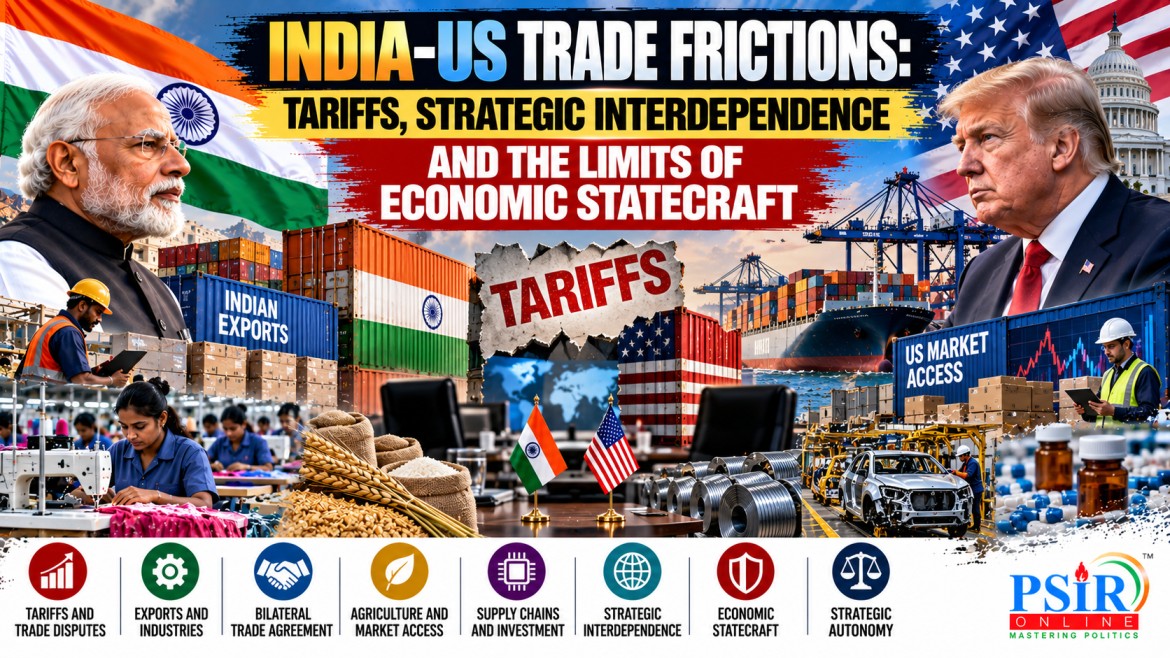
India–US relations combine expanding defence cooperation, technological partnerships and shared concerns about the Indo-Pacific with persistent disagreements over market access, tariffs and economic sovereignty. The negotiations for a Bilateral Trade Agreement (BTA) have become a test of whether strategic convergence can withstand increasingly coercive trade policies.
In August 2026, both governments continued to express their commitment to the trade framework agreed earlier in the year, even as US tariff measures and the threat of additional duties complicated negotiations. By October, talks had stalled again, exposing the fragility of the negotiating process. The central question is no longer simply whether India and the United States can expand bilateral trade, but whether they can do so without allowing economic pressure to undermine the wider strategic partnership.
FROM TRADE NEGOTIATIONS TO TARIFF UNCERTAINTY: THE RECENT TRAJECTORY
India and the United States have sought to expand bilateral trade and address long-standing disagreements over tariffs, agricultural market access, non-tariff barriers and regulatory practices. The BTA negotiations gained momentum as both governments pursued a broader economic partnership.
On 7 February 2026, the two countries announced a framework for an interim agreement on reciprocal and mutually beneficial trade, reaffirming their commitment to the wider BTA. Negotiations subsequently covered market access, customs and trade facilitation, technical barriers, investment promotion, digital trade and economic-security alignment.
The process, however, encountered renewed uncertainty as Washington introduced additional tariff measures and linked trade discussions to concerns about forced labour, industrial capacity and India’s purchases of Russian oil.
Timeline of the trade dispute
|
Date |
Development |
Significance |
|
7 February 2026 |
India and the United States announced a framework for an interim trade agreement. |
Established a basis for further negotiations under the broader BTA. |
|
20–23 April 2026 |
Indian and US officials held negotiations in Washington. |
Discussions covered market access, non-tariff measures, digital trade, investment and economic security. |
|
1–4 June 2026 |
A US delegation visited India for further BTA negotiations. |
Both sides continued working towards an interim agreement and broader trade settlement. |
|
23–25 July 2026 |
The United States finalised additional 10% duties under its Section 301 forced-labour measures, with exemptions for specified products. |
Introduced further tariff costs and uncertainty for a substantial share of Indian exports. |
|
August 2026 |
India and the United States remained in contact and reiterated their commitment to the February framework. |
Demonstrated that negotiations continued despite disagreement over tariffs and market access. |
|
6 October 2026 |
Reuters reported that negotiations had stalled again, with no imminent agreement in sight. |
Highlighted unresolved disputes over tariff treatment, Russian oil and additional US trade investigations. |
The trajectory demonstrates that the BTA is not merely a technical exercise in reducing tariffs. It has become a negotiation over market access, domestic policy autonomy and the use of trade restrictions to secure strategic concessions.
TARIFFS AS ECONOMIC STATECRAFT
Economic statecraft refers to the use of economic instruments—including tariffs, sanctions, investment restrictions, export controls and access to markets—to influence the behaviour of other states. In the India–US relationship, tariffs have become an important instrument of bargaining.
Washington argues that its trade measures address concerns involving market access, domestic industrial competitiveness, forced labour and economic security. India, meanwhile, has sought predictable tariff treatment and has defended the need to protect sensitive sectors, including agriculture and certain industrial activities.
The July 2026 measures illustrate the practical consequences. Following a US investigation under Section 301 of the Trade Act of 1974, the United States announced an additional 10% duty on imports from India under its forced-labour measures. The Indian government stated that approximately 45% of exports to the US remained outside the additional duty because of product exemptions, while the remaining 55% would be subject to it. Products already covered by specified Section 232 measures, including steel, aluminium and auto parts, were excluded from this additional duty, although their existing sectoral duties could continue to apply.
|
Trade issue |
Implication for India |
|
Additional US tariffs |
Increase costs for affected exporters and may reduce price competitiveness. |
|
Product exemptions |
Protect selected sectors but create uneven effects across export industries. |
|
Tariff uncertainty |
Makes long-term contracts, investment planning and production decisions more difficult. |
|
Potential additional duties linked to Russian oil purchases |
Connects commercial access to India’s energy and foreign-policy decisions. |
|
Section 301 investigations |
Introduce further uncertainty over the future tariff treatment of Indian exports. |
The October developments added another layer of risk. Reuters reported that a new US legislative measure could enable tariffs of up to 100% on Indian goods in connection with India’s continued purchases of Russian oil. This should be distinguished from an already implemented universal tariff: the reported measure represented a potential additional source of pressure, while the broader trade dispute and the pending Section 301 investigation remained unresolved.
The strategic significance is clear. Tariffs are functioning not only as instruments of trade policy but also as leverage in wider negotiations over energy, industrial policy and international alignment.
STRATEGIC INTERDEPENDENCE: WHY NEITHER SIDE CAN TREAT TRADE IN ISOLATION
India and the United States are connected through trade, investment, technology, services, defence production and supply-chain cooperation. Their relationship has expanded beyond conventional merchandise trade into areas such as semiconductors, digital services, critical technologies, pharmaceuticals and aerospace.
The United States is a major market for Indian exporters, while India offers US businesses a large consumer market, skilled professionals and opportunities to diversify production. Both countries also have an interest in resilient supply chains and in reducing excessive dependence on concentrated sources of critical goods.
Recent trade figures demonstrate the scale of this relationship. Reuters reported that Indian exports to the United States reached US$42.79 billion during April–August 2026. It also reported a US$34 billion Indian trade surplus for the 2025–26 financial year. These figures underline the importance of the American market, particularly for export-oriented industries.
The relationship is nevertheless asymmetric in certain respects. Indian exporters may be more exposed to changes in US tariff treatment because access to the American market is commercially important to them. Conversely, US firms have interests in India’s expanding consumer economy, technology sector and manufacturing base. This creates mutual dependence, but not necessarily equal bargaining power.
The distinction matters because interdependence does not eliminate coercion. A state that controls access to a valuable market can use that access as leverage, particularly when its trading partner depends heavily on exports to that destination. India’s challenge is to preserve the benefits of economic cooperation while reducing vulnerabilities that arise from excessive concentration.
DOMESTIC ECONOMIC INTERESTS AND THE LIMITS OF CONCESSIONS
The BTA negotiations involve competing domestic priorities in both countries. For India, the challenge is to expand exports and attract investment without exposing vulnerable sectors to sudden competition or compromising essential policy objectives.
Agriculture and dairy remain particularly sensitive because changes in import access can affect farmers, rural livelihoods and domestic production systems. India also has concerns about the treatment of generic pharmaceuticals, textiles, engineering goods and other export sectors. For US negotiators, market access, tariff reduction, regulatory practices and the treatment of American products remain important issues.
The Parliamentary Standing Committee on Commerce examined India–US trade relations in a report presented on 6 August 2026. Its recommendations included concluding the BTA while protecting India’s interests, strengthening export infrastructure, improving competitiveness and seeking appropriate protection for key exports.
This domestic dimension makes a rapid agreement difficult. Tariff concessions may benefit some exporters and consumers while placing adjustment pressures on other producers. The political acceptability of a trade agreement therefore depends on how its benefits and costs are distributed.
A sustainable agreement needs to balance three objectives:
· Export competitiveness: predictable access to the US market for Indian firms.
· Domestic policy space: sufficient flexibility to protect sensitive sectors and pursue legitimate developmental priorities.
· Reciprocal benefits: commercially meaningful opportunities for both countries rather than concessions concentrated in a limited set of sectors.
India must also recognise that tariff relief alone cannot resolve deeper competitiveness problems. Logistics, infrastructure, product standards, productivity, access to finance and the ability of firms to scale production influence whether Indian businesses can benefit from trade preferences.
STRATEGIC AUTONOMY, RUSSIAN OIL AND THE WIDER GEOPOLITICAL BARGAIN
The trade dispute illustrates the growing intersection between economic policy and geopolitical alignment. Washington’s concerns about India’s purchases of Russian oil have linked trade negotiations to the wider debate over sanctions, energy security and the international response to the Russia–Ukraine war.
For India, Russian oil purchases have been connected to energy costs, supply availability and the broader objective of maintaining diversified external relationships. New Delhi has defended its right to make decisions based on national interests, while the United States has used economic pressure and the prospect of further tariffs to pursue its objectives.
This creates a challenge for strategic autonomy, understood as the capacity to make independent foreign-policy decisions while cooperating with different powers where interests converge. Strategic autonomy does not mean avoiding all compromise; nor does it require rejecting trade agreements. It means evaluating concessions against their economic costs, strategic consequences and long-term implications.
The dispute also reveals the limits of assuming that defence and security cooperation will automatically produce favourable economic treatment. India and the United States can share concerns about China and cooperate in the Indo-Pacific while disagreeing over energy purchases, agricultural access and tariffs.
The relationship therefore operates on several tracks simultaneously: strategic cooperation, economic competition and diplomatic bargaining. Treating it as a simple partnership between like-minded democracies obscures the importance of these material disagreements.
THE WAY FORWARD: NEGOTIATING WITHOUT SURRENDERING POLICY SPACE
India’s response should combine sustained negotiations with domestic economic adjustment and wider trade diversification. A breakdown in talks could impose costs on exporters and weaken commercial confidence, but an agreement that leaves major tariff uncertainties unresolved may provide limited long-term security.
|
Policy priority |
Practical direction |
|
Tariff predictability |
Seek clear and durable tariff commitments, transparent exemptions and mechanisms to manage future changes. |
|
Sensitive sectors |
Protect legitimate agricultural and dairy concerns while exploring calibrated market access where mutually beneficial. |
|
Export competitiveness |
Strengthen logistics, standards compliance, export finance and manufacturing productivity. |
|
Trade diversification |
Expand access to other markets and deepen existing trade agreements to reduce excessive dependence on a single destination. |
|
Investment and technology |
Pursue cooperation in semiconductors, digital technologies, pharmaceuticals and advanced manufacturing. |
|
Dispute management |
Establish consultation and review mechanisms to address disagreements before they trigger fresh tariff escalation. |
|
Strategic autonomy |
Keep commercial negotiations connected to, but not automatically subordinated to, wider geopolitical bargaining. |
India should also assess the implications of US tariff measures through sector-specific evidence rather than relying on aggregate trade figures alone. The effects on textiles, engineering goods, pharmaceuticals, electronics and smaller exporters may differ considerably. Targeted support and adjustment policies can help firms respond without turning the trade dispute into a permanent justification for protectionism.
Ultimately, the objective should be an agreement that improves market access while providing predictability and preserving legitimate policy space. Negotiations are most likely to produce durable results when both sides see tangible benefits in cooperation and understand the costs of prolonged uncertainty.
THEORETICAL ANGLES
|
Theory or concept |
Application to India–US trade frictions |
|
Economic Statecraft |
Explains how tariffs and market access can be used as instruments of diplomatic and geopolitical leverage. |
|
Complex Interdependence |
Highlights the multiple connections between trade, investment, technology, services and security, while showing that interdependence does not eliminate unequal bargaining power. |
|
Realism |
Explains how states use economic instruments to protect national interests, improve bargaining positions and pursue strategic objectives. |
|
Liberal Institutionalism |
Emphasises the role of negotiated rules, trade agreements and dispute-settlement mechanisms in managing conflict and reducing uncertainty. |
|
Strategic Autonomy |
Explains India’s effort to preserve independent decisions on energy, trade and foreign policy while cooperating with the United States. |
|
Asymmetric Interdependence |
Shows how unequal dependence on markets and supply chains can create leverage for one partner over another. |
|
Domestic Politics and Foreign Policy |
Explains why agricultural interests, exporters, industrial groups and political constituencies shape the concessions governments can make in trade negotiations. |
CONCLUSION
India–US trade frictions demonstrate that strategic interdependence can coexist with economic coercion. Tariffs have become instruments of bargaining over market access, domestic regulation and geopolitical choices, exposing the limits of assuming that security convergence will guarantee economic accommodation.
For India, the challenge is to protect exporters, sustain technological and strategic cooperation, and preserve the capacity to make independent decisions on energy and foreign policy. For the United States, the durability of its economic partnership with India depends partly on whether trade pressure produces negotiated cooperation or prolonged uncertainty. The future of the BTA will test whether economic statecraft can advance bilateral interests without eroding the strategic trust on which the wider partnership depends.
RELATED READING
PRACTISE QUESTIONS FOR GS2 MAINS
PRACTISE QUESTIONS FOR PSIR
