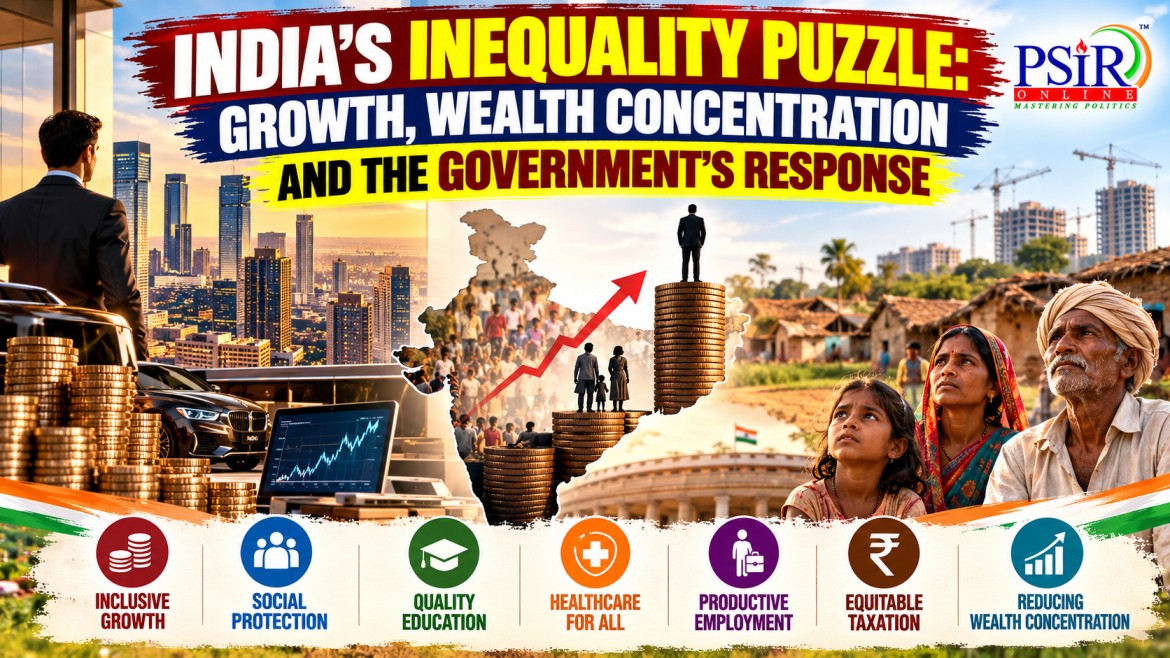
India's economic transformation since 1991 has produced two realities. On the one hand, economic growth has expanded incomes, reduced extreme poverty and improved access to banking, basic services and social protection. The World Bank estimates that India's extreme-poverty rate fell from 16.2% in 2011–12 to 2.3% in 2022–23 under its updated international poverty methodology.
On the other hand, the distribution of the gains from growth remains highly unequal. The World Inequality Report 2026 estimates that India's top 10% receive 57.7% of national income, while the bottom 50% receive only 15%. The concentration is even sharper for wealth: the top 10% own around 65% of total wealth, while the bottom half own only 6.4%; the top 1% alone account for about 40.1% of wealth. This creates what may be called India's inequality puzzle:
A society can become substantially less poor without becoming substantially more equal. India's policy challenge, therefore, is no longer only to reduce deprivation at the bottom. It is also to ensure that the benefits of economic growth generate broader access to income, assets, quality education, healthcare, productive employment and economic opportunity.
WHAT IS ECONOMIC INEQUALITY?
Economic inequality refers to the unequal distribution of economic resources and opportunities among individuals or households.
It has several dimensions:
|
Type |
What it measures |
|
Income inequality |
Difference in earnings and other income received by individuals or households, including wages, profits, rents and transfers. |
|
Wealth inequality |
Difference in ownership of accumulated assets such as land, housing, businesses, shares and financial assets, after accounting for debt. |
|
Consumption inequality |
Difference in household expenditure on goods and services. It is commonly used in household consumption surveys. |
|
Opportunity inequality |
Unequal access to education, healthcare, credit, employment, technology and other capabilities that influence future income. |
|
Inter-generational inequality |
The extent to which economic advantage or disadvantage is transmitted from parents to children through assets, education, networks and social position. |
Why income and wealth must be separated? Because, Income is a flow and wealth is a stock. A person's salary is income received during a period. A house, landholding, business or portfolio of shares represents accumulated wealth. Wealth can generate further income through rent, interest, dividends, capital gains and business profits. It can also be inherited. Therefore: Income inequality can reproduce wealth inequality, while wealth inequality can in turn reproduce income inequality. This is why wealth concentration is particularly important when examining long-term economic inequality.
INDIA'S INEQUALITY PUZZLE: TWO SETS OF NUMBERS
World Inequality Report 2026
|
Group |
Share of India's total |
|
Bottom 50% – income |
15.0% |
|
Middle 40% – income |
27.3% |
|
Top 10% – income |
57.7% |
|
Top 1% – income |
22.6% |
|
Bottom 50% – wealth |
6.4% |
|
Middle 40% – wealth |
28.6% |
|
Top 10% – wealth |
65.0% |
|
Top 1% – wealth |
40.1% |
These estimates show that wealth is substantially more concentrated than income. The World Inequality Lab also estimates India's female labour-income share at only 15.7%, highlighting the gender dimension of economic inequality.
But official consumption data tells another story. MoSPI's Household Consumption Expenditure Survey (HCES) 2023–24 shows a decline in consumption inequality.
|
Gini coefficient |
2011 –12 |
2022 –23 |
2023 –24 |
|
Rural India |
0.283 |
0.266 |
0.237 |
|
Urban India |
0.363 |
0.314 |
0.284 |
The Economic Survey 2025–26 also notes this decline in consumption inequality and attributes part of the improvement to rising consumption expenditure among lower-income groups and social-sector interventions. Hence, according to data sets above, India is facing reduced consumption inequality, but wealth inequality is still large.
|
Consumption inequality |
Income/wealth inequality |
|
Measures differences in household spending |
Measures distribution of income and accumulated assets |
|
Captures current consumption capacity |
Captures earnings and ownership |
|
Can improve through transfers and public services |
Can remain high even when poverty falls |
|
HCES is the principal source |
World Inequality Lab uses income, tax and national-account based methods |
|
Shows significant recent improvement |
Shows high concentration at the top |
Hence, India can simultaneously experience falling consumption inequality and persistent concentration of income and wealth. The World Bank itself notes that consumption-based inequality can understate inequality because of data limitations, while its assessment also recognises persistent labour-market and access disparities.
POVERTY IS NOT THE SAME AS INEQUALITY
Poverty and inequality might look like two sides of the same coin, but they are not equal.
|
Poverty |
Inequality |
|
Asks whether people have sufficient resources to meet basic needs |
Asks how resources are distributed across society |
|
Focuses on deprivation |
Focuses on relative distribution |
|
Can decline even when inequality remains high |
Can increase even when poverty falls |
|
Government transfers and basic services can substantially reduce it |
Requires broader changes in opportunities, income distribution and asset ownership |
|
Example: fewer people living below an extreme-poverty threshold |
Example: top 10% receiving a disproportionately large share of income |
India's experience demonstrates this distinction clearly. The reduction in extreme poverty is a major development achievement. But it does not automatically imply a reduction in concentration at the top.
HOW DOES ECONOMIC INEQUALITY GET REPRODUCED?
Economic inequality does not arise from one factor. It is produced through the interaction of assets, education, employment, technology, social identity, geography and public policy.
|
Driver |
How it reproduces inequality |
|
Unequal asset ownership |
Ownership of land, businesses, housing and financial assets allows wealthier households to earn additional income and accumulate further wealth. |
|
Unequal access to quality education |
Higher-income households can more easily access high-quality schooling, coaching and higher education, improving future earnings. |
|
Labour-market segmentation |
Formal, skilled and secure employment provides higher wages and social protection, while informal workers often face lower earnings and greater insecurity. |
|
Skill-biased technological change |
New technologies can raise returns to advanced skills while reducing opportunities for workers with fewer skills. |
|
Low female economic participation |
When women have limited access to paid employment and productive assets, household and national income potential remains underutilised. |
|
Caste and social disadvantage |
Historical exclusion can affect education, occupational mobility, access to credit, assets and formal employment. |
|
Regional disparities |
Differences in state capacity, infrastructure, human capital and employment opportunities produce unequal economic outcomes across regions. |
|
Inheritance |
Assets, businesses, education and social networks can pass from one generation to the next, reproducing economic advantage. |
|
Unequal access to capital |
Entrepreneurs with collateral, networks and formal financial access can accumulate productive assets more easily than poorer households. |
THE POST-1991 QUESTION: DID LIBERALISATION INCREASE INEQUALITY?
India's 1991 reforms liberalised trade and investment, reduced many controls on private enterprise and integrated the economy more closely with global markets. The reforms contributed to higher economic growth and structural transformation. But the distribution of these gains was uneven.
Research by the World Inequality Lab finds that India's top 1% income share, after declining substantially in the post-Independence decades, rose sharply from the 1980s onward and reached 23.3% in 2022–23, the highest level in their historical series. Hence, Liberalisation changed the structure of economic opportunity, but the distribution of its gains depended heavily on access to capital, skills, formal employment, education and productive assets. Thus, sectors such as finance, technology, corporate services, real estate and high-skilled services generated substantial returns for those already positioned to benefit, while a large workforce remained concentrated in informal and relatively low-productivity employment.
GOVERNMENT'S RESPONSE: FROM POVERTY REDUCTION TO INCLUSIVE GROWTH
India does not have one single “inequality reduction programme”. Instead, the government uses a combination of:
|
Income Support |
Food Security |
Employment Guarantees |
|
Healthcare |
Financial Inclusion |
Social Security
|
|
Rural Livelihoods |
Skill Development |
Affirmative Action |
|
Education
|
Housing
|
Progressive Taxation |
The Economic Survey 2025–26 explicitly frames policies such as income support, social protection, labour-market regulation and education as instruments for reducing inequality of opportunity and enabling upward social mobility.
Major policy instruments
|
Government measure |
How it addresses inequality |
|
Public Distribution System / NFSA |
Reduces the effective cost of food for vulnerable households and protects real consumption. |
|
MGNREGA / VB-G RAM G |
Provides statutory rural wage employment and acts as an income and employment safety net. |
|
PM-KISAN |
Provides ₹6,000 annually to eligible farmer families, supporting farm-income security. |
|
PM Jan Dhan Yojana |
Expands access to formal bank accounts and enables direct transfer of government benefits. |
|
Direct Benefit Transfer |
Transfers eligible benefits directly into bank accounts, reducing dependence on intermediaries. |
|
Ayushman Bharat |
Reduces the financial burden associated with eligible hospitalisation and seeks to improve access to healthcare. |
|
PMAY |
Supports access to housing and creates an important household asset for poorer families. |
|
DAY-NRLM |
Builds women's self-help groups, savings, credit access and livelihood opportunities in rural areas. |
|
Social-security schemes |
Provide targeted insurance and pension protection to vulnerable and low-income groups. |
|
Skill development programmes |
Seek to improve employability and move workers towards higher-productivity employment. |
|
Financial inclusion and credit schemes |
Expand access to formal credit and productive capital for groups traditionally excluded from formal finance. |
|
Reservations and targeted educational support |
Address historical social disadvantage and improve access to education and public employment. |
These interventions mainly reduce deprivation and inequality of opportunity. They do not necessarily redistribute accumulated private wealth at the top.
THE LIMIT OF THE EXISTING APPROACH
India has built a large social-protection architecture, but most interventions are designed to raise the floor rather than alter the distribution of assets at the top. The distinction can be summarised as:
|
Raising the floor |
Reducing concentration at the top |
|
Food subsidies |
Wealth taxation |
|
Employment support |
Stronger taxation of high incomes/capital |
|
Cash transfers |
Inheritance/estate taxation |
|
Free or subsidised healthcare |
Greater taxation of economic rents |
|
Scholarships |
Broader asset ownership |
|
Housing support |
Land and asset redistribution |
|
Financial inclusion |
Wider ownership of productive capital |
|
Skill development |
Stronger bargaining power and labour institutions |
India's contemporary policy framework has largely emphasised the left side of this table. That does not make these policies unimportant. On the contrary, poverty reduction, food security, employment support, education and healthcare can substantially improve living standards and capabilities. But they address a different question from the concentration of wealth.
WHAT SHOULD INDIA DO?
The policy response to inequality should therefore combine growth, redistribution and capability creation.
1. Make growth employment-intensive: India needs greater expansion of productive employment in manufacturing, labour-intensive services and modern agriculture rather than relying disproportionately on low-productivity informal work.
2. Improve the quality of public services: Education and healthcare are powerful equalising institutions because they reduce the extent to which a family's economic position determines a child's future.
3. Strengthen women's economic participation: Reducing gender gaps in employment, wages, skills, asset ownership, childcare and safe mobility is essential to broadening household and national income.
4. Expand access to productive assets: Credit alone is insufficient. Poor households need access to land, housing, skills, technology, markets and productive capital.
5. Make taxation more equitable: A progressive tax system should ensure that those with greater ability to pay contribute appropriately, while maintaining incentives for productive investment and entrepreneurship.
6. Strengthen labour institutions: Higher productivity must translate into better wages and greater social security rather than creating a widening gap between high-skilled formal workers and insecure informal workers.
7. Address regional inequality: States with weaker fiscal and institutional capacity require stronger equalisation mechanisms so that access to basic public services does not depend excessively on one's place of residence.
8. Measure inequality better: India needs continued improvement in the measurement of income, wealth, assets and labour-market outcomes, because consumption expenditure alone cannot provide a complete picture of economic concentration.
UPSC DIMENSION: ECONOMIC INEQUALITY AS A CONSTITUTIONAL QUESTION
|
Constitutional / Conceptual Dimension |
How Economic Inequality Connects to It |
|
Article 14 – Equality before law and equal protection of laws |
Economic inequality can translate into unequal access to opportunities. Article 14 therefore supports a constitutional framework in which similarly placed persons receive equal protection while reasonable classification and affirmative measures can address substantive disadvantage. |
|
Article 15(1) & 15(4)/(5) – Equality and affirmative action |
Formal equality alone cannot overcome historically entrenched social and educational disadvantages. Articles 15(4) and 15(5) enable special provisions for socially and educationally backward classes, SCs and STs, making substantive equality an important response to unequal starting positions. |
|
Article 16 – Equality of opportunity in public employment |
Economic and social disadvantage can restrict access to education, skills and competitive opportunities long before recruitment takes place. Reservation and other enabling measures under Article 16 seek to ensure that historically disadvantaged groups have meaningful access to public employment. |
|
Article 21 – Life with dignity, livelihood and basic conditions of existence |
The Supreme Court has interpreted Article 21 beyond mere physical survival to encompass dimensions of a dignified life. In Olga Tellis, the Court recognised livelihood as an important facet of the right to life; the Court has also recognised health as an aspect of Article 21. Thus, extreme economic deprivation can affect the substantive ability to enjoy constitutional life and dignity. |
|
Article 21A – Right to education |
Education is one of the strongest long-term equalising mechanisms. By guaranteeing free and compulsory education for children aged 6–14, Article 21A reduces the extent to which family income determines basic educational opportunity. However, broader inequalities in school quality, higher education and skills remain relevant to economic mobility. |
|
Article 38(1) – Social order based on justice |
Article 38 directs the State to promote a social order in which social, economic and political justice informs national life. Economic inequality is therefore not merely an economic-policy concern; reducing unjust disparities is part of the constitutional vision of the social order. |
|
Article 38(2) – Minimising inequalities |
This is the Constitution's most explicit provision on inequality. The State must strive to minimise inequalities in income and eliminate inequalities in status, facilities and opportunities among individuals and groups, including across different regions and occupations. |
|
Article 39(a) – Adequate means of livelihood |
Economic justice requires citizens, both men and women, to have adequate means of livelihood. Employment generation, skill development, rural employment programmes and livelihood support therefore have a direct constitutional connection. |
|
Article 39(b) – Distribution of material resources |
The Constitution directs the State towards distribution of the material resources of the community in a manner that serves the common good. This gives constitutional significance to policies concerning access to productive resources and the distribution of economic opportunities. |
|
Article 39(c) – Prevention of concentration of wealth |
This is particularly relevant to India's wealth-concentration debate. The Constitution directs the State to ensure that the economic system does not result in the concentration of wealth and means of production to the common detriment. It provides a constitutional basis for examining taxation, regulation, competition and distribution of productive assets. |
|
Article 39(d) – Equal pay for equal work |
Economic inequality has a strong labour-market dimension. Equal-pay principles seek to prevent gender-based wage discrimination and connect economic justice with equality in the workplace. |
|
Article 41 – Right to work, education and public assistance |
Within the limits of economic capacity and development, the State is directed to make effective provision for work, education and public assistance in cases such as unemployment, old age, sickness and disablement. This provides a constitutional foundation for social-security and employment-support measures. |
|
Article 43 – Living wage and decent conditions of work |
Economic equality cannot be achieved merely through transfers. Article 43 directs the State towards securing a living wage, decent conditions of work and a decent standard of life for workers. It therefore connects inequality with the quality and remuneration of employment. |
|
Article 46 – Protection of weaker sections |
The State is specifically directed to promote the educational and economic interests of weaker sections, particularly SCs and STs, and protect them from social injustice and exploitation. Targeted scholarships, reservations, economic empowerment and social-protection measures reflect this constitutional commitment. |
|
Article 47 – Nutrition, standard of living and public health |
Inequality is not only about income. Poor nutrition, inadequate healthcare and weak living conditions reduce human capabilities. Article 47 therefore connects redistribution and public expenditure with the broader objective of improving the standard of living and public health. |
|
Preamble – Justice, Equality and Fraternity |
Economic inequality has constitutional significance because the Preamble promises social and economic justice and equality of status and opportunity. Persistent deprivation can therefore be examined not merely as a development gap but as a challenge to the constitutional vision of an egalitarian democratic society. |
|
Substantive equality |
The Constitution does not treat equality as simply giving everyone identical treatment. Where historical and structural disadvantages produce unequal starting points, targeted interventions can be used to create more meaningful equality of opportunity. This explains the constitutional logic behind reservations, scholarships, social protection and targeted welfare. |
|
Social and economic democracy |
Political democracy cannot be fully meaningful when severe economic and social disadvantages prevent citizens from exercising real opportunities. India's constitutional framework therefore seeks to combine political democracy with social and economic justice through Fundamental Rights and Directive Principles. |
CONCLUSION
India's inequality debate should not be reduced to the question of whether the country is becoming more or less equal. The evidence points to a more complex reality.
Extreme poverty has fallen sharply. Consumption inequality has declined in recent surveys. Yet income and wealth remain highly concentrated at the top.
The challenge, therefore, is to move from poverty reduction to broader economic inclusion. India needs growth that creates productive employment, public services that equalise capabilities, social protection that prevents households from falling back into deprivation, and a fiscal system that ensures the gains of economic expansion are broadly shared.
The objective of economic policy should not merely be to lift people above poverty, but to widen their capacity to participate in the creation and ownership of India's prosperity.
RELATED READING
· Poverty versus inequality
· Income inequality versus wealth inequality
· Gini coefficient and Lorenz curve
· Absolute poverty and relative poverty
· Inclusive growth
· Inequality of opportunity
· Capability approach — Amartya Sen
· Human development and social mobility
· Post-1991 economic reforms
· Informalisation of labour
· Female labour-force participation
· Caste and economic inequality
· Regional inequality in India
· Inter-generational mobility
· Progressive taxation and redistribution
· Public expenditure on education and health
· Social protection and welfare state
· Financial inclusion
· Employment-intensive growth
· Fiscal federalism and regional disparities
· HCES 2023–24
· World Inequality Report 2026
· Economic Survey 2025–26
GS2 MAINS PRACTICE QUESTIONS
1. “Poverty reduction and reduction of economic inequality are related but distinct policy objectives.” Explain with reference to India. 10 Marks | 150 Words
2. Distinguish between income inequality, wealth inequality and consumption inequality. Why is the distinction important for understanding inequality in India? 10 Marks | 150 Words
3. “India has succeeded more in raising the economic floor than in reducing concentration at the economic summit.” Critically examine the statement with reference to recent government policies. 15 Marks | 250 Words
4. Economic growth alone cannot ensure inclusive development. Discuss the major policy measures required to reduce persistent economic inequality in India. 15 Marks | 250 Words
