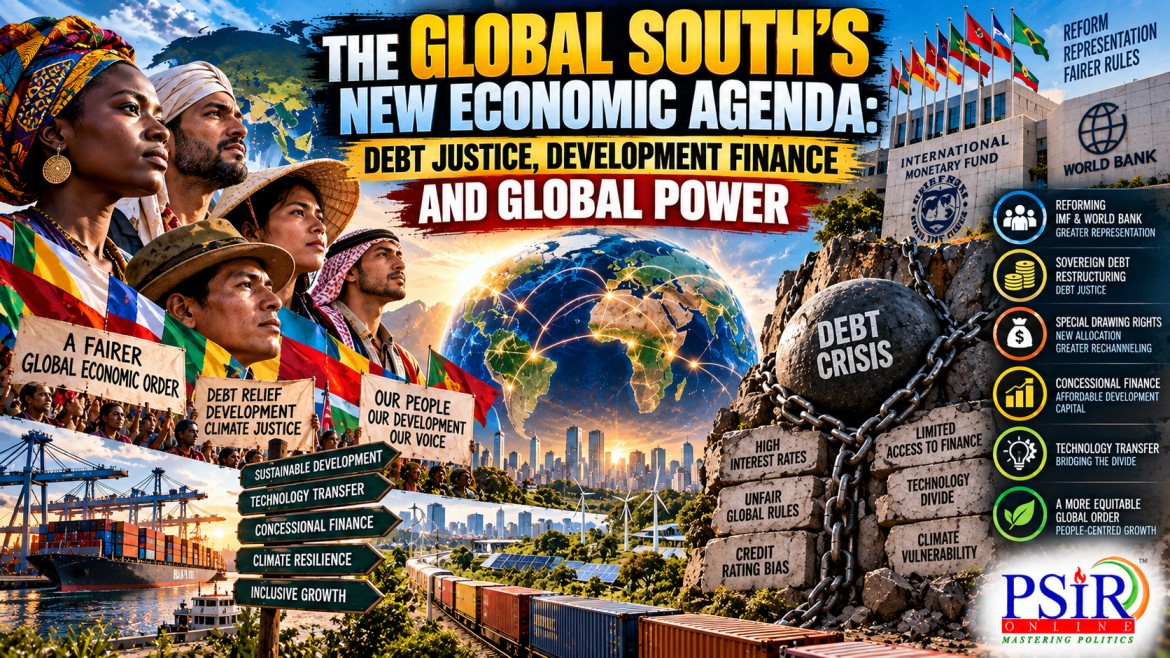
The international economic order was built around institutions designed to promote monetary stability, economic cooperation and development. Yet, more than eight decades after the establishment of the Bretton Woods institutions, developing countries continue to raise concerns about unequal representation, costly borrowing, debt distress and limited access to advanced technology. These concerns have become more pressing as governments face growing development needs alongside climate risks, economic uncertainty and rising debt-servicing obligations.
The G77 and China Ministerial Declaration of September 2026 reflects this wider demand for reform. It calls for changes in the governance of the International Monetary Fund (IMF) and World Bank, improvements to the global sovereign-debt architecture, a new allocation and rechanneling of Special Drawing Rights (SDRs), expanded concessional finance and stronger international cooperation on development. The declaration also raises questions about international tax governance, multilateral development bank resources and the influence of credit-rating agencies.
The economic pressures behind these demands are substantial. According to UN Trade and Development’s 2026 report on external debt sustainability, developing countries’ external debt reached US$12.3 trillion in 2025. Least developed countries spent 18.2% of their export earnings on external debt service that year. Such obligations can reduce the resources available for public health, education, infrastructure, climate adaptation and industrial development.
The Global South’s emerging agenda is therefore not simply a request for financial assistance. It is a broader argument about the distribution of economic power in global governance. The central question is whether international financial institutions can support development while giving borrowing countries a meaningful voice in the rules that govern debt, finance and economic transformation.
THE DEBT–DEVELOPMENT DILEMMA
Borrowing is an essential instrument of development. Governments use external finance to build transport networks, expand electricity generation, strengthen public services and invest in productive capacity. When investment generates sufficient economic and social returns, borrowing can support growth and improve a country’s ability to repay its obligations.
Problems emerge when borrowing costs rise, export earnings weaken or external shocks reduce government revenue. Debt repayment can then compete directly with development expenditure. Countries may be required to borrow again to meet existing obligations, while limited fiscal space constrains the investment needed to strengthen future productive capacity.
UN Trade and Development’s External Debt Sustainability and Development 2026 report identifies the scale of this challenge.
|
Indicator |
Reported position |
|
External debt of developing countries |
US$12.3 trillion in 2025 |
|
Total debt service by developing countries |
US$1.6 trillion in 2025 |
|
External debt service as a share of export earnings in least developed countries |
18.2% in 2025 |
|
Financial inflows from non-residents as a share of gross capital formation |
Declined from 20% in 2014 to 11% in 2024 |
|
Rechannelled SDRs pledged |
US$114.7 billion, of which US$8 billion had been disbursed by the end of March 2026 |
Source: UN Trade and Development, External Debt Sustainability and Development 2026. Figures refer to the periods specified.
The problem is not that all borrowing is undesirable. It is that the availability, cost and maturity of finance may not match the long-term needs of development. Commercial borrowing can be expensive, while short repayment schedules may create pressure before infrastructure or industrial projects begin generating returns.
External shocks can intensify these difficulties. Higher global interest rates, currency depreciation, commodity-price volatility, climate disasters and geopolitical disruptions may increase debt-servicing costs even when a government has not substantially expanded its spending.
The development dilemma is therefore structural as well as fiscal: countries need investment to strengthen their economies, but the terms on which they obtain finance can limit their ability to make those investments.
IMF AND WORLD BANK REFORM: WHO SETS THE RULES?
The IMF and World Bank occupy central positions in the international financial system. The IMF provides balance-of-payments support, surveillance and financial assistance during economic crises. The World Bank and other multilateral development banks provide financing, technical assistance and policy support for development.
However, the governance of these institutions has long been contested. Voting power and representation are not distributed equally among member states. The G77 and China argue that developing countries require a stronger voice in international economic decision-making, including decisions affecting lending conditions, debt sustainability and development priorities.
The September 2026 declaration calls for further reform of international financial institutions, particularly the IMF and World Bank. It also welcomes the Diriyah Guiding Principles for IMF quota reform and the decision permitting SDRs to be used for hybrid-capital instruments.
Three interconnected issues shape the debate.
First, representation. Developing countries argue that their growing importance in the world economy and their exposure to global financial shocks should be reflected more adequately in institutional governance.
Second, policy autonomy. IMF-supported programmes can require fiscal, monetary and structural adjustments intended to restore economic stability. Supporters argue that such measures can address imbalances and improve debt sustainability. Critics, including some developing-country governments and civil-society organisations, question whether particular adjustment programmes adequately protect public investment, social expenditure and national policy priorities.
Third, development finance. Multilateral development banks face pressure to expand financing for infrastructure, climate adaptation, health, education and industrial transformation. This requires sufficient capital, responsible lending practices and mechanisms capable of mobilising additional public and private investment.
The IMF and World Bank have also taken steps to adapt their existing instruments. In September 2026, their executive boards reviewed and approved changes to the joint Debt Sustainability Framework for Low-Income Countries. The review sought to respond to a more complex debt environment while maintaining the framework’s role in identifying risks and guiding lending decisions.
These developments illustrate that institutional reform is not limited to voting shares. It also concerns how financial risks are assessed, which development needs are recognised and how the costs of adjustment are distributed.
SOVEREIGN-DEBT RESTRUCTURING AND THE DEMAND FOR DEBT JUSTICE
Sovereign-debt restructuring occurs when a government renegotiates its obligations because existing repayment terms are unsustainable or cannot be met without serious economic disruption. Restructuring may involve extending maturities, reducing interest rates, lowering principal or changing other repayment conditions.
The process is complicated by the diversity of creditors. A government may owe money to multilateral institutions, bilateral lenders, private bondholders, commercial banks and domestic creditors. These creditors may have different legal claims, financial interests and expectations concerning repayment.
The G77 and China’s demand for an improved global sovereign-debt architecture reflects concerns about the speed, transparency and fairness of current arrangements. Delays can deepen economic uncertainty, postpone new investment and increase the social costs of adjustment.
The G20 Common Framework, the Global Sovereign Debt Roundtable and the Borrowers’ Platform are among the initiatives addressing aspects of the problem. In April 2026, developing countries launched the Borrowers’ Platform, with UN Trade and Development serving as its secretariat. It is intended to strengthen coordination, knowledge-sharing and the collective voice of borrowing countries.
A more effective debt architecture would require several elements:
· Timely restructuring: negotiations should begin early enough to reduce prolonged uncertainty and unnecessary economic damage.
· Creditor coordination: bilateral and private creditors should engage in coherent processes that address comparability of treatment and conflicting claims.
· Greater transparency: clearer information about public debt, guarantees, collateral arrangements and repayment schedules can improve risk assessment.
· Borrower participation: countries facing debt distress need a meaningful role in shaping restructuring procedures.
· Development-sensitive assessments: debt sustainability should be considered alongside a country’s capacity to finance essential services and long-term investment.
Debt justice does not mean that every debt obligation should be cancelled or that borrowing countries have no responsibility for fiscal management. Poor investment choices, weak public financial management and inadequate revenue mobilisation can contribute to debt vulnerabilities. Nevertheless, creditor decisions, external shocks, high borrowing costs and fragmented restructuring arrangements also influence outcomes.
The central issue is how to distribute the costs of a debt crisis without making recovery and future development more difficult. A sustainable settlement must address both repayment capacity and the conditions required for economic recovery.
SPECIAL DRAWING RIGHTS AND CONCESSIONAL DEVELOPMENT FINANCE
Special Drawing Rights are international reserve assets created by the IMF. They are not a conventional currency or a grant, but they can provide reserve liquidity to IMF members. Their usefulness depends partly on countries’ access to convertible currencies and the arrangements through which SDRs can be exchanged or channelled to countries that need additional financing.
The IMF’s 2021 general allocation of SDRs amounted to approximately US$650 billion. Because allocations are distributed according to IMF quotas, countries with larger quotas received larger shares, while many low-income countries received comparatively small allocations despite substantial financing needs.
The G77 and China’s September 2026 declaration calls for a new SDR allocation and the urgent rechanneling of unused SDRs towards developing countries. It also encourages countries with strong external positions to voluntarily channel at least US$250 billion in SDRs to developing countries in need, including through multilateral and regional development banks.
Rechanneling can help make existing reserve assets available for broader development purposes. However, it depends on voluntary contributions, institutional arrangements and the financial and legal conditions under which the assets can be used. Pledges should not be confused with funds already disbursed.
Concessional finance is another central demand. It generally provides funding on more favourable terms than commercial borrowing, such as lower interest rates, longer maturities or grace periods. Grants and highly concessional loans can be especially important for countries that have limited revenue, high vulnerability to external shocks or substantial adaptation needs.
|
Financing instrument |
Development relevance |
Main limitation |
|
Special Drawing Rights |
Provides international reserve liquidity and may support financing through approved rechanneling arrangements |
Allocation is quota-based; rechanneling requires additional arrangements |
|
Concessional loans |
Reduces borrowing costs and can provide longer repayment periods |
Still creates repayment obligations |
|
Grants |
Supports essential services and investment without adding sovereign debt |
Availability depends on donor resources and priorities |
|
Multilateral development bank lending |
Can finance infrastructure, public services and climate-related investment |
Requires adequate institutional capital and responsible project selection |
|
Debt-for-development swaps |
Can redirect part of debt-service obligations towards agreed development or environmental spending |
Design, transparency and scale determine their usefulness |
|
Guarantees and blended finance |
Can reduce selected risks and attract private investment |
May create contingent liabilities and cannot replace public finance in every sector |
Debt swaps and private capital mobilisation may contribute to development financing, but they are not universal substitutes for grants, affordable loans or debt restructuring. Their effectiveness depends on transaction costs, contractual design, additionality and the distribution of risks.
The broader objective is to make development finance more affordable, predictable and aligned with long-term public needs, rather than relying excessively on costly borrowing during periods of crisis.
TECHNOLOGY TRANSFER, INDUSTRIAL DEVELOPMENT AND STRUCTURAL INEQUALITY
Debt and development finance cannot be separated from the productive structure of the global economy. Countries that depend heavily on primary commodities or low-value manufacturing may face volatile export earnings and limited opportunities to capture higher-value activities. Their ability to service external debt can therefore be constrained by the same structural weaknesses that limit industrial development.
Technology transfer is central to changing this pattern. Access to advanced technology, technical skills, research partnerships and productive infrastructure can help economies move into higher-value manufacturing, digital services, renewable energy and other emerging sectors.
The G77 and China’s wider development agenda links international economic reform to greater technological capacity and more equitable participation in the world economy. The underlying concern is that access to finance alone may not produce structural transformation if productive knowledge and high-value activities remain concentrated in a limited number of countries and firms.
Technology transfer involves several dimensions:
· Access to technology: affordable access to equipment, software, research and production systems.
· Knowledge and skills: technical education, research cooperation and institutional capacity to adapt technologies.
· Domestic innovation: investment in universities, research institutions, local enterprises and industrial ecosystems.
· Financing and infrastructure: reliable electricity, connectivity, transport and affordable capital for technology-intensive investment.
· International cooperation: partnerships that enable knowledge-sharing while addressing legitimate intellectual-property, security and commercial concerns.
The challenge is to reconcile incentives for innovation with the development needs of countries that lack the resources to acquire or adapt advanced technologies. Intellectual-property protection can support research and investment, but restrictive licensing arrangements, high costs and limited access to technical knowledge may impede wider diffusion.
A development-oriented approach would combine international cooperation with domestic capability-building. Technology transfer should not be treated simply as the delivery of imported equipment; it should support the ability to maintain, adapt, improve and eventually develop technologies locally.
The long-term objective is productive transformation: moving from dependence on externally controlled technologies and low-value exports towards greater domestic value addition, stronger research capacity and more diversified economies.
THE GLOBAL SOUTH’S AGENDA: COOPERATION, CONSTRAINTS AND IMPLEMENTATION
The G77 and China provide a platform through which developing countries articulate common positions in international negotiations. Their collective demands draw attention to shared concerns about financial vulnerability, unequal representation and limited access to development resources.
However, the Global South is not a homogeneous economic or political bloc. It includes large emerging economies, least developed countries, small island developing states, landlocked developing countries, commodity exporters and countries with differing creditor and debtor positions. Their priorities may overlap, but their financing needs, institutional preferences and strategic interests are not identical.
This diversity creates both opportunities and constraints for collective bargaining. A common agenda can strengthen negotiating influence, but effective implementation requires agreement on specific reforms and the distribution of responsibilities.
Several priorities are especially relevant.
· Strengthening collective coordination: the Borrowers’ Platform can support information-sharing, debt-management capacity and cooperation among borrowing countries without replacing formal negotiations with creditors.
· Improving domestic capacity: transparent borrowing, effective tax administration, public-investment appraisal and stronger debt-management institutions can reduce avoidable vulnerabilities.
· Expanding South–South cooperation: regional development banks, technology partnerships and cross-border infrastructure can diversify sources of finance and strengthen productive links.
· Reforming international institutions: changes to representation, lending instruments and development-bank capital should reflect the scale and diversity of contemporary financing needs.
· Protecting development expenditure: debt programmes and fiscal adjustments should consider the consequences for health, education, climate resilience and productive investment, while maintaining credible paths towards debt sustainability.
· Improving accountability: both borrowers and creditors require transparent reporting, clear responsibilities and mechanisms to assess whether financed projects deliver intended public benefits.
The Global South’s agenda will ultimately be judged not only by declarations but by changes in financing conditions, institutional representation, debt-resolution outcomes and access to technology. The challenge is to translate collective demands into workable international arrangements while recognising the different responsibilities and capacities of states.
THEORETICAL ANGLES
|
Theory or concept |
Connection to the Global South’s economic agenda |
|
New International Economic Order (NIEO) |
The demands for fairer financial governance, development finance, technology transfer and greater participation echo the NIEO’s objective of restructuring unequal economic relationships between developed and developing countries. |
|
Dependency theory |
Persistent reliance on external finance, commodity exports and imported technology can reproduce structural dependence even when developing economies expand their output and trade. |
|
World-systems analysis |
Unequal control over capital, technology and high-value production helps explain the concentration of economic power within the international system. |
|
Liberal institutionalism |
The IMF, World Bank and multilateral development banks can facilitate cooperation, but their effectiveness depends on legitimacy, representation and the capacity to respond to members’ needs. |
|
Structural power |
States and institutions that influence access to credit, reserve assets, technology and financial rules possess power beyond conventional military capabilities. |
|
North–South dialogue |
The G77 and China’s agenda represents collective bargaining over finance, debt, development responsibilities and the distribution of decision-making authority. |
|
Complex interdependence |
Developing countries depend on international markets and finance, while creditors and financial institutions also depend on a stable global economy. These relationships can produce mutual gains but also unequal vulnerabilities. |
|
State-led development |
Industrial policy, domestic technological capabilities and public investment can help countries move into higher-value activities and reduce excessive dependence on external production systems. |
CONCLUSION
The Global South’s new economic agenda reflects a continuing debate over the relationship between international financial stability and development justice. The demands expressed by G77 and China concern not only the quantity of available finance but also its cost, conditions, distribution and governance.
Debt sustainability, concessional finance, SDR rechanneling, institutional representation and technology transfer are interconnected elements of this debate. Without affordable and predictable financing, governments may struggle to invest in productive capacity. Without productive transformation, debt repayment can remain vulnerable to external shocks. Without meaningful participation in global governance, developing countries may have limited influence over the rules that shape these outcomes.
At the same time, international reform cannot eliminate the importance of responsible borrowing, transparent public expenditure and effective domestic institutions. A durable approach must combine national accountability with fairer international arrangements and more coordinated creditor participation.
The central question is whether the global financial system can move towards a model in which development finance strengthens productive capacity rather than merely managing recurring crises. The Global South’s agenda ultimately seeks a more representative international economic order in which financial stability, technological progress and development opportunities are more widely shared.
RELATED READING
PRACTICE QUESTIONS FOR GS2 MAINS
PRACTICE QUESTIONS FOR PSIR
