INTRODUCTION: THE REPRESENTATION PARADOX
The enactment of the Constitution (106th Amendment) Act, 2023 (Nari Shakti Vandan Adhiniyam) marks a constitutional milestone by reserving one-third of seats for women in the Lok Sabha, State Legislative Assemblies, and the Delhi Assembly, including a horizontal quota within seats reserved for Scheduled Castes and Scheduled Tribes.
However, under Article 334A, its actual implementation remains contingent upon a delimitation exercise conducted after the publication of figures from the first Census held after the amendment's commencement. This procedural linkage proved contentious in April 2026 when the Constitution (131st Amendment) Bill, 2026—seeking to accelerate the quota alongside seat expansion—failed to secure the required two-thirds special majority in the Lok Sabha (298 in favour, 230 against).
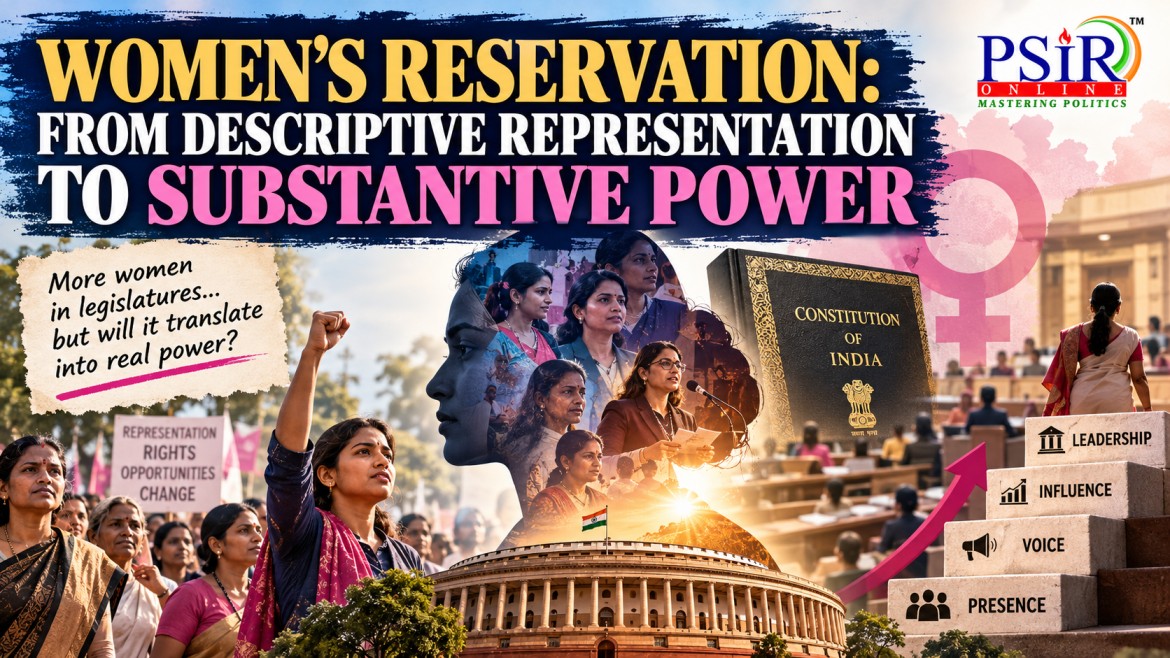
Beyond the procedural logjam, the debate exposes a foundational question: Will numerical presence in legislative bodies automatically translate into genuine political influence? India's democratic challenge lies in transforming formal descriptive representation into autonomous substantive power.
DESCRIPTIVE VS. SUBSTANTIVE REPRESENTATION
Evaluating political quotas requires distinguishing between numerical presence and consequential power:
· Descriptive Representation: Focuses on numbers and physical presence—the degree to which the demographic makeup of a legislature mirrors the wider population.
· Substantive Representation: Focuses on political efficacy and policy impact—whether representatives can independently shape agendas, direct resources, and advance the structural rights of the groups they represent.
As political theorist Hanna Pitkin established, "standing for" a constituency (descriptive presence) does not guarantee "acting for" that constituency (substantive power). Anne Phillips similarly observed that while a "politics of presence" is essential to bring marginalized perspectives into public debate, presence alone cannot ensure equal authority. In India, because women are socially differentiated by caste, religion, class, and region, substantive representation demands diverse, cross-cutting democratic access rather than tokenistic inclusion.
WHY QUOTAS MATTER IN INDIAN POLITICS
Mandatory reservation tackles entrenched democratic imbalances:
· Dismantling Party Gatekeeping: Political candidate selection has historically been mediated by patronage, dynastic ties, and male-dominated party elites. Statutory quotas compel parties to institutionalize nominations for women rather than relying on voluntary, unenforceable targets.
· Reframing Policy Priorities: An increased presence of women introduces critical focus to areas frequently sidelined in policy debates, such as maternal health, sanitation, social care infrastructure, and safety in public spaces.
· Challenging Institutional Monopolies: Guaranteed entry breaks the glass ceiling in legislative chambers, challenging the systemic exclusion of women from cabinet portfolios, high-stakes ministries, and statutory committees.
THE PANCHAYATI RAJ BLUEPRINT: ENTRY VS. AUTONOMY
The implementation of 33% (and up to 50% in multiple states) reservation in local governance under the 73rd and 74th Constitutional Amendments (1992) offers vital lessons for higher legislatures:
· The Proxy Trap (Sarpanch Pati): In numerous instances, male relatives have attempted to act as informal proxies for elected women, illustrating that formal office does not automatically confer real decision-making authority.
· Compounded Social Barriers: Dalit and marginalized-caste women often face dual vulnerabilities of gender and caste hierarchies, which impede their control over local funds and decision-making.
· Cumulative Empowerment: Over three decades, sustained exposure to grassroots governance has enabled millions of women to build administrative competence, challenge patriarchal norms, and redirect development spending toward public health, water, and schooling.
The local governance experience proves that statutory quotas open institutional doors, but institutional support and financial independence determine whether that access becomes transformative.
INSTITUTIONAL HURDLES TO SUBSTANTIVE POWER
Even after the 106th Amendment takes full effect, several barriers will continue to restrict women's political agency:
· Intra-Party Oligarchy: Party hierarchies remain heavily male-dominated. Without internal quotas on ticket-distribution panels, parties risk fielding female candidates only in difficult constituencies or selecting dynastic surrogates.
· Campaign Finance Asymmetries: The high cost of modern electioneering puts women at a disadvantage, as they frequently lack equal access to independent corporate funding and patronage networks.
· Executive Exclusion: Representation in the legislature does not guarantee seats in the inner circle of power. Female legislators remain underrepresented in cabinet posts and crucial legislative committees.
· The Rotation Dilemma: The periodic rotation of reserved seats mandated by Article 334A may disrupt continuity, discouraging legislators from cultivating deep, long-term constituency relationships.
· Intersectionality: The 106th Amendment includes sub-quotas for SC and ST women, but contains no separate provision for Other Backward Classes (OBCs), prompting concerns regarding the equitable distribution of representation across social strata.
INSTITUTIONAL ROADMAP: CONVERTING PRESENCE INTO POWER
To ensure that numerical quotas translate into genuine political influence, state institutions and political parties must adopt complementary measures:
· Internal Party Democratisation: Enforce internal quotas within central executive and candidate-selection committees to dismantle dynastic and patriarchal gatekeeping.
· Equitable Campaign Financing: Provide targeted campaign subsidies, public resources, and media airtime to level the playing field for women contesting elections.
· Executive & Committee Parity: Establish conventions guaranteeing women equitable representation across key parliamentary committees and cabinet ministries.
· Procedural Decoupling: Consider decoupling the rollout of women’s reservation from the contentious, multi-year census and delimitation process to prevent further implementation delays.
· Legislative Capacity-Building: Provide institutional training, research staff, and policy support to empower first-time legislators in parliamentary procedure and budget oversight.
PSIR THEORETICAL DIMENSION & EXAMINATION LINKAGES
|
PSIR Theoretical Dimension & Concepts |
How It Connects to Examination Answers (PSIR Paper 1 / Paper 2) |
|
Substantive Representation vs. Descriptive Presence (Hanna Pitkin; Anne Phillips – The Politics of Presence) |
The Quota vs. Power Dilemma: Contrasts Pitkin's formal/descriptive presence ("standing for") with substantive representation ("acting for"). Connects the 106th Constitutional Amendment Act (Nari Shakti Vandan Adhiniyam) to the limitation of numerical quotas, showing that a seat headcount does not automatically guarantee influence over legislative agendas, fiscal allocations, or executive decisions. |
|
Intra-Party Oligarchy & Gatekeeping (Robert Michels – Iron Law of Oligarchy) |
Male-Dominated Candidate Selection: Evaluates how central executive committees and informal high commands within political parties act as patriarchal gatekeepers. Demonstrates that without statutory internal quotas on candidate nomination committees, parties risk fielding female candidates disproportionately in losing seats or resorting to dynastic proxies. |
|
The "Proxy Representative" Paradox (Carole Pateman – Participatory Democracy; Gail Omvedt) |
Access vs. Decision-Making Autonomy: Uses the three-decade empirical record of Panchayati Raj (Sarpanch Pati phenomenon) to show that formal constitutional entry under Articles 243D/T can be subverted by familial, caste, and patriarchal networks. Argues that institutional training, financial independence, and administrative authority are required to convert nominal office into genuine agency. |
|
Social Cleavages & Intersectional Exclusion (Iris Marion Young – Inclusion and Democracy; Kimberlé Crenshaw) |
De-Homogenizing the Category of 'Women': Critiques the assumption of a uniform female political constituency. Evaluates demands for sub-quotas by highlighting how gender intersects with caste and class, demonstrating that blanket reservation without sub-classification risks reinforcing elite representation while leaving marginalized-caste and working-class women underrepresented. |
|
Demographic Federalism & Representational Sequencing (Alfred Stepan; Arend Lijphart) |
The Delimitation-Census Conditionality: Analyzes the procedural linkage under Article 334A tying the rollout of women’s reservation to the post-census delimitation exercise. Connects the defeated Constitution (131st Amendment) Bill, 2026, to federal anxieties in peninsular states, showing how sequencing rights behind contested interstate seat reapportionment stalls affirmative action. |
|
Autonomous Civil Society vs. Hegemonic Statecraft (Antonio Gramsci; Nancy Fraser – Subaltern Counterpublics) |
Civic Pressure vs. Depoliticized Welfarism: Traces how colonial-era suffrage platforms (WIA, AIWC) largely transitioned into state-partnered service delivery and UN SDG frameworks, while groups like the YWCA of India retain a politically contentious stance by demanding immediate quota implementation without waiting for delimitation. |
CONCLUSION
The Constitution (106th Amendment) Act, 2023, represents a major constitutional milestone by establishing that the chronic exclusion of women from India's legislative chambers is incompatible with a mature democracy. However, the procedural impasse surrounding Article 334A and the defeated legislative efforts of April 2026 demonstrate that constitutional enactment does not equate to operational governance. As three decades of Panchayati Raj governance reveal, the true success of political affirmative action cannot be evaluated merely by a numerical headcount of legislators.
Descriptive presence opens institutional doors, but substantive representation depends on whether women can exercise independent authority over state resources, challenge patriarchal party gatekeeping, direct cabinet priorities, and shape legislative agendas. For Indian democracy, the ultimate test of women's reservation lies not simply in changing who occupies seats in Parliament and State Assemblies, but in fundamentally restructuring how sovereign political power is negotiated, organized, and exercised.
RELATED READING & ANALYTICAL ANGLES
· Constitutional Articles & Statutory Mechanisms:
o Articles 330A & 332A (Constitution 106th Amendment Act, 2023): The constitutional framework reserving 33% of seats for women in the Lok Sabha and State Legislative Assemblies, alongside horizontal quotas for SC and ST women.
o Article 334A: The sunset and commencement clause linking the activation of women's reservation to the publication of the first post-amendment Census and subsequent delimitation.
o Articles 243D & 243T (73rd and 74th Amendments): Mandatory reservation of seats and chairperson posts in rural and urban local bodies, serving as the empirical baseline for evaluating women's political leadership in India.
· Institutional Reports & Analytical Angles for Examination Prep:
o The Descriptive vs. Substantive Gap: Track empirical studies (e.g., Esther Duflo and Rohini Pande) on how women sarpanches shift local public-goods spending toward drinking water, sanitation, and primary health compared to male counterparts.
o The Decoupling Debate: Examine legal arguments around whether Parliament can statutorily implement women's quotas within the current 543 Lok Sabha seats using rotational lot allocation without waiting for the national census and federal delimitation.
o Candidate Selection and Campaign Financing: Milan Vaishnav and E. Sridharan on how the high cost of electioneering and "winnability" metrics systematically disadvantage candidates without access to dynastic or corporate finance networks.
o Intersectional Representation: Parliamentary debates surrounding the inclusion or exclusion of an explicit sub-quota for Other Backward Classes (OBC) women within reserved legislative seats.
PRACTICE QUESTIONS FOR PSIR
