Government administration depends not only on policies and institutions but also on the effective management of its workforce. Recruitment, transfers, promotions, leave, salary, performance appraisal and retirement benefits generate extensive records and require coordination across departments. When these processes depend heavily on paper files and fragmented databases, maintaining accurate service histories and processing employee requests can become administratively demanding.
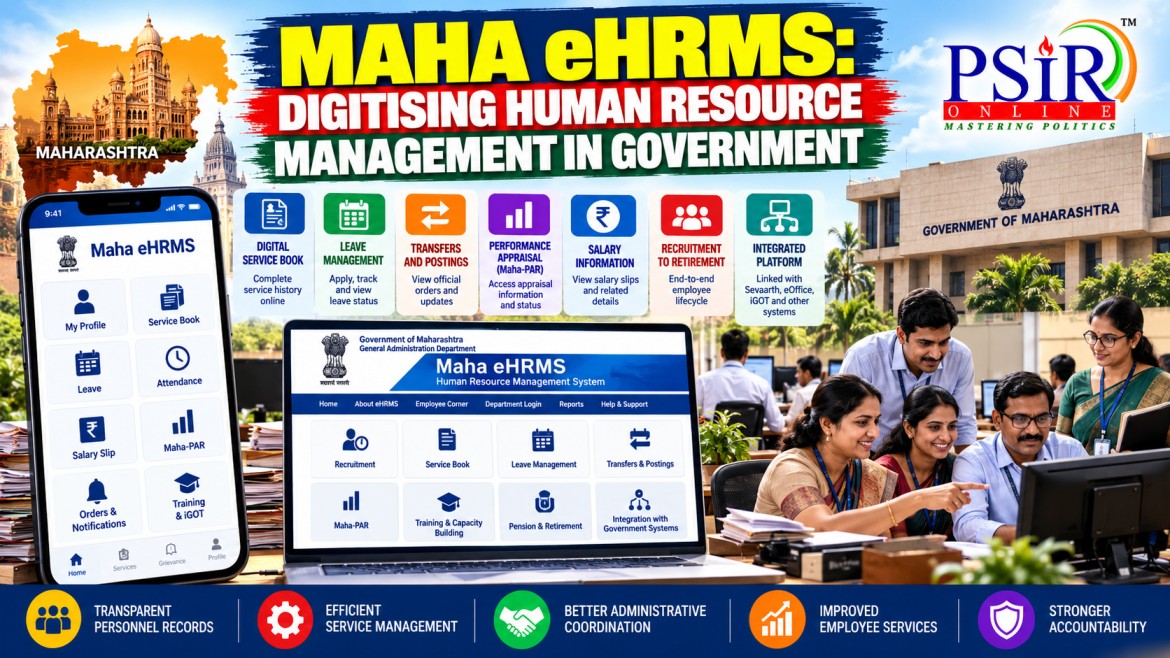
The Maharashtra Electronic Human Resource Management System (Maha eHRMS) seeks to address these challenges through a digital platform for managing government employees’ service-related information and processes. Developed under the General Administration Department, in collaboration with relevant state departments and the National Informatics Centre (NIC), the platform is designed to support the employee lifecycle from recruitment to retirement. Its associated mobile application provides access to selected human-resource services and employee records.
The governance significance of Maha eHRMS lies in its potential to connect personnel records, administrative workflows and employee services through a common digital framework. However, the existence of a digital platform alone does not establish that delays have fallen or accountability has improved. These outcomes depend on the quality of records, departmental adoption, workflow integration and effective grievance redressal.
WHAT IS MAHA eHRMS?
Maha eHRMS is a state-level human-resource management platform intended to digitise and coordinate service-related processes for Maharashtra government employees. Official materials identify modules covering recruitment, digital service books, employee services, training, statutory compliance, transfers and postings, departmental enquiries, electronic orders and retirement-related processes. The platform is also designed to integrate with other government systems.
The official mobile application lists several employee-facing functions:
|
Function |
Documented role |
Administrative significance |
|
Digital service book |
Access to service history, including appointments, postings, transfers, promotions and training |
Supports continuity and retrieval of employment records. |
|
Leave management |
Submit leave applications and view balances, history and approval status |
Makes the leave process accessible through a digital interface. |
|
Electronic orders |
View official orders relating to transfers, promotions, postings and departmental instructions |
Helps employees access service-related decisions and associated records. |
|
Maha-PAR |
Access performance-appraisal information and status |
Provides visibility into the appraisal process. |
|
Attendance |
View attendance records and summaries |
Enables employees to access recorded attendance information. |
|
Salary information |
View salary slips and related financial details |
Improves employee access to payroll information. |
These functions are described in the official portal and NIC-published mobile application information. The availability of a feature does not, by itself, establish that every department or employee has access to every module in operational practice.
The important distinction is between digitising a record and digitising the entire administrative process. An electronic service book can make information easier to retrieve, but a transfer, promotion or pension case may still require verification, approval and action by designated officials.
FROM PAPER SERVICE BOOKS TO DIGITAL PERSONNEL RECORDS
A government employee’s service book is central to the administration of appointments, pay-related entitlements, promotions, leave, retirement and other employment matters. In a paper-based environment, records may be distributed across offices or require manual verification when an employee moves between posts or departments.
Maha eHRMS seeks to create a digital record of the employee’s service history. The platform’s published documentation identifies personal profiles, appointment details, supporting documents, service history, pay, family and nomination details, leave, pension-related information, training and other service records among its documented record categories.
Digitisation can support three important administrative functions.
· Record continuity: A structured digital record can help preserve service information across different stages of an employee’s career.
· Record retrieval: Authorised officials and employees can access relevant information without relying exclusively on physical files.
· Verification and correction: Digital records can make discrepancies easier to identify, provided that there are clear procedures for correcting inaccurate entries and validating supporting documents.
Maharashtra’s administrative instructions underline why record quality matters. A General Administration Department circular dated 28 March 2024 instructed state government officers and employees to submit leave applications through the eHRMS system from 1 April 2024. Later state instructions also addressed the maintenance and updating of service books as part of administrative performance monitoring.
These measures illustrate that digital human-resource management requires more than uploading documents. Records must be complete, updated and supported by reliable verification procedures. An incorrect digital record can reproduce the problems of a paper record at greater scale if it is not corrected promptly.
INTEGRATION WITH PAYROLL, ATTENDANCE AND ADMINISTRATIVE SYSTEMS
A human-resource platform becomes more useful when it can exchange information with other administrative systems rather than functioning as an isolated database.
Maha eHRMS documentation identifies integration with systems including Sevaarth, the state’s finance and payroll system; biometric attendance; Maha-PAR, for performance appraisal; and iGOT, for learning and capacity building. The official platform also lists connections or access points relating to eOffice, electronic orders, leave management and other government services.
Such integration can support coordination across different stages of personnel administration.
For example, an approved transfer order may need to be reflected in an employee’s service history. Leave applications require a workflow involving submission, scrutiny and approval. Performance-appraisal records must be associated with the relevant employee and appraisal period. Payroll and service records may also need to be reconciled when an employee’s posting or service status changes.
If these systems exchange accurate and timely information, the government can reduce repetitive data entry and the need to obtain the same information from multiple offices. Departmental administrators may also gain a more consistent view of employee records and pending service-related actions.
However, integration is not the same as complete automation. Different systems may have distinct approval rules, data formats, access controls and update schedules. The actual administrative benefit depends on whether the systems exchange information reliably and whether officials act on the information received.
EMPLOYEE SERVICES, TRANSPARENCY AND ADMINISTRATIVE ACCOUNTABILITY
Maha eHRMS provides an employee-facing route to service information and selected transactions. The mobile application describes access to service records, leave balances, salary information, attendance, official orders, notifications and performance-appraisal details.
This can change the employee’s relationship with the administrative system in several ways.
First, it can improve access to information. Employees who can view their service records and leave status digitally may be better placed to identify missing entries or follow the progress of requests.
Second, it can support administrative traceability. Digital workflows can record submissions, approvals, rejections and associated timestamps. The platform’s privacy documentation describes transaction records and audit trails as part of its data-management framework. Such records can help establish what action was taken and when, subject to the system’s actual configuration and use.
Third, it can support coordination between employees and departmental officials. A common platform can provide a shared reference point for service-related information, reducing dependence on informal communication and repeated requests for documents.
Nevertheless, accountability requires more than visibility. A digital record that shows a pending application does not automatically ensure that the application will be decided on time. Effective accountability requires clearly assigned responsibility, prescribed timelines, escalation procedures and accessible grievance mechanisms.
Similarly, the mobile application’s stated objective of reducing administrative delays should be understood as an intended benefit, not as independent evidence that delays have already declined across Maharashtra’s government departments.
IMPLEMENTATION CHALLENGES AND THE WAY FORWARD
The effectiveness of Maha eHRMS depends on how well digital processes are embedded in routine administration. Four areas deserve particular attention.
Data accuracy and updating: Missing appointment orders, inconsistent employee identifiers, outdated service entries and incorrect leave or pay information can undermine trust in the system. Departments need regular verification, defined responsibility for corrections and mechanisms to resolve discrepancies.
Uneven departmental adoption: The availability of a statewide platform does not guarantee uniform use across every office. Implementation needs to be assessed by department, cadre and administrative level, including the extent to which relevant transactions are actually processed through the platform.
Privacy and cybersecurity: Human-resource records may contain personal identifiers, family information, salary details, performance assessments and disciplinary records. Access should be role-based and limited to legitimate official purposes. Security audits, access logs, data minimisation, backup arrangements and incident-response procedures are essential. The official privacy policy describes controls and procedures intended to govern the handling of employee data.
Employee support and grievance redressal: Employees need clear guidance on registration, document submission, correction of service records and escalation of unresolved cases. Digital access should be accompanied by helpdesk support and alternative assistance for employees who face technical or accessibility barriers.
To establish whether the platform is improving service delivery, the state could publish regular, verifiable performance indicators. These might include the proportion of service books digitised and verified, the share of eligible transactions completed online, average processing time for selected requests, the number of unresolved data discrepancies, system availability and grievance-resolution time.
Such indicators would allow the government to distinguish between technical deployment, actual usage and measurable administrative outcomes. Without this distinction, the number of digitised records or registered employees would provide only a partial picture of performance.
UPSC ANGLES
|
Dimension |
Relevance to Maha eHRMS |
|
Governance and administrative reform |
Demonstrates how digital platforms can reorganise personnel administration around structured records and service workflows. |
|
Personnel administration |
Connects with recruitment, transfers, promotions, performance appraisal, leave and retirement-related processes. |
|
Transparency and accountability |
Digital records and workflow histories can improve traceability, but accountability still requires assigned responsibility, timelines and corrective action. |
|
Service delivery |
Employee-facing access to service records, leave status and official orders can make internal government services more accessible. |
|
Digital governance |
Illustrates the importance of interoperable systems, reliable databases, user-oriented interfaces and process redesign. |
|
Privacy and cybersecurity |
Highlights the need to protect sensitive employment, salary, family and performance information through appropriate access controls and security safeguards. |
|
Administrative capacity |
Requires trained officials, clear departmental ownership, helpdesk support and procedures for correcting inaccurate records. |
|
Performance evaluation |
Calls for outcome indicators such as processing time, record accuracy and grievance resolution rather than relying only on the number of digitised files. |
CONCLUSION
Maha eHRMS represents Maharashtra’s effort to organise government human-resource management through digital personnel records, employee-facing services and integration with related administrative systems. Its documented functions cover important parts of the employee lifecycle, including service books, leave, attendance, official orders, performance appraisal and retirement-related information.
The platform’s potential contribution is not simply the replacement of paper files with electronic records. It lies in making personnel information more accessible, supporting coordination between administrative units and creating greater traceability in service-related transactions.
Realising these benefits requires accurate records, reliable system integration, clear responsibility for pending cases, strong privacy safeguards and effective employee support. The success of digital human-resource management should ultimately be measured by the quality and timeliness of services delivered—not merely by the existence of a portal.
OFFICIAL REFERENCES AND FURTHER READING
GS2 MAINS PRACTICE QUESTIONS
