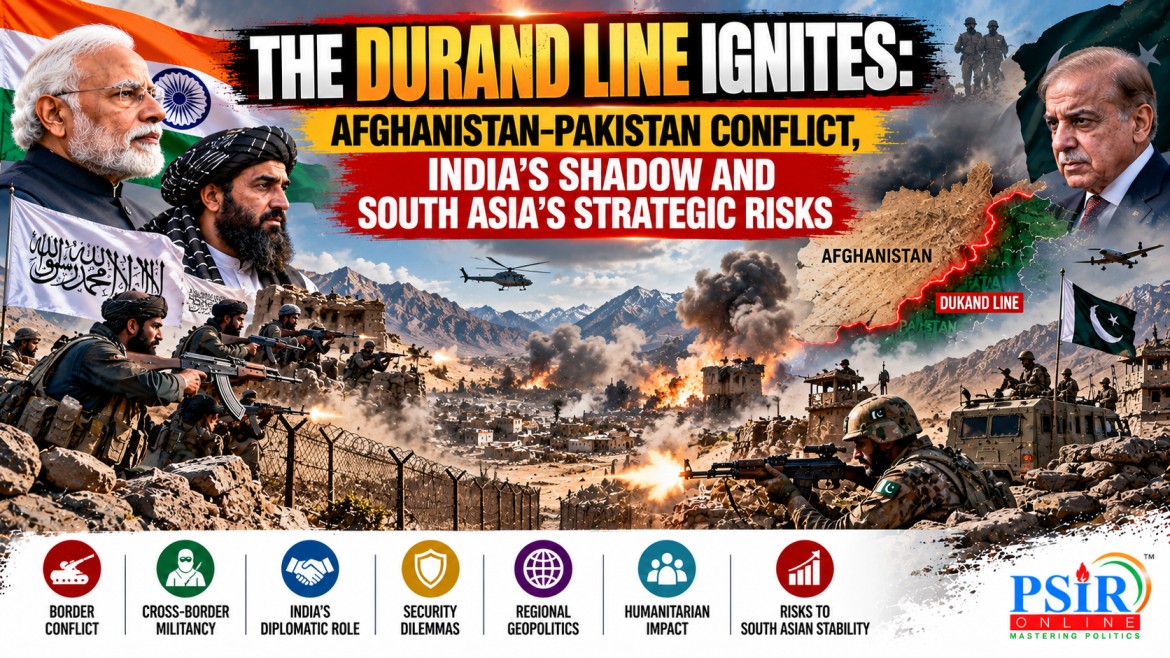
The escalating conflict between Afghanistan and Pakistan has exposed a major fault line in South Asian security. Once regarded by Islamabad as a strategic partner, the Taliban-led government in Kabul has become embroiled in repeated border clashes, cross-border accusations and military retaliation. The conflict intensified in October 2025, escalated again in February and March 2026, and continued through fresh strikes and diplomatic exchanges in September and October 2026.
India has become an important part of the geopolitical debate. Pakistan accuses India of supporting anti-Pakistan militant groups through Afghan territory, while New Delhi rejects the allegations. Meanwhile, Afghan Taliban figures have invoked Pakistan’s defeat in the 1971 war and the surrender that preceded the creation of Bangladesh to taunt Islamabad. These developments have given the conflict a wider strategic dimension: it now concerns not only border security and militancy, but also India’s diplomatic space, Pakistan’s regional security calculations and the stability of South Asia.
FROM STRATEGIC PARTNERSHIP TO ARMED CONFRONTATION
Pakistan initially viewed the Taliban’s return to power in August 2021 as an opportunity to secure a friendly government in Kabul. However, relations deteriorated as attacks attributed to the Tehreek-e-Taliban Pakistan (TTP) intensified inside Pakistan. Islamabad accuses the Afghan Taliban of allowing the TTP to operate from Afghan territory; Kabul rejects the accusation and argues that Pakistan’s security crisis is an internal problem.
The relationship is complicated by historical and organisational connections between the Afghan Taliban and the TTP. Although the two are distinct organisations with different immediate objectives, they share ideological affinities and overlapping militant networks. Pakistan’s military operations and pressure on Kabul have failed to produce a durable settlement.
The resulting escalation has involved airstrikes, artillery exchanges, border closures and competing claims about casualties. The dispute also reflects unresolved questions surrounding the Durand Line, the boundary established during British colonial rule that Afghanistan has historically contested. Border communities, cross-border ethnic ties and militant mobility make the frontier difficult to secure through military measures alone.
Timeline of the Afghanistan–Pakistan conflict
|
Date |
Major development |
Strategic significance |
|
August 2021 |
The Taliban returned to power in Kabul. |
Pakistan initially anticipated a more favourable security environment, while India recalibrated its Afghan policy. |
|
January 2023 |
Taliban official Ahmad Yasir circulated an image associated with Pakistan’s 1971 surrender, warning Islamabad against military action. |
Historical memory became a tool of political and military signalling. |
|
October 2025 |
Deadly border clashes followed escalating tensions and Pakistani strikes on Afghan territory. |
Marked a major deterioration in relations between the two governments. |
|
19 October 2025 |
Qatar helped broker a temporary ceasefire. |
Demonstrated the possibility of regional mediation, but did not resolve the underlying dispute. |
|
October–November 2025 |
Subsequent negotiations failed to secure a lasting settlement; further strikes and clashes followed. |
Exposed the weakness of ceasefires without enforceable security arrangements. |
|
27 February–March 2026 |
Pakistan intensified strikes against Afghan military sites, while cross-border fighting and civilian casualties were reported. |
Expanded the confrontation beyond isolated frontier incidents. |
|
March 2026 |
China helped facilitate diplomatic efforts, followed by a temporary reduction in tensions. |
Highlighted the growing involvement of external powers in regional de-escalation. |
|
22 September 2026 |
India condemned Pakistani airstrikes in Afghanistan’s Kunar and Paktika provinces. |
New Delhi publicly linked the strikes to regional peace, Afghan sovereignty and civilian protection. |
|
25 September 2026 |
Renewed escalation was examined in international reporting amid continued accusations over militant sanctuaries and attacks. |
Confirmed that the conflict remained unresolved despite earlier mediation efforts. |
|
5 October 2026 |
Afghan Taliban Foreign Minister Amir Khan Muttaqi called for dialogue at consultations in Moscow involving regional actors. |
Created another diplomatic opening, although Pakistan continued demanding action against cross-border militancy. |
The chronology demonstrates that the conflict is not a single, continuous conventional war in which all hostilities have remained at the same intensity. It is a recurring cycle of military escalation, temporary ceasefires and failed political negotiations. The distinction matters because a sustainable settlement requires more than a pause in fighting.
THE 1971 SURRENDER, POLITICAL TAUNTS AND THE INFORMATION WAR
The conflict has acquired a symbolic dimension through references to the 1971 Indo-Pakistani War. On 16 December 1971, Pakistani forces in East Pakistan surrendered to the joint command of Indian and Bangladeshi forces in Dhaka. The surrender followed a war that culminated in the creation of Bangladesh.
In January 2023, Taliban official Ahmad Yasir invoked the surrender image while warning Pakistan against military action. During the October 2025 clashes, social-media posts and commentary again drew comparisons with 1971, including references to the surrender of Pakistani personnel and claims about abandoned military clothing.
These references should be understood as political messaging rather than evidence of a direct Indian role in the conflict. The memory of 1971 carries exceptional significance in Pakistan’s national-security discourse, and its use by Afghan figures highlights the deterioration of relations between Islamabad and the Taliban leadership.
The online dimension has amplified the confrontation. Images, videos and claims about battlefield victories circulate rapidly, sometimes without independent verification. Such material can shape domestic opinion, intensify nationalist sentiment and make compromise politically difficult. The information war is therefore not incidental to the conflict: it is part of how the opposing sides seek to demonstrate resolve and undermine each other’s credibility.
For India, the historical references carry strategic resonance but also create risks. The conflict may reinforce Pakistan’s suspicion that Afghanistan could become a space for Indian influence. Yet symbolic taunts and shared hostility towards Islamabad do not establish that India directs Afghan military decisions.
INDIA’S CONNECTION: ALLEGATIONS, DENIALS AND STRATEGIC MANOEUVRING
Pakistan has repeatedly accused India of providing support, including funds or weapons, to militant groups operating against Pakistan, and of using Afghan territory to facilitate anti-Pakistan activity. New Delhi rejects these allegations. Afghan Taliban representatives have also denied that their territory is being used by India to destabilise Pakistan.
These claims must be separated from independently established facts. Public reporting has documented Pakistan’s accusations and the denials by India and Afghanistan, but the allegations of Indian direction or weapons support have not been independently established in the available public evidence. An accusation made during an armed confrontation should not be treated as proof of operational involvement.
|
Issue |
Pakistan’s position |
India’s and Afghanistan’s responses |
|
TTP attacks inside Pakistan |
Islamabad accuses Kabul of providing sanctuary to militants and alleges Indian support for anti-Pakistan groups. |
Kabul denies allowing Afghan territory to be used against other countries; India rejects Pakistan’s allegations. |
|
Indian engagement with Kabul |
Pakistan views closer India–Afghanistan ties through the lens of its security competition with New Delhi. |
India presents its engagement as support for Afghan sovereignty, humanitarian needs and regional stability. |
|
Pakistani strikes in Afghanistan |
Pakistan describes military action as necessary to target militant infrastructure and prevent attacks. |
India condemned the September 2026 strikes; Kabul characterised Pakistani attacks as aggression and asserted its right to self-defence. |
|
Arms and material support |
Pakistan alleges that India provides support to groups threatening Pakistani security. |
India denies the allegations; the public record does not independently establish the alleged Indian weapons supply. |
India’s strategic position is shaped by several considerations. First, maintaining relations with Afghanistan prevents New Delhi from losing diplomatic access to a country of considerable regional importance. Second, humanitarian assistance, development cooperation and the restoration of India’s diplomatic presence preserve channels of influence without requiring formal recognition of the Taliban government.
Third, Afghanistan connects South Asia with Central Asia and provides a setting in which India’s relations with Iran, Russia and other regional powers intersect. India’s use of Chabahar and its broader interest in regional connectivity must therefore be understood within a wider strategy of economic and diplomatic diversification.
However, India also faces a difficult balancing act. Closer engagement with Kabul may be interpreted by Islamabad as strategic encirclement, while excessive distance from Afghanistan could reduce India’s influence and its ability to protect its interests. India’s policy space depends on retaining diplomatic access without becoming entangled in an armed confrontation.
WHY THE CONFLICT THREATENS SOUTH ASIAN STABILITY
The Afghanistan–Pakistan confrontation has implications beyond the two countries.
First, cross-border militancy can intensify regional insecurity. Pakistan’s concern about attacks originating from Afghan territory is a significant security issue, but repeated airstrikes and retaliation risk increasing civilian casualties and strengthening militant recruitment. Military pressure without credible political arrangements may perpetuate rather than resolve the conflict.
Second, the conflict complicates India–Pakistan relations. Pakistan’s allegations of Indian involvement risk turning an Afghanistan-centred confrontation into another arena of bilateral strategic competition. If such claims become embedded in military planning or diplomatic rhetoric, the possibility of miscalculation increases. This is particularly concerning in a region where India and Pakistan possess nuclear weapons.
Third, Afghanistan’s humanitarian and economic vulnerabilities may worsen. Border closures disrupt trade, transport, livelihoods and access to essential goods. Civilian casualties and displacement create additional burdens for an already vulnerable population. Prolonged instability could also complicate regional efforts to address terrorism, refugee movements and illicit trafficking.
Fourth, external powers have competing interests. China seeks regional stability and protection against militant threats affecting its interests. Iran is concerned about border security, refugees and regional connectivity, while Russia has expanded its diplomatic engagement with the Taliban authorities. Their involvement creates opportunities for mediation but also reflects different strategic priorities.
The central regional danger is therefore not simply a prolonged bilateral conflict. It is the possibility that military escalation, militant networks and competing regional alignments reinforce one another, making South Asia’s security environment more fragmented.
INDIA’S STRATEGIC OPTIONS: INFLUENCE WITHOUT ESCALATION
India does not need to choose between complete disengagement from Afghanistan and overt involvement in the conflict. A more sustainable approach would combine diplomatic engagement, security vigilance and support for de-escalation.
|
Policy priority |
Practical direction |
|
Afghan sovereignty and civilian protection |
Continue opposing cross-border attacks that threaten civilians and regional stability, while supporting respect for international law. |
|
Counterterrorism |
Maintain clear expectations that Afghan territory must not be used for attacks against India or other countries. |
|
Diplomatic engagement |
Preserve communication with Kabul while keeping formal recognition separate from functional relations. |
|
Regional diplomacy |
Support credible dialogue involving Afghanistan and Pakistan, with constructive roles for relevant regional mediators. |
|
Information integrity |
Distinguish verified military developments from propaganda, unverified battlefield claims and allegations of external sponsorship. |
|
Connectivity and economic interests |
Protect the long-term viability of regional trade and transport initiatives without making them instruments of military confrontation. |
|
India–Pakistan crisis management |
Avoid allowing unsubstantiated allegations about Afghanistan to trigger a wider bilateral escalation. |
India’s diplomacy must recognise that Pakistan has legitimate security concerns regarding attacks on its territory, while also insisting that such concerns do not automatically justify unilateral military action across an international boundary. A durable solution requires verifiable measures against militant networks, credible border-management arrangements and sustained political dialogue.
For New Delhi, the principal objective should be to prevent Afghanistan from becoming a theatre for a broader India–Pakistan confrontation. That requires strategic restraint, sustained diplomatic access and a clear distinction between defending Indian interests and endorsing military escalation.
THEORETICAL ANGLES
|
Theory or concept |
Application to the conflict |
|
Realism |
Explains Pakistan’s security concerns, India’s pursuit of regional influence and the strategic competition surrounding Afghanistan. |
|
Security Dilemma |
Shows how India’s diplomatic engagement with Kabul may be interpreted by Pakistan as a threat, encouraging countermeasures that deepen insecurity. |
|
Balance of Power |
Examines how India, Pakistan, China, Iran and Russia seek to protect their interests in Afghanistan and the wider region. |
|
Proxy Conflict and Strategic Competition |
Provides a framework for analysing allegations of external sponsorship, while requiring a distinction between claims and verified evidence. |
|
Constructivism |
Explains how the memory of the 1971 war and national narratives shape political signalling, identity and perceptions of military humiliation. |
|
Complex Interdependence |
Highlights the effects of border closures, trade disruption, humanitarian needs and connectivity on regional relations beyond military competition. |
|
Regional Security Complex Theory |
Explains why Afghanistan’s instability affects Pakistan, India and neighbouring powers through interconnected security concerns. |
CONCLUSION
The Afghanistan–Pakistan conflict exposes the limits of military pressure in resolving disputes involving militant networks, contested borders and competing national-security perceptions. References to the 1971 surrender have added a powerful historical and symbolic dimension, while Pakistan’s allegations of Indian involvement have connected the conflict to South Asia’s wider strategic rivalry. Those allegations remain disputed and should not be mistaken for independently verified evidence.
For India, the conflict creates both diplomatic opportunities and serious risks. Sustaining engagement with Afghanistan can protect long-term interests, but becoming associated with an armed confrontation could deepen regional instability. The most consequential Indian response is therefore to preserve strategic flexibility, reject unsubstantiated accusations, support Afghan sovereignty and civilian protection, and encourage a political settlement that addresses cross-border militancy. South Asian stability depends on preventing a bilateral security crisis from becoming a wider regional confrontation.
RELATED READING
PRACTISE QUESTIONS FOR GS2 MAINS
PRACTISE QUESTIONS FOR PSIR
