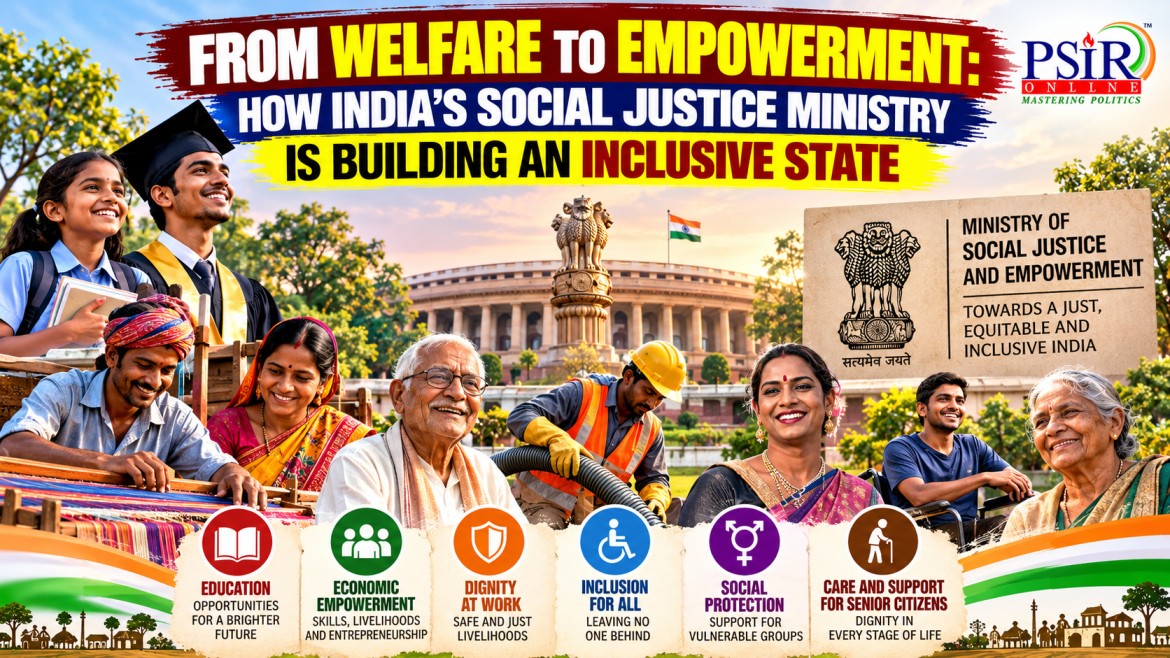
Social justice in India is not merely about providing welfare to those who are poor or vulnerable. It is about addressing historical disadvantage, social exclusion, discrimination and unequal access to opportunities that prevent certain groups from participating on equal terms in society and the economy.
India's constitutional framework therefore places special emphasis on the advancement and protection of disadvantaged sections, while the Union Government has created specialised institutions and programmes to translate these commitments into public policy. Among them, the Ministry of Social Justice and Empowerment (MSJE) occupies a central position.
However, understanding the Ministry requires an important distinction. It is not a general-purpose welfare ministry, nor does it deal with every disadvantaged group or every dimension of social policy. Its mandate is focused on particular communities and specific forms of social disadvantage, while other ministries deal with areas such as tribal development, women and children, minorities, health, education, labour and rural livelihoods.
Therefore, before examining its schemes, it is important to understand what the Ministry is responsible for, whom it caters to, what kind of interventions it provides, and where its mandate ends and that of other institutions begins.
WHAT DOES THE MINISTRY OF SOCIAL JUSTICE AND EMPOWERMENT ACTUALLY DO?
The first point students must understand is that the Ministry of Social Justice and Empowerment (MSJE) is not the Ministry for every form of welfare in India.
Its core responsibility is to address the social, educational and economic empowerment of specifically identified disadvantaged and marginalised groups, while also serving as the nodal department for certain social-justice laws and institutions.
Under the Government of India (Allocation of Business) Rules, the Department of Social Justice and Empowerment is the nodal department for overall policy, planning and coordination concerning Scheduled Castes, Socially and Educationally Backward Classes, Denotified Tribes, Economically Backward Classes and Senior Citizens, with important additional responsibilities relating to manual scavenging rehabilitation, substance-abuse rehabilitation, beggary, social-justice legislation and related institutions.
In simple terms: The Ministry focuses on groups that face structural social disadvantage and require targeted interventions for dignity, opportunity, protection and empowerment.
WHOM DOES THE MINISTRY CATER TO?
The Department's own official overview identifies its principal target groups. These include Scheduled Castes, OBCs, Senior Citizens, victims of substance abuse, Denotified/Nomadic/Semi-Nomadic Tribes, persons engaged in begging, transgender persons, manual scavengers, sewer and septic-tank workers and waste pickers.
|
Target Group |
Broad Nature of Intervention |
|
Scheduled Castes (SCs) |
Educational scholarships, hostels, higher-education support, economic empowerment, skill development, PM-AJAY and measures connected with protection against caste-based discrimination and atrocities. |
|
Other Backward Classes (OBCs) |
Scholarships, hostels, skill development, free coaching, educational support, entrepreneurship and concessional credit through institutions such as NBCFDC |
|
Denotified, Nomadic and Semi-Nomadic Tribes (DNTs) |
Educational support, economic empowerment, housing/livelihood-oriented assistance and targeted interventions under schemes such as SEED. |
|
Economically Backward Classes (EBCs) |
Targeted educational and economic-support measures, including scholarships and educational-loan-related interventions. |
|
Senior Citizens |
Welfare, care and support programmes under the Department's senior-citizen mandate, including the Atal Vayo Abhyuday Yojana framework. |
|
Manual Scavengers |
Rehabilitation and alternative livelihoods, alongside the broader effort to eliminate hazardous sanitation work. |
|
Sewer & Septic-Tank Workers |
Occupational safety, mechanisation, profiling, PPE, livelihood and rehabilitation measures through NAMASTE. |
|
Waste Pickers |
Inclusion within the sanitation and livelihood-security framework, particularly through the evolving NAMASTE architecture. |
|
Transgender Persons |
Rehabilitation, livelihood, skill development, healthcare, shelter and social inclusion under SMILE and related initiatives. |
|
Persons affected by substance abuse |
Prevention, rehabilitation, treatment and social reintegration under the Department's drug-demand-reduction framework. |
|
Persons engaged in begging |
Rehabilitation and livelihood-oriented interventions, including the SMILE framework. |
The target groups are not all defined in the same way. Some are identified primarily through social identity or historical disadvantage — such as SCs, OBCs and DNTs. Others are identified through age or vulnerability — such as senior citizens. Still others are identified through occupation, social exclusion or life circumstances — such as sanitation workers, waste pickers, transgender persons, persons engaged in begging and victims of substance abuse.
WHAT ARE THE MAJOR TYPES OF WORK DONE BY THE MINISTRY?
Rather than memorising dozens of schemes, students should understand the Ministry through its functional areas.
|
Function |
What it means in practice |
|
Educational empowerment |
Scholarships, hostels, coaching, fellowships and higher-education support help disadvantaged groups overcome barriers to educational mobility. |
|
Economic empowerment |
Skill development, entrepreneurship, concessional credit and livelihood programmes seek to convert social protection into productive capability. |
|
Social empowerment |
Programmes address discrimination, social exclusion, dignity and participation in society. PM-AJAY and interventions connected with civil-rights legislation fall within this broader architecture. |
|
Legal and institutional protection |
The Department is associated with implementation/monitoring of the Protection of Civil Rights Act, 1955 and the SC/ST (Prevention of Atrocities) Act, 1989, subject to the allocation of responsibilities specified in the rules. |
|
Rehabilitation |
Rehabilitation is central to interventions concerning manual scavengers, persons engaged in begging and victims of substance abuse. |
|
Occupational dignity and safety |
NAMASTE addresses hazardous sanitation work through mechanisation, safety and livelihood interventions. |
|
Senior-citizen welfare |
The Department has a specific mandate for the care and support of senior citizens. |
|
Research, evaluation and social audit |
The Department also undertakes evaluation, research, data work, social audits, monitoring and policy support for its programmes. |
The Allocation of Business Rules specifically state that the Department is the nodal department for overall policy, planning and coordination for several target groups. But sectoral programmes remain the responsibility of the concerned Central Ministry, State Government or UT administration. Each Central Ministry/Department retains nodal responsibility for its own sector.
Therefore: A person may belong to a target group of the Ministry without every government service received by that person being delivered by the Ministry of Social Justice and Empowerment.
Example: An SC student may receive a scholarship from MSJE. But that student's school education, university administration, healthcare, housing, drinking water, employment, rural livelihood may involve completely different ministries and departments.
WHAT DOES THE MINISTRY NOT PRIMARILY HANDLE?
India has deliberately created specialised ministries/departments for certain dimensions of social disadvantage.
|
Issue / Group |
Primary Union- Level Institutional Responsibility |
Why it is not simply an MSJE subject |
|
Scheduled Tribes |
Ministry of Tribal Affairs |
The Ministry of Tribal Affairs was created in 1999 by bifurcating the then Ministry of Social Justice and Empowerment to provide a more focused approach to ST development. It is now the nodal ministry for overall policy, planning and coordination for ST development. |
|
Women |
Ministry of Women and Child Development |
Women-specific development, protection, empowerment and gender policy fall primarily within MWCD. |
|
Children |
Ministry of Women and Child Development |
Child development, nutrition, protection, early childhood care and related programmes are primarily handled by MWCD. |
|
Religious minorities |
Ministry of Minority Affairs |
The Ministry of Minority Affairs handles overall policy, planning and coordination for notified minority communities and was itself carved out of MSJE in 2006 for a more focused approach. |
|
Persons with disabilities |
Department of Empowerment of Persons with Disabilities (DEPwD) under the same Ministry |
This is an important distinction: disability is within the Ministry of Social Justice and Empowerment, but is handled by a separate Department, not the Department of Social Justice and Empowerment. |
|
General school education |
Ministry of Education |
MSJE provides targeted educational support to particular disadvantaged groups; it does not run India's entire school-education system. |
|
Higher education generally |
Ministry of Education – Department of Higher Education |
MSJE operates targeted scholarships and support for particular social groups, while overall higher-education policy is handled by the education ministry. |
|
Employment and labour rights generally |
Ministry of Labour & Employment |
MSJE addresses targeted livelihood/social-justice issues among specific vulnerable groups; general labour regulation, industrial relations and employment policy belong primarily to the labour ministry. |
|
Rural livelihoods generally |
Ministry of Rural Development |
Programmes such as rural employment and DAY-NRLM are outside MSJE's primary sectoral mandate, even though their beneficiaries may include SCs, OBCs, DNTs and other vulnerable groups. |
|
Food security and PDS |
Department of Food & Public Distribution |
Food security is a broad social-protection function and is not administered primarily through MSJE. |
|
Public health generally |
Ministry of Health & Family Welfare |
MSJE may provide targeted health/rehabilitation support for specific groups, but the national health system is primarily under MoHFW. |
|
Housing and urban development generally |
Ministry of Housing & Urban Affairs / Ministry of Rural Development, depending on context |
MSJE may support targeted vulnerable groups, but general housing policy is handled by the sectoral ministries. |
A single person can simultaneously belong to several policy categories. For example: An elderly tribal woman with a disability living in a rural area may simultaneously fall within the concerns of Tribal Affairs, Social Justice, Disability Affairs, Women & Child Development, Rural Development and Health. But this does not mean six ministries independently provide the same welfare benefit. Instead, different ministries handle different dimensions of her vulnerability.
|
Dimension of vulnerability of that tribal women (see above) |
Relevant institutional response |
|
Tribal identity |
Ministry of Tribal Affairs |
|
Disability |
Department of Empowerment of Persons with Disabilities |
|
Senior citizenship |
Department of Social Justice and Empowerment |
|
Woman-specific concerns |
Ministry of Women and Child Development |
|
Rural livelihood |
Ministry of Rural Development |
|
Healthcare |
Ministry of Health & Family Welfare |
|
Food security |
Department of Food & Public Distribution |
Therefore: Social justice in India is an inter-ministerial responsibility, with MSJE acting as a nodal institution for particular disadvantaged groups and specific social-justice domains.
THE INSTITUTIONAL MAP IN ONE GLANCE
|
IF THE QUESTION CONCERNS... |
THINK PRIMARILY OF... |
|
SCs / OBCs / DNTs / EBCs |
Ministry of Social Justice & Empowerment |
|
Senior Citizens |
Department of Social Justice & Empowerment |
|
Transgender persons |
Department of Social Justice & Empowerment |
|
Manual scavengers / sanitation workers / waste pickers |
Department of Social Justice & Empowerment |
|
Substance-abuse rehabilitation |
Department of Social Justice & Empowerment |
|
Scheduled Tribes / Fifth Schedule / Forest Rights-related tribal policy |
Ministry of Tribal Affairs |
|
Women |
Ministry of Women & Child Development |
|
Children / nutrition / child protection |
Ministry of Women & Child Development |
|
Notified religious minorities |
Ministry of Minority Affairs |
|
Persons with disabilities |
Department of Empowerment of Persons with Disabilities, under MSJE |
|
General education |
Ministry of Education |
|
General health |
Ministry of Health & Family Welfare |
|
Rural employment / SHGs / rural livelihoods |
Ministry of Rural Development |
|
Labour regulation / workers' rights generally |
Ministry of Labour & Employment |
HOW IS THE MINISTRY HELPING BUILD AN INCLUSIVE STATE?
The Ministry's importance lies not merely in the number of schemes it administers, but in the different forms of exclusion that those schemes attempt to address.
Its 2025–26 Annual Report defines the Department's vision as building an inclusive society in which disadvantaged and vulnerable groups can lead productive, safe and dignified lives, supported through educational, economic and social development and rehabilitation where necessary. This approach can be understood through five broad dimensions.
|
Dimension of an Inclusive State |
How the Ministry contributes |
|
1. Inclusion through equal opportunity |
Scholarships, hostels, coaching, higher-education support and programmes such as PM-YASASVI seek to reduce the educational disadvantages faced by OBC, EBC and DNT students. PM-YASASVI covers pre-matric and post-matric scholarships, top-class school and college education and hostels. |
|
2. Inclusion through economic empowerment |
Schemes such as PM-DAKSH, PM-AJAY and development-finance institutions seek to move disadvantaged groups beyond passive welfare towards skills, employment, entrepreneurship and income-generating opportunities. PM-AJAY, for example, combines employment and skill development with infrastructure and educational interventions in SC-dominated areas. |
|
3. Inclusion through dignity and protection |
Social justice is not only about income. It also requires freedom from degrading and hazardous forms of work and protection from discrimination. NAMASTE seeks to formalise and rehabilitate sanitation workers, promote mechanised cleaning and eliminate direct human contact with human waste. |
|
4. Inclusion through rehabilitation and social reintegration |
The SMILE scheme addresses transgender persons and persons engaged in begging through rehabilitation, healthcare, counselling, education, skill development and economic linkages. This represents an attempt to reconnect socially excluded individuals with mainstream social and economic life. |
|
5. Inclusion through participation and dignity in old age |
Senior-citizen interventions recognise that social justice extends across the life cycle. The Ministry's programmes seek to provide care, support and an enabling environment for older persons rather than treating ageing merely as a private family responsibility. |
From welfare to empowerment: The broader significance of this approach is the movement from relief to capability.
· Scholarship attempts to overcome an educational barrier.
· Skill development attempts to create employability.
· Credit and entrepreneurship attempt to create productive capacity.
· Infrastructure support attempts to improve the conditions in which disadvantaged communities live.
· Rehabilitation attempts to restore social and economic participation.
· Occupational safety attempts to protect dignity at work.
· Legal protection attempts to address discrimination and rights violations.
Thus, the Ministry's role is not simply to give something to a disadvantaged person. Its larger objective is to make it possible for that person to participate more equally in society, education and the economy.
The Ministry itself operates within a larger federal and inter-ministerial system. Its schemes frequently depend on States, Union Territories, local bodies, educational institutions, banks, NGOs and community organisations for delivery. For example, SMILE explicitly envisages implementation with State Governments/UTs, local urban bodies, voluntary organisations and community-based organisations. Similarly, the Department's work includes monitoring, social audits, grievance redressal, evaluation and coordination with other Ministries and Departments.
Therefore: An inclusive State is not created by the Ministry of Social Justice alone. It emerges when targeted social-justice interventions converge with education, health, employment, housing, rural development, financial inclusion and legal protection.
CONCLUSION
India's social-justice architecture has gradually moved beyond the idea that disadvantaged communities require only relief or compensation. The contemporary approach increasingly combines education, skills, livelihoods, credit, rehabilitation, social protection, occupational safety and legal protection. The Ministry of Social Justice and Empowerment occupies an important position in this architecture because it focuses on groups facing specific and historically entrenched forms of disadvantage. Its interventions demonstrate an important policy transition: From welfare of the disadvantaged to empowerment of citizens.
Yet, the ultimate measure of social justice is not the number of schemes announced or beneficiaries enrolled. It is whether historically excluded citizens experience greater dignity, capability, opportunity and participation in everyday life. The challenge for India, therefore, is to transform targeted welfare into sustainable social empowerment and ensure that institutional boundaries do not become barriers to integrated service delivery.
RELATED READING
For a comprehensive understanding of this topic, students should connect the Ministry's work with:
GS2 MAINS: PRACTICE QUESTIONS
1. “Social justice in India requires targeted interventions for historically disadvantaged groups rather than a uniform welfare approach.” Discuss with reference to the mandate of the Ministry of Social Justice and Empowerment. (10M) (150 words)
2. The Ministry of Social Justice and Empowerment is not a general-purpose welfare ministry. Explain its institutional mandate and identify the major groups covered by it. (10M) (150 words)
3. “The transition from welfare to empowerment represents a significant evolution in India's approach to social justice.” Examine the role of the Ministry of Social Justice and Empowerment in this transition. (15M) (250 words)
4. “Social justice is an inter-ministerial responsibility rather than the exclusive domain of the Ministry of Social Justice and Empowerment.” Discuss with suitable examples. (15M) (250 words)
