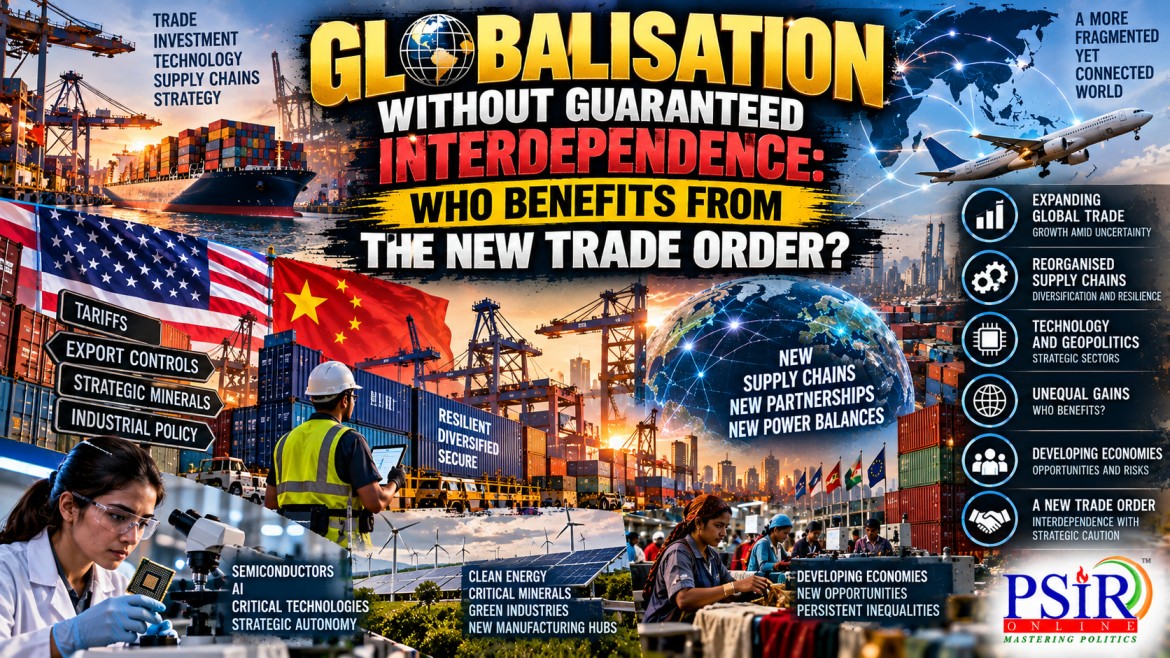
Globalisation was once widely associated with expanding markets, integrated production networks and the growing economic interdependence of states. Contemporary international trade, however, reveals a more complicated reality. Trade continues to expand even as governments seek to reduce strategic vulnerabilities, diversify suppliers and restrict access to sensitive technologies. Interdependence is no longer treated exclusively as a source of prosperity; it is also recognised as a potential instrument of political pressure.
UN Trade and Development’s Global Trade Update (July/August 2026) estimated that global goods trade reached approximately US$13.7 trillion in the first half of 2026, representing a 12.5% increase over the corresponding period in 2025. Services trade grew by 10.5%. However, higher prices, particularly in energy and transport, contributed significantly to the increase in trade values. The expansion therefore did not represent an equivalent increase in the physical volume of global commerce. The report highlighted both the resilience of international trade and its increasingly uneven character.
The emerging order is not defined by the complete retreat of globalisation. Instead, it reflects a transition from cost-efficient integration towards risk-managed interdependence, in which governments and businesses seek access to international markets while retaining greater control over critical technologies, infrastructure and strategic inputs. The central question is no longer simply whether countries participate in global trade, but who captures its gains, who bears its risks and who controls the most valuable stages of production.
THE PARADOX OF EXPANDING TRADE AND STRATEGIC FRAGMENTATION
The apparent contradiction between rising trade and geopolitical fragmentation becomes clearer when the value, volume and composition of trade are distinguished. International commerce can expand even when political relations deteriorate because modern production remains dependent on cross-border inputs, specialised suppliers, consumer markets and services.
UN Trade and Development reported that global trade reached a record value of approximately US$35 trillion in 2025. Its 2026 assessment projected continued growth in goods and services trade, even as geopolitical tensions and economic uncertainty increased. The expansion of artificial intelligence infrastructure, semiconductors, electric vehicles, digital services and clean-energy technologies has created new sources of cross-border demand.
At the same time, governments increasingly scrutinise trade in sectors considered essential to national security or technological leadership. Export controls, investment screening, industrial subsidies and restrictions on sensitive technologies influence where companies invest and whom they choose as suppliers.
This produces a distinctive pattern: economic integration continues, but its geographical and political organisation changes. A company may diversify its production across several countries without abandoning international sourcing. Similarly, states may impose restrictions on advanced chips while continuing to import other goods from the same trading partner.
The distinction is therefore between globalisation as the expansion of economic connections and interdependence as a condition of mutual vulnerability. The former can continue even when the latter becomes politically contested.
FROM COST EFFICIENCY TO RESILIENCE: THE REORGANISATION OF SUPPLY CHAINS
For decades, global value chains were shaped substantially by cost minimisation. Firms located production where labour, logistics, taxation and regulatory conditions offered competitive advantages. The pandemic, geopolitical tensions, transport disruptions and technological competition exposed the vulnerabilities of production networks concentrated in a limited number of locations.
Supply-chain strategies are consequently changing in several ways.
|
Strategy |
Meaning and strategic purpose |
|
Diversification |
Sourcing from multiple countries to reduce dependence on a single supplier or production hub |
|
Nearshoring |
Moving production closer to major consumer markets to reduce logistical exposure |
|
Friendshoring |
Prioritising production or sourcing relationships with politically trusted partners |
|
Vertical integration |
Bringing additional stages of production under the control of the same firm or corporate group |
|
Strategic stockpiling |
Maintaining reserves of critical materials and components against supply disruptions |
|
Industrial policy |
Supporting domestic production in sectors considered economically or strategically essential |
These strategies do not necessarily reduce international trade. Diversification can create new commercial relationships, while relocating one stage of production can increase imports of intermediate goods from alternative suppliers. The result may be a reconfiguration of trade networks rather than their disappearance.
UN Trade and Development’s January 2026 analysis noted that nearly two-thirds of global trade takes place within global value chains. Their restructuring creates opportunities for emerging manufacturing centres, but it may also increase costs and marginalise economies unable to meet new technological, logistical and regulatory requirements.
Resilience is therefore not costless. Maintaining alternative suppliers, duplicating facilities and complying with multiple regulatory regimes can raise production costs. The policy challenge is to reduce excessive dependence without creating inefficient economic isolation.
GEOECONOMICS: WHEN ECONOMIC RELATIONSHIPS BECOME STRATEGIC INSTRUMENTS
The emerging trade order increasingly reflects geoeconomics, the use of economic instruments to pursue geopolitical and national-security objectives. Tariffs, sanctions, export controls, investment restrictions, subsidies and access to critical infrastructure can influence the strategic choices of other states.
The US–China technological rivalry illustrates this transformation. Semiconductors, artificial intelligence, advanced computing, telecommunications and critical minerals are no longer treated merely as commercial sectors. They are also associated with military capabilities, industrial competitiveness and technological sovereignty.
Governments may restrict exports of advanced technologies to prevent strategic competitors from acquiring capabilities considered sensitive. Other states may respond through domestic substitution, counter-restrictions or efforts to develop alternative supply chains. Businesses then face decisions shaped not only by production costs but also by sanctions exposure, political risk and the possibility of sudden regulatory change.
Economic interdependence consequently produces a dual effect. It can raise the cost of conflict because disruption damages both sides. Yet it can also create asymmetric vulnerability when one country controls an indispensable technology, financial network, mineral-processing stage or transport corridor.
The ability to impose costs on another state depends not simply on the volume of trade but on the structure of dependence. A country controlling a critical input may possess greater bargaining power than a larger trading partner that can replace its own exports more easily.
Nevertheless, economic coercion has limits. Restrictions can encourage substitution, stimulate rival technologies, damage domestic firms and redirect trade through third countries. Geoeconomic power is therefore shaped by the durability of technological advantages, the availability of alternatives and the political willingness to bear economic costs.
WHO BENEFITS? THE UNEQUAL DISTRIBUTION OF OPPORTUNITIES
The new trade order creates opportunities for some economies while increasing the barriers faced by others. Its effects depend on productive capabilities, technological access, infrastructure, market size and the ability to negotiate favourable investment arrangements.
Connector economies can benefit when firms relocate production or diversify suppliers across regions. Countries with reliable infrastructure, skilled labour, competitive manufacturing ecosystems and stable policies may attract new investment. Emerging production hubs can gain employment, export earnings and access to international production networks.
However, participation in a supply chain does not automatically produce technological upgrading. An economy may assemble imported components while the highest-value activities—research, design, intellectual property, advanced manufacturing equipment, branding and finance—remain concentrated elsewhere.
UN Trade and Development’s July 2026 analysis of investment in strategic sectors identified a striking concentration of investment. Strategic sectors accounted for 44% of global greenfield investment in 2025, compared with 16% in 2020. Announced project values increased from US$109 billion to US$576 billion over that period. Yet the top three investor economies accounted for 72% of strategic-sector project values in 2025, while the top three recipient economies captured 56%. Low-income and lower-middle-income economies attracted only around 10% of global greenfield investment in strategic sectors between 2020 and 2025.
These patterns reveal a central inequality: the sectors driving the next phase of globalisation are also those in which technological capabilities and investment are highly concentrated.
|
Potential beneficiaries |
Structural disadvantages and risks |
|
Economies with advanced technology and research capacity |
Economies dependent on imported technology and intellectual property |
|
Manufacturing hubs with reliable infrastructure and skilled labour |
Economies with weak logistics, energy systems and industrial ecosystems |
|
States controlling critical minerals, processing or specialised components |
Commodity exporters unable to move into higher-value production |
|
Firms with access to finance, data and international markets |
Small enterprises facing high compliance and financing costs |
|
Countries able to negotiate investment and technology partnerships |
Economies exposed to market concentration and external policy shocks |
The new order may therefore widen the gap between countries that merely participate in international production and those that control its most profitable stages. Trade growth and development gains are not synonymous: the distribution of technology, bargaining power and value addition matters as much as export performance.
DEPENDENCY, LIBERALISM AND THE POLITICS OF INTERDEPENDENCE
The changing trade system challenges simplistic assumptions about both the benefits and the dangers of globalisation. Liberal approaches emphasise the potential of trade to generate mutual gains, deepen cooperation and increase the costs of interstate conflict. Dependency and structural approaches highlight unequal exchange, technological dependence and the concentration of economic power.
The two perspectives illuminate different dimensions of the contemporary order.
From a liberal perspective, international specialisation enables countries to access larger markets, benefit from comparative advantage and obtain goods or technologies that would be expensive to produce domestically. Cross-border investment and supply chains can spread productive knowledge and generate shared economic interests. However, these gains depend on predictable rules, functioning institutions and the capacity of states and firms to adjust to economic change.
Dependency theory draws attention to the unequal structure of these relationships. Economies that rely on primary commodities, low-value assembly or externally controlled technology may remain vulnerable despite increasing exports. Dependence becomes especially consequential when a country cannot easily substitute suppliers, diversify markets or develop domestic technological capabilities.
A structural interpretation also explains why the expansion of trade can coexist with unequal development. The ownership of intellectual property, access to finance and control over production standards may allow dominant firms and economies to capture a disproportionate share of value.
Neither perspective alone fully explains the new order. International trade can generate real gains while simultaneously reproducing inequalities. The decisive issue is the distribution of capabilities and bargaining power within interdependence, rather than the existence of trade itself.
For developing economies, the challenge is to preserve access to global markets while building the industrial, technological and institutional capabilities required to move into higher-value activities.
THE GLOBAL SOUTH AND THE SEARCH FOR STRATEGIC AUTONOMY
The reorganisation of supply chains creates both opportunities and risks for the Global South. The diversification of production can attract investment to emerging manufacturing centres, strengthen South–South trade and reduce dependence on a narrow set of markets. However, technological restrictions, concentrated investment and increasingly demanding standards can also narrow the development pathways available to poorer economies.
Strategic autonomy does not necessarily mean self-sufficiency. Complete economic separation would be expensive and difficult for most countries. A more practical approach combines international integration with the ability to withstand disruptions and negotiate from a stronger position.
Several policy priorities follow:
· Diversify exports and markets: reduce excessive dependence on a small number of products, destinations or suppliers.
· Build domestic productive capacity: strengthen manufacturing ecosystems, logistics, reliable energy supply, skills and research.
· Move up global value chains: encourage domestic firms to develop design, engineering, processing, branding and technological capabilities.
· Strengthen regional and South–South cooperation: expand market access, cross-border infrastructure and complementary production networks.
· Improve access to finance and technology: ensure that developing economies can participate in capital-intensive and technology-intensive sectors.
· Preserve predictable multilateral rules: reduce arbitrary restrictions and improve transparency in trade and industrial policy.
India’s position illustrates the importance of combining integration with capability-building. Its large domestic market, expanding digital services sector and manufacturing ambitions can support participation in changing production networks. Yet sustained gains depend on productivity, logistics, skills, technological innovation and the capacity of domestic firms to move beyond low-value activities.
Strategic autonomy is therefore best understood as the capacity to participate in interdependence without becoming excessively vulnerable to external decisions. Its achievement requires both national investment and a more inclusive international economic system.
THEORETICAL ANGLES
|
Theory or concept |
Connection to the changing trade order |
|
Liberalism and complex interdependence |
Continued trade despite political rivalry demonstrates the persistence of multiple economic connections. However, asymmetric dependence can create vulnerabilities and complicate cooperation. |
|
Dependency theory |
Unequal control over technology, finance and high-value production explains why expanding trade does not necessarily eliminate structural inequalities between core and peripheral economies. |
|
World-systems analysis |
The concentration of advanced technologies and strategic investment illustrates how global production can reproduce hierarchical relationships between core, semi-peripheral and peripheral positions. |
|
Economic nationalism |
Tariffs, subsidies, local-production incentives and strategic stockpiling reflect the priority given to national industrial capacity and economic security. |
|
Geoeconomics |
Export controls, sanctions and investment screening demonstrate how states use economic instruments to pursue strategic objectives. |
|
Realism and relative gains |
Governments may restrict mutually beneficial exchanges when they believe a rival will gain disproportionate economic or military advantages. |
|
Global value-chain theory |
Participation in international production networks can generate employment and exports, but the distribution of value depends on control over technology, design, finance and intellectual property. |
|
Strategic autonomy |
Diversification and domestic capability-building seek to preserve the benefits of interdependence while reducing exposure to external coercion or disruption. |
CONCLUSION
Globalisation is not disappearing; it is becoming more selective, strategic and uneven. International trade continues to expand because production, consumption, technology and services remain interconnected. At the same time, states are attempting to shape those connections according to national-security priorities, industrial objectives and geopolitical alignments.
The resulting order rewards economies that combine market access with technological capabilities, diversified supply chains and institutional strength. It creates new opportunities for emerging production hubs, but it also risks concentrating strategic investment and high-value activities among a relatively small group of economies.
The central challenge is to prevent resilience from becoming a justification for exclusion and strategic autonomy from becoming another name for protectionism. A sustainable trade order must reconcile economic security with openness, technological advancement with development opportunities, and national interests with international cooperation. The future of globalisation will depend not merely on how much the world trades, but on who controls production, who captures value and whether the benefits of interdependence become more broadly shared.
RELATED READING
PRACTICE QUESTIONS FOR GS2 MAINS
PRACTICE QUESTIONS FOR PSIR
