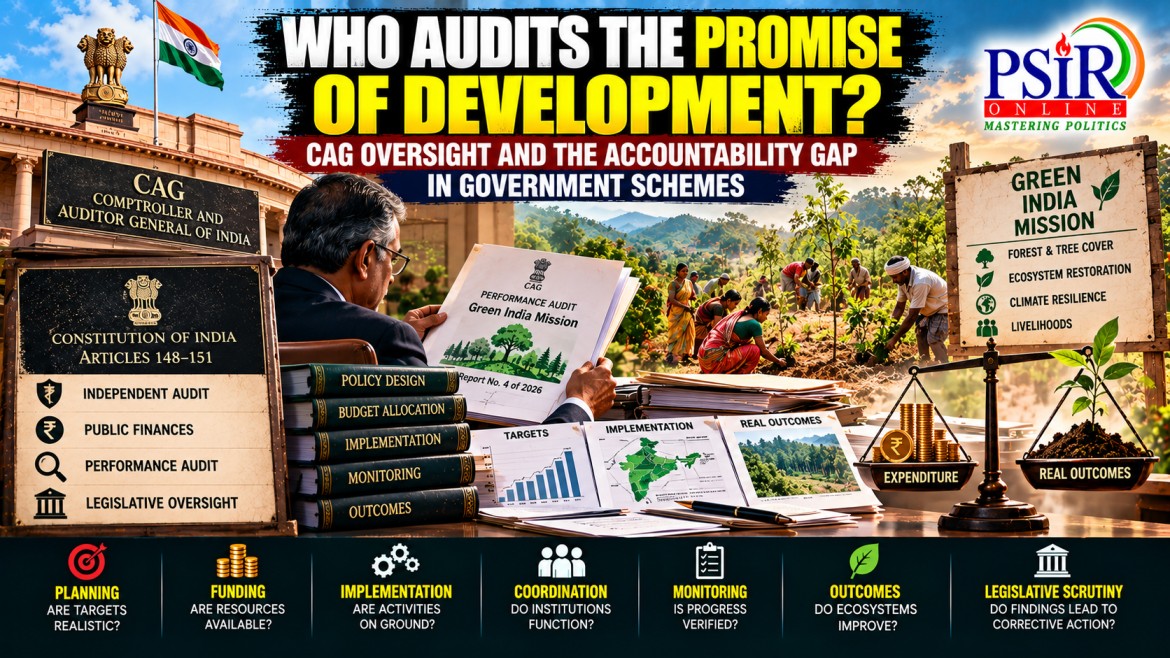
Government schemes translate policy priorities into public expenditure, administrative action and development outcomes. However, the announcement of a target, allocation of funds or completion of administrative procedures does not necessarily establish that a programme has achieved its intended purpose. Public expenditure must be assessed against measurable results, particularly when schemes involve environmental protection, livelihoods and long-term sustainability.
The Comptroller and Auditor General of India (CAG) occupies a central position in this accountability framework. Its constitutional mandate enables independent scrutiny of government finances and programme implementation, while its reports provide legislatures with evidence for examining executive performance. In August 2026, the CAG’s official website listed its Report No. 4 of 2026: Performance Audit on the Green India Mission, concerning the Union Ministry of Environment, Forest and Climate Change. The report was tabled on 12 August 2026
The Green India Mission provides a useful case study of the relationship between policy ambition, financing, implementation and environmental outcomes. The broader governance question is whether audit findings lead to institutional correction and measurable improvements. An audit report matters most when independent evidence leads to legislative scrutiny, executive action and verifiable results.
THE CONSTITUTIONAL MANDATE OF THE CAG
The CAG is a constitutional authority established under Article 148. Its institutional independence is intended to protect public audit from inappropriate executive influence and strengthen legislative scrutiny of government finances.
Articles 149–151 establish the broader constitutional framework governing the CAG’s duties, accounts and reports.
|
Constitutional provision |
Significance for public accountability |
|
Article 148 |
Establishes the office of the CAG and provides safeguards concerning appointment, tenure and service conditions. |
|
Article 149 |
Provides for the CAG’s duties and powers, as prescribed by law. |
|
Article 150 |
Provides that the form of Union and State accounts is prescribed by the President on the advice of the CAG. |
|
Article 151 |
Provides for Union audit reports to be submitted to the President and State audit reports to the Governor, for placement before the respective legislatures. |
The CAG’s duties and powers are primarily governed by the Comptroller and Auditor General’s (Duties, Powers and Conditions of Service) Act, 1971. Its audit work includes financial audit, compliance audit and performance audit, subject to the applicable legal mandate.
Performance auditing is especially relevant to development programmes because it examines whether public resources have been used economically and efficiently and whether programme objectives have been achieved effectively. It can identify weaknesses in planning, financing, coordination, implementation and monitoring.
The CAG does not ordinarily replace the executive as the authority responsible for designing or implementing policy. Nor does an adverse audit observation automatically establish corruption or criminal liability. Its role is to provide independent evidence that enables legislatures and competent authorities to demand explanations and corrective action.
Constitutional independence gives the CAG credibility; effective legislative follow-up gives its findings practical significance.
GREEN INDIA MISSION: FROM POLICY AMBITION TO ENVIRONMENTAL OUTCOMES
The Green India Mission (GIM) is part of the National Action Plan on Climate Change. It seeks to improve the quality of forest and tree cover, restore degraded landscapes, strengthen ecosystem services and support forest-based livelihoods. The mission also contributes to India’s broader environmental and climate objectives.
The Ministry of Environment, Forest and Climate Change reported in an official parliamentary response dated 10 August 2026 that the mission had brought 1,84,467 hectares under eco-restoration in 17 States and one Union Territory since 2015–16. This is an administrative implementation figure; by itself, it does not establish the ecological quality, long-term survival or wider environmental impact of the restoration work.
The CAG’s performance audit, tabled on 12 August 2026, provides a separate institutional assessment of the mission. The report’s official listing confirms its existence, title and tabling date. However, numerical findings should be quoted only after checking the relevant pages of the primary report, including the definitions, sampling methodology and period to which each figure relates.
The distinction between administrative reporting and independent audit is essential. An implementing ministry may report hectares treated, funds released or activities completed. A performance audit can examine whether these activities complied with the approved framework and whether the evidence supports the claimed results.
|
Dimension of assessment |
Key accountability question |
|
Policy design |
Were objectives, targets, responsibilities and timelines clearly defined? |
|
Financial planning |
Were sufficient resources identified and made available when required? |
|
Implementation |
Were activities undertaken at appropriate locations and according to the approved plan? |
|
Coordination |
Did participating ministries, State agencies and local institutions fulfil their responsibilities? |
|
Environmental outcomes |
Did the interventions produce measurable and sustained ecological improvement? |
|
Independent verification |
Can reported achievements be substantiated through reliable field evidence and appropriate monitoring? |
The central issue is not whether expenditure occurred, but whether it produced the intended public value. Hectares treated, funds spent and activities completed are outputs; sustained ecological improvement is an outcome. Both matter, but they measure different aspects of programme performance.
THE GOVERNANCE GAPS THAT PERFORMANCE AUDITS CAN EXPOSE
The Green India Mission illustrates the kinds of institutional weaknesses that performance audits are designed to identify. Specific deficiencies must be attributed to the audit report after checking its detailed findings; nevertheless, the governance questions involved are relevant to development schemes generally.
First, planning must be operational. A scheme may have ambitious targets, but targets require clear implementation guidelines, assigned responsibilities, realistic milestones and measurable indicators. Where these elements are absent or delayed, implementing agencies may struggle to translate policy objectives into coordinated action.
Second, financing arrangements must be credible. Some programmes depend on convergence with other government schemes to combine financial resources and administrative capacity. Such convergence can reduce duplication, but it becomes a source of risk when anticipated contributions are not secured or when responsibilities for funding and execution remain unclear.
Third, institutional coordination must function in practice. National, State and district-level bodies need defined roles, regular meetings and reliable reporting mechanisms. Formal committees cannot ensure coordination unless they make timely decisions, resolve implementation problems and follow up on agreed actions.
Fourth, implementation must reflect the purpose of the scheme. In environmental programmes, site selection should be guided by ecological suitability and restoration priorities rather than administrative convenience alone. The number of activities completed is not sufficient to demonstrate that interventions have been directed towards the locations where they are most needed.
Fifth, monitoring must verify outcomes. Administrative records can establish that activities were reported as completed, but they may not establish whether the intended results persisted. Field inspections, geospatial analysis, independent sampling and scientifically appropriate indicators can help assess the difference between reported progress and actual outcomes.
These issues are interconnected. Weak planning can create funding delays; uncertain funding can disrupt implementation; fragmented coordination can weaken monitoring; and inadequate verification can allow poor results to remain undetected.
Performance auditing examines this chain of implementation rather than treating expenditure as proof of success.
FROM AUDIT REPORTS TO LEGISLATIVE ACCOUNTABILITY
The constitutional audit system connects independent scrutiny with legislative financial control. Under Article 151, Union audit reports are submitted to the President for placement before Parliament, while State audit reports are submitted to the Governor for placement before the State Legislature.
At the Union level, the Public Accounts Committee (PAC) examines CAG reports and scrutinises issues relating to public expenditure within its remit. The Committee on Public Undertakings examines matters concerning public-sector undertakings within its jurisdiction. Department-related standing committees also scrutinise ministries, programmes and budgetary demands.
These institutions form an important link between audit evidence and executive accountability. The CAG documents findings; legislative committees examine the issues and may seek explanations from departments or recommend corrective measures; the executive remains responsible for implementing policy and responding to identified deficiencies.
However, the tabling of an audit report does not automatically ensure that its findings are resolved. Recommendations may require administrative changes, additional verification, recovery of amounts where legally warranted or revision of programme procedures.
The accountability chain remains incomplete when audit findings are recorded but corrective action is neither tracked nor verified.
Effective follow-up should identify the department responsible for each finding, the action required, the deadline and the evidence needed to demonstrate compliance. Legislative scrutiny should distinguish between recommendations that have been implemented, those still under consideration and those for which adequate action remains outstanding.
The CAG does not itself impose every corrective measure or determine criminal liability. Its findings must be acted upon through the appropriate legislative, administrative, financial or legal processes.
STRENGTHENING PERFORMANCE AUDITS AND OUTCOME-BASED GOVERNANCE
The Green India Mission case highlights reforms that can strengthen accountability across government schemes.
Outcome-linked budgeting: Major programmes should specify clear output and outcome indicators, realistic milestones and the institutional responsibilities attached to each target. Budget proposals should explain how expenditure is expected to produce measurable results.
Assured convergence arrangements: Where a scheme depends on funds or activities from other programmes, the participating departments should have clearly defined responsibilities, financing commitments and mechanisms for resolving implementation disputes.
Independent verification: Administrative claims should be tested through field inspections, appropriate sampling, geospatial evidence and other reliable methods. In environmental programmes, monitoring should assess not only planting activity but also survival, ecological suitability and sustained restoration.
Stronger local monitoring: District and State institutions should maintain reliable records, meet as prescribed and respond to implementation problems. Gram Sabhas, local communities and forest-dependent groups, where relevant, can contribute knowledge about site suitability, plantation survival and environmental change.
Time-bound action-taken reports: Ministries should provide detailed responses to significant audit findings and disclose the status of corrective measures. Legislative committees should be able to track unresolved observations and assess whether the action taken addresses the underlying problem.
Appropriate use of technology: Satellite imagery, geographic information systems and digital financial records can improve monitoring, but technology should supplement rather than replace field verification and professional judgement. Data systems must preserve audit trails, identify inconsistencies and support scrutiny.
These reforms would help shift governance from a narrow focus on expenditure and administrative completion towards verified outputs, sustainable outcomes and demonstrable public value.
UPSC DIMENSION
|
Constitutional provision or governance concept |
Relevance |
|
Article 148 |
Establishes the CAG and safeguards the independence of the office. |
|
Article 149 |
Provides the constitutional basis for the CAG’s legally prescribed duties and powers. |
|
Article 150 |
Connects the form of government accounts with the advice of the CAG. |
|
Article 151 |
Establishes the process for submitting audit reports and placing them before legislatures. |
|
Parliamentary financial control |
Enables elected legislatures to scrutinise expenditure and hold the executive accountable. |
|
Public Accounts Committee |
Examines CAG reports and public expenditure issues within its remit. |
|
Performance auditing |
Assesses economy, efficiency and effectiveness in programme implementation. |
|
Outcome budgeting |
Connects expenditure and administrative activity with measurable policy results. |
|
Cooperative governance |
Highlights the need for coordination when programmes depend on Union, State and local institutions. |
|
Environmental governance |
Links public expenditure, ecological restoration, biodiversity and measurable climate outcomes. |
|
Social accountability |
Encourages transparency, community participation and scrutiny of programme delivery. |
|
Digital governance and audit |
Uses reliable databases, digital financial records and geospatial tools to improve verification. |
CONCLUSION
The Green India Mission audit provides a timely basis for examining the relationship between independent scrutiny and development accountability. Its constitutional significance lies within the wider system established by Articles 148–151, which connects the CAG’s independent audit function with legislative oversight of public finances.
The central lesson is that development accountability cannot stop at budget allocations, administrative reports or announced targets. It requires realistic planning, credible financing, functioning institutions, reliable monitoring and evidence that the intended outcomes have been achieved.
An audit report becomes an instrument of better governance when evidence leads to explanation, legislative scrutiny and verifiable corrective action. In environmental policy, this means assessing not merely expenditure recorded or activities completed, but whether ecosystems have recovered and the intended benefits have been sustained.
RELATED READING
PRACTISE QUESTIONS FOR GS2 MAINS
PRACTISE QUESTIONS FOR PSIR
