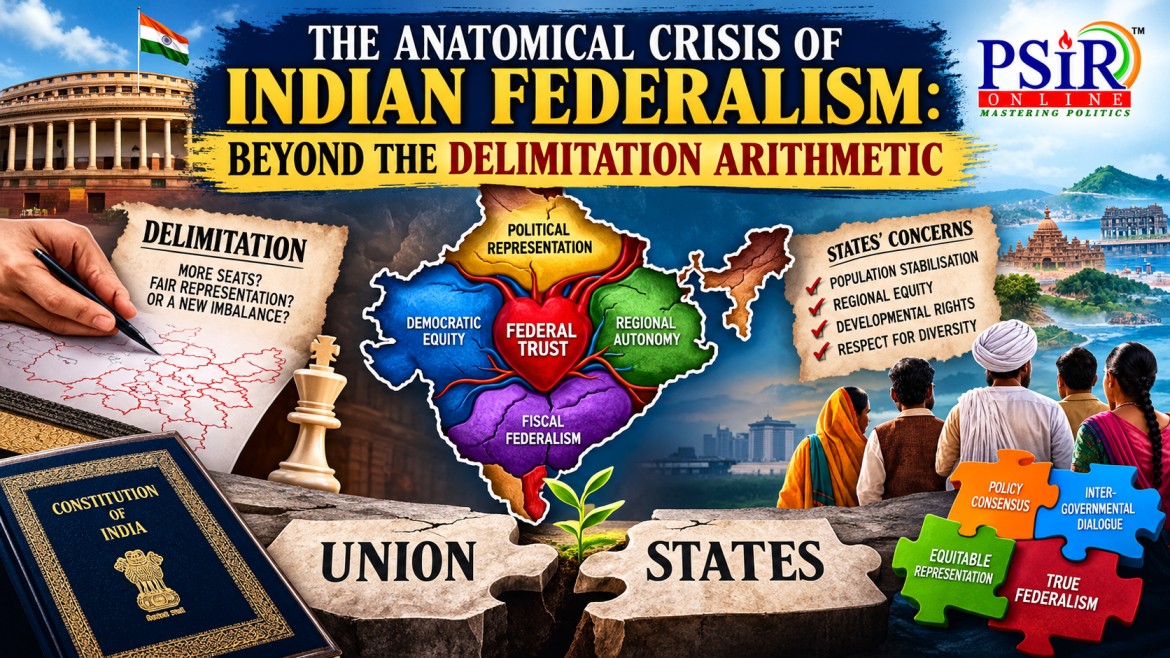
The deadlock over the Constitution (131st Amendment) Bill, 2026 and the proposed delimitation package is not an isolated electoral dispute. It is the culmination of a decades-long erosion of federal trust. The standoff over raw population vs. democratic representation exposes a deeper constitutional disease: India’s Union-state architecture has drifted into an over-centralized, coercive apparatus where states are systematically bypassed, fiscally constrained, culturally uniformized, and politically disempowered.
In Federalist No. 45 and 51, James Madison argued that federalism exists as a structural check against tyranny and the unchecked hegemony of a national faction. Madison noted that the powers delegated to the federal government were "few and defined," while those remaining with the states were "numerous and indefinite," ensuring that local governments formed an impenetrable barrier against majoritarian overreach.
In India, that founding logic has been inverted. What B.R. Ambedkar envisioned as an indestructible Union composed of distinct constitutional partners has increasingly mutated into an administrative monolith where central dominance dictates local outcomes.
THE REAL PILLARS OF TRUST EROSION: A MULTI-FRONT RETROGRESSION
The southern and western states' backlash against delimitation cannot be understood in a vacuum. It represents the breaking point of cumulative administrative, fiscal, and socio-cultural grievances.
A. The Linguistic and Cultural Bulldozer
Under the guise of administrative efficiency and national integration, linguistic autonomy has faced sustained pressure:
· The Backdoor Infiltration of Hindi: Recommendations from the Parliamentary Committee on Official Language pushing Hindi as the medium of instruction in central institutes (IITs, IIMs, central universities) and competitive exams systematically disadvantage non-Hindi mother-tongue populations.
· Symbolic Erasure: Renaming central legislations exclusively into Sanskritized Hindi phrases (such as the Bharatiya Nyaya Sanhita and allied criminal codes), alongside branding central welfare schemes exclusively in Hindi nomenclature, forces state governments—even in non-Hindi speaking regions—to finance and market central programs in a tongue alien to their electorates.
B. Encroachment on the State List: Committee Governance & Parastatals
The Seventh Schedule is being rendered functionally obsolete through administrative and statutory backchannels:
· Health and Agriculture (Entries 6 & 14, List II): Although public health is a State subject, the Union has established statutory central authorities, standardized testing protocols (such as NEET through the National Medical Commission), and digital health ecosystems (Ayushman Bharat Digital Mission) that displace state-specific medical infrastructure and historic affirmative-action pipelines.
· Cooperative Societies: The creation of a dedicated Union Ministry of Cooperation and the enactment of the Multi-State Co-operative Societies (Amendment) Act directly infringed upon what has historically been a state-controlled economic grassroots base (Entry 32, List II).
· Technocratic Centralization via "Conditionalities": Centrally Sponsored Schemes (CSS) force states to lock up substantial matching funds (often 40% to 50%) into rigid, centrally planned templates. This strips state cabinets of the fiscal freedom to design policy suited to local realities, turning state administrations into mere franchise outlets for Union ministries.
C. Fiscal Extraction And The Mirage Of 41% Devolution
The headline devolution figure determined by the Finance Commission has been hollowed out by statutory mechanics:
· The "Cess and Surcharge" Loophole: Under Articles 270 and 271, revenues gathered through cesses and surcharges do not enter the divisible pool shared with the states. Between 2011 and 2026, the share of cesses and surcharges in the Union’s Gross Tax Revenue (GTR) rose from under 10% to approximately 14–20%. While the 15th Finance Commission officially prescribed a 41% devolution to states, the effective vertical transfer has hovered near 30–32% of gross taxes.
· GST Council Asymmetries: The implementation of the Goods and Services Tax (GST) stripped states of over 70% of their indirect tax sovereignty (e.g., VAT, luxury tax, octroi). The voting architecture of the GST Council—where the Union commands an effective 33.3% veto alongside a simple one-state-one-vote rule—disadvantages manufacturing and export-heavy states that generate high consumption tax but are easily outvoted by geographically clustered states.
· Double Fiscal Penalty on Performance: The 15th Finance Commission’s shift to the 2011 Census (with a 45% weight on Income Distance and only 12.5% for Demographic Performance) systematically transfers resources from states with high per capita incomes and low birth rates to states lagging in administrative efficiency and population control.
D. The Neutrality Deficit: The Role of the Gubernatorial Office
Rather than acting as constitutional elder statesmen, Governors have frequently converted Raj Bhavans into parallel administrative secretariats:
· Weaponizing Article 200 by indefinitely sitting on, pocket-vetoing, or referring state legislative bills to the President without constitutional timelines, stalling laws passed by elected state legislatures.
· Politicizing Vice-Chancellor appointments in state-funded universities, using chancellor roles to override state higher education policies.
THE DELIMITATION THREAT: THE CULMINATION OF DISENFRANCHISEMENT
The debate reignited in August 2026 directly connects to this pre-existing structural deficit. Southern states (Tamil Nadu, Kerala, Andhra Pradesh, Telangana, Karnataka) and certain western/eastern states feel that complying with national directives has only weakened their political agency:
Decades of Human Development & Population Control
(TFR dropped to ~1.5 - 1.7)
↓
Lower Relative Population Weight in Updated Census
↓
Loss of Relative Representation in the Lok Sabha
(e.g., UP/Bihar expand massively, South shrinks proportionally)
↓
Diluted Voice in Parliament to Contest Linguistic, Fiscal, and Federal Encroachment
When democratic representation is reduced strictly to raw headcount, India risks establishing an enduring majoritarian bloc where a political coalition can form a national government by winning seats purely across the Hindi-speaking belt—completely bypassing the peninsular, northeastern, and border states. This strips the constitutional compact of Madisonian checks and balances.
WHAT THE UNION MUST DO TO REGAIN FEDERAL TRUST
Trust cannot be rebuilt through rhetorical appeals to "cooperative federalism." It requires legally binding concessions and administrative self-restraint:
|
Core Area |
The Concrete Reform |
Legal / Institutional Pathway |
|
Delimitation Safeguards |
Enact a constitutional floor stipulating that no state’s proportional share of the Lok Sabha can drop below its 1971 baseline, irrespective of how many seats are added overall. |
Constitutional Amendment via Article 368 with mandatory ratification by at least half the state legislatures. |
|
Plugging the Fiscal Drain |
Amend Article 270 to cap cesses and surcharges at a hard 5% of Gross Tax Revenue, mandating that all collections beyond that automatically enter the divisible pool. |
Constitutional Amendment; binding terms of reference for the 16th/17th Finance Commissions. |
|
Ending Backdoor Governance |
Impose a strict 60-day limit for Governors to grant assent or return bills under Article 200, strictly implementing the recommendations of the Sarkaria and Punchhi Commissions. |
Supreme Court constitutional bench ruling or an amendment to Article 200. |
|
Linguistic Parity |
Grant official language status to all 22 languages listed in the Eighth Schedule for national competitive exams, official notifications, and statutory branding. |
Statutory revision of the Official Languages Act, 1963. |
|
Institutionalizing Consent |
Grant constitutional teeth to the Inter-State Council (Article 263), mandating that any bill affecting the Concurrent List must receive 50% state concurrence in the ISC before parliamentary introduction. |
Statutory charter for the ISC Secretariat, decoupling it from the Ministry of Home Affairs. |
REIMAGINING "TRUE FEDERALISM" IN THE INDIAN REPUBLIC
True federalism is not an administrative convenience granted by the Union; it is the constitutional foundation that keeps a continental-scale republic united. If India is to honor both democratic equality and its federal compact, three institutional pivots are non-negotiable:
1. Symmetric Bicameralism: Equalizing the Rajya Sabha
The fundamental institutional flaw in India's Parliament is that the Rajya Sabha mirrors the Lok Sabha’s demographic logic. If the Lok Sabha is the House of the People, the Rajya Sabha must become a true Council of the States. India must follow the American model of equal state representation (e.g., 4 to 6 seats per state regardless of population) or the German Bundesrat model (a capped, tiered allocation with block voting). This ensures that no single demographic region can alter the basic structure of the Constitution without the active consent of diverse federating units.
2. Fiscal Federalism Based on Subsidiarity
Government power should be handled by the smallest, lowest, or least centralized competent authority. The Union must focus on sovereign national matters: defense, foreign policy, interstate commerce, and macroeconomic stability. Policy design for health, primary education, policing, agriculture, and welfare must revert unencumbered to the states, accompanied by unconditional, formula-driven tax transfers rather than tied, conditional grants.
3. Asymmetric Equality as a Constitutional Asset
India's survival as a democratic entity rests on its ability to embrace internal differences. Uniformity is not unity. Articles 371 through 371-J, special tribal self-governance provisions, and linguistic identities are essential checks against majoritarian friction.
Federalism in India was not an accident; it was the essential condition under which diverse princely states and linguistic regions agreed to form a sovereign democratic republic. If the Union continues to prioritize a majoritarian electoral footprint over the legitimate interests of its constituent states, it does not merely redraw constituency maps—it risks dissolving the constitutional glue that holds the Union together.
PSIR THEORETICAL DIMENSION & EXAMINATION LINKAGES
|
PSIR Theoretical Dimension & Concepts |
How It Connects to Answer Writing (PSIR Paper 1 / Paper 2) |
|
Madisonian Federalism & Separation of Powers (Federalist No. 45 & 51) |
Institutional Checks Against Tyranny of the Majority: Frame delimitation beyond raw demographic counts. Use Madison’s thesis—that local jurisdictions form barriers against a national faction—to argue that reducing representation strictly to population creates a permanent majoritarian heartland bloc, undermining federal checks and balances. |
|
"Indestructible Union of Indestructible States" (B.R. Ambedkar; Comparative Federalism) |
Constitutional Architecture vs. Administrative Monolith: Contrast Ambedkar’s conception of distinct constitutional partners with the contemporary reality of the Indian state drifting toward a centralized administrative apparatus. Shows the tension between Article 1 (Union of States) and the unitary tilt enforced through central statutory authorities. |
|
Fiscal Federalism & The Principle of Subsidiarity (Wallace Oates; Charles Tiebout) |
De-Facto Recentralisation via Fiscal Engineering: Analyze how the Union exploits the Article 270/271 loophole (cesses and surcharges) to reduce effective vertical transfers from the headline 41% to ~30–32%. Couple this with rigid conditionalities in Centrally Sponsored Schemes (CSS) to demonstrate how fiscal extraction strips states of policy discretion and subverts subsidiarity. |
|
Symmetric vs. Asymmetric Bicameralism (Arend Lijphart – Patterns of Democracy) |
Reforming the Council of States (Rajya Sabha): Highlight the institutional flaw that Rajya Sabha reflects the Lok Sabha's demographic logic. Connect to comparative models (US Senate equality or German Bundesrat block voting) to argue that federal bicameralism must check demographic majoritarianism in the lower house. |
|
"Holding Together" vs. "Coming Together" Federalism (Alfred Stepan) |
The Fragility of the Federal Compact: Stepan categorized India as a "holding together" federation built on explicit bargains. Use this to explain how demographic penalties on performance-driven southern states dissolve the historic political compromise reached in 1976 (freezing seats at the 1971 census baseline). |
|
Multiculturalism & Asymmetric Citizenship (Will Kymlicka; Charles Taylor) |
Linguistic Autonomy vs. Cultural Majoritarianism: Evaluate the centralization of language (official recommendations, Sanskritized renaming of criminal codes, Hindi scheme nomenclature). Connect to Kymlicka’s theory of minority rights, arguing that federal stability requires recognizing internal linguistic differentiation rather than enforcing cultural uniformity. |
|
Gubernatorial Discretion & Constitutional Morality (B.R. Ambedkar; Granville Austin) |
Erosion of Neutrality & Executive Paralysis: Analyze the weaponization of Article 200 (pocket-vetoing state bills, delaying assent, and university chancellorship contestations). Frame Governors not as constitutional elder statesmen, but as instruments of central oversight that violate constitutional morality and state legislative supremacy. |
|
Consociational Democracy & Power-Sharing (Arend Lijphart) |
Institutionalizing Consent via Article 263: Address the demand to empower the Inter-State Council (ISC) with mandatory concurrence on Concurrent List legislation. Illustrate how consociational mechanisms and institutional vetoes prevent the alienation of regional units in deeply divided or territorially diverse polities. |
CONCLUSION
The contemporary crisis of Indian federalism is not a mere arithmetic dilemma born of electoral boundary redrawing; it is a structural crisis of constitutional trust. Decades of fiscal centralisation through cesses and surcharges, linguistic homogenization, gubernatorial overreach under Article 200, and technocratic displacement of the Seventh Schedule have hollowed out the constitutional compact between the Union and the States. Reducing democratic representation solely to population headcount threatens to reward demographic inertia while penalizing sub-national developmental success, establishing an enduring majoritarian hegemony that bypasses the peninsular, border, and northeastern states. If India is to sustain itself as a united, continental republic, it must move beyond rhetorical appeals to "cooperative federalism" and commit to structural institutional reform: entrenching a representational floor based on the 1971 census baseline, capping fiscal extraction, reforming the Rajya Sabha into a genuine guardian of state equality, and honoring asymmetric diversity as a vital constitutional asset rather than an administrative inconvenience.
RELATED READING & ANALYTICAL ANGLES
· Constitutional Articles & Judicial Doctrines:
o Articles 82 & 170: Delimitation mechanics, the history of the 42nd and 84th Constitutional Amendments, and the constitutional freeze on Lok Sabha seat allocation based on the 1971 Census.
o Articles 200 & 201: Gubernatorial assent, pocket vetoes, presidential reservation, and recent Supreme Court jurisprudence on gubernatorial timelines (State of Punjab v. Principal Secretary to Governor, 2023).
o Articles 269, 270, and 271: Divisible pool mechanics, the expanding share of cesses/surcharges, and the erosion of vertical fiscal transfers.
o Article 263: The Inter-State Council as an under-utilized institutional architecture for federal dispute resolution and consensus-building.
o Basic Structure Doctrine (S.R. Bommai v. Union of India, 1994): Judicial entrenchment of federalism as an unamendable core feature of the Constitution.
· Commissions on Centre–State Relations:
o Sarkaria Commission Report (1988): Recommendations on consulting Chief Ministers on Gubernatorial appointments, restraint in Concurrent List legislation, and activating the Inter-State Council.
o Punchhi Commission Report (2010): Specific proposals regarding Article 200 timelines (fixed six-month cap for Governors), guidelines on discretionary powers, and localized emergency provisions.
o 15th and 16th Finance Commission Terms of Reference: The political economy debate over using the 2011 Census versus rewarding demographic performance (Total Fertility Rate reductions).
· Comparative Federal Models & Theoretical Formulations:
o Alfred Stepan: "Federalism and Democracy: Beyond the U.S. Model" (The conceptual distinction between "Coming-Together", "Holding-Together", and "Putting-Together" federations).
o Arend Lijphart: Consociationalism, federal bicameralism, and executive power-sharing in deeply divided, multi-linguistic societies.
o Louise Tillin: Indian Federalism (Oxford India Short Introductions) and Remapping India (territorial politics, regional identity, and state reorganization).
o Chanchal Kumar Sharma: Studies on "coercive federalism," fiscal centralization, and the politics of conditionalities in Centrally Sponsored Schemes.
PRACTICE QUESTIONS FOR PSIR
