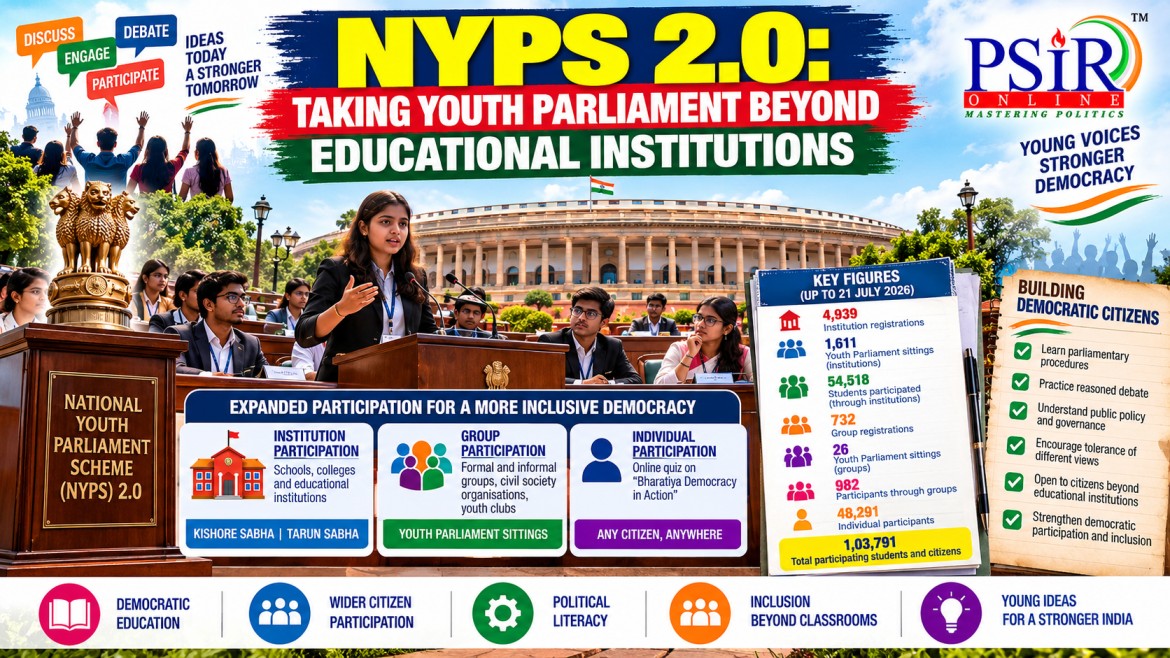
Democracy requires more than periodic elections. Citizens also need to understand how legislatures function, how public issues are debated, how governments are held accountable and how competing viewpoints can be reconciled through discussion. The National Youth Parliament Scheme (NYPS) 2.0 seeks to promote this understanding by expanding participation in simulated parliamentary activities beyond the conventional educational setting.
The Ministry of Parliamentary Affairs launched the upgraded NYPS 2.0 portal on 11 September 2024. Unlike the earlier portal, which primarily served students of recognised educational institutions, the upgraded scheme provides three modes of participation: institutional participation, group participation and individual participation. The expansion creates opportunities for schools, colleges, citizen groups and individuals to engage with parliamentary procedures and democratic values.
The central governance question is whether this wider access can translate into deeper political literacy, more inclusive participation and sustained democratic engagement.
WHAT IS NYPS 2.0?
The Ministry of Parliamentary Affairs uses the Youth Parliament Programme to familiarise participants with parliamentary procedures, debate, discipline, tolerance of opposing views and democratic practices. The portal also provides learning resources, including tutorials, literature and training videos.
NYPS 2.0 broadens the scheme through three participation channels:
|
Participation mode |
How it works |
Governance significance |
|
Institution participation |
Schools and higher educational institutions organise Youth Parliament sittings. The programme includes Kishore Sabha for school students and Tarun Sabha for undergraduate and postgraduate students. |
Integrates parliamentary learning into educational activities. |
|
Group participation |
Citizens form formal or informal groups and organise Youth Parliament sittings. |
Opens a route for participation outside conventional educational institutions. |
|
Individual participation |
Citizens participate in the online quiz on “Bharatiya Democracy in Action”. |
Offers an individual entry point for parliamentary awareness without requiring membership of a participating institution or group. |
The three channels represent different forms of engagement. Institutional and group participation can involve collective preparation and simulated debate, while individual participation provides a more direct, self-paced route to parliamentary awareness. These activities should therefore be assessed separately rather than treated as identical experiences.
WHAT DO THE PARTICIPATION FIGURES TELL US?
A Press Information Bureau release dated 10 August 2026, reporting information provided to the Rajya Sabha, recorded the following participation under NYPS 2.0 from its launch on 11 September 2024 to 21 July 2026.
|
Indicator |
Officially reported figure |
|
Institutional registrations |
4,939 |
|
Youth Parliament sittings organised by institutions |
1,611 |
|
Students participating through institutions |
54,518 |
|
Group registrations |
732 |
|
Youth Parliament sittings organised by groups |
26 |
|
Participants through groups |
982 |
|
Individual participants |
48,291 |
|
Total participating students and citizens |
1,03,791 |
These figures show that the scheme has created multiple entry points for parliamentary awareness. Institutional participation accounted for 54,518 students, while individual participation accounted for 48,291 citizens. The group category recorded 982 participants across 26 sittings.
The figures nevertheless require careful interpretation.
First, registrations are not the same as participation. The number of institutions or groups registered indicates potential reach, whereas the reported participant totals capture engagement recorded under the scheme.
Second, the number of sittings indicates programme activity, but does not independently establish the quality of debate, the depth of learning or the extent to which participants understand legislative processes.
Third, the figures do not, by themselves, demonstrate that participants became more politically informed, more tolerant of opposing viewpoints or more active in democratic life. Establishing those outcomes requires assessment beyond portal statistics.
The reported total of 1,03,791 is therefore best understood as an indicator of recorded programme reach, not proof of a corresponding improvement in democratic knowledge or civic behaviour.
DEMOCRATIC EDUCATION BEYOND THE CLASSROOM
The expansion of Youth Parliament activities beyond educational institutions is significant because political learning does not occur only in schools and universities. Citizens encounter public issues through local associations, community organisations, social networks, voluntary groups and everyday interactions with public institutions.
NYPS 2.0 creates an opportunity to connect parliamentary learning with these wider settings. Citizen groups can potentially organise discussions around public policy, social justice, welfare delivery, education, health and economic development. Individual participation offers a separate route for people who may not have access to a formal Youth Parliament programme.
This broader approach is consistent with democratic citizenship education: citizens learn not only about political institutions but also about reasoned disagreement, representation, accountability and the responsibilities associated with democratic participation.
The scheme's official guidelines encourage discussion of welfare activities, social justice, economic development, education, health and other public issues. They also emphasise discipline and tolerance of others' views. Participants may speak in any Scheduled language, preferably Hindi or English.
However, widening eligibility does not automatically guarantee equal participation. People with limited internet access, lower digital literacy, language barriers or fewer opportunities to organise may remain underrepresented. Effective inclusion requires the programme to be accessible not only in principle but also in practice.
GOVERNANCE OPPORTUNITIES: INCLUSION, POLITICAL LITERACY AND PARTICIPATION
NYPS 2.0 can contribute to democratic governance through several interconnected pathways.
First, it can improve institutional awareness. Simulated parliamentary proceedings can help participants understand the roles of legislators, debate procedures, public policy questions and the importance of reasoned argument.
Second, it can create spaces for democratic dialogue. Youth Parliament activities can encourage participants to listen to different viewpoints, formulate arguments and engage with disagreement without treating it as inherently illegitimate.
Third, it can broaden access to civic learning. Group and individual participation reduce the scheme's dependence on formal institutional membership. This is particularly relevant for citizens who are outside conventional school or university settings.
Fourth, it can strengthen the connection between public policy and citizen understanding. Discussions of social justice, welfare schemes and economic development can help participants relate parliamentary institutions to the decisions that affect everyday life.
These are plausible contributions rather than guaranteed outcomes. Their realisation depends on the quality of learning materials, facilitation, participation opportunities and follow-up activities.
The Ministry has reported outreach efforts involving State Governments, Union Territory Administrations, State and Union Territory legislatures, educational boards such as CBSE and CISCE, and publicity through Sansad TV. Such outreach can increase awareness, but its effectiveness should be assessed through evidence of participation across regions and social groups.
IMPLEMENTATION CHALLENGES AND MEASURING IMPACT
The principal challenge is to move from counting participation to assessing learning and democratic engagement.
Digital access and inclusion: An online portal can reduce geographical barriers, but connectivity, device availability, digital literacy and language accessibility can still affect who participates. Outreach should include rural communities, small institutions and groups that may lack established organisational support.
Quality of participation: A Youth Parliament sitting can become a procedural exercise if participants merely reproduce speeches or memorise formalities. Meaningful learning requires preparation, evidence-based arguments, opportunities to question claims and respectful engagement with opposing views.
Political neutrality and pluralism: Parliamentary awareness initiatives should familiarise participants with democratic institutions without becoming exercises in partisan promotion. Activities should encourage critical understanding of institutions, constitutional values and competing public-policy arguments.
Monitoring and evaluation: The Ministry's reported figures establish participation and activity levels, but a stronger assessment framework could examine what participants learn and retain. Useful indicators would include pre- and post-programme assessments, understanding of parliamentary procedures, ability to distinguish evidence from assertion, quality of debate and feedback on inclusion.
Continuity after participation: A certificate or one-time quiz may recognise participation, but sustained democratic engagement requires opportunities for further learning. Follow-up discussions, local civic activities, repeat participation and access to reliable parliamentary information could help connect the programme to everyday citizenship.
An effective evaluation framework should distinguish between inputs such as portal resources, outputs such as registrations and sittings, outcomes such as demonstrated improvement in parliamentary knowledge, and longer-term impacts such as sustained civic engagement. These categories should not be conflated.
UPSC ANGLES
|
Dimension |
Relevance to NYPS 2.0 |
|
Constitutional |
Connects with the constitutional vision of representative democracy, popular sovereignty and responsible citizenship. Article 51A(j), the Fundamental Duty to strive towards excellence in individual and collective activity, can provide a supplementary civic-education perspective; it is not a direct statutory mandate for NYPS 2.0. |
|
Governance |
Illustrates how a digital public platform can expand access to civic-learning programmes beyond traditional institutions. |
|
Social justice and inclusion |
Raises questions about participation by rural citizens, smaller institutions, women, disadvantaged groups and people with limited digital access. |
|
Political literacy |
Offers a practical route to understanding legislative procedures, deliberation, accountability and public-policy debate. |
|
Institutional accountability |
Demonstrates the importance of monitoring programme quality and evaluating outcomes rather than relying exclusively on registrations and event counts. |
|
Digital governance |
Highlights both the outreach potential of online platforms and the continuing importance of digital literacy, language access and connectivity. |
|
Participatory democracy |
Provides a structured opportunity to practise discussion and civic participation, while remaining distinct from actual legislative authority or formal decision-making. |
|
Comparative policy perspective |
Can be examined alongside civic-education programmes, mock parliaments and legislative outreach initiatives to identify approaches that improve learning and inclusion. |
CONCLUSION
NYPS 2.0 represents an expansion of parliamentary awareness from a predominantly institution-based model towards a framework that also accommodates citizen groups and individuals. The 1,03,791 participants recorded up to 21 July 2026 demonstrate the scale of reported engagement across its three participation channels. They do not, however, establish how far parliamentary knowledge, democratic tolerance or sustained civic participation has improved.
The next step is to complement outreach with measurable learning outcomes, accessible participation and credible evaluation. If programme reach is matched by meaningful deliberation and continued civic learning, NYPS 2.0 can become a useful instrument for strengthening democratic education beyond the classroom.
OFFICIAL REFERENCES AND FURTHER READING
GS2 MAINS PRACTICE QUESTIONS
1. 10 marks, 150 words: Explain how NYPS 2.0 seeks to expand parliamentary awareness beyond educational institutions.
2. 10 marks, 150 words: Why should participation figures be distinguished from learning outcomes while evaluating civic-education programmes?
3. 15 marks, 250 words: Discuss the opportunities and challenges involved in using digital platforms to promote democratic education and inclusive citizen participation in India.
4. 15 marks, 250 words: “Democratic citizenship requires deliberation and political literacy, not merely electoral participation.” Examine this statement with reference to NYPS 2.0.
