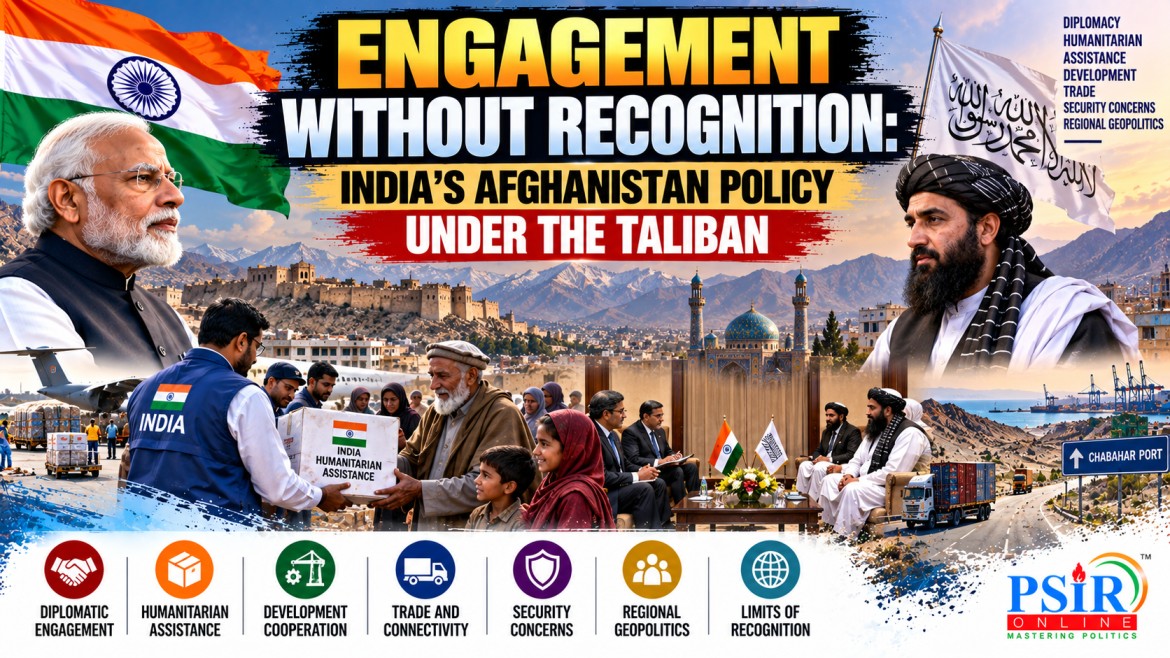
The return of the Taliban to power in Afghanistan in August 2021 confronted India with a difficult foreign-policy dilemma. For two decades, New Delhi had invested heavily in Afghanistan’s infrastructure, education, healthcare and democratic institutions. The Taliban takeover abruptly disrupted this partnership, creating concerns over terrorism, regional influence and the security of Indian interests. Yet complete disengagement would have reduced India’s ability to shape developments in a country central to South Asian geopolitics.
India consequently adopted a policy of engagement without formal recognition. Beginning with limited humanitarian contact, the approach gradually expanded to diplomatic exchanges, medical assistance, trade, development cooperation and the restoration of India’s diplomatic presence. By August 2026, India’s policy reflected a pragmatic attempt to protect national interests while maintaining a distinction between dealing with the authorities in Kabul and recognising their political legitimacy.
THE EVOLUTION OF INDIA’S AFGHANISTAN POLICY: A TIMELINE
India’s relationship with the Taliban-led administration has developed incrementally rather than through a single diplomatic breakthrough.
|
Date |
Major development |
Significance |
|
1996– 2001 |
During the Taliban’s first period in power, India did not recognise its government and supported the anti-Taliban Northern Alliance. |
Established India’s historical distrust of the Taliban and its concerns about regional security. |
|
2001– 2021 |
India developed a broad partnership with the Afghan Republic, committing more than US$3 billion to reconstruction and development. |
Built long-term goodwill through infrastructure, education, healthcare and capacity-building. |
|
15 August 2021 |
The Taliban returned to power; India evacuated diplomatic personnel from Kabul. |
Marked a major strategic setback and an initial phase of diplomatic disengagement. |
|
31 August 2021 |
Indian Ambassador to Qatar Deepak Mittal met Taliban representative Sher Mohammad Abbas Stanekzai in Doha. |
First official contact after the takeover, focused on the safety of Indians, travel and counterterrorism concerns. |
|
30 August 2021 |
India, during its presidency of the UN Security Council, supported Resolution 2593 on Afghanistan. |
Emphasised counterterrorism, human rights, an inclusive political settlement and the need to prevent Afghan territory from being used for terrorism. |
|
December 2021– 2022 |
India began humanitarian consignments, including medicines and wheat; an Indian delegation visited Kabul in June 2022. |
Shifted the focus from diplomatic distance to assistance for the Afghan population. |
|
June 2022 |
India deployed a technical team to its embassy premises in Kabul. |
Re-established an operational presence primarily to coordinate humanitarian assistance without formal recognition. |
|
2023– 2024 |
India continued humanitarian support and explored limited working-level contacts, including meetings with Taliban representatives. |
Preserved communication channels while maintaining political reservations. |
|
January 2025 |
Foreign Secretary Vikram Misri met Acting Afghan Foreign Minister Amir Khan Muttaqi in Dubai. |
Signalled more structured engagement on bilateral relations, trade, development and regional security. |
|
October 2025 |
Muttaqi visited New Delhi; India announced the re-establishment of its embassy in Kabul. |
Marked a major expansion of diplomatic engagement, while stopping short of formal recognition. |
|
December 2025 |
India and Afghanistan discussed expanded health cooperation, medical supplies and capacity-building. |
Demonstrated the growing sectoral and humanitarian dimensions of engagement. |
|
August 2026 |
India reiterated its intention to continue engagement in diplomacy, development, trade and connectivity; Indian officials attended an Afghan Embassy event in New Delhi marking five years since the Taliban takeover. |
Consolidated functional engagement while retaining the distinction between diplomatic contact and formal recognition. |
The trajectory demonstrates a gradual recalibration: limited contact, humanitarian engagement, technical presence, high-level dialogue and expanded functional cooperation. The policy has evolved in response to the changing strategic environment rather than through an unconditional acceptance of Taliban rule.
FROM DEVELOPMENT PARTNERSHIP TO HUMANITARIAN DIPLOMACY
Before 2021, India was among Afghanistan’s most significant development partners. Its projects included the Afghan Parliament building in Kabul, the Afghanistan–India Friendship Dam in Herat, the Zaranj–Delaram highway and numerous smaller community-development initiatives. These investments strengthened India’s public image and established long-term institutional and social connections.
The Taliban takeover changed the context in which this assistance could operate. India suspended its earlier development framework and initially concentrated on emergency humanitarian relief. The underlying distinction was important: assistance to the Afghan population did not require political endorsement of the authorities controlling the country.
India’s assistance to Afghanistan: Selected figures
|
Assistance category |
Reported contribution |
Context |
|
Development assistance, 2001– 2021 |
More than US$3 billion committed |
Infrastructure, education, health, governance and community-development projects under the Afghan Republic. |
|
Wheat assistance after the 2021 takeover |
50,000 metric tonnes committed |
Humanitarian food support, with consignments channelled through the World Food Programme. |
|
Medicines and vaccines, 2021– 2025 |
327 tonnes supplied over four years, according to India’s Health Ministry in December 2025 |
Medical assistance for the Afghan population. |
|
COVID-19 vaccines |
More than 500,000 doses reported in early post-takeover assistance accounts |
Part of India’s humanitarian response during the public-health crisis. |
|
Healthcare infrastructure |
Five maternity and health clinics, a 30-bed hospital in Kabul, and specialised facilities including oncology and trauma care |
Projects reflect India’s longer-term health-sector partnership, although not all were newly constructed after the takeover. |
|
Jaipur Foot assistance, June 2025 |
75 prosthetic limbs fitted during a camp in Kabul |
Targeted medical and rehabilitation support. |
|
Medical access, 2025 |
More than 500 visas, including over 200 medical visas, reported as issued in the four months cited by India’s Health Ministry |
Facilitated treatment for Afghan patients in India. |
Note: These figures cover different periods and types of assistance. They should not be added together as a single post-2021 aid total. Commitments, supplies delivered, previously completed projects and ongoing programmes are distinct categories.
Humanitarian diplomacy has enabled India to retain a presence despite political differences. Food, medicines, healthcare and educational support address immediate needs while preserving relationships with Afghan communities. However, the long-term impact of this approach depends on the continuity of access, transparent delivery and the ability to reach vulnerable populations, including women and girls.
WHY INDIA IS ENGAGING THE TALIBAN
India’s recalibration reflects several overlapping strategic considerations.
First, counterterrorism remains central. New Delhi has consistently stressed that Afghan territory must not be used for activities directed against India. The presence and activities of militant organisations, including groups associated with anti-India violence, make communication with the authorities controlling Afghan territory a security necessity. Engagement provides a channel for conveying concerns, although it cannot by itself guarantee that threats will be neutralised.
Second, regional geopolitics has changed. China, Russia, Iran, Pakistan and several Central Asian states maintain different forms of engagement with Afghanistan. Prolonged Indian absence could reduce its ability to monitor developments and protect its interests. Renewed engagement helps India avoid surrendering diplomatic space to other regional actors.
Third, Afghanistan matters for connectivity and economic diversification. India’s access to Afghanistan and Central Asia is constrained by geography and its difficult relationship with Pakistan. Cooperation involving Iran’s Chabahar Port, trade routes and regional transport networks can offer alternatives, although sanctions, security conditions and infrastructure limitations complicate implementation.
Fourth, India has substantial developmental investments and people-to-people links to preserve. Educational exchanges, medical assistance, scholarships and professional training have created connections that extend beyond any single government. Maintaining these relationships helps sustain India’s longer-term influence.
The resulting policy is neither complete isolation nor unconditional normalisation. It reflects strategic pragmatism under conditions of political uncertainty.
RECOGNITION, LEGITIMACY AND THE HUMAN RIGHTS DILEMMA
A central distinction in India’s approach is that diplomatic engagement does not automatically amount to formal recognition. States can communicate with de facto authorities, maintain technical missions and provide humanitarian assistance without formally accepting a government as the legitimate representative of a country.
The distinction is particularly significant in Afghanistan because of the Taliban’s restrictions on women and girls. Exclusion from secondary and higher education, limitations on employment and movement, and restrictions on public participation have generated extensive international criticism. These policies create a tension between India’s practical security interests and its stated support for an inclusive political order and fundamental rights.
India’s approach faces three related challenges:
· Normative credibility: Sustained engagement must not be interpreted as indifference to the rights of Afghan women, girls and minority communities.
· Security assurance: Diplomatic contact must produce credible cooperation against terrorism and threats to Indian interests.
· Political legitimacy: The absence of an inclusive political system complicates any move towards formal recognition.
The policy dilemma cannot be resolved through diplomacy alone. Complete isolation could reduce India’s access and influence, while unconditional recognition could weaken its ability to press for political inclusivity and human rights. A calibrated approach therefore requires continued engagement alongside clear expectations on security, humanitarian access and rights.
LIMITS AND RISKS OF THE ENGAGEMENT STRATEGY
India’s expanding engagement does not necessarily translate into equivalent influence over Taliban decision-making. The authorities in Kabul retain their own political priorities, and India has limited leverage over domestic governance and the restrictions imposed on Afghan society.
Security remains a major concern. The presence of militant networks, uncertainty over counterterrorism cooperation and the possibility of regional instability complicate the expansion of diplomatic and economic activity. Any increase in Indian personnel or development projects requires credible security arrangements.
Economic cooperation also faces structural barriers. Afghanistan’s financial constraints, damaged infrastructure, limited access to international finance and uncertainty in its external relations can restrict trade and investment. Connectivity initiatives depend on cooperation with neighbouring countries and the wider regional environment.
A further risk is that diplomatic normalisation may advance more quickly than improvements in governance or human rights. India must therefore distinguish the practical necessity of maintaining channels from the political decision to confer formal recognition.
THE WAY FORWARD: CALIBRATED ENGAGEMENT WITH CLEAR CONDITIONS
India’s future policy can build on functional engagement while retaining safeguards around recognition and security.
|
Policy priority |
Practical direction |
|
Counterterrorism |
Maintain direct communication on threats to India and insist that Afghan territory is not used for anti-India activities. |
|
Humanitarian assistance |
Continue food, healthcare and disaster-relief support through reliable channels, with attention to vulnerable groups. |
|
Women’s and girls’ rights |
Raise restrictions on education, employment and public participation in diplomatic discussions and multilateral forums. |
|
Development cooperation |
Prioritise feasible health, education, agriculture and community-level projects with clear delivery and monitoring arrangements. |
|
Trade and connectivity |
Explore practical commercial links through regional routes while accounting for security, sanctions and financial constraints. |
|
Diplomatic status |
Continue distinguishing working-level engagement and embassy operations from the separate decision to grant formal recognition. |
|
Regional coordination |
Consult Iran, Central Asian states, Russia and other relevant partners where cooperation supports Afghan stability and India’s security interests. |
The central objective should be to retain diplomatic access without abandoning India’s concerns about terrorism, political inclusivity and human rights. Such a policy requires periodic assessment rather than an irreversible commitment to either isolation or normalisation.
THEORETICAL ANGLES
|
Theory or concept |
Application to India’s Afghanistan policy |
|
Realism |
Explains India’s emphasis on security, regional influence and counterterrorism despite political differences with the Taliban. |
|
Pragmatism and National Interest |
Illustrates why states may maintain working relations with de facto authorities when disengagement could damage strategic interests. |
|
Constructivism |
Highlights the continuing role of norms, identity and political legitimacy in shaping India’s reluctance to grant formal recognition. |
|
Recognition in International Relations |
Distinguishes diplomatic contact and relations with de facto authorities from the separate political act of formally recognising a government. |
|
Soft Power |
Explains how India’s development assistance, healthcare, education and people-to-people ties can sustain goodwill beyond changes of government. |
|
Security Dilemma |
Shows how the uncertain intentions of actors and the presence of militant networks complicate confidence-building and regional stability. |
|
Complex Interdependence |
Highlights the significance of humanitarian assistance, trade, healthcare and connectivity alongside traditional security concerns. |
CONCLUSION
India’s Afghanistan policy since August 2021 illustrates the tension between national interest and normative concerns in foreign policy. The shift from limited contact to humanitarian assistance, a technical presence, ministerial dialogue and a restored embassy reflects the strategic cost of remaining disengaged from a neighbouring region of considerable importance. Yet engagement has not removed the risks associated with terrorism, political exclusion or the Taliban’s restrictions on women and girls.
The central challenge is to sustain engagement without recognition as a disciplined diplomatic strategy rather than an end in itself. Its success will depend on whether India can protect its security interests, assist the Afghan population, preserve regional influence and continue articulating its concerns about political inclusivity and fundamental rights.
RELATED READING
PRACTISE QUESTIONS FOR GS2 MAINS
PRACTISE QUESTIONS FOR PSIR
