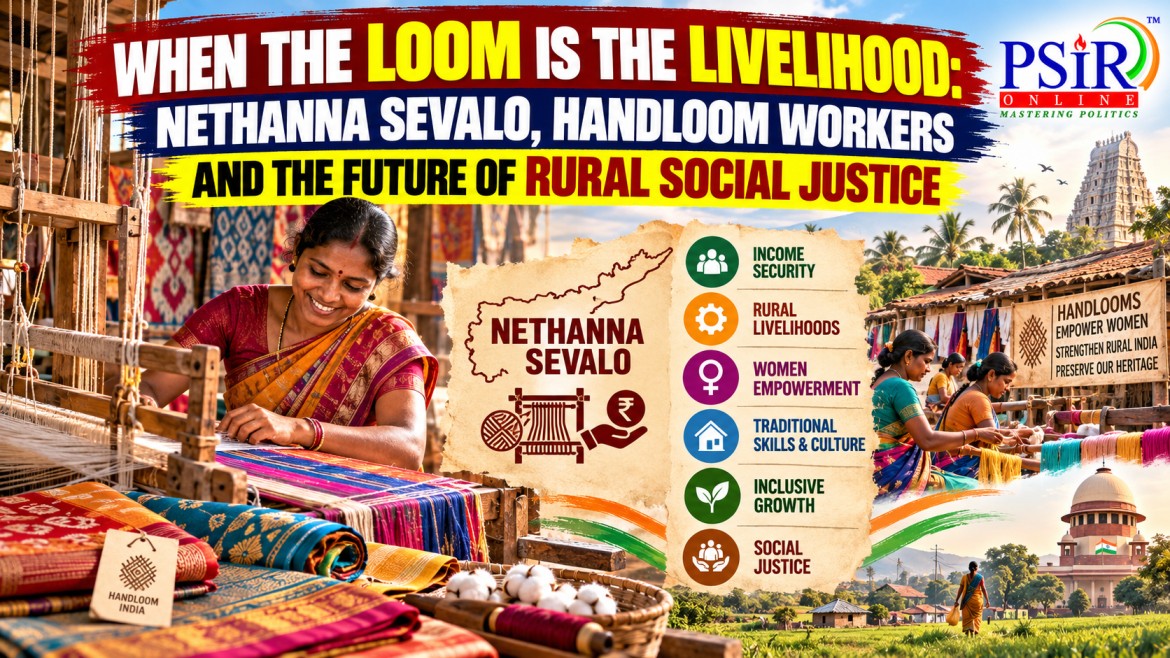
INTRODUCTION: WHEN A LOOM SUPPORTS AN ENTIRE FAMILY
India's handloom sector represents more than a traditional craft. For millions of rural households, the loom is a source of income, identity and intergenerational livelihood. Yet the sector operates under severe pressure from mechanised production, fluctuating yarn prices, weak bargaining power and changing consumer markets.
This makes Andhra Pradesh's Nethanna Sevalo significant. The scheme provides ₹25,000 annually to eligible handloom families through direct benefit transfer, offering immediate income support to households dependent on weaving. Andhra Pradesh launched it on 7 August 2026, coinciding with National Handloom Day. The first disbursement covered 71,536 families with ₹179 crore.
THE SCHEME: NETHANNA SEVALO
The Andhra Pradesh Cabinet approved Nethanna Sevalo in July 2026. The scheme provides ₹25,000 annual financial assistance to eligible below-poverty-line handloom families, with one beneficiary from each family. The assistance is not restricted by age or the number of looms owned. The scheme replaced the earlier YSR Nethanna Nestham, which provided ₹24,000 annually.
Key features
|
Feature |
Nethanna Sevalo |
|
State |
Andhra Pradesh |
|
Nature |
Direct income-support scheme |
|
Beneficiary unit |
Eligible handloom family |
|
Annual assistance |
₹25,000 |
|
Eligibility |
BPL handloom families meeting scheme conditions |
|
Age restriction |
No age bar |
|
Loom restriction |
No cap on number of looms |
|
Mode of payment |
Direct Benefit Transfer |
|
Launch |
7 August 2026 |
|
First disbursement |
₹179 crore |
|
Families covered initially |
71,536 |
|
Occasion |
National Handloom Day |
The scheme therefore provides a basic income cushion rather than a production subsidy.
WHY DOES NETHANNA SEVALO MATTER?
For a handloom household, income is often irregular and dependent on orders, raw-material costs and market demand. The ₹25,000 transfer can therefore provide immediate liquidity for:
· purchase of yarn and other inputs;
· loom repair and maintenance;
· children's education;
· healthcare expenses;
· household consumption;
· repayment of small debts; and
· continuation of weaving during periods of weak demand.
More importantly, because assistance is transferred directly to eligible families, it is not dependent entirely on participation in a cooperative marketing structure. However, income support is not the same as livelihood transformation.
A cash transfer can help a family survive a difficult year. It cannot by itself make a handloom sari competitive with cheaper powerloom or mill-produced cloth.
HANDLOOM: THE NATIONAL SOCIAL-JUSTICE CONTEXT
The Fourth All India Handloom Census (2019–20) recorded 35.22 lakh handloom weavers and allied workers, including 25.46 lakh women—more than 72% of the workforce. It also recorded 28.20 lakh handlooms, of which 25.30 lakh were located in rural areas.
The sector is therefore deeply connected with:
· rural employment;
· women's economic participation;
· traditional skills;
· SC/ST/OBC livelihoods;
· household-based production;
· local economies; and
· cultural heritage.
The Census also shows that 17.89 lakh workers were full-time while 17.33 lakh were part-time, indicating the increasing importance of weaving as a supplementary rather than exclusive livelihood for many households. This makes handloom policy a social-protection issue as much as a textile-policy issue.
WHAT THE UNION GOVERNMENT ALREADY DOES
Nethanna Sevalo operates within a much wider national policy framework. The Union Government's principal handloom interventions include the National Handloom Development Programme (NHDP) and the Raw Material Supply Scheme (RMSS). The Ministry of Textiles states that these programmes support raw materials, upgraded looms, worksheds, solar lighting, skill development, design innovation, infrastructure, branding, e-commerce and marketing.
For 2026–27, the Budget provides:
· ₹205 crore for the National Handloom Development Programme.
· ₹200 crore for the Raw Material Supply Scheme.
Major central interventions
|
Instrument |
How it supports handloom workers |
|
National Handloom Development Programme |
Supports upgraded looms, worksheds, lighting, design, skill development, clusters and marketing. |
|
Raw Material Supply Scheme |
Supports access to yarn and reduces the input-cost burden through the yarn-supply mechanism. |
|
Weaver MUDRA |
Provides concessional institutional credit to handloom weavers. |
|
Social security schemes |
Provides life and accident insurance support through schemes such as PMJJBY and PMSBY. |
|
Handloom Mark |
Helps distinguish genuine handloom products from imitations. |
|
India Handloom Brand |
Promotes quality-certified Indian handloom products. |
|
GI protection |
Protects geographical identity and traditional product differentiation. |
|
E-commerce and marketing support |
Attempts to connect weavers and producer organisations with wider domestic and international markets. |
The Union Government has also highlighted branding, design, market access, e-commerce and social-security support as part of its wider handloom-development strategy.
STATE MODELS: INDIA IS TRYING DIFFERENT SOLUTIONS
India does not have a single model for protecting handloom livelihoods. States are experimenting with different combinations of income support, productivity enhancement, social security, technology adoption, cooperative institutions and market access.
|
State / Scheme |
Policy Approach and Social-Justice Significance |
|
Andhra Pradesh – Nethanna Sevalo |
Income security + livelihood support. The scheme provides ₹25,000 annually to each eligible handloom family, irrespective of the age of the weaver or number of looms, with the family as the unit of support. The first disbursement covered 71,536 families with ₹179 crore. The scheme is designed to help active weavers meet expenditure on yarn, dyes, chemicals, equipment repair and modernisation. Policy logic: protect the household's immediate purchasing power and help keep the loom economically active. Strength: directly addresses livelihood distress. Limitation: cash support alone cannot solve weak markets, low productivity or declining demand. |
|
Odisha – Mukhyamantri Hastatanta Bikasha Yojana (MHBY) |
Value-chain and ecosystem approach. Odisha approved ₹589.10 crore over five years for holistic handloom development. The scheme covers pre-loom, on-loom and post-loom infrastructure, modern machinery, design diversification, skill development and employment generation. A Raw Material Bank is intended to improve access to quality yarn, dyes and chemicals at affordable prices. It also emphasises GI, trademarks, publicity and market adaptability Policy logic: instead of treating the weaver only as a welfare beneficiary, strengthen the entire production and marketing ecosystem. Strength: addresses structural constraints. |
|
Uttar Pradesh – Mukhyamantri Hathkargha Bunakar Samriddhi Yojana |
Technology + productivity + market access. The newly introduced scheme provides an 80% subsidy for solar-powered looms, seeking to modernise production, reduce operating costs and improve the competitiveness of traditional weaving. It also seeks stronger national and international market access. Policy logic: make traditional handloom economically viable through appropriate technological upgrading rather than leaving weavers trapped between traditional methods and mechanised competition. Strength: combines technology with market orientation. Risk: technology adoption must remain affordable and compatible with the skills and production characteristics of individual weavers. |
|
Telangana – Nethanna Bhima + Nethannaku Cheyutha |
Social security + savings + income resilience. Telangana has developed a more layered model. Nethanna Bhima provides ₹5 lakh life-risk coverage to eligible weavers and ancillary workers, while Nethannaku Cheyutha supports the savings/social-security needs of weavers. The State has also used loan-waiver measures to help indebted weavers regain access to working capital. Policy logic: a livelihood cannot be sustainable if one death, illness or financial shock pushes the household into debt. Strength: recognises that social protection is part of livelihood policy, not separate from it. |
|
Tamil Nadu – Cooperative + Electricity + Market Model |
Institutional ecosystem approach. Tamil Nadu relies strongly on its Primary Weavers' Cooperative Societies and combines them with electricity support, interest subsidies, pensions/social-security measures, cluster development and marketing interventions. The State's textile policy provides for free electricity for handloom weaver households, interest subsidy for Primary Handloom Weavers' Cooperative Societies and support for onboarding cooperatives onto e-commerce platforms. Policy logic: strengthen the collective bargaining, production and marketing capacity of weavers rather than leaving each household to negotiate individually with traders and markets. Strength: institutional depth through cooperatives. Challenge: cooperatives must remain commercially viable, professionally managed and market-responsive. |
THE HANDLOOM ECONOMY: WHY THE LOOM STILL MATTERS
Handloom production has several characteristics that make it important from a rural-development perspective.
1. Labour-intensive production: Unlike mechanised textile production, handloom production depends heavily on skilled human labour.
2. Rural concentration: The Fourth Census recorded 25.30 lakh of the 28.20 lakh handlooms in rural areas. This means that the survival of handloom directly affects rural economies.
3. Women's economic participation: Women account for more than 72% of handloom weavers and allied workers. Therefore, handloom policy also becomes a question of women's economic empowerment.
4. Low entry barriers: Household-based weaving can provide employment without requiring migration to large industrial centres.
5. Cultural economy: Products such as Mangalagiri, Uppada, Dharmavaram and Venkatagiri textiles carry geographical and cultural identities that can generate a premium if markets recognise their authenticity and quality.
BUT THE SECTOR IS SHRINKING
The most important warning sign is not simply low income—it is declining participation in weaving. The Fourth Handloom Census recorded 35.22 lakh weavers and allied workers. The preceding Census had recorded a larger workforce, indicating a long-term decline in the number of people dependent on handloom.
The reasons are structural:
· mechanised production;
· cheaper powerloom alternatives;
· rising yarn prices;
· weak bargaining power;
· dependence on intermediaries;
· changing consumer preferences;
· inadequate design innovation;
· limited access to organised credit;
· weak direct-to-consumer marketing; and
· younger workers shifting to construction, services and other occupations.
Thus, the fundamental problem is: The handloom worker is not merely poor; the economic ecosystem supporting handloom production is becoming less competitive.
THE CHALLENGES
|
Challenge |
Why it matters |
|
Irregular income |
Orders and earnings fluctuate, making household financial planning difficult. |
|
Rising input costs |
Yarn and other raw materials can increase faster than the prices received by weavers. |
|
Powerloom competition |
Mechanised production can reproduce designs at lower cost and greater scale. |
|
Weak bargaining power |
Weavers often depend on master weavers, traders or intermediaries and may not receive the final retail value. |
|
Declining younger workforce |
Younger generations increasingly move towards construction, services and other occupations. |
|
Limited credit access |
Small producers often lack sufficient working capital to expand or modernise. |
|
Weak market access |
Many weavers remain disconnected from organised retail, e-commerce and export markets. |
|
Design gap |
Traditional products may struggle to adapt to rapidly changing consumer preferences without losing their identity. |
|
Social-security gaps |
Insurance and pension coverage do not reach all workers. |
|
Targeting challenges |
Cash-transfer schemes need accurate identification to prevent exclusion of genuine weavers and inclusion of inactive loom owners. |
|
Digital divide |
E-commerce and digital marketing opportunities remain concentrated among better-organised clusters. |
|
Fragmented policy |
Central and State schemes may operate without sufficient integration at the level of the individual weaver. |
UPSC DIMENSION
|
UPSC Dimension |
How Nethanna Sevalo and handloom policy connect with it |
|
Social justice |
Nethanna Sevalo provides direct income support to vulnerable handloom households, protecting livelihoods in a labour-intensive rural sector facing market pressures. |
|
Women empowerment |
Since women constitute more than 72% of India's handloom and allied workforce, strengthening handloom directly supports women's participation in economic activity and household income. |
|
Inclusive growth |
Supporting handloom combines employment generation, rural production and income support, allowing economic growth to reach dispersed household-based producers. |
|
Rural employment |
The concentration of handlooms in rural areas makes the sector an important source of non-farm rural employment. |
|
Livelihood security |
The ₹25,000 transfer provides a financial cushion to families whose earnings are irregular and vulnerable to market fluctuations. |
|
Informal sector |
Handloom workers largely operate through household-based and informal production arrangements, making social security, credit and market access important dimensions of labour welfare. |
|
Financial inclusion |
Direct transfers, Weaver MUDRA credit and institutional financial support bring informal producers closer to formal financial systems. |
|
Cooperative movement |
Strong weaver cooperatives can improve collective procurement, credit access, marketing and bargaining power against intermediaries. |
|
Women-led household production |
Supporting household-based weaving can create employment opportunities close to home, particularly for women whose mobility may be constrained by care responsibilities. |
|
Traditional knowledge |
Handloom represents intergenerational skills and cultural knowledge; policy therefore combines livelihood protection with preservation of intangible cultural heritage. |
|
GI and local economies |
GI-tagged and region-specific products can convert traditional skills into geographical economic value when branding and market access are effective. |
|
Technology vs employment |
Handloom policy must balance productivity-enhancing technology with the need to preserve labour-intensive livelihoods. |
|
MSME and rural industrialisation |
Handloom represents decentralised, household-based manufacturing and therefore connects rural welfare with small-scale industrial development. |
|
Centre–State relations |
The Centre provides national programmes such as NHDP and RMSS, while States add their own income, infrastructure, electricity and social-security measures. |
|
Market-oriented welfare |
Nethanna Sevalo protects income, while branding, e-commerce, design and infrastructure attempt to improve the underlying market position of weavers. |
|
SDG 5 |
Women's predominance in the sector makes handloom development relevant to women's economic empowerment and gender equality. |
|
SDG 8 |
Supporting decent and sustainable livelihoods in a labour-intensive sector contributes to productive employment and decent work. |
|
SDG 10 |
Targeted support to vulnerable informal workers can reduce economic inequalities within rural communities. |
WAY FORWARD
|
Priority |
Way Forward |
|
Protect income |
Continue targeted income support such as Nethanna Sevalo to prevent distress exit from the occupation. |
|
Reduce input costs |
Strengthen yarn banks, raw-material subsidies and collective procurement. |
|
Improve market power |
Strengthen cooperatives and producer organisations so that weavers have greater bargaining power. |
|
Direct market access |
Expand verified e-commerce, GeM, exhibitions and institutional procurement to reduce dependence on intermediaries. |
|
Design innovation |
Connect traditional weaving clusters with designers, fashion institutions and contemporary markets without destroying traditional identities. |
|
Technology upgrading |
Provide affordable access to improved looms, solar lighting and appropriate technologies that raise productivity without eliminating skilled employment. |
|
Credit inclusion |
Expand Weaver MUDRA and working-capital access, particularly for individual weavers outside strong cooperative networks. |
|
Women-focused support |
Recognise the overwhelming participation of women and ensure that transfers, credit, training and ownership opportunities reach women directly. |
|
Social security |
Expand insurance, pension and health protection for informal handloom households. |
|
Authenticity protection |
Strengthen Handloom Mark, GI enforcement and action against misleading powerloom imitations. |
|
Youth retention |
Make weaving economically attractive through better earnings, technology, design training and entrepreneurship opportunities. |
|
Integrated policy |
Connect Central and State schemes around the individual weaver and household, rather than treating each intervention as a separate programme. |
CONCLUSION
Nethanna Sevalo is important because it recognises a simple reality: before asking the handloom sector to become competitive, the State must ensure that the families dependent on it can survive.
The ₹25,000 annual transfer provides immediate income security to eligible handloom families in Andhra Pradesh. But India's handloom challenge extends far beyond household income. The sector needs cheaper inputs, better credit, stronger cooperatives, design innovation, technology, social security and direct access to markets.
The national handloom workforce of 35.22 lakh, more than 72% of whom are women, demonstrates that this is not merely a cultural preservation issue. It is a question of rural employment, women's economic participation, informal-worker protection and social justice.
The real social-justice challenge is to make the loom economically viable enough that the next generation chooses to continue weaving—not because it has no alternative, but because weaving offers a dignified and sustainable livelihood.
RELATED READING
For comprehensive UPSC preparation, students should connect handloom policy with:
· Women and rural employment
· Informal-sector social security
· MSMEs and decentralised manufacturing
· Cooperative movements
· Financial inclusion and Weaver MUDRA
· GI tags and intellectual-property protection
· Traditional knowledge and cultural heritage
· E-commerce and rural market access
· Technology and employment
· Inclusive growth
· Rural non-farm economy
· SDG 5 – Gender Equality
· SDG 8 – Decent Work
· SDG 10 – Reduced Inequalities
· National Handloom Development Programme
· Raw Material Supply Scheme
· Handloom Mark and India Handloom Brand
PRACTICE QUESTIONS – GS PAPER II
1. “Handloom policy in India is not merely about preserving traditional crafts; it is an instrument of rural social justice.” Discuss with reference to Nethanna Sevalo. (10 Marks, 150 Words)
2. With women constituting more than 72% of India's handloom and allied workforce, strengthening the handloom sector can become an important instrument of women's economic empowerment. Examine. (10 Marks, 150 Words)
3. Direct income support can protect handloom households from livelihood distress, but cannot by itself address the structural decline of the sector. Critically examine the role of Nethanna Sevalo alongside India's broader handloom policies. (15 Marks, 250 Words)
4. “The survival of India's handloom sector requires a transition from welfare of weavers to viability of weaving.” Discuss the policy measures required to achieve this transition. (15 Marks, 250 Words)
