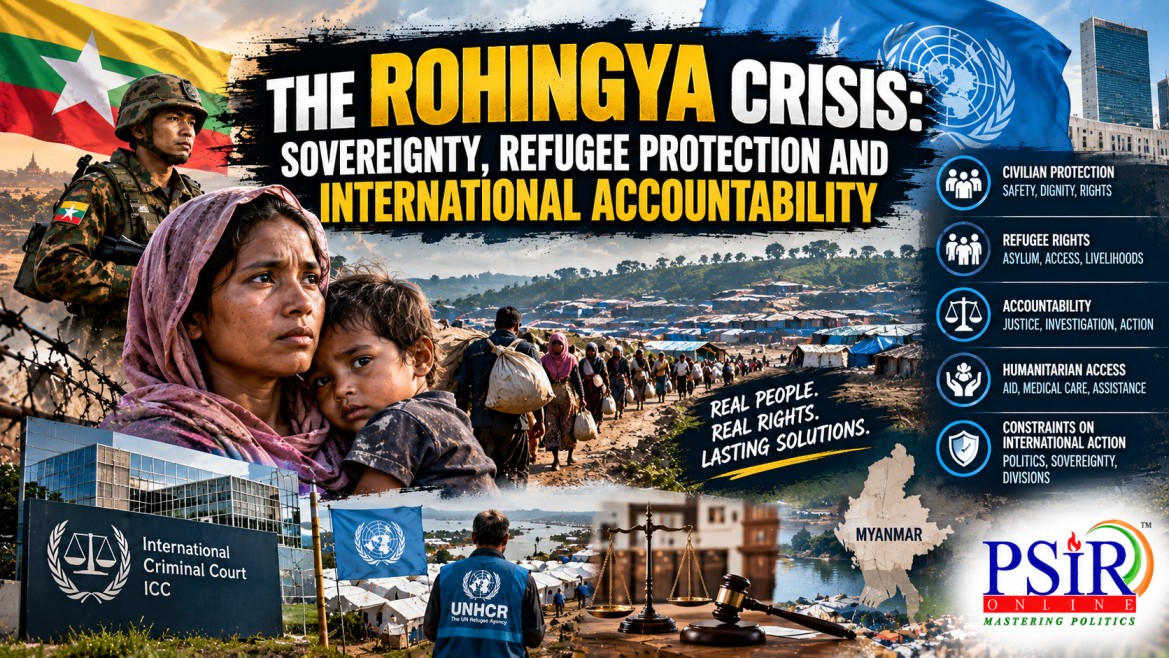
The Rohingya crisis is one of the most prolonged refugee and human-rights emergencies in contemporary international politics. The Rohingya, a predominantly Muslim ethnic minority from Myanmar’s Rakhine State, have faced decades of discrimination, restrictions on citizenship and movement, and repeated episodes of violence and displacement. The mass exodus of August 2017 brought international attention to the scale of the crisis, when more than 700,000 Rohingya fled to neighbouring Bangladesh following a military crackdown.
Nine years later, the crisis remains unresolved. On 24 August 2026, the United Nations Secretary-General called for renewed international attention, warning that Rohingya communities in Myanmar, Bangladesh and elsewhere faced deepening insecurity, shrinking protection and diminishing prospects for durable solutions. A report issued by the Office of the UN High Commissioner for Human Rights on 25 August also documented continuing abuses, displacement and restrictions on humanitarian access in Myanmar.
The crisis raises fundamental questions about the relationship between state sovereignty and international responsibility. It exposes the limitations of international refugee protection, the difficulties of securing accountability for alleged international crimes, and the challenges of coordinating humanitarian assistance when political solutions remain elusive.
THE SCALE OF THE CRISIS: FROM MASS DISPLACEMENT TO PROTRACTED REFUGEEHOOD
The 2017 exodus did not occur in isolation. It followed decades of exclusion and earlier waves of displacement. The denial of citizenship and restrictions on basic rights left many Rohingya vulnerable to persecution and prevented them from enjoying secure legal status in Myanmar.
The situation has deteriorated further amid the wider conflict that followed Myanmar’s February 2021 military coup. Fighting between the military and armed opposition groups has spread across the country, while northern Rakhine has experienced renewed violence involving the Myanmar military and the Arakan Army. Rohingya civilians have faced threats from multiple armed actors, including reported killings, arbitrary arrests, forced recruitment, sexual violence and displacement.
The UN Secretary-General’s August 2026 statement highlighted continuing restrictions on movement and humanitarian access. The OHCHR report covering June 2025 to May 2026 documented widespread abuses affecting Rohingya communities and other civilians, including the destruction of villages and the confiscation of property.
|
Indicator |
Latest available figure or finding |
|
Major displacement in 2017 |
More than 700,000 Rohingya fled to Bangladesh |
|
Rohingya refugees in Bangladesh |
Approximately 1.2 million, according to the June 2026 UNHCR and Government of Bangladesh data |
|
Total people targeted by the 2026 Joint Response Plan |
Approximately 1.56 million, including refugees and members of host communities |
|
Humanitarian funding requirement for 2026 |
US$710.5 million under the recalibrated Joint Response Plan |
|
Principal protection concerns in Myanmar |
Violence, forced recruitment, arbitrary detention, sexual violence, displacement and restrictions on humanitarian access |
Sources: UNHCR and Government of Bangladesh population data, June 2026; UN and partners’ Joint Response Plan update, May 2026; UN Secretary-General’s statement, August 2026; OHCHR report, August 2026.
The figures demonstrate that the crisis is no longer simply an emergency involving an initial influx of refugees. It has become a protracted displacement crisis in which several generations face uncertainty about citizenship, education, livelihoods, protection and the possibility of returning home.
SOVEREIGNTY, CITIZENSHIP AND THE LIMITS OF NON-INTERVENTION
State sovereignty remains a foundational principle of international relations. Governments exercise authority over their territory and population, while Article 2(7) of the UN Charter protects matters essentially within domestic jurisdiction, subject to the Charter’s enforcement provisions.
However, sovereignty does not remove a state’s obligations under applicable international law. Myanmar’s treatment of the Rohingya has raised questions concerning citizenship, discrimination, arbitrary deprivation of nationality and protection from persecution. The crisis demonstrates how domestic laws and administrative practices can produce severe consequences when an ethnic minority is systematically excluded from political and legal membership.
The Rohingya’s statelessness is particularly significant. Without secure citizenship, individuals can face barriers to education, healthcare, employment, freedom of movement and access to legal remedies. Statelessness also complicates repatriation because return requires more than crossing a border: it requires a credible legal status and protection against renewed persecution.
The principle of non-intervention does not prevent international institutions from discussing human-rights violations or exercising powers authorised under the UN Charter. Yet political divisions within the Security Council and disagreements over appropriate responses can constrain collective action.
The crisis therefore reveals the tension between sovereign authority and international obligations. Respect for sovereignty cannot automatically resolve questions of persecution and accountability, while international intervention also requires legal authority, political legitimacy and careful consideration of its consequences.
REFUGEE PROTECTION, HUMANITARIAN ACCESS AND BANGLADESH’S BURDEN
Bangladesh has hosted approximately 1.2 million Rohingya refugees, primarily in the densely populated camps of Cox’s Bazar, with a smaller population on Bhasan Char. The scale and duration of displacement have placed sustained pressure on housing, public services, local infrastructure, livelihoods and the environment.
Bangladesh is not a party to the 1951 Refugee Convention or its 1967 Protocol. Nevertheless, its hosting of Rohingya refugees and its cooperation with UN agencies have been central to the humanitarian response. International human-rights obligations, relevant customary international law and the principle of non-refoulement also remain important to assessing the protection of people at risk of persecution.
The 2025–2026 Joint Response Plan, led by the Government of Bangladesh with UN agencies and humanitarian partners, was recalibrated in May 2026. The updated plan sought US$710.5 million to support approximately 1.56 million people, including refugees and members of host communities. This was 26 per cent lower than the 2025 funding requirement and was designed to prioritise essential assistance.
|
Humanitarian challenge |
Policy implications |
|
Food insecurity and inadequate nutrition |
Maintain predictable food assistance and protect vulnerable households |
|
Pressure on healthcare, education and sanitation |
Support essential services while strengthening the resilience of host communities |
|
Restrictions on humanitarian access inside Myanmar |
Secure safe, impartial and sustained access to affected populations |
|
Funding shortages |
Prioritise life-saving needs without abandoning protection and education |
|
Prolonged displacement |
Expand livelihood opportunities, skills development and self-reliance where feasible |
|
Unsafe maritime movements |
Strengthen search and rescue, safe disembarkation and action against trafficking networks |
Humanitarian assistance remains essential, but it cannot substitute for a political settlement. Nor should reductions in assistance be treated as a mechanism for forcing refugees to return. Repatriation must be voluntary, safe, dignified and sustainable, supported by credible guarantees concerning citizenship or legal status, freedom of movement, security and access to livelihoods.
A durable response also requires burden-sharing. Bangladesh cannot reasonably be expected to sustain a crisis of this scale indefinitely without predictable international financing and diplomatic support. International solidarity must extend beyond emergency relief to long-term protection and solutions.
INTERNATIONAL ACCOUNTABILITY: THE ICJ, THE ICC AND THE LIMITS OF ENFORCEMENT
International accountability has developed through multiple legal and institutional channels. These mechanisms have different mandates and must not be confused with one another.
The International Court of Justice (ICJ) considers disputes between states. The Gambia instituted proceedings against Myanmar under the Genocide Convention, alleging violations relating to the treatment of the Rohingya. The ICJ ordered provisional measures in January 2020 requiring Myanmar to take steps to prevent acts covered by the Convention and preserve relevant evidence. In January 2026, the Court held public hearings on the merits of the case. A final judgment on the merits is distinct from the earlier provisional-measures order.
The International Criminal Court (ICC), by contrast, prosecutes individuals for crimes within its jurisdiction. Its investigation concerning the situation in Bangladesh/Myanmar includes alleged crimes against the Rohingya, including deportation and persecution, where the legal requirements for the Court’s jurisdiction are met. The ICC’s jurisdictional basis is important because Myanmar is not a party to the Rome Statute, while Bangladesh is.
|
Institution or mechanism |
Principal role in the Rohingya crisis |
|
International Court of Justice |
Determines state responsibility under applicable international law, including the Genocide Convention |
|
International Criminal Court |
Investigates and prosecutes individuals for crimes within its jurisdiction |
|
UN Human Rights Council and OHCHR |
Document violations, report findings and support international monitoring and accountability |
|
UN Security Council |
Can adopt measures under the UN Charter, although political disagreement may constrain action |
|
National courts |
May investigate and prosecute crimes where jurisdictional and procedural requirements are met |
These mechanisms represent important avenues for accountability, but they face significant limitations. International courts depend on evidence, legal jurisdiction, cooperation and the practical ability to implement decisions. Political pressure and the absence of direct enforcement powers can delay or complicate outcomes.
It is also essential to distinguish allegations, documented violations, judicial findings and final judgments. The existence of proceedings under the Genocide Convention does not mean that the ICJ has already delivered a final judgment establishing genocide in the case.
The wider significance is that international accountability is a process rather than an automatic outcome. Legal proceedings can establish authoritative findings and clarify obligations, but their preventive and deterrent effects depend on implementation and sustained political support.
RESPONSIBILITY TO PROTECT AND THE POLITICS OF INTERNATIONAL ACTION
The Responsibility to Protect (R2P) framework was endorsed by UN member states in the 2005 World Summit Outcome. It rests on the principle that each state has a responsibility to protect its population from genocide, war crimes, ethnic cleansing and crimes against humanity. The international community should assist states in fulfilling that responsibility and respond collectively through the UN Charter when national authorities manifestly fail to protect their populations.
The Rohingya crisis has become a major reference point in debates about the effectiveness of R2P. The scale of displacement and allegations of grave abuses raised questions about whether international responses were timely, sufficiently coordinated and capable of preventing further harm.
R2P is not an automatic authorisation for military intervention. Collective coercive measures require the relevant legal authority and must be considered within the framework of the UN Charter. The Security Council’s political composition and veto structure can make consensus difficult, especially when major powers disagree about the appropriate response.
Regional diplomacy has also faced constraints. ASEAN’s principles of non-interference and consensus have complicated efforts to address Myanmar’s crisis, although regional engagement, humanitarian assistance and diplomatic initiatives remain important. The absence of a unified approach limits the ability to exert sustained pressure and coordinate practical measures.
A more effective response requires early warning, sustained diplomacy, support for refugees, accountability mechanisms and coordinated pressure on actors responsible for abuses. R2P is most meaningful when prevention and protection are translated into practical measures, rather than remaining a declaration of principle.
PATHWAYS TOWARDS A DURABLE SOLUTION
A sustainable resolution requires action across several interconnected areas.
First, civilian protection must be strengthened inside Myanmar. All parties to the conflict must comply with applicable international humanitarian law, including the principles of distinction, proportionality and precautions in attack. Humanitarian agencies need safe and sustained access to affected communities.
Second, the structural causes of exclusion must be addressed. This includes the Rohingya’s citizenship and legal status, discriminatory restrictions, freedom of movement and access to public services. Without meaningful changes in these areas, repatriation risks reproducing the conditions that originally drove displacement.
Third, international accountability must continue through judicial proceedings, evidence preservation, independent reporting and cooperation with relevant institutions. Accountability should be pursued through established legal processes, with careful attention to evidence and due process.
Fourth, refugee-hosting countries require predictable support for food, healthcare, education, livelihoods and infrastructure. Funding should also strengthen the resilience of host communities, reducing the risk that prolonged displacement generates additional economic and social pressures.
Finally, regional and international diplomacy must remain coordinated. ASEAN, the UN, Bangladesh and other relevant states can support dialogue, humanitarian access and conditions for a voluntary return. Any repatriation process must be based on informed choice and credible safeguards, rather than coercion or premature declarations that conditions are safe.
A durable solution cannot be measured simply by the number of people crossing back into Myanmar. It must be assessed by whether returnees can live safely, enjoy basic rights, establish secure legal status and rebuild their lives without renewed persecution.
THEORETICAL ANGLES
|
Theory or concept |
Application to the Rohingya crisis and exam use |
|
State Sovereignty |
Demonstrates the tension between territorial authority and international scrutiny of human-rights violations. Examine the limits of non-intervention under the UN Charter. |
|
Responsibility to Protect |
Provides a framework for analysing prevention and collective responses to genocide, war crimes, ethnic cleansing and crimes against humanity. Distinguish R2P from an automatic right to military intervention. |
|
Human Rights and Human Security |
Shifts the focus from state security to citizenship, freedom from violence, access to services and protection against forced displacement. |
|
Liberal Institutionalism |
Highlights the roles of the ICJ, ICC, UNHCR, OHCHR and multilateral diplomacy. The crisis illustrates how institutional effectiveness depends on cooperation and implementation. |
|
Constructivism |
Examines how international norms concerning minority rights, refugee protection and accountability shape diplomatic expectations and international legitimacy. |
|
Realism |
Explains how national interests, regional stability and great-power competition can constrain collective action, even when humanitarian concerns are widely recognised. |
CONCLUSION
The Rohingya crisis demonstrates the limits of an international system in which legal commitments coexist with persistent political obstacles. Statelessness, forced displacement, restrictions on humanitarian access and continuing violence have made the crisis a test of refugee governance and international accountability.
The ICJ and ICC provide distinct avenues for addressing state responsibility and individual criminal responsibility, while UN institutions and regional diplomacy remain important for protection and humanitarian assistance. Yet legal proceedings and emergency relief cannot alone resolve the structural causes of displacement.
A durable solution requires safe and voluntary repatriation, secure legal status, civilian protection, humanitarian access and sustained international cooperation. The crisis ultimately illustrates that sovereignty and international responsibility cannot be treated as mutually exclusive principles when the protection of vulnerable populations is at stake.
RELATED READING
PRACTICE QUESTIONS FOR GS2 MAINS
PRACTICE QUESTIONS FOR PSIR
