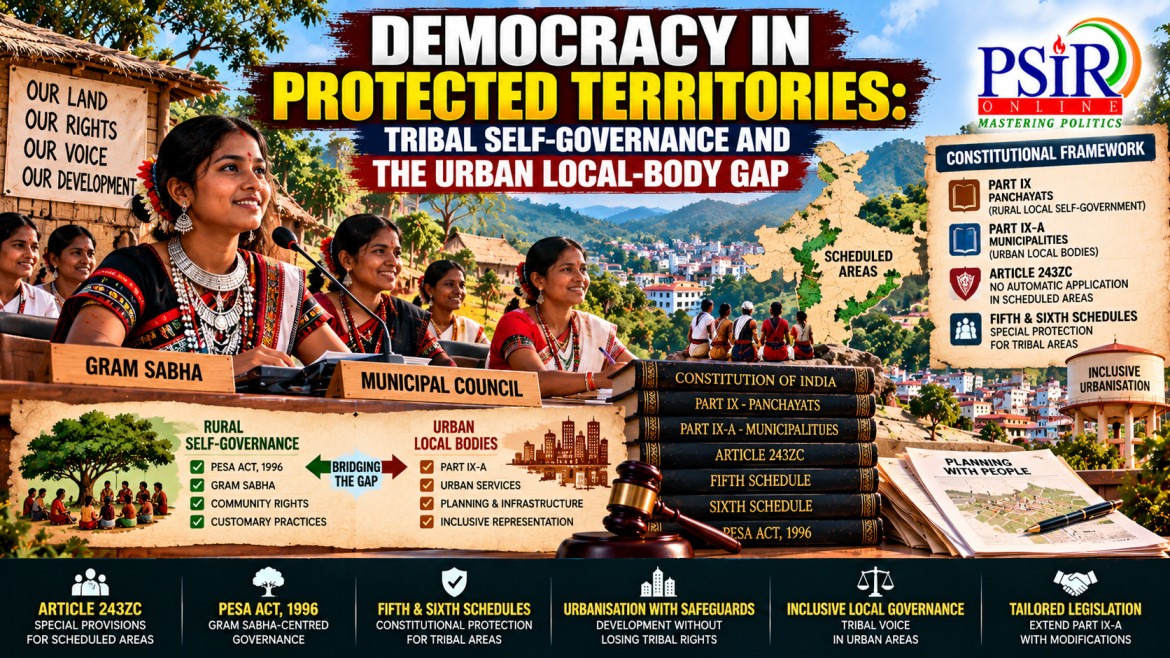
India’s constitutional framework recognises that democratic decentralisation must accommodate the distinct social, cultural and territorial circumstances of tribal communities. The 73rd Constitutional Amendment strengthened rural local self-government, while the 74th Constitutional Amendment established a constitutional framework for urban local bodies. However, the Constitution does not automatically extend the municipal framework to Scheduled Areas and certain tribal areas.
Article 243ZC excludes these territories from the automatic application of Part IX-A while empowering Parliament to extend its provisions through legislation with appropriate exceptions and modifications. The absence of a comprehensive parliamentary framework for municipalities in Scheduled Areas raises a fundamental question: how can urbanisation proceed without weakening tribal self-governance and constitutional protection?
The issue gained renewed attention through the Rajasthan High Court’s judgment of 5 January 2026 in Anil Kumar Meena & Anr. v. State of Rajasthan & Ors. and connected petitions. A separate petition filed by Lok Sabha MP Rajkumar Roat in the Supreme Court in July 2026 also raised the broader question of urban local self-government in Scheduled Areas. These developments highlight the need to reconcile effective urban administration with tribal autonomy and constitutional safeguards.
THE CONSTITUTIONAL ARCHITECTURE OF TRIBAL SELF-GOVERNANCE
The Constitution adopts different institutional arrangements for local government and tribal administration. Part IX governs Panchayats, Part IX-A governs municipalities, and Article 244, read with the Fifth and Sixth Schedules, provides special arrangements for designated tribal territories.
The Fifth Schedule applies to Scheduled Areas in States other than those governed by the Sixth Schedule framework. It provides for special responsibilities of the Governor, Tribes Advisory Councils and regulatory powers concerning the application of laws in Scheduled Areas. The Sixth Schedule provides for autonomous district and regional councils in specified tribal areas of Assam, Meghalaya, Tripura and Mizoram.
These arrangements recognise that uniform administrative structures may not adequately protect customary institutions, land relationships and community resources. However, constitutional protection does not require tribal territories to remain outside development or essential public services. The challenge is to ensure that administrative changes do not undermine the rights and institutional safeguards attached to these territories.
ARTICLE 243ZC: THE PRECISE CONSTITUTIONAL POSITION
Article 243ZC establishes the special position of Scheduled Areas and certain tribal areas in relation to municipalities. Its three clauses perform distinct functions.
|
Constitutional provision |
Meaning and significance |
|
Article 243ZC(1) |
Part IX-A does not apply to the Scheduled Areas referred to in Article 244(1) and the tribal areas referred to in Article 244(2). |
|
Article 243ZC(2) |
Protects the functions and powers of the Darjeeling Gorkha Hill Council under the applicable law relating to the Darjeeling hill areas of West Bengal. |
|
Article 243ZC(3) |
Empowers Parliament to extend Part IX-A to the specified Scheduled and tribal areas, subject to exceptions and modifications. Such a law is not deemed an amendment of the Constitution under Article 368. |
The distinction between these clauses is essential. Article 243ZC(1) excludes the automatic application of Part IX-A; Article 243ZC(2) preserves the Darjeeling Gorkha Hill Council’s functions and powers; and Article 243ZC(3) provides the parliamentary extension mechanism.
Article 243ZC does not create a blanket prohibition on all municipal administration in Scheduled Areas. The constitutional question is whether Part IX-A applies automatically and how municipal legislation interacts with the Fifth Schedule, PESA and other applicable laws.
Consequently, the absence of automatic application of Part IX-A does not, by itself, invalidate every State municipal law operating in a Scheduled Area. The legal position must be assessed alongside applicable State legislation, the Fifth Schedule and any relevant notification issued under paragraph 5(1) of that Schedule.
PESA AND THE RURAL–URBAN TRANSITION
The Panchayats (Extension to Scheduled Areas) Act, 1996, commonly known as PESA, extends Part IX to Scheduled Areas with specified modifications. It places the Gram Sabha at the centre of local self-governance and recognises the importance of customary practices, community resources and participation in local development.
PESA provides for the protection of traditions and cultural identity and recognises the role of Gram Sabhas and Panchayats in specified decision-making processes. Its provisions concerning consultation, recommendations and control over local resources must be interpreted according to the particular statutory requirement involved; they do not establish a universal veto over every development decision.
A constitutional difficulty arises when a village or Gram Panchayat is incorporated into a municipality. The administrative transition can change the institutional setting through which local participation is organised. The Gram Sabha-centred framework under PESA may no longer operate in its original form once the territory becomes part of an urban local body.
However, municipal inclusion does not automatically extinguish Scheduled Area status or the constitutional protections attached to it. The question is how to preserve meaningful community participation and applicable tribal safeguards while providing urban services such as sanitation, transport, drainage, housing and public health.
A suitable urban framework must therefore do more than redraw administrative boundaries. It must clarify the relationship between municipal councils, tribal communities and customary institutions, while protecting applicable rights over land and community resources.
THE RAJASTHAN HIGH COURT JUDGMENT OF 2026
In Anil Kumar Meena & Anr. v. State of Rajasthan & Ors. and connected petitions, decided on 5 January 2026, the Rajasthan High Court considered challenges concerning the inclusion of villages and Gram Panchayat areas situated in Scheduled Areas within municipal limits. The proceedings raised questions about the Rajasthan Municipalities Act, 2009, Article 243ZC, PESA and the Fifth Schedule.
The Court clarified that inclusion within municipal limits does not, by itself, denotify a Scheduled Area or extinguish the constitutional protections attached to it. It also rejected the proposition that Article 243ZC categorically prevents State municipal legislation from operating in Scheduled Areas.
The legal distinction is significant: the non-application of Part IX-A does not mean that all State municipal legislation is automatically inoperative. The operation of a particular law must be considered in the light of applicable constitutional provisions, State legislation and any relevant notification under paragraph 5(1) of the Fifth Schedule.
The Court outlined a hybrid governance approach in the context of the cases before it, under which municipal civic functions could operate alongside continuing Fifth Schedule protections and appropriate consultative arrangements for tribal interests. This approach sought to address the practical requirements of urban administration without treating municipal inclusion as the automatic removal of tribal safeguards.
The judgment also brought attention to the long-standing legislative gap concerning the extension of the municipal framework to Scheduled Areas. The Municipalities (Extension to the Scheduled Areas) Bill, 2001, introduced in the Rajya Sabha, has not been enacted. Article 243ZC(3) provides a constitutional route for Parliament to establish a tailored framework.
Separately, Lok Sabha MP Rajkumar Roat filed a petition in the Supreme Court in July 2026 seeking a framework for urban local self-government in Scheduled Areas. This development raises a broader constitutional and legislative question, but the filing of a petition must not be treated as a final Supreme Court ruling.
The Rajasthan High Court judgment is therefore significant for its treatment of territorial protection, municipal administration and the limits of administrative reclassification. Its case-specific directions should not be presented as a uniform national municipal framework already applicable to every Scheduled Area.
THE SIXTH SCHEDULE AND DIFFERENTIATED GOVERNANCE
The Sixth Schedule provides a distinct model of tribal administration through autonomous district and regional councils in specified areas of four north-eastern States. These institutions exercise powers assigned by the Constitution and relevant legislation, including functions concerning local administration, customary matters and specified land-related subjects.
The Sixth Schedule should not be treated as interchangeable with the Fifth Schedule or PESA. Each has a different constitutional foundation, territorial application and institutional design. Nevertheless, the Sixth Schedule demonstrates that tribal self-governance can be accommodated through differentiated institutions rather than a uniform local-government model.
The challenge for urban governance is to develop institutions that respect the applicable constitutional framework while responding to demographic and economic change. Expanding settlements require municipal services, infrastructure and planning, but these needs do not automatically justify replacing customary and community institutions without appropriate safeguards.
Any reform must therefore be sensitive to the relevant constitutional category. A framework suitable for a Fifth Schedule area may not be directly transferable to a Sixth Schedule area, where autonomous councils and distinct constitutional arrangements already exist.
Article 243ZC(2) also expressly preserves the functions and powers of the Darjeeling Gorkha Hill Council under the relevant law. This provision reinforces the importance of accounting for existing institutional arrangements when considering the constitutional application of urban local governance.
REFORM AGENDA: RECONCILING URBAN SERVICES WITH TRIBAL AUTONOMY
The constitutional gap calls for a legislative and administrative response that protects community participation while addressing the practical needs of urbanising tribal settlements.
First, Parliament should consider a tailored framework under Article 243ZC(3). Such legislation could specify how Part IX-A applies in Scheduled Areas, with exceptions and modifications designed to protect tribal institutions, customary rights and community resources. The framework should be developed with meaningful consultation involving affected communities and States.
Second, community participation must be institutionalised. The framework should clarify how Gram Sabha processes, tribal representatives and municipal councils interact, particularly in matters affecting land, community resources, cultural sites and local development priorities.
Third, urban planning must preserve applicable safeguards. Municipal expansion should not become a mechanism for bypassing protections relating to land, rehabilitation, forests or community resources. Consultation and consent requirements must be followed wherever the relevant law requires them.
Fourth, institutional responsibilities must be clear. Municipal authorities need workable powers over sanitation, drainage, roads, transport and public health, while tribal institutions must retain their constitutionally and statutorily protected roles. Clear allocation of responsibilities can reduce jurisdictional conflict.
Fifth, fiscal arrangements must support genuine decentralisation. Urban local bodies require predictable resources to deliver services. Funding arrangements should also account for the additional responsibilities and development needs of tribal communities, consistent with applicable constitutional and statutory safeguards.
Finally, any new framework should include monitoring, public disclosure and grievance-redress mechanisms. These can help establish whether urbanisation improves service delivery without weakening community participation or the protection of tribal interests.
UPSC DIMENSION
|
Constitutional provision or concept |
Relevance |
|
Part IX — Articles 243–243O |
Establishes the constitutional framework for Panchayats and rural decentralisation. |
|
Part IX-A — Articles 243P–243ZG |
Provides the constitutional framework for municipalities and urban local self-government. |
|
Article 243ZC(1) |
Excludes the automatic application of Part IX-A to specified Scheduled and tribal areas. |
|
Article 243ZC(2) |
Preserves the functions and powers of the Darjeeling Gorkha Hill Council under the applicable law. |
|
Article 243ZC(3) |
Authorises Parliament to extend Part IX-A to the specified areas, subject to exceptions and modifications, without invoking Article 368. |
|
Article 244(1) and Fifth Schedule |
Establishes the framework for administration and protection of Scheduled Areas outside the Sixth Schedule States. |
|
Article 244(2) and Sixth Schedule |
Provides autonomous district and regional council arrangements in specified north-eastern tribal areas. |
|
PESA Act, 1996 |
Extends Part IX to Scheduled Areas with modifications and strengthens Gram Sabha-centred governance. |
|
Article 46 |
Directs the State to promote the educational and economic interests of Scheduled Tribes and other weaker sections and protect them from social injustice and exploitation. |
|
Article 275(1) |
Provides for grants-in-aid to States, including support for approved schemes concerning Scheduled Areas and the welfare of Scheduled Tribes. |
|
Decentralisation and subsidiarity |
Supports decision-making close to affected communities, subject to constitutional and statutory arrangements. |
|
Differentiated federalism |
Highlights the need to coordinate Union legislation, State municipal laws and constitutionally protected tribal institutions. |
CONCLUSION
India’s constitutional commitment to tribal autonomy does not require tribal settlements to remain outside urban development. Equally, urbanisation cannot be used to assume that special constitutional protections have become irrelevant. The central task is to reconcile effective municipal administration with substantive tribal self-governance.
Article 243ZC provides a legislative pathway for a tailored framework, while the Fifth and Sixth Schedules establish distinct forms of constitutional protection. PESA demonstrates the importance of community-centred decision-making in Scheduled Areas. The Rajasthan High Court’s January 2026 judgment further illustrates why municipal inclusion, territorial status and the operation of State legislation must be examined as distinct but interconnected legal questions.
A durable solution requires legislation, clear institutional responsibilities, meaningful participation and adequate financial support. The constitutional objective should be urban development without the dilution of tribal rights, and decentralisation without the loss of democratic voice.
RELATED READING
PRACTISE QUESTIONS FOR GS2 MAINS
PRACTISE QUESTIONS FOR PSIR
